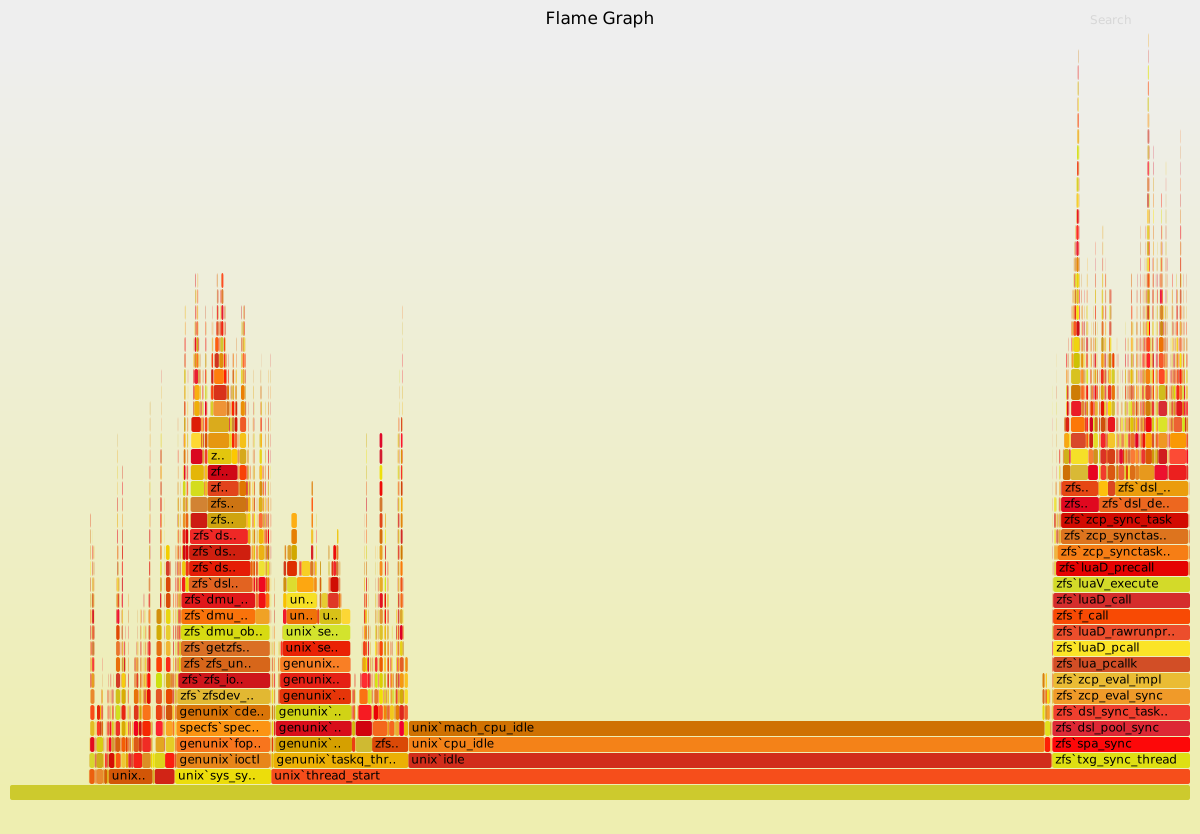
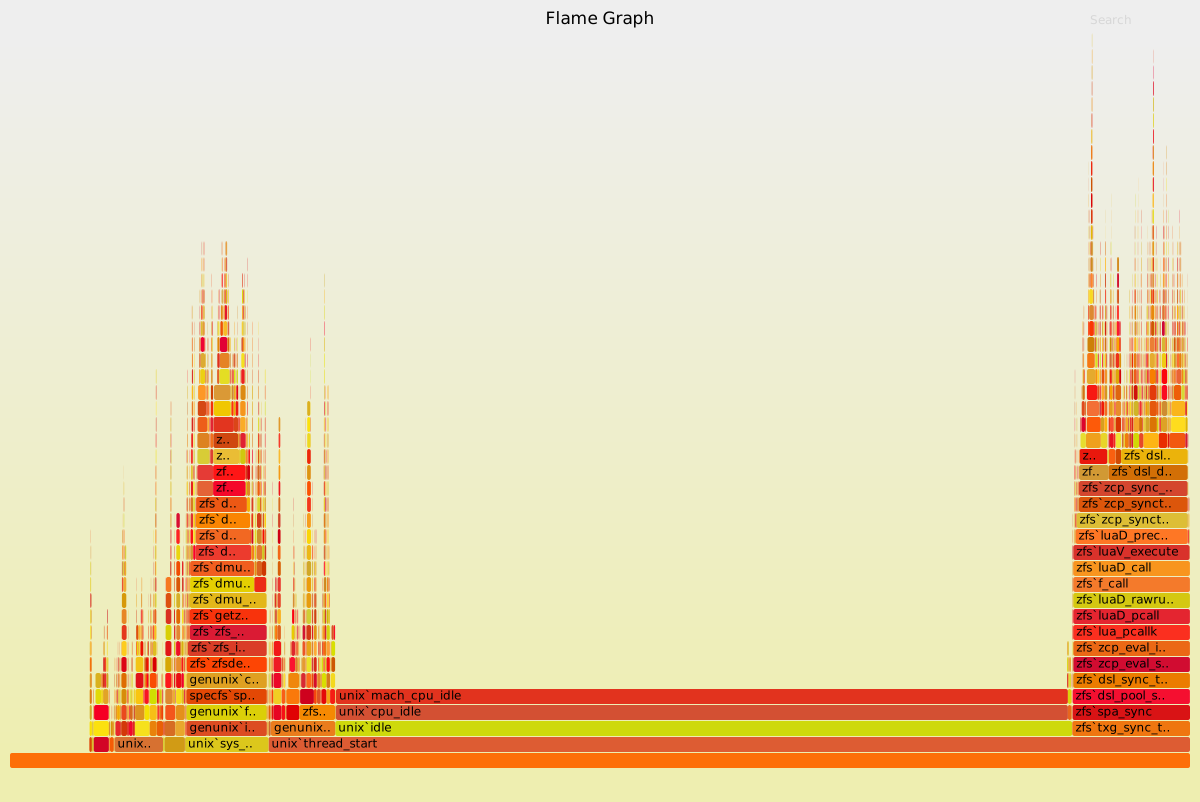
When a disk is replaced with another on a pool with the resilver_defer
feature present, but not enabled the resilver activity restarts during
each spa_sync. This patch checks to make sure that the resilver_defer
feature is first enabled before requesting a deferred resilver.
This was originally fixed in illumos-joyent as OS-7982.
Reviewed-by: Chris Dunlop <chris@onthe.net.au>
Reviewed-by: George Melikov <mail@gmelikov.ru>
Reviewed-by: Brian Behlendorf <behlendorf1@llnl.gov>
Reviewed-by: Tom Caputi <tcaputi@datto.com>
Reviewed by: Jerry Jelinek <jerry.jelinek@joyent.com>
Signed-off-by: Kody A Kantor <kody@kkantor.com>
External-issue: illumos-joyent OS-7982
Closes#9299Closes#9338
The was incorrect with respect to swapping dataset IDs both in the
on-disk ZAP object and the in-memory queue.
In both cases, if ds1 was already present, then it would be first
replaced with ds2 and then ds would be replaced back with ds1.
Also, both cases did not properly handle a situation where both ds1 and
ds2 are already queued. A duplicate insertion would be attempted and
its failure would result in a panic.
Reviewed-by: Matt Ahrens <matt@delphix.com>
Reviewed-by: Tom Caputi <tcaputi@datto.com>
Signed-off-by: Andriy Gapon <avg@FreeBSD.org>
Closes#9140Closes#9163
Originally the zfs_vdev_elevator module option was added as a
convenience so the requested elevator would be automatically set
on the underlying block devices. At the time this was simple
because the kernel provided an API function which did exactly this.
This API was then removed in the Linux 4.12 kernel which prompted
us to add compatibly code to set the elevator via a usermodehelper.
Unfortunately changing the evelator via usermodehelper requires reading
some userland binaries, most notably modprobe(8) or sh(1), from a zfs
dataset on systems with root-on-zfs. This can deadlock the system if
used during the following call path because it may need, if the data
is not already cached in the ARC, reading directly from disk while
holding the spa config lock as a writer:
zfs_ioc_pool_scan()
-> spa_scan()
-> spa_scan()
-> vdev_reopen()
-> vdev_elevator_switch()
-> call_usermodehelper()
While the usermodehelper waits sh(1), modprobe(8) is blocked in the
ZIO pipeline trying to read from disk:
INFO: task modprobe:2650 blocked for more than 10 seconds.
Tainted: P OE 5.2.14
modprobe D 0 2650 206 0x00000000
Call Trace:
? __schedule+0x244/0x5f0
schedule+0x2f/0xa0
cv_wait_common+0x156/0x290 [spl]
? do_wait_intr_irq+0xb0/0xb0
spa_config_enter+0x13b/0x1e0 [zfs]
zio_vdev_io_start+0x51d/0x590 [zfs]
? tsd_get_by_thread+0x3b/0x80 [spl]
zio_nowait+0x142/0x2f0 [zfs]
arc_read+0xb2d/0x19d0 [zfs]
...
zpl_iter_read+0xfa/0x170 [zfs]
new_sync_read+0x124/0x1b0
vfs_read+0x91/0x140
ksys_read+0x59/0xd0
do_syscall_64+0x4f/0x130
entry_SYSCALL_64_after_hwframe+0x44/0xa9
This commit changes how we use the usermodehelper functionality from
synchronous (UMH_WAIT_PROC) to asynchronous (UMH_NO_WAIT) which prevents
scrubs, and other vdev_elevator_switch() consumers, from triggering the
aforementioned issue.
Signed-off-by: Brian Behlendorf <behlendorf1@llnl.gov>
Signed-off-by: loli10K <ezomori.nozomu@gmail.com>
Issue #8664Closes#9321
1. Fix issue: Kernel BUG with QAT during decompression #9276.
Now it is uninterruptible for a specific given QAT request,
but Ctrl-C interrupt still works in user-space process.
2. Copy the digest result to the buffer only when doing encryption,
and vise-versa for decryption.
Reviewed-by: Tom Caputi <tcaputi@datto.com>
Reviewed-by: Brian Behlendorf <behlendorf1@llnl.gov>
Signed-off-by: Chengfei Zhu <chengfeix.zhu@intel.com>
Closes#9276Closes#9303
Determine the location of depmod on the system, either /sbin/depmod or
/usr/sbin/depmod. Then use that path when generating the specfile.
Additionally, update the Requires lines to reference the package which
provides depmod rather than the binary itself. For CentOS/RHEL 7+8
and all supported Fedora releases this is the kmod package, and for
CentOS/RHEL 6 it is the module-init-tools package.
Reviewed-by: Minh Diep <mdiep@whamcloud.com>
Signed-off-by: Olaf Faaland <faaland1@llnl.gov>
Signed-off-by: Brian Behlendorf <behlendorf1@llnl.gov>
Closes#8724Closes#9310
Accidentally introduced by dc04a8c which now takes the SCL_VDEV lock
as a reader in zfs_blkptr_verify(). A deadlock can occur if the
/etc/hostid file resides on a dataset in the same pool. This is
because reading the /etc/hostid file may occur while the caller is
holding the SCL_VDEV lock as a writer. For example, to perform a
`zpool attach` as shown in the abbreviated stack below.
To resolve the issue we cache the system's hostid when initializing
the spa_t, or when modifying the multihost property. The cached
value is then relied upon for subsequent accesses.
Call Trace:
spa_config_enter+0x1e8/0x350 [zfs]
zfs_blkptr_verify+0x33c/0x4f0 [zfs] <--- trying read lock
zio_read+0x6c/0x140 [zfs]
...
vfs_read+0xfc/0x1e0
kernel_read+0x50/0x90
...
spa_get_hostid+0x1c/0x38 [zfs]
spa_config_generate+0x1a0/0x610 [zfs]
vdev_label_init+0xa0/0xc80 [zfs]
vdev_create+0x98/0xe0 [zfs]
spa_vdev_attach+0x14c/0xb40 [zfs] <--- grabbed write lock
Reviewed-by: loli10K <ezomori.nozomu@gmail.com>
Signed-off-by: Brian Behlendorf <behlendorf1@llnl.gov>
Closes#9256Closes#9285
Building against RHEL 8 requires libtirpc-devel, as with fedora 28.
Add rhel8 and centos8 options to the test, to account for that.
BuildRequires Originally added for fedora 28 via commit
1a62a305be
Reviewed-by: Brian Behlendorf <behlendorf1@llnl.gov>
Reviewed-by: George Melikov <mail@gmelikov.ru>
Signed-off-by: Olaf Faaland <faaland1@llnl.gov>
Closes#9289
Both 'detach' and 'online' zpool subcommands, when provided with an
unsupported option, forget to print it in the error message:
# zpool online -t rpool vda3
invalid option ''
usage:
online [-e] <pool> <device> ...
This changes fixes the error message in order to include the actual
option that is not supported.
Reviewed-by: Ryan Moeller <ryan@ixsystems.com>
Reviewed-by: Brian Behlendorf <behlendorf1@llnl.gov>
Signed-off-by: loli10K <ezomori.nozomu@gmail.com>
Closes#9270
Debian zfs-dkms package generated by alien doesn't call the prerm script
(rpm's %preun) with an integer as first parameter, which results in the
following warning when the package is uninstalled:
"zfs-dkms.prerm: line 3: [: remove: integer expression expected"
Modify the if-condition to avoid the warning.
Reviewed-by: Brian Behlendorf <behlendorf1@llnl.gov>
Signed-off-by: loli10K <ezomori.nozomu@gmail.com>
Closes#9271
This fixes a hole in the situation where the resume state is left from
receiving a new dataset and, so, the state is set on the dataset itself
(as opposed to %recv child).
Additionally, distinguish incremental and resume streams in error
messages.
Reviewed-by: Matt Ahrens <matt@delphix.com>
Reviewed-by: Tom Caputi <tcaputi@datto.com>
Reviewed-by: Brian Behlendorf <behlendorf1@llnl.gov>
Signed-off-by: Andriy Gapon <avg@FreeBSD.org>
Closes#9252
Remove the x86_64 warning, it's no longer the case that this is the
only supported architecture.
Reviewed-by: Brian Behlendorf <behlendorf1@llnl.gov>
Signed-off-by: Georgy Yakovlev <gyakovlev@gentoo.org>
Closes: #9177
This is a typical case of use after free. We would call zfs_close(zhp)
which would free the handle, and then call zfs_iter_children() on that
handle later. This change ensures that the zfs_handle is only closed
when we are ready to return.
Running `zfs inherit -r sharenfs pool` was failing with an error
code without any error messages. After some debugging I've pinpointed
the issue to be memory corruption, which would cause zfs to try to
issue an ioctl to the wrong device and receive ENOTTY.
Reviewed-by: Paul Dagnelie <pcd@delphix.com>
Reviewed-by: George Wilson <gwilson@delphix.com>
Reviewed-by: Sebastien Roy <sebastien.roy@delphix.com>
Reviewed-by: Brian Behlendorf <behlendorf1@llnl.gov>
Reviewed-by: Alek Pinchuk <apinchuk@datto.com>
Signed-off-by: Pavel Zakharov <pavel.zakharov@delphix.com>
Issue #7967Closes#9165
If TX_REMOVE is followed by TX_CREATE on the same object id, we need to
make sure the object removal is completely finished before creation. The
current implementation relies on dnode_hold_impl with
DNODE_MUST_BE_ALLOCATED returning ENOENT. While this check seems to work
fine before, in current version it does not guarantee the object removal
is completed.
We fix this by checking if DNODE_MUST_BE_FREE returns successful
instead. Also add test and remove dead code in dnode_hold_impl.
Reviewed-by: Brian Behlendorf <behlendorf1@llnl.gov>
Reviewed-by: Tom Caputi <tcaputi@datto.com>
Signed-off-by: Chunwei Chen <david.chen@nutanix.com>
Closes#7151Closes#8910Closes#9123Closes#9145
Previously, the permissions were checked on the pool which was obviously
incorrect.
After this change, zfs_check_userprops() only validates the properties
without any permission checks. The permissions are checked individually
for each snapshotted dataset.
Reviewed-by: Brian Behlendorf <behlendorf1@llnl.gov>
Reviewed-by: Matt Ahrens <mahrens@delphix.com>
Signed-off-by: Andriy Gapon <avg@FreeBSD.org>
Closes#9179Closes#9180
Entering the ZFS encryption passphrase under Plymouth wasn't working
because in the ZFS initrd script, Plymouth was calling zfs via
"--command", which wasn't passing through the filesystem argument to
zfs load-key properly (it was passing through the single quotes around
the filesystem name intended to handle spaces literally,
which zfs load-key couldn't understand).
Reviewed-by: Richard Laager <rlaager@wiktel.com>
Reviewed-by: Garrett Fields <ghfields@gmail.com>
Signed-off-by: Richard Allen <belperite@gmail.com>
Issue #9193Closes#9202
Currently, the 'zfs rollback' code can end up deadlocked due to
the way the kernel handles unreferenced inodes on a suspended fs.
Essentially, the zfs_resume_fs() code path may cause zfs to spawn
new threads as it reinstantiates the suspended fs's zil. When a
new thread is spawned, the kernel may attempt to free memory for
that thread by freeing some unreferenced inodes. If it happens to
select inodes that are a a part of the suspended fs a deadlock
will occur because freeing inodes requires holding the fs's
z_teardown_inactive_lock which is still held from the suspend.
This patch corrects this issue by adding an additional reference
to all inodes that are still present when a suspend is initiated.
This prevents them from being freed by the kernel for any reason.
Reviewed-by: Alek Pinchuk <apinchuk@datto.com>
Reviewed-by: Brian Behlendorf <behlendorf1@llnl.gov>
Signed-off-by: Tom Caputi <tcaputi@datto.com>
Closes#9203
The slog tests fail when attempting to create pools using file vdevs
that already exist from previous test runs. Remove these files in the
setup for the test.
Reviewed-by: Igor Kozhukhov <igor@dilos.org>
Reviewed-by: Brian Behlendorf <behlendorf1@llnl.gov>
Reviewed-by: John Kennedy <john.kennedy@delphix.com>
Signed-off-by: Ryan Moeller <ryan@ixsystems.com>
Closes#9194
Fix some switch() fall-though compiler errors:
abd.c:1504:9: error: this statement may fall through
Reviewed-by: Brian Behlendorf <behlendorf1@llnl.gov>
Signed-off-by: Tony Hutter <hutter2@llnl.gov>
Closes#9170
Uses obj-m instead, due to kernel changes.
See LKML: Masahiro Yamada, Tue, 6 Aug 2019 19:03:23 +0900
Reviewed-by: Brian Behlendorf <behlendorf1@llnl.gov>
Reviewed-by: Tony Hutter <hutter2@llnl.gov>
Signed-off-by: Dominic Pearson <dsp@technoanimal.net>
Closes#9169
We should only call zil_remove_async when an object is removed. However,
in current implementation, it is called whenever TX_REMOVE is called. In
the case of hardlinked file, every unlink will generate TX_REMOVE and
causing operations to be dropped even when the object is not removed.
We fix this by only calling zil_remove_async when the file is fully
unlinked.
Reviewed-by: George Wilson <gwilson@delphix.com>
Reviewed-by: Brian Behlendorf <behlendorf1@llnl.gov>
Reviewed-by: Prakash Surya <prakash.surya@delphix.com>
Signed-off-by: Chunwei Chen <david.chen@nutanix.com>
Closes#8769Closes#9061
When creating hundreds of clones (for example using containers with
LXD) cloning slows down as the number of clones increases over time.
The reason for this is that the fetching of the clone information
using a small zcmd buffer requires two ioctl calls, one to determine
the size and a second to return the data. However, this requires
gathering the data twice, once to determine the size and again to
populate the zcmd buffer to return it to userspace.
These are expensive ioctl() calls, so instead, make the default buffer
size much larger: 256K.
Reviewed-by: Brian Behlendorf <behlendorf1@llnl.gov>
Reviewed-by: George Melikov <mail@gmelikov.ru>
Signed-off-by: Colin Ian King <colin.king@canonical.com>
Signed-off-by: Michael Niewöhner <foss@mniewoehner.de>
Closes#9084
In zfs_write() and dmu_tx_hold_sa(), we can use dmu_tx_hold_*_by_dnode()
instead of dmu_tx_hold_*(), since we already have a dbuf from the target
dnode in hand. This eliminates some calls to dnode_hold(), which can be
expensive. This is especially impactful if several threads are
accessing objects that are in the same block of dnodes, because they
will contend for that dbuf's lock.
We are seeing 10-20% performance wins for the sequential_writes tests in
the performance test suite, when doing >=128K writes to files with
recordsize=8K.
This also removes some unnecessary casts that are in the area.
Reviewed-by: Brian Behlendorf <behlendorf1@llnl.gov>
Reviewed-by: Tony Nguyen <tony.nguyen@delphix.com>
Signed-off-by: Matthew Ahrens <mahrens@delphix.com>
Closes#9081
When adapting the original sources for s390x the JMP_BUF_CNT was
mistakenly halved due to an incorrect assumption of the size of
a unsigned long. They are 8 bytes for the s390x architecture.
Increase JMP_BUF_CNT accordingly.
Authored-by: Don Brady <don.brady@delphix.com>
Reviewed-by: Brian Behlendorf <behlendorf1@llnl.gov>
Reported-by: Colin Ian King <canonical.com>
Tested-by: Colin Ian King <canonical.com>
Signed-off-by: Brian Behlendorf <behlendorf1@llnl.gov>
Closes#8992Closes#9080
When a system boots the zfs-mount.service and the
zfs-share.service can start simultaneously. What may be
unclear is that sharing a filesystem will first mount
the filesystem if it's not already mounted. This means
that both service can race to mount the same fileystem.
This race can result in a SEGFAULT or EBUSY conditions.
This change explicitly defines the start ordering between the
two services such that the zfs-mount.service is solely
responsible for mounting filesystems eliminating the race
between "zfs mount -a" and "zfs share -a" commands.
Reviewed-by: Sebastien Roy <sebastien.roy@delphix.com>
Reviewed-by: Brian Behlendorf <behlendorf1@llnl.gov>
Signed-off-by: George Wilson <george.wilson@delphix.com>
Closes#9083
zed core dumps due to a NULL pointer in zfs_agent_iter_vdev(). The
gs_devid is NULL, but the nvl has a "devid" entry.
zfs_agent_post_event() checks that ZFS_EV_VDEV_GUID or DEV_IDENTIFIER is
present in nvl, but then later it and zfs_agent_iter_vdev() assume that
DEV_IDENTIFIER is present and thus gs_devid is set.
Typically this is not a problem because usually either all vdevs have
devid's, or none of them do. Since zfs_agent_iter_vdev() first checks if
the vdev has devid before dereferencing gs_devid, the problem isn't
typically encountered. However, if some vdevs have devid's and some do
not, then the problem is easily reproduced. This can happen if the pool
has been moved from a system that has devid's to one that does not.
The fix is for zfs_agent_iter_vdev() to only try to match the devid's if
both nvl and gsp have devid's present.
Reviewed-by: Prashanth Sreenivasa <pks@delphix.com>
Reviewed-by: Don Brady <don.brady@delphix.com>
Reviewed-by: Brian Behlendorf <behlendorf1@llnl.gov>
Reviewed-by: loli10K <ezomori.nozomu@gmail.com>
Signed-off-by: Matthew Ahrens <mahrens@delphix.com>
External-issue: DLPX-65090
Closes#9054Closes#9060
Cast to uintptr_t first for portability on integer to/from pointer
conversion.
Reviewed-by: Brian Behlendorf <behlendorf1@llnl.gov>
Signed-off-by: Tomohiro Kusumi <kusumi.tomohiro@gmail.com>
Closes#9065
The tests in tests/functional/cli_root/zpool_status should all require
root. However, linux.run has "user =" specified for those tests, which
means they run as a normal user. When I removed that line to run them
as root, the following tests did not pass:
zpool_status_003_pos
zpool_status_-c_disable
zpool_status_-c_homedir
zpool_status_-c_searchpath
These tests need to be run as a normal user. To fix this, move these
tests to a new tests/functional/cli_user/zpool_status directory.
Reviewed-by: George Melikov <mail@gmelikov.ru>
Reviewed-by: Brian Behlendorf <behlendorf1@llnl.gov>
Reviewed-by: Giuseppe Di Natale <guss80@gmail.com>
Signed-off-by: Tony Hutter <hutter2@llnl.gov>
Closes#9057
In the past we've seen multiple race conditions that have
to do with open-context threads async threads and concurrent
calls to spa_export()/spa_destroy() (including the one
referenced in issue #9015).
This patch ensures that only one thread can execute the
main body of spa_export_common() at a time, with subsequent
threads returning with a new error code created just for
this situation, eliminating this way any race condition
bugs introduced by concurrent calls to this function.
Reviewed by: Matt Ahrens <matt@delphix.com>
Reviewed by: Brian Behlendorf <behlendorf1@llnl.gov>
Signed-off-by: Serapheim Dimitropoulos <serapheim@delphix.com>
Closes#9015Closes#9044
There exists a race condition were hdr_recl() calls
zthr_wakeup() on a destroyed zthr. The timeline is the
following:
[1] hdr_recl() runs first and goes intro zthr_wakeup()
because arc_initialized is set.
[2] arc_fini() is called by another thread, zeroes
that flag, destroying the zthr, and goes into
buf_init().
[3] hdr_recl() tries to enter the destroyed mutex
and we blow up.
This patch ensures that the ARC's zthrs are not offloaded
any new work once arc_initialized is set and then destroys
them after all of the ARC state has been deleted.
Reviewed by: Matt Ahrens <matt@delphix.com>
Reviewed by: Brian Behlendorf <behlendorf1@llnl.gov>
Signed-off-by: Serapheim Dimitropoulos <serapheim@delphix.com>
Closes#9047
These aren't tunable; illumos has this comment fixed in
"3742 zfs comments need cleaner, more consistent style",
so sync with that.
Reviewed-by: George Melikov <mail@gmelikov.ru>
Reviewed-by: Brian Behlendorf <behlendorf1@llnl.gov>
Signed-off-by: Tomohiro Kusumi <kusumi.tomohiro@gmail.com>
Closes#9052
These functions are unused and can be removed along
with the spl-mutex.c and spl-rwlock.c source files.
Reviewed-by: Tony Hutter <hutter2@llnl.gov>
Reviewed-by: Tomohiro Kusumi <kusumi.tomohiro@gmail.com>
Signed-off-by: Brian Behlendorf <behlendorf1@llnl.gov>
Closes#9029
The Linux kernel's rwsem's have never provided an interface to
allow a reader to be upgraded to a writer. Historically, this
functionality has been implemented by a SPL wrapper function.
However, this approach depends on internal knowledge of the
rw_semaphore and is therefore rather brittle.
Since the ZFS code must always be able to fallback to rw_exit()
and rw_enter() when an rw_tryupgrade() fails; this functionality
isn't critical. Furthermore, the only potentially performance
sensitive consumer is dmu_zfetch() and no decrease in performance
was observed with this change applied. See the PR comments for
additional testing details.
Therefore, it is being retired to make the build more robust and
to simplify the rwlock implementation.
Reviewed-by: Tony Hutter <hutter2@llnl.gov>
Reviewed-by: Tomohiro Kusumi <kusumi.tomohiro@gmail.com>
Signed-off-by: Brian Behlendorf <behlendorf1@llnl.gov>
Closes#9029
Commit https://github.com/torvalds/linux/commit/94a9717b updated the
rwsem's owner field to contain additional flags describing the rwsem's
state. Rather then update the wrappers to mask out these bits, the
code no longer relies on the owner stored by the kernel. This does
increase the size of a krwlock_t but it makes the implementation
less sensitive to future kernel changes.
Reviewed-by: Tony Hutter <hutter2@llnl.gov>
Reviewed-by: Tomohiro Kusumi <kusumi.tomohiro@gmail.com>
Signed-off-by: Brian Behlendorf <behlendorf1@llnl.gov>
Closes#9029
lockdep reports a possible recursive lock in dbuf_destroy.
It is true that dbuf_destroy is acquiring the dn_dbufs_mtx
on one dnode while holding it on another dnode. However,
it is impossible for these to be the same dnode because,
among other things,dbuf_destroy checks MUTEX_HELD before
acquiring the mutex.
This fix defines a class NESTED_SINGLE == 1 and changes
that lock to call mutex_enter_nested with a subclass of
NESTED_SINGLE.
In order to make the userspace code compile,
include/sys/zfs_context.h now defines mutex_enter_nested and
NESTED_SINGLE.
This is the lockdep report:
[ 122.950921] ============================================
[ 122.950921] WARNING: possible recursive locking detected
[ 122.950921] 4.19.29-4.19.0-debug-d69edad5368c1166 #1 Tainted: G O
[ 122.950921] --------------------------------------------
[ 122.950921] dbu_evict/1457 is trying to acquire lock:
[ 122.950921] 0000000083e9cbcf (&dn->dn_dbufs_mtx){+.+.}, at: dbuf_destroy+0x3c0/0xdb0 [zfs]
[ 122.950921]
but task is already holding lock:
[ 122.950921] 0000000055523987 (&dn->dn_dbufs_mtx){+.+.}, at: dnode_evict_dbufs+0x90/0x740 [zfs]
[ 122.950921]
other info that might help us debug this:
[ 122.950921] Possible unsafe locking scenario:
[ 122.950921] CPU0
[ 122.950921] ----
[ 122.950921] lock(&dn->dn_dbufs_mtx);
[ 122.950921] lock(&dn->dn_dbufs_mtx);
[ 122.950921]
*** DEADLOCK ***
[ 122.950921] May be due to missing lock nesting notation
[ 122.950921] 1 lock held by dbu_evict/1457:
[ 122.950921] #0: 0000000055523987 (&dn->dn_dbufs_mtx){+.+.}, at: dnode_evict_dbufs+0x90/0x740 [zfs]
[ 122.950921]
stack backtrace:
[ 122.950921] CPU: 0 PID: 1457 Comm: dbu_evict Tainted: G O 4.19.29-4.19.0-debug-d69edad5368c1166 #1
[ 122.950921] Hardware name: Supermicro H8SSL-I2/H8SSL-I2, BIOS 080011 03/13/2009
[ 122.950921] Call Trace:
[ 122.950921] dump_stack+0x91/0xeb
[ 122.950921] __lock_acquire+0x2ca7/0x4f10
[ 122.950921] lock_acquire+0x153/0x330
[ 122.950921] dbuf_destroy+0x3c0/0xdb0 [zfs]
[ 122.950921] dbuf_evict_one+0x1cc/0x3d0 [zfs]
[ 122.950921] dbuf_rele_and_unlock+0xb84/0xd60 [zfs]
[ 122.950921] dnode_evict_dbufs+0x3a6/0x740 [zfs]
[ 122.950921] dmu_objset_evict+0x7a/0x500 [zfs]
[ 122.950921] dsl_dataset_evict_async+0x70/0x480 [zfs]
[ 122.950921] taskq_thread+0x979/0x1480 [spl]
[ 122.950921] kthread+0x2e7/0x3e0
[ 122.950921] ret_from_fork+0x27/0x50
Reviewed-by: Tony Hutter <hutter2@llnl.gov>
Reviewed-by: Brian Behlendorf <behlendorf1@llnl.gov>
Signed-off-by: Jeff Dike <jdike@akamai.com>
Closes#8984
Make use of __GFP_HIGHMEM flag in vmem_alloc, which is required for
some 32-bit systems to make use of full available memory.
While kernel versions >=4.12-rc1 add this flag implicitly, older
kernels do not.
Reviewed-by: Brian Behlendorf <behlendorf1@llnl.gov>
Signed-off-by: Sebastian Gottschall <s.gottschall@dd-wrt.com>
Signed-off-by: Michael Niewöhner <foss@mniewoehner.de>
Closes#9031
Resolve an assortment of style inconsistencies including
use of white space, typos, capitalization, and line wrapping.
There is no functional change.
Reviewed-by: Tony Hutter <hutter2@llnl.gov>
Reviewed-by: George Melikov <mail@gmelikov.ru>
Signed-off-by: Brian Behlendorf <behlendorf1@llnl.gov>
Closes#9030
The cast of the size_t returned by strlcpy() to a uint64_t by the
VERIFY3U can result in a build failure when CONFIG_FORTIFY_SOURCE
is set. This is due to the additional hardening. Since the token
is expected to always fit in strval the VERIFY3U has been removed.
If somehow it doesn't, it will still be safely truncated.
Reviewed-by: Tony Hutter <hutter2@llnl.gov>
Reviewed-by: Don Brady <don.brady@delphix.com>
Signed-off-by: Brian Behlendorf <behlendorf1@llnl.gov>
Issue #8999Closes#9020
Modify zfs-mount-generator to produce a dependency on new
zfs-import-key-*.service units, dynamically created at boot to call
zfs load-key for the encryption root, before attempting to mount any
encrypted datasets.
These units are created by zfs-mount-generator, and RequiresMountsFor on
the keyfile, if present, or call systemd-ask-password if a passphrase is
requested.
This patch includes suggestions from @Fabian-Gruenbichler, @ryanjaeb and
@rlaager, as well an adaptation of @rlaager's script to retry on
incorrect password entry.
Reviewed-by: Richard Laager <rlaager@wiktel.com>
Reviewed-by: Fabian Grünbichler <f.gruenbichler@proxmox.com>
Reviewed-by: Brian Behlendorf <behlendorf1@llnl.gov>
Signed-off-by: Antonio Russo <antonio.e.russo@gmail.com>
Closes#8750Closes#8848
ZFS_ACLTYPE_POSIXACL has already been tested in zpl_init_acl(),
so no need to test again on POSIX ACL access.
Reviewed by: Brian Behlendorf <behlendorf1@llnl.gov>
Reviewed-by: Tony Hutter <hutter2@llnl.gov>
Signed-off-by: Tomohiro Kusumi <kusumi.tomohiro@gmail.com>
Closes#9009
External consumers such as Lustre require access to the dnode
interfaces in order to correctly manipulate dnodes.
Reviewed-by: James Simmons <uja.ornl@yahoo.com>
Reviewed-by: Olaf Faaland <faaland1@llnl.gov>
Reviewed-by: George Melikov <mail@gmelikov.ru>
Signed-off-by: Brian Behlendorf <behlendorf1@llnl.gov>
Issue #8994Closes#9027
This patch corrects a small issue where the dsl_destroy_head()
code that runs when the async_destroy feature is disabled would
not properly decrypt the dataset before beginning processing.
If the dataset is not able to be decrypted, the optimization
code now simply does not run and the dataset is completely
destroyed in the DSL sync task.
Reviewed-by: Brian Behlendorf <behlendorf1@llnl.gov>
Signed-off-by: Tom Caputi <tcaputi@datto.com>
Closes#9021
struct pathname is originally from Solaris VFS, and it has been used
in ZoL to merely call VOP from Linux VFS interface without API change,
therefore pathname::pn_path* are unused and unneeded. Technically,
struct pathname is a wrapper for C string in ZoL.
Saves stack a bit on lookup and unlink.
(#if0'd members instead of removing since comments refer to them.)
Reviewed-by: Brian Behlendorf <behlendorf1@llnl.gov>
Reviewed-by: Richard Elling <Richard.Elling@RichardElling.com>
Reviewed-by: George Melikov <mail@gmelikov.ru>
Signed-off-by: Tomohiro Kusumi <kusumi.tomohiro@gmail.com>
Closes#9025
Large allocation over the spl_kmem_alloc_warn value was being performed.
Switched to vmem_alloc interface as specified for large allocations.
Changed the subsequent frees to match.
Reviewed-by: Tom Caputi <tcaputi@datto.com>
Reviewed-by: Brian Behlendorf <behlendorf1@llnl.gov>
Signed-off-by: nmattis <nickm970@gmail.com>
Closes#8934Closes#9011
Strategy of parallel mount is as follows.
1) Initial thread dispatching is to select sets of mount points that
don't have dependencies on other sets, hence threads can/should run
lock-less and shouldn't race with other threads for other sets. Each
thread dispatched corresponds to top level directory which may or may
not have datasets to be mounted on sub directories.
2) Subsequent recursive thread dispatching for each thread from 1)
is to mount datasets for each set of mount points. The mount points
within each set have dependencies (i.e. child directories), so child
directories are processed only after parent directory completes.
The problem is that the initial thread dispatching in
zfs_foreach_mountpoint() can be multi-threaded when it needs to be
single-threaded, and this puts threads under race condition. This race
appeared as mount/unmount issues on ZoL for ZoL having different
timing regarding mount(2) execution due to fork(2)/exec(2) of mount(8).
`zfs unmount -a` which expects proper mount order can't unmount if the
mounts were reordered by the race condition.
There are currently two known patterns of input list `handles` in
`zfs_foreach_mountpoint(..,handles,..)` which cause the race condition.
1) #8833 case where input is `/a /a /a/b` after sorting.
The problem is that libzfs_path_contains() can't correctly handle an
input list with two same top level directories.
There is a race between two POSIX threads A and B,
* ThreadA for "/a" for test1 and "/a/b"
* ThreadB for "/a" for test0/a
and in case of #8833, ThreadA won the race. Two threads were created
because "/a" wasn't considered as `"/a" contains "/a"`.
2) #8450 case where input is `/ /var/data /var/data/test` after sorting.
The problem is that libzfs_path_contains() can't correctly handle an
input list containing "/".
There is a race between two POSIX threads A and B,
* ThreadA for "/" and "/var/data/test"
* ThreadB for "/var/data"
and in case of #8450, ThreadA won the race. Two threads were created
because "/var/data" wasn't considered as `"/" contains "/var/data"`.
In other words, if there is (at least one) "/" in the input list,
the initial thread dispatching must be single-threaded since every
directory is a child of "/", meaning they all directly or indirectly
depend on "/".
In both cases, the first non_descendant_idx() call fails to correctly
determine "path1-contains-path2", and as a result the initial thread
dispatching creates another thread when it needs to be single-threaded.
Fix a conditional in libzfs_path_contains() to consider above two.
Reviewed-by: Brian Behlendorf <behlendorf1@llnl.gov>
Reviewed by: Sebastien Roy <sebastien.roy@delphix.com>
Signed-off-by: Tomohiro Kusumi <kusumi.tomohiro@gmail.com>
Closes#8450Closes#8833Closes#8878
This commit ensures make(1) targets that build .deb packages fail if
alien(1) can't convert all .rpm files; additionally it also updates
the zfs-dracut package name which was changed to "noarch" in ca4e5a7.
Reviewed-by: Neal Gompa <ngompa@datto.com>
Reviewed-by: Brian Behlendorf <behlendorf1@llnl.gov>
Reviewed-by: Olaf Faaland <faaland1@llnl.gov>
Signed-off-by: loli10K <ezomori.nozomu@gmail.com>
Closes#8990Closes#8991
This patch fixes an issue where dsl_dataset_crypt_stats() would
VERIFY that it was able to hold the encryption root. This function
should instead silently continue without populating the related
field in the nvlist, as is the convention for this code.
Reviewed-by: Brian Behlendorf <behlendorf1@llnl.gov>
Signed-off-by: Tom Caputi <tcaputi@datto.com>
Closes#8976
Having the mountpoint and dataset name both in the message made it
confusing to read. Additionally, convert this to a zfs_dbgmsg rather than
sending it to the console.
Reviewed-by: Tom Caputi <tcaputi@datto.com>
Reviewed-by: Brian Behlendorf <behlendorf1@llnl.gov>
Signed-off-by: Paul Zuchowski <pzuchowski@datto.com>
Closes#8959
The b_freeze_cksum field can only have data when ZFS_DEBUG_MODIFY
is set. Therefore, the EQUIV check must be wrapped accordingly.
For the same reason the ASSERT in arc_buf_fill() in unsafe.
However, since it's largely redundant it has simply been removed.
Reviewed-by: George Wilson <gwilson@delphix.com>
Reviewed-by: Allan Jude <allanjude@freebsd.org>
Reviewed-by: Igor Kozhukhov <igor@dilos.org>
Signed-off-by: Brian Behlendorf <behlendorf1@llnl.gov>
Closes#8979
This small patch fixes the EINVAL case for zfs_receive_one(). A
missing 'else' has been added to the two possible cases, which
will ensure the intended error message is printed.
Reviewed-by: Brian Behlendorf <behlendorf1@llnl.gov>
Reviewed-by: loli10K <ezomori.nozomu@gmail.com>
Signed-off-by: Tom Caputi <tcaputi@datto.com>
Closes#8977
Chroot'd process fails to automount snapshots due to realpath(3)
failure in mount.zfs(8).
Construct a mount point path from sb of the ctldir inode and dirent
name, instead of from d_path(), so that chroot'd process doesn't get
affected by its view of fs.
Reviewed-by: Brian Behlendorf <behlendorf1@llnl.gov>
Signed-off-by: Tomohiro Kusumi <kusumi.tomohiro@gmail.com>
Closes#8903Closes#8966
After device removal, performing nopwrites on a dmu_sync-ed block
will result in a panic. This panic can show up in two ways:
1. an attempt to issue an IOCTL in vdev_indirect_io_start()
2. a failed comparison of zio->io_bp and zio->io_bp_orig in
zio_done()
To resolve both of these panics, nopwrites of blocks on indirect
vdevs should be ignored and new allocations should be performed on
concrete vdevs.
Reviewed-by: Igor Kozhukhov <igor@dilos.org>
Reviewed-by: Pavel Zakharov <pavel.zakharov@delphix.com>
Reviewed-by: Brian Behlendorf <behlendorf1@llnl.gov>
Reviewed-by: Don Brady <don.brady@delphix.com>
Signed-off-by: George Wilson <gwilson@delphix.com>
Closes#8957
DMU sync code calls taskq_dispatch() for each sublist of os_dirty_dnodes
and os_synced_dnodes. Since the number of sublists by default is equal
to number of CPUs, it will dispatch equal, potentially large, number of
tasks, waking up many CPUs to handle them, even if only one or few of
sublists actually have any work to do.
This change adds check for empty sublists to avoid this.
Reviewed by: Sean Eric Fagan <sef@ixsystems.com>
Reviewed by: Matt Ahrens <matt@delphix.com>
Reviewed by: Brian Behlendorf <behlendorf1@llnl.gov>
Signed-off-by: Alexander Motin <mav@FreeBSD.org>
Closes#8909
This patch corrects the error message reported when attempting
to promote a dataset outside of its encryption root.
Reviewed-by: Brian Behlendorf <behlendorf1@llnl.gov>
Signed-off-by: Tom Caputi <tcaputi@datto.com>
Closes#8905Closes#8935
Resolve the incorrect use of srcdir and builddir references for
various files in the build system. These have crept in over time
and went unnoticed because when building in the top level directory
srcdir and builddir are identical.
With this change it's again possible to build in a subdirectory.
$ mkdir obj
$ cd obj
$ ../configure
$ make
Reviewed-by: loli10K <ezomori.nozomu@gmail.com>
Reviewed-by: Tony Hutter <hutter2@llnl.gov>
Reviewed-by: Don Brady <don.brady@delphix.com>
Signed-off-by: Brian Behlendorf <behlendorf1@llnl.gov>
Closes#8921Closes#8943
The thread calling dmu_tx_try_assign() can't hold the dn_struct_rwlock
while assigning the tx, because this can lead to deadlock. Specifically,
if this dnode is already assigned to an earlier txg, this thread may
need to wait for that txg to sync (the ERESTART case below). The other
thread that has assigned this dnode to an earlier txg prevents this txg
from syncing until its tx can complete (calling dmu_tx_commit()), but it
may need to acquire the dn_struct_rwlock to do so (e.g. via
dmu_buf_hold*()).
This commit adds an assertion to dmu_tx_try_assign() to ensure that this
deadlock is not inadvertently introduced.
Reviewed-by: Brian Behlendorf <behlendorf1@llnl.gov>
Signed-off-by: Matthew Ahrens <mahrens@delphix.com>
Closes#8929
Functions such as `fnvlist_lookup_nvlist` need libnvpair to be linked.
Default pkg-config file did not contain it.
Reviewed-by: Brian Behlendorf <behlendorf1@llnl.gov>
Signed-off-by: Harry Mallon <hjmallon@gmail.com>
Closes#8919
The zfs-mount service can unexpectedly fail to start when zfs
encounters a mount that is in progress. This service uses
zfs mount -a, which has a window between the time it checks if
the dataset was mounted and when the actual mount (via mount.zfs
binary) occurs.
The reason for the racing mounts is that both zfs-mount.target
and zfs-share.target are allowed to execute concurrently after
the import. This is more of an issue with the relatively recent
addition of parallel mounting, and we should consider serializing
the mount and share targets.
Reviewed-by: Brian Behlendorf <behlendorf1@llnl.gov>
Reviewed by: John Kennedy <john.kennedy@delphix.com>
Reviewed-by: Allan Jude <allanjude@freebsd.org>
Signed-off-by: Don Brady <don.brady@delphix.com>
Closes#8881
Count the bytes of payload for each replication record type
Count the bytes of overhead (replication records themselves)
Include these counters in the output summary at the end of the run.
Reviewed-by: Brian Behlendorf <behlendorf1@llnl.gov>
Reviewed-by: Matt Ahrens <mahrens@delphix.com>
Signed-off-by: Allan Jude <allanjude@freebsd.org>
Sponsored-By: Klara Systems and Catalogic
Closes#8432
When exporting ZVOLs as SCSI LUNs, by default Windows will not
issue them UNMAP commands. This reduces storage efficiency in
many cases.
We add the SCSI_PASSTHROUGH flag to the zvol's device queue,
which lets the SCSI target logic know that it can handle SCSI
commands.
Reviewed-by: Brian Behlendorf <behlendorf1@llnl.gov>
Reviewed-by: George Melikov <mail@gmelikov.ru>
Reviewed-by: John Gallagher <john.gallagher@delphix.com>
Signed-off-by: Paul Dagnelie <pcd@delphix.com>
Closes#8933
`show_str` could be a pointer to a local variable in stack
which is out-of-scope by the time
`return (snprintf(buf, buflen, "%s\n", show_str));`
is called.
Reviewed-by: Tony Hutter <hutter2@llnl.gov>
Reviewed-by: Brian Behlendorf <behlendorf1@llnl.gov>
Signed-off-by: Tomohiro Kusumi <kusumi.tomohiro@gmail.com>
Closes#8924Closes#8940
The logic to handle strong checksum collisions where the data doesn't
match is incorrect. It is not clearing the dedup bit of the blkptr,
which can cause a panic later in zio_ddt_free() due to the dedup table
not matching what is in the blkptr.
Reviewed-by: Tom Caputi <tcaputi@datto.com>
Reviewed-by: Brian Behlendorf <behlendorf1@llnl.gov>
Signed-off-by: Matthew Ahrens <mahrens@delphix.com>
External-issue: DLPX-48097
Closes#8936
When encryption was first added to ZFS, we made a decision to
prevent users from creating unencrypted children of encrypted
datasets. The idea was to prevent users from inadvertently
leaving some of their data unencrypted. However, since the
release of 0.8.0, some legitimate reasons have been brought up
for this behavior to be allowed. This patch simply removes this
limitation from all code paths that had checks for it and updates
the tests accordingly.
Reviewed-by: Jason King <jason.king@joyent.com>
Reviewed-by: Sean Eric Fagan <sef@ixsystems.com>
Reviewed-by: Richard Laager <rlaager@wiktel.com>
Reviewed-by: Brian Behlendorf <behlendorf1@llnl.gov>
Signed-off-by: Tom Caputi <tcaputi@datto.com>
Closes#8737Closes#8870
The whereis command should not be used since it may not exist
in the initramfs. The dracut plymouth module also uses the type
command instead of whereis.
Reviewed-by: Brian Behlendorf <behlendorf1@llnl.gov>
Reviewed-by: Garrett Fields <ghfields@gmail.com>
Signed-off-by: Dacian Reece-Stremtan <dacianstremtan@gmail.com>
Closes#8920Closes#8938
When configure is run with --with-spec=redhat, and rpms are built, the
kmod-zfs-devel package is missing
Provides: kmod-spl-devel = %{version}
which is required by software such as Lustre which builds against zfs
kmods. Adding it makes it easier for such software to build against
both zfs-0.7 (where SPL is separate and may be missing) and zfs-0.8.
Reviewed-by: Tony Hutter <hutter2@llnl.gov>
Reviewed-by: Brian Behlendorf <behlendorf1@llnl.gov>
Signed-off-by: Olaf Faaland <faaland1@llnl.gov>
Closes#8930
The mmp_interval test case was failing on Fedora 30 due to the built-in
'echo' command terminating the script when it was unable to write to
the sysfs module parameter. This change in behavior was observed with
ksh-2020.0.0-alpha1. Resolve the issue by using the external cat
command which fails gracefully as expected.
Additionally, remove some incorrect quotes around the $? return values.
Reviewed-by: Giuseppe Di Natale <guss80@gmail.com>
Reviewed-by: Tony Hutter <hutter2@llnl.gov>
Reviewed-by: Olaf Faaland <faaland1@llnl.gov>
Reviewed-by: Richard Elling <Richard.Elling@RichardElling.com>
Reviewed-by: George Melikov <mail@gmelikov.ru>
Signed-off-by: Brian Behlendorf <behlendorf1@llnl.gov>
Closes#8906
For busy ARC situation when arc_size close to arc_c is desired. But
then it is quite likely that aggsum_compare(&arc_size, arc_c) will need
to flush per-CPU buckets to find exact comparison result. Doing that
often in a hot path penalizes whole idea of aggsum usage there, since it
replaces few simple atomic additions with dozens of lock acquisitions.
Replacing aggsum_compare() with aggsum_upper_bound() in code increasing
arc_p when ARC is growing (arc_size < arc_c) according to PMC profiles
allows to save ~5% of CPU time in aggsum code during sequential write
to 12 ZVOLs with 16KB block size on large dual-socket system.
I suppose there some minor arc_p behavior change due to lower precision
of the new code, but I don't think it is a big deal, since it should
affect only very small window in time (aggsum buckets are flushed every
second) and in ARC size (buckets are limited to 10 average ARC blocks
per CPU).
Reviewed-by: Chris Dunlop <chris@onthe.net.au>
Reviewed-by: Richard Elling <Richard.Elling@RichardElling.com>
Reviewed-by: George Melikov <mail@gmelikov.ru>
Reviewed-by: Allan Jude <allanjude@freebsd.org>
Reviewed-by: Brian Behlendorf <behlendorf1@llnl.gov>
Signed-off-by: Alexander Motin <mav@FreeBSD.org>
Closes#8901
Don't require Python at configure/build unless building pyzfs.
Move ZFS_AC_PYTHON_MODULE to always-pyzfs.m4 where it is used.
Make test syntax more consistent.
Sponsored by: iXsystems, Inc.
Reviewed-by: Neal Gompa <ngompa@datto.com>
Reviewed-by: Brian Behlendorf <behlendorf1@llnl.gov>
Signed-off-by: Ryan Moeller <ryan@ixsystems.com>
Closes#8895
`lz4_decompress_abd` is declared in zio_compress.h but it is not defined
anywhere. The declaration should be removed.
Reviewed by: Dan Kimmel <dan.kimmel@delphix.com>
Reviewed-by: Allan Jude <allanjude@freebsd.org>
Reviewed-by: Brian Behlendorf <behlendorf1@llnl.gov>
Signed-off-by: Matthew Ahrens <mahrens@delphix.com>
External-issue: DLPX-47477
Closes#8894
If the zfs_remove_max_segment tunable is changed to be not a multiple of
the sector size, then the device removal code will malfunction and try
to create mappings that are smaller than one sector, leading to a panic.
On debug bits this assertion will fail in spa_vdev_copy_segment():
ASSERT3U(DVA_GET_ASIZE(&dst), ==, size);
On nondebug, the system panics with a stack like:
metaslab_free_concrete()
metaslab_free_impl()
metaslab_free_impl_cb()
vdev_indirect_remap()
free_from_removing_vdev()
metaslab_free_impl()
metaslab_free_dva()
metaslab_free()
Fortunately, the default for zfs_remove_max_segment is 1MB, so this
can't occur by default. We hit it during this test because
removal_remap.ksh changes zfs_remove_max_segment to 1KB. When testing on
4KB-sector disks, we hit the bug.
This change makes the zfs_remove_max_segment tunable more robust,
automatically rounding it up to a multiple of the sector size. We also
turn some key assertions into VERIFY's so that similar bugs would be
caught before they are encoded on disk (and thus avoid a
panic-reboot-loop).
Reviewed-by: Sean Eric Fagan <sef@ixsystems.com>
Reviewed-by: Pavel Zakharov <pavel.zakharov@delphix.com>
Reviewed-by: Serapheim Dimitropoulos <serapheim@delphix.com>
Reviewed-by: Sebastien Roy <sebastien.roy@delphix.com>
Reviewed-by: Brian Behlendorf <behlendorf1@llnl.gov>
Signed-off-by: Matthew Ahrens <mahrens@delphix.com>
External-issue: DLPX-61342
Closes#8893
Starting in sync pass 5 (zfs_sync_pass_dont_compress), we disable
compression (including of metadata). Ostensibly this helps the sync
passes to converge (i.e. for a sync pass to not need to allocate
anything because it is 100% overwrites).
However, in practice it increases the average number of sync passes,
because when we turn compression off, a lot of block's size will change
and thus we have to re-allocate (not overwrite) them. It also increases
the number of 128KB allocations (e.g. for indirect blocks and spacemaps)
because these will not be compressed. The 128K allocations are
especially detrimental to performance on highly fragmented systems,
which may have very few free segments of this size, and may need to load
new metaslabs to satisfy 128K allocations.
We should increase zfs_sync_pass_dont_compress. In practice on a highly
fragmented system we see a few 5-pass txg's, a tiny number of 6-pass
txg's, and no txg's with more than 6 passes.
Reviewed-by: Brian Behlendorf <behlendorf1@llnl.gov>
Reviewed-by: Richard Elling <Richard.Elling@RichardElling.com>
Reviewed by: Pavel Zakharov <pavel.zakharov@delphix.com>
Reviewed-by: Serapheim Dimitropoulos <serapheim@delphix.com>
Reviewed-by: George Wilson <george.wilson@delphix.com>
Signed-off-by: Matthew Ahrens <mahrens@delphix.com>
External-issue: DLPX-63431
Closes#8892
Memory copy is too heavy operation to do under the congested lock.
Moving it out reduces congestion by many times to almost invisible.
Since the original zio removed from the queue, and the child zio is
not executed yet, I don't see why would the copy need protection.
My guess it just remained like this from the time when lock was not
dropped here, which was added later to fix lock ordering issue.
Multi-threaded sequential write tests with both HDD and SSD pools
with ZVOL block sizes of 4KB, 16KB, 64KB and 128KB all show major
reduction of lock congestion, saving from 15% to 35% of CPU time
and increasing throughput from 10% to 40%.
Reviewed-by: Richard Yao <ryao@gentoo.org>
Reviewed-by: Matt Ahrens <mahrens@delphix.com>
Reviewed-by: Brian Behlendorf <behlendorf1@llnl.gov>
Signed-off-by: Alexander Motin <mav@FreeBSD.org>
Closes#8890
When running zloop, we occasionally see the following crash:
dmu_tx_assign(tx, TXG_WAIT) == 0 (0x1c == 0)
ASSERT at ../../module/zfs/vdev_removal.c:1507:spa_vdev_remove_thread()/sbin/ztest(+0x89c3)[0x55faf567b9c3]
The error value 0x1c is ENOSPC.
The transaction used by spa_vdev_remove_thread() should not be able to
fail due to being out of space. i.e. we should not call
dmu_tx_hold_space(). This will allow the removal thread to schedule its
work even when the pool is low on space. The "slop space" will provide
enough free space to sync out the txg.
Reviewed-by: Igor Kozhukhov <igor@dilos.org>
Reviewed-by: Paul Dagnelie <pcd@delphix.com>
Reviewed-by: Brian Behlendorf <behlendorf1@llnl.gov>
Signed-off-by: Matthew Ahrens <mahrens@delphix.com>
External-issue: DLPX-37853
Closes#8889
sysfs_attr_init() is required to make lockdep happy for dynamically
allocated sysfs attributes. This fixed#8868 on Fedora 29 running
kernel-debug.
This requirement was introduced in 2.6.34.
See include/linux/sysfs.h for what it actually does.
Reviewed-by: Brian Behlendorf <behlendorf1@llnl.gov>
Reviewed-by: Olaf Faaland <faaland1@llnl.gov>
Signed-off-by: Tomohiro Kusumi <kusumi.tomohiro@gmail.com>
Closes#8868Closes#8884
When iterating over a ZAP object, we're almost always certain to iterate
over the entire object. If there are multiple leaf blocks, we can
realize a performance win by issuing reads for all the leaf blocks in
parallel when the iteration begins.
For example, if we have 10,000 snapshots, "zfs destroy -nv
pool/fs@1%9999" can take 30 minutes when the cache is cold. This change
provides a >3x performance improvement, by issuing the reads for all ~64
blocks of each ZAP object in parallel.
Reviewed-by: Andreas Dilger <andreas.dilger@whamcloud.com>
Reviewed-by: Brian Behlendorf <behlendorf1@llnl.gov>
Signed-off-by: Matthew Ahrens <mahrens@delphix.com>
External-issue: DLPX-58347
Closes#8862
Sometimes the target ARC size is reduced to arc_c_min, which impacts
performance. We've seen this happen as part of the random_reads
performance regression test, where the ARC size is reduced before the
reads test starts which impacts how long it takes for system to reach
good IOPS performance.
We call arc_reduce_target_size when arc_reap_cb_check() returns TRUE,
and arc_available_memory() is less than arc_c>>arc_shrink_shift.
However, arc_available_memory() could easily be low, even when arc_c is
low, because we can have tons of unused bufs in the abd kmem cache. This
would be especially true just after the DMU requests a bunch of stuff be
evicted from the ARC (e.g. due to "zpool export").
To fix this, the ARC should reduce arc_c by the requested amount, not
all the way down to arc_size (or arc_c_min), which can be very small.
Reviewed-by: Tim Chase <tim@chase2k.com>
Reviewed by: Brian Behlendorf <behlendorf1@llnl.gov>
Reviewed-by: George Melikov <mail@gmelikov.ru>
Signed-off-by: Matthew Ahrens <mahrens@delphix.com>
External-issue: DLPX-59431
Closes#8864
The udevadm settle timeout can be 120 or 180 seconds by default
for some distributions. If a long delay is experienced, it could
be due to some strangeness in a malfunctioning device that isn't
related to the devices under test. To help debug this condition,
a notice is given if settle takes too long.
Arguments can now be passed to block_device_wait. The expected
arguments are block device pathnames.
Reviewed by: John Kennedy <john.kennedy@delphix.com>
Reviewed-by: Giuseppe Di Natale <guss80@gmail.com>
Reviewed-by: Tony Hutter <hutter2@llnl.gov>
Reviewed-by: Brian Behlendorf <behlendorf1@llnl.gov>
Signed-off-by: Richard Elling <Richard.Elling@RichardElling.com>
Closes#8839
On large systems, the memory used by loaded metaslabs can become
a concern. While range trees are a fairly efficient data structure,
on heavily fragmented pools they can still consume a significant
amount of memory. This problem is amplified when we fail to unload
metaslabs that we aren't using. Currently, we only unload a metaslab
during metaslab_sync_done; in order for that function to be called
on a given metaslab in a given txg, we have to have dirtied that
metaslab in that txg. If the dirtying was the result of an allocation,
we wouldn't be unloading it (since it wouldn't be 8 txgs since it
was selected), so in effect we only unload a metaslab during txgs
where it's being freed from.
We move the unload logic from sync_done to a new function, and
call that function on all metaslabs in a given vdev during
vdev_sync_done().
Reviewed-by: Richard Elling <Richard.Elling@RichardElling.com>
Reviewed-by: Brian Behlendorf <behlendorf1@llnl.gov>
Signed-off-by: Paul Dagnelie <pcd@delphix.com>
Closes#8837
Historically while doing performance testing we've noticed that IOPS
can be significantly reduced when all vdevs in the pool are hitting
the zfs_mg_fragmentation_threshold percentage. Specifically in a
hypothetical pool with two vdevs, what can happen is the following:
Vdev A would go above that threshold and only vdev B would be used.
Then vdev B would pass that threshold but vdev A would go below it
(we've been freeing from A to allocate to B). The allocations would
go back and forth utilizing one vdev at a time with IOPS taking a hit.
Empirically, we've seen that our vdev selection for allocations is
good enough that fragmentation increases uniformly across all vdevs
the majority of the time. Thus we set the threshold percentage high
enough to avoid hitting the speed bump on pools that are being pushed
to the edge. We effectively disable its effect in the majority of the
cases but we don't remove (at least for now) just in case we hit any
weird behavior in the future.
Reviewed-by: George Melikov <mail@gmelikov.ru>
Reviewed-by: Brian Behlendorf <behlendorf1@llnl.gov>
Reviewed-by: Matt Ahrens <mahrens@delphix.com>
Signed-off-by: Serapheim Dimitropoulos <serapheim@delphix.com>
Closes#8859
Since zfs_znode_alloc() already takes dmu_buf_t*, taking another
uint64_t argument for objid is redundant. inode's ->i_ino does and
needs to match znode's ->z_id.
zfs_znode_alloc() in FreeBSD and illumos doesn't have this argument
since vnode doesn't have vnode# in VFS (hence ->z_id exists).
Reviewed-by: Brian Behlendorf <behlendorf1@llnl.gov>
Reviewed-by: Tony Hutter <hutter2@llnl.gov>
Signed-off-by: Tomohiro Kusumi <kusumi.tomohiro@osnexus.com>
Closes#8841
Per suggestion from @behlendorf in #8777, remove vn_set_fs_pwd() and
vn_set_pwd() which are only used in zfs_ioctl.c:_init() while loading
zfs.ko.
The rest of initialization functions being called here after cwd set
to / don't depend on cwd of the process except for spa_config_load().
spa_config_load() uses a relative path ".//etc/zfs/zpool.cache" when
`rootdir` is non-NULL, which is "/etc/zfs/zpool.cache" given cwd is /,
so just unconditionally use the absolute path without "./", so that
`vn_set_pwd("/")` as well as the entire functions can be removed.
This is also what FreeBSD does.
Reviewed-by: Brian Behlendorf <behlendorf1@llnl.gov>
Reviewed-by: Tony Hutter <hutter2@llnl.gov>
Signed-off-by: Tomohiro Kusumi <kusumi.tomohiro@osnexus.com>
Closes#8826
For recursive renaming, simplify the code by moving `zhrp` and
`parentname` to inner scope. `zhrp` is only used to test existence
of a parent dataset for recursive dataset dir scan since ba6a24026c.
Reviewed by: Brian Behlendorf <behlendorf1@llnl.gov>
Reviewed-by: Richard Laager <rlaager@wiktel.com>
Reviewed-by: Giuseppe Di Natale <guss80@gmail.com>
Signed-off-by: Tomohiro Kusumi <kusumi.tomohiro@osnexus.com>
Closes#8815
s/get_vdev_spec/make_root_vdev
The former doesn't exist anymore.
Sponsored by: iXsystems, Inc.
Reviewed-by: Brian Behlendorf <behlendorf1@llnl.gov>
Reviewed-by: Tom Caputi <tcaputi@datto.com>
Signed-off-by: Ryan Moeller <ryan@freqlabs.com>
Closes#8759
In `config/kernel-timer.m4` refactor slightly to check more generally
for the new `timer_setup()` APIs, but also check the callback signature
because some kernels (notably 4.14) have the new `timer_setup()` API but
use the old callback signature. Also add a check for a `flags` member in
`struct timer_list`, which was added in 4.1-rc8.
Add compatibility shims to `include/spl/sys/timer.h` to allow using the
new timer APIs with the only two caveats being that the callback
argument type must be declared as `spl_timer_list_t` and an explicit
assignment is required to get the timer variable for the `timer_of()`
macro. So the callback would look like this:
```c
__cv_wakeup(spl_timer_list_t t)
{
struct timer_list *tmr = (struct timer_list *)t;
struct thing *parent = from_timer(parent, tmr,
parent_timer_field);
... /* do stuff with parent */
```
Make some minor changes to `spl-condvar.c` and `spl-taskq.c` to use the
new timer APIs instead of conditional code.
Reviewed-by: Tomohiro Kusumi <kusumi.tomohiro@gmail.com>
Reviewed-by: Brian Behlendorf <behlendorf1@llnl.gov>
Signed-off-by: Rafael Kitover <rkitover@gmail.com>
Closes#8647
When ARC size is very small, aggsum_lower_bound(&arc_size) may return
negative values, that due to unsigned comparison caused delays, waiting
for arc_adjust() to "fix" it by calling aggsum_value(&arc_size). Use
of signed comparison there fixes the problem.
Reviewed-by: Matt Ahrens <mahrens@delphix.com>
Reviewed-by: Brian Behlendorf <behlendorf1@llnl.gov>
Reviewed-by: George Melikov <mail@gmelikov.ru>
Signed-off-by: Alexander Motin <mav@FreeBSD.org>
Closes#8873
This patch fixes an incorrect error message that comes up when
doing a non-forcing, raw, incremental receive into a dataset
that has a newer snapshot than the "from" snapshot. In this
case, the current code prints a confusing message about an IVset
guid mismatch.
This functionality is supported by non-raw receives as an
undocumented feature, but was never supported by the raw receive
code. If this is desired in the future, we can probably figure
out a way to make it work.
Reviewed by: Brian Behlendorf <behlendorf1@llnl.gov>
Reviewed by: Matthew Ahrens <mahrens@delphix.com>
Signed-off-by: Tom Caputi <tcaputi@datto.com>
Issue #8758Closes#8863
This matches the behavior of other python scripts, such as arcstat and
dbufstat, which are always installed but whose install-exec-hook actions
will simply touch up the shebang if a python interpreter was configured
*and* that interpreter is a python2 interpreter.
Fixes installation in a minimal build chroot without python available.
Reviewed-by: Brian Behlendorf <behlendorf1@llnl.gov>
Reviewed-by: Ryan Moeller <ryan@freqlabs.com>
Signed-off-by: Eli Schwartz <eschwartz@archlinux.org>
Closes#8851
During zfs-kmod RPM build, $(uname -r) gets unintentionally evaluated on
the build host, once and for all. It should be evaluated during the
execution of the scriptlets on the installation host. Escaping the $
character avoids evaluating it during build.
Reviewed-by: Brian Behlendorf <behlendorf1@llnl.gov>
Reviewed-by: Olaf Faaland <faaland1@llnl.gov>
Reviewed-by: Neal Gompa <ngompa@datto.com>
Signed-off-by: Samuel Verschelde <stormi-xcp@ylix.fr>
Closes#8866
This patch re-adds a check that was removed in 369aa50. The check
confirms that a raw receive is not occuring before truncating an
object's dn_maxblkid. At the time, it was believed that all cases
that would hit this code path would be handled in other places,
but that was not the case.
Reviewed-by: Matt Ahrens <mahrens@delphix.com>
Reviewed-by: Paul Dagnelie <pcd@delphix.com>
Reviewed-by: Brian Behlendorf <behlendorf1@llnl.gov>
Signed-off-by: Tom Caputi <tcaputi@datto.com>
Closes#8852Closes#8857
The ZFS on-disk format stores each inode's generation ID as a 64
bit number on disk and in-core. However, the Linux kernel's inode
is only a 32 bit number. In most places, the code handles this
correctly, but the cast is missing in zfs_rezget(). For many pools,
this isn't an issue since the generation ID is computed as the
current txg when the inode is created and many pools don't have
more than 2^32 txgs.
For the pools that have more txgs, this issue causes any inode with
a high enough generation number to report IO errors after a call to
"zfs rollback" while holding the file or directory open. This patch
simply adds the missing cast.
Reviewed-by: Alek Pinchuk <apinchuk@datto.com>
Reviewed-by: George Melikov <mail@gmelikov.ru>
Reviewed-by: Brian Behlendorf <behlendorf1@llnl.gov>
Signed-off-by: Tom Caputi <tcaputi@datto.com>
Closes#8858
The build for test binary hkdf_test was linking both against libicp
and libzpool. This results in two instances of libicp inside the
binary but the call to icp_init() only initializes one of them!
Reviewed-by: Richard Elling <Richard.Elling@RichardElling.com>
Reviewed-by: Brian Behlendorf <behlendorf1@llnl.gov>
Reviewed-by: George Melikov <mail@gmelikov.ru>
Signed-off-by: Don Brady <don.brady@delphix.com>
Closes#8850
If ZFS is built with enable_linux_builtin, it seems to be possible
to compile the kernel with TRIM_UNUSED_KSYM.
Reviewed-by: Brian Behlendorf <behlendorf1@llnl.gov>
Signed-off-by: Torsten Wörtwein <twoertwein@gmail.com>
Closes#8820
Previously, --without-python would cause ./configure to fail. Now it is
able to proceed, and the Python scripts will not be built.
Use portable parameter expansion matching instead of nonstandard
substring matching to detect the Python version. This test is
duplicated in several places, so define a function for it.
Don't assume the full path to binaries, since different platforms do
install things in different places. Use AC_CHECK_PROGS instead.
When building without Python, also build without pyzfs.
Sponsored by: iXsystems, Inc.
Reviewed-by: Brian Behlendorf <behlendorf1@llnl.gov>
Reviewed-by: Richard Laager <rlaager@wiktel.com>
Reviewed-by: Eli Schwartz <eschwartz93@gmail.com>
Signed-off-by: Ryan Moeller <ryan@freqlabs.com>
Closes#8809Closes#8731
This reverts commit ec4f9b8f30 which introduced a narrow race which
can lead to lseek(, SEEK_DATA) incorrectly returning ENXIO. Resolve
the issue by revering this change to restore the previous behavior
which depends solely on checking the dirty list.
Reviewed-by: Olaf Faaland <faaland1@llnl.gov>
Reviewed-by: Igor Kozhukhov <igor@dilos.org>
Signed-off-by: Brian Behlendorf <behlendorf1@llnl.gov>
Closes#8816Closes#8834
When opening a log device during import its allocation bias will
not yet have been set by vdev_load(). This results in the log
device's ashift being incorrectly applied to the maximum ashift
of the vdevs in the normal class. Which in turn prevents the
removal of any top-level devices due to the ashift check in the
spa_vdev_remove_top_check() function.
This issue is resolved by including vdev_islog in the check since
it will be set correctly during vdev_open().
Reviewed-by: Matt Ahrens <mahrens@delphix.com>
Reviewed-by: Igor Kozhukhov <igor@dilos.org>
Signed-off-by: Brian Behlendorf <behlendorf1@llnl.gov>
Closes#8735
dn->dn_datablksz type is uint32_t and need to be casted to uint64_t
to avoid an overflow when the record size is greater than 4 MiB.
Reviewed-by: Tom Caputi <tcaputi@datto.com>
Reviewed-by: Brian Behlendorf <behlendorf1@llnl.gov>
Signed-off-by: Olivier Mazouffre <olivier.mazouffre@ims-bordeaux.fr>
Closes#8778Closes#8797
This commits fixes a double-free in zfs_ioc_pool_create() triggered by
specifying an unsupported combination of properties when creating a pool
with encryption enabled.
Reviewed-by: Brian Behlendorf <behlendorf1@llnl.gov>
Reviewed-by: Tom Caputi <tcaputi@datto.com>
Signed-off-by: loli10K <ezomori.nozomu@gmail.com>
Closes#8791
files in dist_*_SCRIPTS get installed with 0755, those in dist_*_DATA
with 0644. This commit moves all .kshlib, .shlib and .cfg files in the
testsuite to dist_pkgdata_DATA, and removes the shebang from
zpool_import.kshlib.
This ensures that the files are installed with appropriate permissions
and silences some warnings from lintian
Reviewed-by: Brian Behlendorf <behlendorf1@llnl.gov>
Reviewed-by: loli10K <ezomori.nozomu@gmail.com>
Reviewed by: John Kennedy <john.kennedy@delphix.com>
Signed-off-by: Stoiko Ivanov <s.ivanov@proxmox.com>
Closes#8803
In commit 6e72a5b9b6 python scripts which
work with python2 and python3 changed the shebang from /usr/bin/python
to /usr/bin/python3. This gets adapted by the build-system on systems
which don't provide python3.
This commit changes test-runner.py to also use /usr/bin/python3,
enabling the change during buildtime and fixing a minor lintian issue
for those Debian packages, which depend on a specific python version
(python3/python2).
Reviewed-by: Brian Behlendorf <behlendorf1@llnl.gov>
Reviewed-by: loli10K <ezomori.nozomu@gmail.com>
Reviewed by: John Kennedy <john.kennedy@delphix.com>
Signed-off-by: Stoiko Ivanov <s.ivanov@proxmox.com>
Closes#8803
On systems where "char" is an unsigned type the value returned by
getopt() will never be negative (-1), leading to an endless loop:
this issue prevents both 'zpool remove' and 'zstreamdump' for
working on some systems.
Reviewed-by: Igor Kozhukhov <igor@dilos.org>
Reviewed-by: Brian Behlendorf <behlendorf1@llnl.gov>
Reviewed-by: Chris Dunlop <chris@onthe.net.au>
Signed-off-by: loli10K <ezomori.nozomu@gmail.com>
Closes#8789
Currently, count_block() does not correctly account for the
possibility that the bp that is passed to it could be embedded.
These blocks shouldn't be counted since the work of scanning
these blocks in already handled when the containing block is
scanned. This patch simply resolves this issue by returning
early in this case.
Reviewed by: Allan Jude <allanjude@freebsd.org>
Reviewed-by: Brian Behlendorf <behlendorf1@llnl.gov>
Authored-by: Bill Sommerfeld <sommerfeld@alum.mit.edu>
Signed-off-by: Tom Caputi <tcaputi@datto.com>
Closes#8800Closes#8766
Currently, 'zfs mount -a' will always attempt to parallelize
work related to mounting as best it can. Unfortunately, when
the user passes the '-l' option to load keys, this causes
all threads to prompt the user for their keys at once,
resulting in a confusing and racy user experience. This patch
simply disables parallel mounting when using the '-l' flag.
Reviewed by: Sebastien Roy <sebastien.roy@delphix.com>
Reviewed by: Brian Behlendorf <behlendorf1@llnl.gov>
Signed-off-by: Tom Caputi <tcaputi@datto.com>
Closes#8762Closes#8811
"whether ->count_objects callback exists" test failed with
"error: error" message for using an incomplete function shrinker_cb().
This is caused by torvalds/linux@83da1bed86. It's configurable,
but we would want to be able to compile with default kbuild setting.
Reviewed-by: Brian Behlendorf <behlendorf1@llnl.gov>
Reviewed-by: loli10K <ezomori.nozomu@gmail.com>
Signed-off-by: Tomohiro Kusumi <kusumi.tomohiro@osnexus.com>
Closes#8776
This failed on 5.2-rc1 with "error: unknown" message, for set_fs_pwd()
not being visible in both const and non-const tests.
This is caused by torvalds/linux@83da1bed86. It's configurable,
but we would want to be able to compile with default kbuild setting.
set_fs_pwd() has never been exported with exception of some distro
kernels, and set_fs_pwd() wasn't used in ZoL to begin with. The test
result was used for a spl function vn_set_fs_pwd().
Reviewed-by: Brian Behlendorf <behlendorf1@llnl.gov>
Reviewed-by: loli10K <ezomori.nozomu@gmail.com>
Signed-off-by: Tomohiro Kusumi <kusumi.tomohiro@osnexus.com>
Closes#8777
This change prevents the following warning when packaging some zfs-tests
files:
*** WARNING: ./usr/src/zfs-0.8.0/tests/zfs-tests/include/zpool_script.shlib
is executable but has empty or no shebang, removing executable bit
Reviewed by: John Kennedy <john.kennedy@delphix.com>
Reviewed-by: George Melikov <mail@gmelikov.ru>
Reviewed-by: Brian Behlendorf <behlendorf1@llnl.gov>
Reviewed-by: Giuseppe Di Natale <guss80@gmail.com>
Signed-off-by: loli10K <ezomori.nozomu@gmail.com>
Closes#8787
This commit simply adds a missing newline ("\n") character to the error
message printed by the zfs command when the provided pool parameter
can't be found.
Reviewed-by: Chris Dunlop <chris@onthe.net.au>
Reviewed-by: Giuseppe Di Natale <guss80@gmail.com>
Reviewed-by: Igor Kozhukhov <igor@dilos.org>
Reviewed-by: George Melikov <mail@gmelikov.ru>
Signed-off-by: loli10K <ezomori.nozomu@gmail.com>
Closes#8783
The test in zfs-tests/tests/perf/regression/random_readwrite_fixed.ksh
is the only file to use /usr/bin/ksh in the shebang.
Change it to /bin/ksh for consistency.
Reviewed by: John Kennedy <john.kennedy@delphix.com>
Reviewed-by: Giuseppe Di Natale <guss80@gmail.com>
Reviewed-by: Igor Kozhukhov <igor@dilos.org>
Signed-off-by: Stoiko Ivanov <s.ivanov@proxmox.com>
Closes#8779
kstrtoul() exists only after torvalds/linux@33ee3b2e2e in 2.6.39.
Use strict_strtoul() if kstrtoul() doesn't exist.
Note that strict_strtoul() has existed as an alias for kstrtoul()
for a while, but removed in torvalds/linux@3db2e9cdc0.
It looks like RHEL6 (2.6.32 based) has backported kstrtoul(),
and this caused build CI to pass compilation test.
It should fail on vanilla < 2.6.39 kernels or distro kernels without
backport as reported in #8760.
--
# grep "kstrtoul(" /lib/modules/2.6.32-754.12.1.el6.x86_64/build/ \
include/linux/kernel.h >/dev/null
# echo $?
0
Reviewed-by: Brian Behlendorf <behlendorf1@llnl.gov>
Reviewed-by: loli10K <ezomori.nozomu@gmail.com>
Signed-off-by: Tomohiro Kusumi <kusumi.tomohiro@gmail.com>
Closes#8760Closes#8761
The issue is caused by an incorrect usage of the sizeof() operator
in vdev_obsolete_sm_object(): on 64-bit systems this is not an issue
since both "uint64_t" and "uint64_t*" are 8 bytes in size. However on
32-bit systems pointers are 4 bytes long which is not supported by
zap_lookup_impl(). Trying to remove a top-level vdev on a 32-bit system
will cause the following failure:
VERIFY3(0 == vdev_obsolete_sm_object(vd, &obsolete_sm_object)) failed (0 == 22)
PANIC at vdev_indirect.c:833:vdev_indirect_sync_obsolete()
Showing stack for process 1315
CPU: 6 PID: 1315 Comm: txg_sync Tainted: P OE 4.4.69+ #2
Hardware name: QEMU Standard PC (i440FX + PIIX, 1996), BIOS 1.10.2-2.fc27 04/01/2014
c1abc6e7 0ae10898 00000286 d4ac3bc0 c14397bc da4cd7d8 d4ac3bf0 d4ac3bd0
d790e7ce d7911cc1 00000523 d4ac3d00 d790e7d7 d7911ce4 da4cd7d8 00000341
da4ce664 da4cd8c0 da33fa6e 49524556 28335946 3d3d2030 65647620 626f5f76
Call Trace:
[<>] dump_stack+0x58/0x7c
[<>] spl_dumpstack+0x23/0x27 [spl]
[<>] spl_panic.cold.0+0x5/0x41 [spl]
[<>] ? dbuf_rele+0x3e/0x90 [zfs]
[<>] ? zap_lookup_norm+0xbe/0xe0 [zfs]
[<>] ? zap_lookup+0x57/0x70 [zfs]
[<>] ? vdev_obsolete_sm_object+0x102/0x12b [zfs]
[<>] vdev_indirect_sync_obsolete+0x3e1/0x64d [zfs]
[<>] ? txg_verify+0x1d/0x160 [zfs]
[<>] ? dmu_tx_create_dd+0x80/0xc0 [zfs]
[<>] vdev_sync+0xbf/0x550 [zfs]
[<>] ? mutex_lock+0x10/0x30
[<>] ? txg_list_remove+0x9f/0x1a0 [zfs]
[<>] ? zap_contains+0x4d/0x70 [zfs]
[<>] spa_sync+0x9f1/0x1b10 [zfs]
...
[<>] ? kthread_stop+0x110/0x110
This commit simply corrects the "integer_size" parameter used to lookup
the vdev's ZAP object.
Reviewed-by: Giuseppe Di Natale <guss80@gmail.com>
Reviewed-by: Igor Kozhukhov <igor@dilos.org>
Reviewed-by: George Melikov <mail@gmelikov.ru>
Reviewed-by: Brian Behlendorf <behlendorf1@llnl.gov>
Signed-off-by: loli10K <ezomori.nozomu@gmail.com>
Closes#8790
CID 186143: Memory - illegal accesses (USE_AFTER_FREE)
This patch fixes an use-after-free in spa_import_progress_destroy()
moving the kmem_free() call at the end of the function.
Reviewed-by: Chris Dunlop <chris@onthe.net.au>
Reviewed-by: Giuseppe Di Natale <guss80@gmail.com>
Reviewed-by: Igor Kozhukhov <igor@dilos.org>
Reviewed-by: George Melikov <mail@gmelikov.ru>
Reviewed by: Brian Behlendorf <behlendorf1@llnl.gov>
Signed-off-by: loli10K <ezomori.nozomu@gmail.com>
Closes#8788
When reading kstats, the health (aka state) of the pool is stored into
/proc/spl/kstat/zfs/POOLNAME/state via spa_state_to_name().
However, during import/export there is a case where the spa exists,
but the root vdev does not exist. This fix checks that case and sets
the state to "TRANSITIONING"
Unfortunately, it is not easy to reproduce a test for this. It was
detected randomly during ZTS runs while kstats were also being sampled
regularly. After this change, further testing did not trip on the case
and the TRANSITIONING state was collected at least once by the kstats.
For posterity, the backtrace prior to this fix is:
[Mon May 13 17:21:00 2019] RIP: 0010:spa_state_to_name+0x10/0xb0 [zfs]
...
Mon May 13 17:21:00 2019] Call Trace:
[Mon May 13 17:21:00 2019] spa_state_data+0x1a/0x40 [zfs]
[Mon May 13 17:21:00 2019] kstat_seq_show+0x117/0x440 [spl]
[Mon May 13 17:21:00 2019] seq_read+0xe5/0x430
[Mon May 13 17:21:00 2019] proc_reg_read+0x45/0x70
[Mon May 13 17:21:00 2019] __vfs_read+0x1b/0x40
[Mon May 13 17:21:00 2019] vfs_read+0x8e/0x130
[Mon May 13 17:21:00 2019] SyS_read+0x55/0xc0
[Mon May 13 17:21:00 2019] ? SyS_fcntl+0x5d/0xb0
[Mon May 13 17:21:00 2019] do_syscall_64+0x73/0x130
[Mon May 13 17:21:00 2019] entry_SYSCALL_64_after_hwframe+0x3d/0xa2
Reviewed-by: Brian Behlendorf <behlendorf1@llnl.gov>
Reviewed-by: Tony Hutter <hutter2@llnl.gov>
Signed-off-by: Richard Elling <Richard.Elling@RichardElling.com>
Closes#8746
Commit torvalds/linux@46ad0840b has removed the architecture specific
rwsem source and headers leaving only the generic version. As part
of this change the RWSEM_ACTIVE_READ_BIAS and RWSEM_ACTIVE_WRITE_BIAS
macros were moved to the private kernel/locking/rwsem.h header.
This results in a build failure because these macros were required
to implement the rw_tryupgrade() compatibility function.
In practice, this isn't a major problem because there are only a
few consumers of rw_tryupgrade() and because consumers of rw_tryupgrade
should be written to retry using rw_enter(RW_WRITER).
After auditing all of the callers only dmu_zfetch() was determined
not to perform a retry. It has been updated in this commit to
resolve this issue.
That said, the rw_tryupgrade() functionality should be considered
for possible removal in a future release due to the difficultly
in supporting the interface.
Reviewed-by: Tomohiro Kusumi <kusumi.tomohiro@gmail.com>
Reviewed-by: Chunwei Chen <tuxoko@gmail.com>
Signed-off-by: Brian Behlendorf <behlendorf1@llnl.gov>
Closes#8730
In compare(), all error cases set the error code to EPIPE, so when an
error is set, the correct assertion to make is that the error is EPIPE,
not EINVAL.
Reviewed-by: Richard Elling <Richard.Elling@RichardElling.com>
Reviewed-by: Brian Behlendorf <behlendorf1@llnl.gov>
Signed-off-by: Ryan Moeller <ryan@freqlabs.com>
Closes#8743
The db_dirtycnt of an EVICTING dbuf is always 0. However, it still
appears in the dn_dbufs tree. If we call dnode_dirty_l1range on a
range that contains an EVICTING dbuf, we will attempt to mark it dirty
(which will fail because it's EVICTING, resulting in a new dbuf being
created and dirtied). Later, in ZFS_DEBUG mode, we assert that all the
dbufs in the range are dirty. If the EVICTING dbuf is still present,
this will trip the assertion erroneously.
Reviewed-by: Matt Ahrens <mahrens@delphix.com>
Reviewed-by: Richard Elling <Richard.Elling@RichardElling.com>
Reviewed-by: Sara Hartse <sara.hartse@delphix.com>
Reviewed-by: Brian Behlendorf <behlendorf1@llnl.gov>
Signed-off-by: Paul Dagnelie <pcd@delphix.com>
Closes#8745
When an import requires a long MMP activity check, or when the user
requests pool recovery, the import make take a long time. The user may
not know why, or be able to tell whether the import is progressing or is
hung.
Add a kstat which lists all imports currently being processed by the
kernel (currently only one at a time is possible, but the kstat allows
for more than one). The kstat is /proc/spl/kstat/zfs/import_progress.
The kstat contents are as follows:
pool_guid load_state multihost_secs max_txg pool_name
16667015954387398 3 15 0 tank3
load_state: the value of spa_load_state
multihost_secs: seconds until the end of the multihost activity
check; if over, or none required, this is 0
max_txg: current spa_load_max_txg, if rewind is occurring
This could be used by outside tools, such as a pacemaker resource agent,
to report import progress, or as a part of manual troubleshooting. The
zpool import subcommand could also be modified to report this
information.
Reviewed-by: Brian Behlendorf <behlendorf1@llnl.gov>
Signed-off-by: Olaf Faaland <faaland1@llnl.gov>
Closes#8696
The code never returned match comparing two datasets (not snapshots).
As result, uu_avl_find(), called from zfs_callback(), never succeeded,
allowing to add same dataset into the list multiple times, for example:
# zfs get name pers pers pers@z pers@z
NAME PROPERTY VALUE SOURCE
pers name pers -
pers name pers -
pers@z name pers@z -
With the patch:
# zfs get name pers pers pers@z pers@z
NAME PROPERTY VALUE SOURCE
pers name pers -
pers@z name pers@z -
Reviewed by: Brian Behlendorf <behlendorf1@llnl.gov>
Reviewed-by: Igor Kozhukhov <igor@dilos.org>
Signed-off-by: Alexander Motin <mav@FreeBSD.org>
Closes#8723
Given how zfs_getattr() is implemented, zfs_getattr_fast() (used by
->getattr() of zpl inodes) also needs to consider an additional link
count if "snapdir" property is set to "visible".
Without this, # of directories in root inode of each dataset doesn't
match the link count when snapdir is visible.
Reviewed-by: Richard Yao <ryao@gentoo.org>
Reviewed-by: Brian Behlendorf <behlendorf1@llnl.gov>
Signed-off-by: Tomohiro Kusumi <kusumi.tomohiro@osnexus.com>
Closes#8727
In adding man-dates.sh, I noticed that zol2zfs-patch.sed was missing,
even though zfs2zol-patch.sed was present. Also, the list was not
sorted, so I sorted it.
Reviewed-by: Olaf Faaland <faaland1@llnl.gov>
Reviewed-by: Brian Behlendorf <behlendorf1@llnl.gov>
Signed-off-by: Richard Laager <rlaager@wiktel.com>
Closes#8710
Various changes (many by me) have been made to the man pages without
bumping their dates. I have now corrected them based on the last commit
to each file. I also added the script I used to make these changes.
Reviewed-by: Olaf Faaland <faaland1@llnl.gov>
Reviewed-by: Brian Behlendorf <behlendorf1@llnl.gov>
Signed-off-by: Richard Laager <rlaager@wiktel.com>
Closes#8710
The 5.0 kernel defines the macro ASM_BUG. In order to prevent a
conflict and build failure rename ASM_BUG to ZFS_ASM_BUG. This
is currently only an issue on aarch64 but all instances of
ASM_BUG we're renamed to avoid any future conflict on x86_64.
Reviewed-by: Tomohiro Kusumi <kusumi.tomohiro@gmail.com>
Reviewed-by: Richard Laager <rlaager@wiktel.com>
Reviewed-by: Chris Dunlop <chris@onthe.net.au>
Signed-off-by: Brian Behlendorf <behlendorf1@llnl.gov>
Closes#8725
Issue #8545
Commit 98bb45e resolved a deadlock which could occur when
handling a page fault in zfs_write(). This change added
the uio_fault_disable field to the uio structure but failed
to initialize it to B_FALSE. This uninitialized field would
cause uiomove_iov() to call __copy_from_user_inatomic()
instead of copy_from_user() resulting in unexpected EFAULTs.
Resolve the issue by fully initializing the uio, and clearing
the uio_fault_disable flags after it's used in zfs_write().
Additionally, reorder the uio_t field assignments to match
the order the fields are declared in the structure.
Reviewed-by: Chunwei Chen <tuxoko@gmail.com>
Reviewed-by: Richard Laager <rlaager@wiktel.com>
Reviewed-by: Tim Chase <tim@chase2k.com>
Signed-off-by: Brian Behlendorf <behlendorf1@llnl.gov>
Closes#8640Closes#8719
When receiving a DRR_OBJECT record the receive_object() function
needs to determine how to handle a spill block associated with the
object. It may need to be removed or kept depending on how the
object was modified at the source.
This determination is currently accomplished using a heuristic which
takes in to account the DRR_OBJECT record and the existing object
properties. This is a problem because there isn't quite enough
information available to do the right thing under all circumstances.
For example, when only the block size changes the spill block is
removed when it should be kept.
What's needed to resolve this is an additional flag in the DRR_OBJECT
which indicates if the object being received references a spill block.
The DRR_OBJECT_SPILL flag was added for this purpose. When set then
the object references a spill block and it must be kept. Either
it is update to date, or it will be replaced by a subsequent DRR_SPILL
record. Conversely, if the object being received doesn't reference
a spill block then any existing spill block should always be removed.
Since previous versions of ZFS do not understand this new flag
additional DRR_SPILL records will be inserted in to the stream.
This has the advantage of being fully backward compatible. Existing
ZFS systems receiving this stream will recreate the spill block if
it was incorrectly removed. Updated ZFS versions will correctly
ignore the additional spill blocks which can be identified by
checking for the DRR_SPILL_UNMODIFIED flag.
The small downside to this approach is that is may increase the size
of the stream and of the received snapshot on previous versions of
ZFS. Additionally, when receiving streams generated by previous
unpatched versions of ZFS spill blocks may still be lost.
OpenZFS-issue: https://www.illumos.org/issues/9952
FreeBSD-issue: https://bugs.freebsd.org/bugzilla/show_bug.cgi?id=233277
Reviewed-by: Paul Dagnelie <pcd@delphix.com>
Reviewed-by: Matt Ahrens <mahrens@delphix.com>
Reviewed-by: Tom Caputi <tcaputi@datto.com>
Signed-off-by: Brian Behlendorf <behlendorf1@llnl.gov>
Closes#8668
`zfs set atime|relatime=off|on` doesn't disable or enable the property
on read for datasets whose property was inherited from parent, until
a dataset is once unmounted and mounted again.
(The properties start to work properly if a dataset is once unmounted
and mounted again. The difference comes from regular mount process,
e.g. via zpool import, uses mount options based on properties read
from ondisk layout for each dataset, whereas
`zfs set atime|relatime=off|on` just remounts a specified dataset.)
--
# zpool create p1 <device>
# zfs create p1/f1
# zfs set atime=off p1
# echo test > /p1/f1/test
# sync
# zfs list
NAME USED AVAIL REFER MOUNTPOINT
p1 176K 18.9G 25.5K /p1
p1/f1 26K 18.9G 26K /p1/f1
# zfs get atime
NAME PROPERTY VALUE SOURCE
p1 atime off local
p1/f1 atime off inherited from p1
# stat /p1/f1/test | grep Access | tail -1
Access: 2019-04-26 23:32:33.741205192 +0900
# cat /p1/f1/test
test
# stat /p1/f1/test | grep Access | tail -1
Access: 2019-04-26 23:32:50.173231861 +0900
^^^^^^^^^^^^^^^^^^^^^^^^^^^^^ changed by read(2)
--
The problem is that zfsvfs::z_atime which was probably intended to keep
incore atime state just gets updated by a callback function of "atime"
property change, atime_changed_cb(), and never used for anything else.
Since now that all file read and atime update use a common function
zpl_iter_read_common() -> file_accessed(), and whether to update atime
via ->dirty_inode() is determined by atime_needs_update(),
atime_needs_update() needs to return false once atime is turned off.
It currently continues to return true on `zfs set atime=off`.
Fix atime_changed_cb() by setting or dropping SB_NOATIME in VFS super
block depending on a new atime value, so that atime_needs_update() works
as expected after property change.
The same problem applies to "relatime" except that a self contained
relatime test is needed. This is because relatime_need_update() is based
on a mount option flag MNT_RELATIME, which doesn't exist in datasets
with inherited "relatime" property via `zfs set relatime=...`, hence it
needs its own relatime test zfs_relatime_need_update().
Reviewed-by: Brian Behlendorf <behlendorf1@llnl.gov>
Signed-off-by: Tomohiro Kusumi <kusumi.tomohiro@gmail.com>
Closes#8674Closes#8675
Linux kernel commit 54d50897d544c874562253e2a8f70dfcad22afe8
"linux/kernel.h: split *_MAX and *_MIN macros into <linux/limits.h>"
which first appeared in 5.1 has moved several macros from
<linux/kernel.h> to <linux/limits.h>. This broke compilation due to
header inclusion order against the local header include/spl/sys/types.h
which also defines ULLONG_MAX and LLONG_MAX if undefined.
It looks like local ULLONG_MAX and LLONG_MAX were never needed
(or after spl integration ?) as <linux/kernel.h> has had the same
definitions since an upstream commit
111ebb6e6f7bd7de6d722c5848e95621f43700d9 in 2.6.18, so drop them.
--
linux/include/linux/limits.h:17: error: "LLONG_MAX" redefined [-Werror]
#define LLONG_MAX ((long long)(~0ULL >> 1))
zfs/include/spl/sys/types.h:35: note: this is the location of the previous definition
#define LLONG_MAX ((long long)(~0ULL>>1))
Reviewed-by: Richard Laager <rlaager@wiktel.com>
Reviewed-by: Brian Behlendorf <behlendorf1@llnl.gov>
Signed-off-by: Tomohiro Kusumi <kusumi.tomohiro@gmail.com>
Closes#8714
This standardizes the language on "deduplication tables" rather than
"dedup data" (which might be read as the data blocks rather than the
DDT). Likewise, it standardizes on "small file blocks". It also
standardizes on "normal" rather than using both "normal" and "general"
in the same paragraph. I also replaced "non-specified" with the more
explicit "non-dedup/special".
Reviewed-by: George Melikov <mail@gmelikov.ru>
Reviewed-by: Brian Behlendorf <behlendorf1@llnl.gov>
Signed-off-by: Richard Laager <rlaager@wiktel.com>
Closes#8713
Alternative implementation of @rlaager's original modification
of zfs-mount-generator fix, with @chrisrd's comments. Set
IFS to be only the tab character, matching our `-H` call in
`zfs list`, allowing spaces to appear in dataset names (and
mountpoints).
Also adds comments explaining our rationale.
Reviewed-by: Chris Dunlop <chris@onthe.net.au>
Reviewed-by: Richard Laager <rlaager@wiktel.com>
Reviewed-by: George Melikov <mail@gmelikov.ru>
Signed-off-by: Antonio Russo <antonio.e.russo@gmail.com>
Closes#8708Closes#8718
Drop duplicated phrases in comments.
Also drop an obsolete comment "Perform a mount of the associated...",
as all it does now is get objid from DMU and lookup incore inode.
Reviewed-by: Giuseppe Di Natale <guss80@gmail.com>
Reviewed-by: Richard Laager <rlaager@wiktel.com>
Reviewed-by: Brian Behlendorf <behlendorf1@llnl.gov>
Signed-off-by: Tomohiro Kusumi <kusumi.tomohiro@gmail.com>
Closes#8707
Linux kernel commit ca79b0c211af63fa3276f0e3fd7dd9ada2439839
"mm: convert totalram_pages and totalhigh_pages variables to atomic"
replaced `totalhigh_pages` with an inline function `totalhigh_pages()`.
This broke compilation on IA32, etc, as ZoL uses `totalhigh_pages`
on archs with highmem. Confirmed on Fedora 30 (5.0.9-301.fc30.i686).
Reviewed-by: Brian Behlendorf <behlendorf1@llnl.gov>
Signed-off-by: Tomohiro Kusumi <kusumi.tomohiro@gmail.com>
Closes#8677Closes#8701
The kernel function which adds new zvols as disks to the system,
add_disk(), briefly opens and closes the zvol as part of its work.
Closing a zvol involves waiting for two txgs to sync. This, combined
with the fact that the taskq processing new zvols is single threaded,
makes this processing new zvols slow.
Waiting for these txgs to sync is only necessary if the zvol has been
written to, which is not the case during add_disk(). This change adds
tracking of whether a zvol has been written to so that we can skip the
txg_wait_synced() calls when they are unnecessary.
This change also fixes the flags passed to blkdev_get_by_path() by
vdev_disk_open() to be FMODE_READ | FMODE_WRITE | FMODE_EXCL instead of
just FMODE_EXCL. The flags were being incorrectly calculated because
we were using the wrong version of vdev_bdev_mode().
Reviewed-by: George Wilson <george.wilson@delphix.com>
Reviewed-by: Serapheim Dimitropoulos <serapheim@delphix.com>
Reviewed-by: Brian Behlendorf <behlendorf1@llnl.gov>
Signed-off-by: John Gallagher <john.gallagher@delphix.com>
Closes#8526Closes#8615
Users of existing pools, especially pools with top-level encrypted
datasets, could run into trouble trying to work around Errata #4.
Clarify that removing encrypted snapshots and bookmarks is enough
to clear the errata.
Reviewed-by: George Melikov <mail@gmelikov.ru>
Reviewed-by: Richard Laager <rlaager@wiktel.com>
Reviewed-by: Brian Behlendorf <behlendorf1@llnl.gov>
Reviewed-by: Tom Caputi <tcaputi@datto.com>
Signed-off-by: Justin Scholz <git@justinscholz.de>
Closes#8682Closes#8683
The comment in lz4_compress_zfs could be more clear and specific. It
also contains needlessly strong language.
Reviewed-by: Brian Behlendorf <behlendorf1@llnl.gov>
Reviewed-by: Serapheim Dimitropoulos <serapheim@delphix.com>
Signed-off-by: Matthew Ahrens <mahrens@delphix.com>
Closes: #8702Closes: #8703
The 'zpool resilver' command requires that the resilver_defer
feature is active on the pool. Unfortunately, the check for
this was left out of the original patch. This commit simply
corrects this so that the command properly returns an error
in this case.
Reviewed by: Brian Behlendorf <behlendorf1@llnl.gov>
Reviewed-by: Igor Kozhukhov <igor@dilos.org>
Signed-off-by: Tom Caputi <tcaputi@datto.com>
Closes#8700
Currently, it is possible for the 'zpool scrub' command to
progress slightly beyond 100% due to concurrent changes
happening on the live pool. This behavior is expected, but
the userspace code for 'zpool status' would subtract the
expected amount of data from the amount of data already
scrubbed, resulting in a negative integer being casted to a
large positive one. This number was then used to calculate
the estimated completion time, resulting in wildly wrong
results. This code changes the behavior so that 'zpool status'
does not attempt to report an estimate during this period.
Reviewed by: Brian Behlendorf <behlendorf1@llnl.gov>
Reviewed-by: Igor Kozhukhov <igor@dilos.org>
Reviewed-by: George Melikov <mail@gmelikov.ru>
Signed-off-by: Tom Caputi <tcaputi@datto.com>
Closes#8611Closes#8687
This comment seems to misunderstand the ## preprocessor token, which
does token concatenation. It is not needed here, since we are
concatenating string literals, which is performed by putting the
literals next to each other.
Additionally, the comment uses offensive language.
Reviewed-by: Igor Kozhukhov <igor@dilos.org>
Reviewed-by: Brian Behlendorf <behlendorf1@llnl.gov>
Reviewed-by: George Melikov <mail@gmelikov.ru>
Reviewed-by: Tony Nguyen <tony.nguyen@delphix.com>
Signed-off-by: Matthew Ahrens <mahrens@delphix.com>
Closes#8698Closes#8699
sigignore(3) isn't portable.
This code fails to compile on platforms without sigignore(3).
Use sigaction(2).
--
zfs_main.c: In function 'zfs_do_diff':
zfs_main.c:7178:9: error: implicit declaration of function 'sigignore' [-Werror=implicit-function-declaration]
(void) sigignore(SIGPIPE);
^~~~~~~~~
Reviewed-by: Brian Behlendorf <behlendorf1@llnl.gov>
Signed-off-by: Tomohiro Kusumi <kusumi.tomohiro@gmail.com>
Closes#8593
sigset(3) isn't portable.
This code fails to compile on platforms without sigset(3).
Use sigaction(2).
--
largest_file.c: In function 'main':
largest_file.c:75:9: error: implicit declaration of function 'sigset'; did you mean 'sigvec'? [-Werror=implicit-function-declaration]
(void) sigset(SIGXFSZ, sigxfsz);
^~~~~~
sigvec
Reviewed-by: Brian Behlendorf <behlendorf1@llnl.gov>
Signed-off-by: Tomohiro Kusumi <kusumi.tomohiro@gmail.com>
Closes#8593
The size argument of snprintf(3) in glibc and snprintf() in Linux
kernel includes trailing \0, as snprintf(3) man page explains it as
"write at most size bytes (including the trailing null byte ('\0'))",
i.e. snprintf() can just take buffer size.
e.g. For snprintf() in module/zfs/zfs_ctldir.c, a buffer size is
MAXPATHLEN, and a caller is passing MAXPATHLEN to snprintf(), so size
should just be `path_len` to do what the caller is trying to do.
Reviewed-by: Brian Behlendorf <behlendorf1@llnl.gov>
Reviewed-by: George Melikov <mail@gmelikov.ru>
Reviewed-by: Richard Laager <rlaager@wiktel.com>
Signed-off-by: Tomohiro Kusumi <kusumi.tomohiro@gmail.com>
Closes#8692
Not all block devices, notably scsi_debug, set a root_blkg on the
request queue. Remove this assertion and allow the the existing
call to blkg_tryget() to gracefully handle the NULL (which it does).
Reviewed-by: Tomohiro Kusumi <kusumi.tomohiro@gmail.com>
Signed-off-by: Brian Behlendorf <behlendorf1@llnl.gov>
Closes#8678
This patch fixes 2 issues with the DMU free throttle implemented
in dmu_free_long_range(). The first issue is that get_next_chunk()
was calculating the number of L1 blocks the free would dirty
incorrectly. In some cases involving extremely large files, this
code would greatly overestimate the number of effected L1 blocks,
causing excessive calls to txg_wait_open(). This patch corrects
the calculation.
The second issue is that the free throttle uses the total number
of free'd blocks in all (open, quiescing, and syncing) txgs to
determine whether to throttle. This causes large frees (such as
those created by the first issue) to cause 4 txg syncs before
any further frees were allowed to proceed. This patch ensures
that the accounting is done entirely in a per-txg fashion, so
that frees from a given txg don't affect those that immediately
follow it.
Reviewed-by: Brian Behlendorf <behlendorf1@llnl.gov>
Reviewed-by: Matthew Ahrens <mahrens@delphix.com>
Signed-off-by: Tom Caputi <tcaputi@datto.com>
Closes#8655
- Remove the language that "all user data" is encrypted. This is to
avoid misunderstandings or arguments about what is "user data",
especially in light of "user properties".
- Document that properties are unencrypted.
- Document that snapshot names are unencrypted.
- For consistency with the rest of the zfs.8 man page, use "ZFS" as the
generic noun, not (bolded) "zfs". The latter refers to the command.
Likewise, use "ZFS" instead of "the kernel module".
- Give "a passphrase" as an example of a "user's key".
Reviewed-by: Tom Caputi <tcaputi@datto.com>
Reviewed-by: Brian Behlendorf <behlendorf1@llnl.gov>
Reviewed-by: George Melikov <mail@gmelikov.ru>
Signed-off-by: Richard Laager <rlaager@wiktel.com>
Closes#8652
This adds the encryption copies=3 limitation language into the copies
property section.
Reviewed-by: George Melikov <mail@gmelikov.ru>
Reviewed-by: Brian Behlendorf <behlendorf1@llnl.gov>
Signed-off-by: Richard Laager <rlaager@wiktel.com>
Closes#8651
This documents, in zpool.8, that dedupditto is deprecated and will be
made to have no effect in a future release.
Reviewed-by: George Melikov <mail@gmelikov.ru>
Reviewed-by: Brian Behlendorf <behlendorf1@llnl.gov>
Reviewed-by: Matthew Ahrens <mahrens@delphix.com>
Signed-off-by: Richard Laager <rlaager@wiktel.com>
Closes#8650
As far as I know and can tell from testing, \fB\fB...\fR\fR is exactly
equivalent to \fB...\fR.
Reviewed-by: Tom Caputi <tcaputi@datto.com>
Reviewed-by: Brian Behlendorf <behlendorf1@llnl.gov>
Signed-off-by: Richard Laager <rlaager@wiktel.com>
Closes#8641
The features are sorted in the en_US locale, not the C locale.
Specifically, that means that bookmark_v2 comes _after_ bookmarks.
Reviewed-by: Tom Caputi <tcaputi@datto.com>
Reviewed-by: Brian Behlendorf <behlendorf1@llnl.gov>
Signed-off-by: Richard Laager <rlaager@wiktel.com>
Closes#8641
This command is being used to unindent, so it should be at the end of
each block. This is consistent with the other man pages.
Reviewed-by: Tom Caputi <tcaputi@datto.com>
Reviewed-by: Brian Behlendorf <behlendorf1@llnl.gov>
Signed-off-by: Richard Laager <rlaager@wiktel.com>
Closes#8641
This needs to use tabs instead of spaces to display correctly (i.e. with
things lined up).
Reviewed-by: Tom Caputi <tcaputi@datto.com>
Reviewed-by: Brian Behlendorf <behlendorf1@llnl.gov>
Signed-off-by: Richard Laager <rlaager@wiktel.com>
Closes#8641
1. Support QAT when ZFS is root file-system:
When ZFS module is loaded before QAT started, the QAT can
be started again in post-process, e.g.:
echo 0 > /sys/module/zfs/parameters/zfs_qat_compress_disable
echo 0 > /sys/module/zfs/parameters/zfs_qat_encrypt_disable
echo 0 > /sys/module/zfs/parameters/zfs_qat_checksum_disable
2. Verify alder checksum of the de-compress result
3. Allocate Digest, IV and AAD buffer in physical contiguous
memory by QAT_PHYS_CONTIG_ALLOC.
4. Update the documentation for zfs_qat_compress_disable,
zfs_qat_checksum_disable, zfs_qat_encrypt_disable.
Reviewed-by: Tom Caputi <tcaputi@datto.com>
Reviewed-by: Brian Behlendorf <behlendorf1@llnl.gov>
Signed-off-by: Weigang Li <weigang.li@intel.com>
Signed-off-by: Chengfeix Zhu <chengfeix.zhu@intel.com>
Closes#8323Closes#8610
This replaces empty for loops with while loops to make the code easier
to read.
Reviewed-by: Tom Caputi <tcaputi@datto.com>
Reviewed-by: Brian Behlendorf <behlendorf1@llnl.gov>
Reported-by: github.com/dcb314
Signed-off-by: Richard Laager <rlaager@wiktel.com>
Closes#6681Closes#6682Closes#6683Closes#8623
Add the 'zfs version' and 'zpool version' subcommands to display
the version of the user space utilities and loaded zfs kernel
module. For example:
$ zfs version
zfs-0.8.0-rc3_169_g67e0366b88
zfs-kmod-0.8.0-rc3_169_g67e0366b88
The '-V' and '--version' aliases were added to support the
common convention of using 'zfs --version` to obtain the version
information.
Reviewed-by: Brian Behlendorf <behlendorf1@llnl.gov>
Reviewed-by: Matthew Ahrens <mahrens@delphix.com>
Reviewed-by: Richard Laager <rlaager@wiktel.com>
Signed-off-by: TerraTech <1118433+TerraTech@users.noreply.github.com>
Closes#2501Closes#8567
When creating a non-sparse volume, zfs create sets a refreservation.
Accordingly, one needs the "refreservation" ability in addition to the
"create" ability in order to create a non-sparse volume.
Reviewed-by: Brian Behlendorf <behlendorf1@llnl.gov>
Reported-by: github.com/homerlinux
Reported-by: Matthew Ahrens <mahrens@delphix.com>
Signed-off-by: Richard Laager <rlaager@wiktel.com>
Closes#8531Closes#8624
zfs.8 correctly said that GRUB did not support them, but
zpool-features.5 said that "Booting off pools...is supported." Now,
zpool-features.5 discusses GRUB specifically and indicates its lack of
support for these features. Also, I have clarified the wording in both
places to indicate that the pool feature cannot be used. It's not a
filesystem dataset thing, but pool-wide.
I described this as "cannot be used". I think technically the feature
can be enabled, just not active. However, the effect is essentially the
same: you cannot enable those checksum algorithms on any dataset in the
pool, so you might as well not enable the feature (which is just
pointing a loaded gun at your foot). In the past, an argument could be
made that having all the features enabled was useful for simplicity, as
long as you didn't activate the GRUB-incompatible features, but that's
getting less and less realistic over time. A user can still do that,
but we should not encourage that.
Reviewed-by: George Melikov <mail@gmelikov.ru>
Reviewed-by: Brian Behlendorf <behlendorf1@llnl.gov>
Signed-off-by: Richard Laager <rlaager@wiktel.com>
Closes#8626Closes#8446
Nobody is going to be bumping SPA_VERSION again, as OpenZFS has moved on
to feature flags. Also, there is no requirement to keep GRUB
up-to-date, nor has that been happening.
The ZPL_VERSION could be bumped, but that would likely be handled in a
similar way, by adding filesystem feature flags. In any event, we do
not need this comment, and we certainly don't need a reference to the
GRUB 0.97 source code in a Solaris tree.
Reviewed-by: George Melikov <mail@gmelikov.ru>
Reviewed-by: Brian Behlendorf <behlendorf1@llnl.gov>
Signed-off-by: Richard Laager <rlaager@wiktel.com>
Closes#8626
The old wording was effectively "You can not use this (except you can)",
which just seems confusing.
Reviewed-by: George Melikov <mail@gmelikov.ru>
Reviewed-by: Brian Behlendorf <behlendorf1@llnl.gov>
Signed-off-by: Richard Laager <rlaager@wiktel.com>
Closes#8626
On Linux, this is in man section 8, not 1M. Also, there is no fsdb on
Linux, so I removed that.
Reviewed-by: George Melikov <mail@gmelikov.ru>
Reviewed-by: Brian Behlendorf <behlendorf1@llnl.gov>
Signed-off-by: Richard Laager <rlaager@wiktel.com>
Closes#8626
This had a mix of command vs subcommand, quoted vs not quoted, and
bolded vs. not bolded command names.
Also, fix man page sections from 1M (Solaris) to 8 (Linux).
Reviewed-by: George Melikov <mail@gmelikov.ru>
Reviewed-by: Brian Behlendorf <behlendorf1@llnl.gov>
Signed-off-by: Richard Laager <rlaager@wiktel.com>
Closes#8626
Previously, the "spare" vdev type was described as "A special
pseudo-vdev which...". I wanted to eliminate the word "special" from
that, now that the allocation_classes feature exists and there is such a
thing as a "special vdev". I ended up eliminating almost all instances
of the word "special" that are not referencing the allocation_classes
feature.
Reviewed-by: George Melikov <mail@gmelikov.ru>
Reviewed-by: Brian Behlendorf <behlendorf1@llnl.gov>
Signed-off-by: Richard Laager <rlaager@wiktel.com>
Closes#8626
When receiving a raw send stream only reallocated objects
whose contents were not freed by the standard indicators
should call dmu_free_long_range().
Furthermore, if calling dmu_free_long_range() is required
then the objects current block size must be used and not
the new block size.
Two additional test cases were added to provided realistic
test coverage for processing reallocated objects which are
part of a raw receive.
Reviewed-by: Olaf Faaland <faaland1@llnl.gov>
Signed-off-by: Brian Behlendorf <behlendorf1@llnl.gov>
Signed-off-by: Tom Caputi <tcaputi@datto.com>
Closes#8528Closes#8607
Use (ZFS_IOC_LAST - ZFS_IOC_FIRST) instead of 256.
It seems 256 is just a number large enough to hold ioctls
at the moment.
Using 256 also causes compile-time warning or error
on platfoms whose enum zfs_ioc definition differs.
Reviewed-by: Olaf Faaland <faaland1@llnl.gov>
Reviewed by: Brian Behlendorf <behlendorf1@llnl.gov>
Reviewed-by: Igor Kozhukhov <igor@dilos.org>
Signed-off-by: Tomohiro Kusumi <kusumi.tomohiro@gmail.com>
Closes#8598
By default, depending on the version, gcc can reuse the frame pointer register.
This is a micro-optimization that might help on some very old x86 processors.
However, it also makes dynamic tracing less useful because the stacks cannot
be easily observed.
This rule change instructs gcc to use the -fno-omit-frame-pointer option
when compiling.
Reviewed-by: Olaf Faaland <faaland1@llnl.gov>
Reviewed by: Brian Behlendorf <behlendorf1@llnl.gov>
Signed-off-by: Richard Elling <Richard.Elling@RichardElling.com>
Closes#8617
This patch simply up cleans up a nit and corrects an error message
issue that were introduced in the Multiple DVA scrub patch.
Reviewed-by: George Melikov <mail@gmelikov.ru>
Reviewed-by: Brian Behlendorf <behlendorf1@llnl.gov>
Signed-off-by: Tom Caputi <tcaputi@datto.com>
Closes#8619
When receiving an object to a previously allocated interior slot
the new object should be "allocated" by setting DMU_NEW_OBJECT,
not "reallocated" with dnode_reallocate(). For resilience verify
the slot is free as required in case the stream is malformed.
Add a test case to generate more realistic incremental send streams
that force reallocation to occur during the receive.
Reviewed-by: Olaf Faaland <faaland1@llnl.gov>
Reviewed-by: Tom Caputi <tcaputi@datto.com>
Signed-off-by: Brian Behlendorf <behlendorf1@llnl.gov>
Closes#8067Closes#8614
Fix style issue for 'tx->tx_txg&TXG_MASK'. There should be white
space around the '&' character. Split the dnode_reallocate() ASSERT
to make it more readable to clearly separate the checks.
Reviewed-by: George Melikov <mail@gmelikov.ru>
Reviewed-by: Tom Caputi <tcaputi@datto.com>
Signed-off-by: Brian Behlendorf <behlendorf1@llnl.gov>
Closes#8606
The cleanup function of auto_online_001_pos does not account for the
possibility that the test may fail while a disk is still removed. If
the test run is using real disks, cleanup should involve restoring any
that are missing.
Reviewed-by: Giuseppe Di Natale <guss80@gmail.com>
Reviewed-by: Brian Behlendorf <behlendorf1@llnl.gov>
Signed-off-by: John Kennedy <john.kennedy@delphix.com>
Closes#8579
When a system sleeps during a zfs-test, the time spent
hibernating is counted against the test's runtime even
though the test can't and isn't running.
This patch tries to detect timeouts due to hibernation and
reruns tests that timed out due to system sleeping.
In this version of the patch, the existing behavior of returning
non-zero when a test was killed is preserved. With this patch applied
we still return nonzero and we also automatically rerun the test we
suspect of being killed due to system hibernation.
Reviewed-by: Brian Behlendorf <behlendorf1@llnl.gov>
Reviewed by: John Kennedy <john.kennedy@delphix.com>
Signed-off-by: Alek Pinchuk <apinchuk@datto.com>
Closes#8575
The error path in zio_crypt_key_unwrap would call zio_crypt_key_destroy which
calls rw_destroy(&key->zk_salt_lock); which has not yet been initialized.
We move the rw_init() call to the start of zio_crypt_key_unwrap instead.
Reviewed-by: Tom Caputi <tcaputi@datto.com>
Reviewed-by: Brian Behlendorf <behlendorf1@llnl.gov>
Signed-off-by: Jorgen Lundman <lundman@lundman.net>
Closes#8604Closes#8605
POSIX doesn't define pthread_t as uint_t. It could be a pointer.
This code causes below compile error on a platform using pointer
for pthread_t.
--
kernel.c:815:25: error: cast from pointer to integer of different size [-Werror=pointer-to-int-cast]
(void) printf("%u ", (uint_t)pthread_self());
Reviewed-by: Brian Behlendorf <behlendorf1@llnl.gov>
Reviewed-by: Igor Kozhukhov <igor@dilos.org>
Signed-off-by: Tomohiro Kusumi <kusumi.tomohiro@gmail.com>
Closes#8558
d12614521a("Fixes for procfs files backed by linked lists")
uses PDE_DATA(), but since PDE_DATA() (public interface which
replaced old public interface PDE()) first appeared in upstream
kernel 3.10, it lacks visible local definition for kernel < 3.10.
Move the local PDE_DATA() definition to a ZoL header, to unbreak
build on kernel < 3.10.
--
module/spl/spl-procfs-list.c: In function 'procfs_list_open':
module/spl/spl-procfs-list.c:166: error: implicit declaration of function 'PDE_DATA'
module/spl/spl-procfs-list.c:166: warning: assignment makes pointer from integer without a cast
Reviewed-by: Brian Behlendorf <behlendorf1@llnl.gov>
Reviewed-by: John Gallagher <john.gallagher@delphix.com>
Signed-off-by: Tomohiro Kusumi <kusumi.tomohiro@gmail.com>
Closes#8599
Commit df583073 introduced the ability to list the snapshots for a
specified dataset. This change inadvertently resulted in only the top-
level snapshots being listed when no dataset was specified. Fix this
issue by adding an additional check to determine if a dataset was
provided to avoid incorrectly restricting the depth.
Reviewed-by: George Melikov <mail@gmelikov.ru>
Reviewed-by: Tom Caputi <tcaputi@datto.com>
Reviewed-by: Alek Pinchuk <apinchuk@datto.com>
Signed-off-by: Brian Behlendorf <behlendorf1@llnl.gov>
Closes#8591Closes#8594
The length used for the strlcpy() used the size of zv_value
when it should have used the size of zc_name. Correct this
typo.
Reviewed-by: George Melikov <mail@gmelikov.ru>
Reviewed-by: Jorgen Lundman <lundman@lundman.net>
Reviewed-by: Igor Kozhukhov <igor@dilos.org>
Signed-off-by: Brian Behlendorf <behlendorf1@llnl.gov>
Closes#8595Closes#8596
This partially reverts commit 5dbf8b4ed. This change resolved
the issues observed with truncated files in raw sends. However,
the required changes to dnode_allocate() introduced a regression
for non-raw streams which needs to be understood.
The additional debugging improvements from the original patch
were not reverted.
Reviewed-by: Tom Caputi <tcaputi@datto.com>
Signed-off-by: Brian Behlendorf <behlendorf1@llnl.gov>
Issue #7378
Issue #8528
Issue #8540
Issue #8565Close#8584
When a pool is initially created (by `zpool create`), predictive
prefetch is inadvertently disabled, until the pool is export/import-ed,
or the machine is rebooted.
When device removal was introduced, we added some code to disable
predictive prefetching until indirect vdevs have been loaded. This
resulted in the "default state" of prefetch being disabled, until we
proactively enable it after indirect vdevs are loaded. Unfortunately
this resulted in a few bugs where in some code paths we neglect to
enable predictive prefetch. The first of these was fixed by
https://github.com/zfsonlinux/zfs/commit/20507534d4ede14d4dd82c99fc8d461704ce7419
This commit fixes another case where we also need to explicitly enable
predictive prefetch, when the pool is initially created.
Reviewed-by: Brian Behlendorf <behlendorf1@llnl.gov>
Reviewed-by: Richard Elling <Richard.Elling@RichardElling.com>
Reviewed-by: George Melikov <mail@gmelikov.ru>
Signed-off-by: Matthew Ahrens <mahrens@delphix.com>
Closes#8577
There are several places where we use zfs_dbgmsg and %p to
print pointers. In the Linux kernel, these values obfuscated
to prevent information leaks which means the pointers aren't
very useful for debugging crash dumps. We decided to restrict
the permissions of dbgmsg (and some other kstats while we were
at it) and print pointers with %px in zfs_dbgmsg as well as
spl_dumpstack
Reviewed-by: Brian Behlendorf <behlendorf1@llnl.gov>
Reviewed-by: John Gallagher <john.gallagher@delphix.com>
Signed-off-by: sara hartse <sara.hartse@delphix.com>
Closes#8467Closes#8476
Callers of txg_wait_open() which set should_quiesce=B_TRUE should be
accounted for as iowait time. Otherwise, the caller is understood
to be idle and cv_wait_sig() is used to prevent incorrectly inflating
the system load average.
Similarly txg_wait_wait() has been updated to use cv_wait_io() to
be accounted against iowait.
Reviewed-by: Tim Chase <tim@chase2k.com>
Reviewed-by: Olaf Faaland <faaland1@llnl.gov>
Reviewed-by: Matt Ahrens <mahrens@delphix.com>
Reviewed-by: George Melikov <mail@gmelikov.ru>
Signed-off-by: Brian Behlendorf <behlendorf1@llnl.gov>
Closes#8550Closes#8558
Dracut depends on the environment variable BOOTFS to be set after pool
import. This dracut specific systemd ExecStartPost command should not be
called for any non-dracut systems, so let's move it to a static systemd
unit that.
Reviewed-by: Manuel Amador (Rudd-O) <rudd-o@rudd-o.com>
Reviewed-by: Matthew Thode <prometheanfire@gentoo.org>
Reviewed-by: Brian Behlendorf <behlendorf1@llnl.gov>
Signed-off-by: Michael Niewöhner <foss@mniewoehner.de>
Closes#8510
Currently, when attempting to list snapshots ZFS may do a lot of
extra work checking child datasets. This is because the code does
not realize that it will not be able to reach any snapshots
contained within snapshots that are at the depth limit since the
snapshots of those datasets are counted as an additional layer
deeper. This patch corrects this issue.
In addition, this patch adds the ability to do perform the commands:
$ zfs list -t snapshot <dataset>
$ zfs get -t snapshot <prop> <dataset>
as a convenient way to list out properties of all snapshots of a
given dataset without having to use the depth limit.
Reviewed-by: Alek Pinchuk <apinchuk@datto.com>
Reviewed-by: Brian Behlendorf <behlendorf1@llnl.gov>
Reviewed-by: Richard Laager <rlaager@wiktel.com>
Reviewed-by: Matt Ahrens <mahrens@delphix.com>
Reviewed-by: George Melikov <mail@gmelikov.ru>
Signed-off-by: Tom Caputi <tcaputi@datto.com>
Closes#8539
On debian, systemd complains about missing /bin/awk because it
actually is located at /usr/bin/awk. It is not a good idea to
hardcode binary paths because different linux distros use different
paths. According to systemd's man page it is absolutely safe to
miss paths for binaries located at standard locations (/bin,
/sbin, /usr/bin, ...).
Further, replace this more or less complicated awk command by
grep.
Reviewed-by: Brian Behlendorf <behlendorf1@llnl.gov>
Signed-off-by: Michael Niewöhner <foss@mniewoehner.de>
Issue #8510
zfs-import-* services have a hard dependency on bash while not
everyone has bash installed. At this point /bin/sh is sufficient,
so use that.
Reviewed-by: Brian Behlendorf <behlendorf1@llnl.gov>
Signed-off-by: Michael Niewöhner <foss@mniewoehner.de>
Issue #8510
This patch simply clarifies some of the limitations related to
raw sends in the man page. No functional changes.
Reviewed-by: Brian Behlendorf <behlendorf1@llnl.gov>
Reviewed-by: Jason Cohen <jwittlincohen@gmail.com>
Signed-off-by: Tom Caputi <tcaputi@datto.com>
Closes#8503Closes#8544
UNMAP/TRIM support is a frequently-requested feature to help
prevent performance from degrading on SSDs and on various other
SAN-like storage back-ends. By issuing UNMAP/TRIM commands for
sectors which are no longer allocated the underlying device can
often more efficiently manage itself.
This TRIM implementation is modeled on the `zpool initialize`
feature which writes a pattern to all unallocated space in the
pool. The new `zpool trim` command uses the same vdev_xlate()
code to calculate what sectors are unallocated, the same per-
vdev TRIM thread model and locking, and the same basic CLI for
a consistent user experience. The core difference is that
instead of writing a pattern it will issue UNMAP/TRIM commands
for those extents.
The zio pipeline was updated to accommodate this by adding a new
ZIO_TYPE_TRIM type and associated spa taskq. This new type makes
is straight forward to add the platform specific TRIM/UNMAP calls
to vdev_disk.c and vdev_file.c. These new ZIO_TYPE_TRIM zios are
handled largely the same way as ZIO_TYPE_READs or ZIO_TYPE_WRITEs.
This makes it possible to largely avoid changing the pipieline,
one exception is that TRIM zio's may exceed the 16M block size
limit since they contain no data.
In addition to the manual `zpool trim` command, a background
automatic TRIM was added and is controlled by the 'autotrim'
property. It relies on the exact same infrastructure as the
manual TRIM. However, instead of relying on the extents in a
metaslab's ms_allocatable range tree, a ms_trim tree is kept
per metaslab. When 'autotrim=on', ranges added back to the
ms_allocatable tree are also added to the ms_free tree. The
ms_free tree is then periodically consumed by an autotrim
thread which systematically walks a top level vdev's metaslabs.
Since the automatic TRIM will skip ranges it considers too small
there is value in occasionally running a full `zpool trim`. This
may occur when the freed blocks are small and not enough time
was allowed to aggregate them. An automatic TRIM and a manual
`zpool trim` may be run concurrently, in which case the automatic
TRIM will yield to the manual TRIM.
Reviewed-by: Jorgen Lundman <lundman@lundman.net>
Reviewed-by: Tim Chase <tim@chase2k.com>
Reviewed-by: Matt Ahrens <mahrens@delphix.com>
Reviewed-by: George Wilson <george.wilson@delphix.com>
Reviewed-by: Serapheim Dimitropoulos <serapheim@delphix.com>
Contributions-by: Saso Kiselkov <saso.kiselkov@nexenta.com>
Contributions-by: Tim Chase <tim@chase2k.com>
Contributions-by: Chunwei Chen <tuxoko@gmail.com>
Signed-off-by: Brian Behlendorf <behlendorf1@llnl.gov>
Closes#8419Closes#598
Currently, zfs send streams will include a list of all snapshots
on the source side if the '-p' option is provided. This can cause
performance problems on the receive side, especially if those
snapshots aren't present on the destination. These problems arise
because guid_to_name(), which is used for several receive side
functions, will search the entire receive-side pool if it can't
find a snapshot with a matching guid. This patch corrects the
issue by ensuring only streams that require this list of snapshots
include them.
Reviewed-by: Alek Pinchuk <apinchuk@datto.com>
Reviewed-by: Brian Behlendorf <behlendorf1@llnl.gov>
Reviewed-by: Matt Ahrens <mahrens@delphix.com>
Signed-off-by: Tom Caputi <tcaputi@datto.com>
Closes#8533
This patch fixes a few issues with raw receives involving
truncated files:
* dnode_reallocate() now calls dnode_set_blksz() instead of
dnode_setdblksz(). This ensures that any remaining dbufs with
blkid 0 are resized along with their containing dnode upon
reallocation.
* One of the calls to dmu_free_long_range() in receive_object()
needs to check that the object it is about to free some contents
or hasn't been completely removed already by a previous call to
dmu_free_long_object() in the same function.
* The same call to dmu_free_long_range() in the previous point
needs to ensure it uses the object's current block size and
not the new block size. This ensures the blocks of the object
that are supposed to be freed are completely removed and not
simply partially zeroed out.
This patch also adds handling for DRR_OBJECT_RANGE records to
dprintf_drr() for debugging purposes.
Reviewed-by: Matt Ahrens <mahrens@delphix.com>
Reviewed-by: Brian Behlendorf <behlendorf1@llnl.gov>
Signed-off-by: Tom Caputi <tcaputi@datto.com>
Closes#7378Closes#8528
The projectid_001_pos and projecttree_001_pos test cases use the lsattr
command to detect that the project quota bit is set correctly. Due to
a bug in e2fsprogs-1.44.4 setting the Project 'P' bit also results in
the Verity 'V' bit being reported as set. This will result in the test
case failing.
The issue has been resolved in e2fsprogs but in order to avoid testing
failures these two test cases are skipped when e2fsprogs-1.44.4 is
installed.
https://github.com/tytso/e2fsprogs/commit/7e5a95e3d
Reviewed-by: Richard Elling <Richard.Elling@RichardElling.com>
Reviewed-by: George Melikov <mail@gmelikov.ru>
Signed-off-by: Brian Behlendorf <behlendorf1@llnl.gov>
Closes#8534
Make a local copy of the vd_path and preserve the removal error
for use in spa_history_log_internal(). This is required because
after spa_vdev_exit() there is nothing preventing the vdev state
from changing.
Reviewed-by: Brian Behlendorf <behlendorf1@llnl.gov>
Reviewed-by: Tom Caputi <tcaputi@datto.com>
Signed-off-by: Igor Kozhukhov <igor@dilos.org>
Closes#8522
ZFS supports O_RSYNC for read operations and when specified will ensure
the same level of data integrity that O_DSYNC and O_SYNC provides for
writes. O_RSYNC by itself has no effect so it must be combined with
either O_DSYNC or O_SYNC. However, many platforms don't support O_RSYNC
and have mapped O_SYNC to mean O_RSYNC within ZFS. This is incorrect
and causes unnecessary calls to zil_commit. Only platforms which
support O_RSYNC should implement the zil_commit functionality in the
read code path.
Reviewed-by: Matt Ahrens <mahrens@delphix.com>
Reviewed-by: Brian Behlendorf <behlendorf1@llnl.gov>
Signed-off-by: George Wilson <george.wilson@delphix.com>
Closes#8523
When Multihost is enabled, and a pool is imported, uberblock writes
include ub_mmp_delay to allow an importing node to calculate the
duration of an activity test. This value, is not enough information.
If zfs_multihost_fail_intervals > 0 on the node with the pool imported,
the safe minimum duration of the activity test is well defined, but does
not depend on ub_mmp_delay:
zfs_multihost_fail_intervals * zfs_multihost_interval
and if zfs_multihost_fail_intervals == 0 on that node, there is no such
well defined safe duration, but the importing host cannot tell whether
mmp_delay is high due to I/O delays, or due to a very large
zfs_multihost_interval setting on the host which last imported the pool.
As a result, it may use a far longer period for the activity test than
is necessary.
This patch renames ub_mmp_sequence to ub_mmp_config and uses it to
record the zfs_multihost_interval and zfs_multihost_fail_intervals
values, as well as the mmp sequence. This allows a shorter activity
test duration to be calculated by the importing host in most situations.
These values are also added to the multihost_history kstat records.
It calculates the activity test duration differently depending on
whether the new fields are present or not; for importing pools with
only ub_mmp_delay, it uses
(zfs_multihost_interval + ub_mmp_delay) * zfs_multihost_import_intervals
Which results in an activity test duration less sensitive to the leaf
count.
In addition, it makes a few other improvements:
* It updates the "sequence" part of ub_mmp_config when MMP writes
in between syncs occur. This allows an importing host to detect MMP
on the remote host sooner, when the pool is idle, as it is not limited
to the granularity of ub_timestamp (1 second).
* It issues writes immediately when zfs_multihost_interval is changed
so remote hosts see the updated value as soon as possible.
* It fixes a bug where setting zfs_multihost_fail_intervals = 1 results
in immediate pool suspension.
* Update tests to verify activity check duration is based on recorded
tunable values, not tunable values on importing host.
* Update tests to verify the expected number of uberblocks have valid
MMP fields - fail_intervals, mmp_interval, mmp_seq (sequence number),
that sequence number is incrementing, and that uberblock values match
tunable settings.
Reviewed-by: Andreas Dilger <andreas.dilger@whamcloud.com>
Reviewed-by: Brian Behlendorf <behlendorf1@llnl.gov>
Reviewed-by: Tony Hutter <hutter2@llnl.gov>
Signed-off-by: Olaf Faaland <faaland1@llnl.gov>
Closes#7842
If the buffer 'digest_buffer' is allocated in the qat_checksum()
stack, it can't ensure that the address is physically contiguous,
and the DMA result of the buffer may be handled incorrectly.
Using QAT_PHYS_CONTIG_ALLOC() ensures a physically
contiguous allocation.
Reviewed-by: Brian Behlendorf <behlendorf1@llnl.gov>
Reviewed-by: Tom Caputi <tcaputi@datto.com>
Signed-off-by: Chengfei, Zhu <chengfeix.zhu@intel.com>
Closes#8323Closes#8521
Update the dirty check in dmu_offset_next() such that dnode's
are only considered dirty for the purpose or reporting holes
when there are pending data blocks or frees to be synced. This
ensures that when there are only metadata updates to be synced
(atime) that holes are reported.
Reviewed-by: Debabrata Banerjee <dbanerje@akamai.com>
Signed-off-by: Brian Behlendorf <behlendorf1@llnl.gov>
Closes#6958Closes#8505
1) As implemented the `zpool labelclear` command overwrites
the calculated offsets of all four vdev labels even when only a
single valid label is found. If the device as been re-purposed
but still contains a valid label this can result in space no
longer owned by ZFS being zeroed. Prevent this by verifying
every label removed is intact before it's overwritten.
2) Address a small bug in zpool_do_labelclear() which prevented
labelclear from working on file vdevs. Only block devices support
BLKFLSBUF, try the ioctl() but when it's reported as unsupported
this should not be fatal.
3) Fix `zpool labelclear` so it can be run on vdevs which were
removed from the pool with `zpool remove`. Additionally, allow
intact but partial labels to be cleared as in the case of a failed
`zpool attach` or `zpool replace`.
4) Remove LABELCLEAR and LABELREAD variables for test cases.
Reviewed-by: Matt Ahrens <mahrens@delphix.com>
Reviewed-by: Tim Chase <tim@chase2k.com>
Reviewed-by: Tony Hutter <hutter2@llnl.gov>
Signed-off-by: Brian Behlendorf <behlendorf1@llnl.gov>
Closes#8500Closes#8373Closes#6261
As it turns out, on the Windows platform when rw_init() is called
(rather its bedrock call ExInitializeResourceLite) it is placed on
an active-list of locks, and is removed at rw_destroy() time.
dnode_move() has logic to copy over the old-dnode to new-dnode,
including calling dmu_zfetch_init(new-dnode). But due to the missing
dmu_zfetch_fini(old-dnode), kmem will call dnode_dest() to release the
memory (and in debug builds fill pattern 0xdeadbeef) over the Windows
active-lock's prev/next list pointers, making Windows sad.
But on other platforms, the contents of dmu_zfetch_fini() is one
call to list_destroy() and one to rw_destroy(), which is effectively
a no-op call and is not required. This commit is mostly for
"correctness" and can be skipped there.
Porting Notes:
* This leak exists on Linux but currently can never happen because
the dnode_move() functionality is not supported.
openzfsonosx-commit: openzfsonosx/zfs@d95fe517
Authored by: Julian Heuking <JulianH@beckhoff.com>
Reviewed-by: Brian Behlendorf <behlendorf1@llnl.gov>
Reviewed-by: Matt Ahrens <mahrens@delphix.com>
Signed-off-by: Jorgen Lundman <lundman@lundman.net>
Closes#8519
When destroying an arc_buf_hdr_t its identity cannot be discarded
until it is entirely undiscoverable. This not only includes being
unhashed, but also being removed from the l2arc header list.
Discarding the header's identify prematurely renders the hash
lock useless because it will always hash to bucket zero.
This change resolves a race with l2arc_evict() by discarding the
identity after it has been removed from the l2arc header list.
This ensures either the header is not on the list or contains
the correct identify.
Reviewed-by: Tom Caputi <tcaputi@datto.com>
Signed-off-by: Brian Behlendorf <behlendorf1@llnl.gov>
Closes#7688Closes#8144
Currently, there is an issue in the sequential scrub code which
prevents self healing from working in some cases. The scrub code
will split up all DVA copies of a bp and issue each of them
separately. The problem is that, since each of the DVAs is no
longer associated with the others, the self healing code doesn't
have the opportunity to repair problems that show up in one of the
DVAs with the data from the others.
This patch fixes this issue by ensuring that all IOs issued by the
sequential scrub code include all DVAs. Initially, only the first
DVA of each is attempted. If an issue arises, the IO is retried
with all available copies, giving the self healing code a chance
to correct the issue.
To test this change, this patch also adds the ability for zinject
to specify individual DVAs to inject read errors into. We then
add a new test case that utilizes this functionality to ensure
scrubs and self-healing reads can handle and transparently fix
issues with individual copies of blocks.
Reviewed-by: Brian Behlendorf <behlendorf1@llnl.gov>
Reviewed-by: Matt Ahrens <mahrens@delphix.com>
Signed-off-by: Tom Caputi <tcaputi@datto.com>
Closes#8453
The number of IO and checksum events should match the number of errors
seen in zpool status. Previously there was a mismatch between the
two counts because zpool status would only count unrecovered errors,
while zpool events would get an event for *all* errors (recovered or
not). This lead to situations where disks could be faulted for
"too many errors", while at the same time showing zero errors in zpool
status.
This fixes the zpool status error counters to increment at the same
times we post the error events.
Reviewed-by: Tom Caputi <tcaputi@datto.com>
Reviewed-by: Brian Behlendorf <behlendorf1@llnl.gov>
Reviewed-by: Olaf Faaland <faaland1@llnl.gov>
Signed-off-by: Tony Hutter <hutter2@llnl.gov>
Closes#4851Closes#7817
This patch simply fixes some small memory leaks that can happen
during error handling in zfsvfs_create_impl(). If the function
fails, it frees all the memory / references it created.
Reviewed-by: Brian Behlendorf <behlendorf1@llnl.gov>
Reviewed-by: Tony Hutter <hutter2@llnl.gov>
Signed-off-by: Tom Caputi <tcaputi@datto.com>
Closes#8490
This patch attempts to address some user concerns that have arisen
since errata 4 was introduced.
* The errata warning has been made less scary for users without
any encrypted datasets.
* The errata warning now clears itself without a pool reimport if
the bookmark_v2 feature is enabled and no encrypted datasets
exist.
* It is no longer possible to create new encrypted datasets without
enabling the bookmark_v2 feature, thus helping to ensure that the
errata is resolved.
Reviewed-by: Brian Behlendorf <behlendorf1@llnl.gov>
Signed-off-by: Tom Caputi <tcaputi@datto.com>
Issue ##8308
Closes#8504
Update zed.rc values reflect their default value. This helps
avoid confusion if a user expects functionality to be enabled.
Reviewed-by: Richard Laager <rlaager@wiktel.com>
Reviewed-by: George Melikov <mail@gmelikov.ru>
Signed-off-by: Kash Pande <kash@tripleback.net>
Closes#8498
The ksh 'echo -n' behavior on Illumos and Linux differs. For
compatibility with others platforms switch to "printf '%s' ".
Reviewed-by: Brian Behlendorf <behlendorf1@llnl.gov>
Reviewed-by: Allan Jude <allanjude@freebsd.org>
Reviewed-by: George Melikov <mail@gmelikov.ru>
Reviewed-by: Giuseppe Di Natale <guss80@gmail.com>
Signed-off-by: Igor Kozhukhov <igor@dilos.org>
Closes#8501
Before sequential scrub patches ZFS never aggregated I/Os above 128KB.
Sequential scrub bumped that to 1MB, supposedly to reduce number of
head seeks for spinning disks. But for SSDs it makes little to no
sense, especially on FreeBSD, where due to MAXPHYS limitation device
will likely still see bunch of 128KB I/Os instead of one large.
Having more strict aggregation limit for SSDs allows to avoid
allocation of large memory buffer and copy to/from it, that is a
serious problem when throughput reaches gigabytes per second.
Reviewed-by: Brian Behlendorf <behlendorf1@llnl.gov>
Reviewed-by: Richard Elling <Richard.Elling@RichardElling.com>
Signed-off-by: Alexander Motin <mav@FreeBSD.org>
Closes#8494
Currently, the verbose output of zstreamdump includes new line
characters within some individual records. Presumably, this was
originally done to keep the output from getting too wide to fit
on a terminal. However, since new flags and struct members have
been added, these rules have not been maintained consistently. In
addition, these newlines can make it hard to grep the output in
some scenarios. This patch simply removes these newlines, making
the output easier to grep and removing the inconsistency.
Reviewed-by: Brian Behlendorf <behlendorf1@llnl.gov>
Reviewed-by: Matt Ahrens <mahrens@delphix.com>
Reviewed by: Allan Jude <allanjude@freebsd.org>
Signed-off-by: Tom Caputi <tcaputi@datto.com>
Closes#8493
Currently, there is an issue in the raw receive code where
raw receives are allowed to happen on top of previously
non-raw received datasets. This is a problem because the
source-side dataset doesn't know about how the blocks on
the destination were encrypted. As a result, any MAC in
the objset's checksum-of-MACs tree that is a parent of both
blocks encrypted on the source and blocks encrypted by the
destination will be incorrect. This will result in
authentication errors when we decrypt the dataset.
This patch fixes this issue by adding a new check to the
raw receive code. The code now maintains an "IVset guid",
which acts as an identifier for the set of IVs used to
encrypt a given snapshot. When a snapshot is raw received,
the destination snapshot will take this value from the
DRR_BEGIN payload. Non-raw receives and normal "zfs snap"
operations will cause ZFS to generate a new IVset guid.
When a raw incremental stream is received, ZFS will check
that the "from" IVset guid in the stream matches that of
the "from" destination snapshot. If they do not match, the
code will error out the receive, preventing the problem.
This patch requires an on-disk format change to add the
IVset guids to snapshots and bookmarks. As a result, this
patch has errata handling and a tunable to help affected
users resolve the issue with as little interruption as
possible.
Reviewed-by: Paul Dagnelie <pcd@delphix.com>
Reviewed-by: Brian Behlendorf <behlendorf1@llnl.gov>
Reviewed-by: Matt Ahrens <mahrens@delphix.com>
Signed-off-by: Tom Caputi <tcaputi@datto.com>
Closes#8308
This patch adds the bookmark v2 feature to the on-disk format. This
feature will be needed for the upcoming redacted sends and for an
upcoming fix that for raw receives. The feature is not currently
used by any code and thus this change is a no-op, aside from the
fact that the user can now enable the feature.
Reviewed-by: Paul Dagnelie <pcd@delphix.com>
Reviewed-by: Brian Behlendorf <behlendorf1@llnl.gov>
Reviewed-by: Matt Ahrens <mahrens@delphix.com>
Signed-off-by: Tom Caputi <tcaputi@datto.com>
Issue #8308
Currently, the receive code can create an unreadable dataset from
a correct raw send stream. This is because it is currently
impossible to set maxblkid to a lower value without freeing the
associated object. This means truncating files on the send side
to a non-0 size could result in corruption. This patch solves this
issue by adding a new 'force' flag to dnode_new_blkid() which will
allow the raw receive code to force the DMU to accept the provided
maxblkid even if it is a lower value than the existing one.
For testing purposes the send_encrypted_files.ksh test has been
extended to include a variety of truncated files and multiple
snapshots. It also now leverages the xattrtest command to help
ensure raw receives correctly handle xattrs.
Reviewed-by: Paul Dagnelie <pcd@delphix.com>
Reviewed-by: Brian Behlendorf <behlendorf1@llnl.gov>
Reviewed-by: Matt Ahrens <mahrens@delphix.com>
Signed-off-by: Tom Caputi <tcaputi@datto.com>
Closes#8168Closes#8487
By default, when multihost is enabled for a pool, the pool is
suspended if (zfs_multihost_fail_intervals*zfs_multihost_interval) ms
pass without a successful MMP write. This is the recommended
configuration.
The default value for zfs_multihost_fail_intervals has been 5, and the
default value for zfs_multihost_interval has been 1000, so pool
suspension occurred at 5 seconds.
There have been multiple cases where a single misbehaving device in a
pool triggered a SCSI reset, and all I/O paused for 5-6 seconds. This
in turn caused MMP to suspend the pool.
In the cases observed, the rest of the devices were healthy and the
pool was otherwise correctly performing I/O. The reset was handled
correctly by ZFS, and by suspending the pool MMP made replacing the
device more difficult as well as forcing the host to be rebooted.
Increase the default value of zfs_multihost_fail_intervals to 10, so
that MMP tolerates up to 10 seconds of failed MMP writes before
suspending the pool.
Increase the default value of zfs_multihost_import_intervals to 20, to
maintain the 2:1 safety factor. This results in a force import taking
approximately 20 seconds when MMP is enabled, with default values.
Reviewed-by: Brian Behlendorf <behlendorf1@llnl.gov>
Reviewed-by: Andreas Dilger <andreas.dilger@whamcloud.com>
Reviewed-by: George Melikov <mail@gmelikov.ru>
Signed-off-by: Olaf Faaland <faaland1@llnl.gov>
Closes#7709Closes#8495
Most of the zfs_arc_* module parameters do not have their values used by
the ARC code directly. Instead, there is a function, arc_tuning_update,
which is called during module initialization and periodically
thereafter, whose job is to fetch the module parameter values, clamp/
limit them appropriately, and then assign those values to a separate set
of internal variables that are actually referenced by the ARC code.
Commit 3ec34e55 featured an overhaul of arc_reclaim_thread, which is the
former location where the post-init-time calls to arc_tuning_update
would occur. The rework split the work previously done by the
arc_reclaim_thread into a pair of replacement threads; and
unfortunately, the call to arc_tuning_update fell through the cracks and
was lost in the reorganization.
This meant that changing almost any ARC-related zfs module parameter via
/sys/module/zfs/parameters/ would result in the module parameter value
itself appearing to change; however the modification would not actually
propagate to the ARC code and have any real effect.
This commit reinstates the post-init-time call to arc_tuning_update. It
is now called during arc_adjust_cb_check; this should be equivalent to
its former call location in arc_reclaim_thread.
Reviewed-by: Brian Behlendorf <behlendorf1@llnl.gov>
Reviewed-by: Tony Hutter <hutter2@llnl.gov>
Signed-off-by: Justin Gottula <justin@jgottula.com>
Closes#8405Closes#8463
This patch modifies the zfs_ioc_snapshot_list_next() ioctl to enable it
to take input parameters that alter the way looping through the list of
snapshots is performed. The idea here is to restrict functions that
throw away some of the snapshots returned by the ioctl to a range of
snapshots that these functions actually use. This improves efficiency
and execution speed for some rollback and send operations.
Reviewed-by: Tom Caputi <tcaputi@datto.com>
Reviewed-by: Brian Behlendorf <behlendorf1@llnl.gov>
Reviewed by: Matt Ahrens <mahrens@delphix.com>
Signed-off-by: Alek Pinchuk <apinchuk@datto.com>
Closes#8077
Resolve a vdev_initialize crash uncovered by ztest. Similar
to when starting a new initialization verify that a removal
is not in progress. Additionally, do not restart when the
thread already exists. This check is now congruent with the
POOL_INITIALIZE_DO handling in spa_vdev_initialize_impl().
Reviewed-by: Tom Caputi <tcaputi@datto.com>
Signed-off-by: Brian Behlendorf <behlendorf1@llnl.gov>
Closes#8477
Instead of choosing a leaf vdev quasi-randomly, by starting at the root
vdev and randomly choosing children, rotate over leaves to issue MMP
writes. This fixes an issue in a pool whose top-level vdevs have
different numbers of leaves.
The issue is that the frequency at which individual leaves are chosen
for MMP writes is based not on the total number of leaves but based on
how many siblings the leaves have.
For example, in a pool like this:
root-vdev
+------+---------------+
vdev1 vdev2
| |
| +------+-----+-----+----+
disk1 disk2 disk3 disk4 disk5 disk6
vdev1 and vdev2 will each be chosen 50% of the time. Every time vdev1
is chosen, disk1 will be chosen. However, every time vdev2 is chosen,
disk2 is chosen 20% of the time. As a result, disk1 will be sent 5x as
many MMP writes as disk2.
This may create wear issues in the case of SSDs. It also reduces the
effectiveness of MMP as it depends on the writes being evenly
distributed for the case where some devices fail or are partitioned.
The new code maintains a list of leaf vdevs in the pool. MMP records
the last leaf used for an MMP write in mmp->mmp_last_leaf. To choose
the next leaf, MMP starts at mmp->mmp_last_leaf and traverses the list,
continuing from the head if the tail is reached. It stops when a
suitable leaf is found or all leaves have been examined.
Added a test to verify MMP write distribution is even.
Reviewed-by: Tom Caputi <tcaputi@datto.com>
Reviewed-by: Kash Pande <kash@tripleback.net>
Reviewed-by: Brian Behlendorf <behlendorf1@llnl.gov>
Reviewed-by: loli10K <ezomori.nozomu@gmail.com>
Signed-off-by: Olaf Faaland <faaland1@llnl.gov>
Closes#7953
The linux kernel's nfsd implementation use RWF_SYNC to determine if the
write is synchronous or not. This flag is used to set the kernel's I/O
control block flags. Unfortunately, ZFS was not updated to inspect these
flags so NFS sync writes were not being honored.
This change maps the IOCB_* flags to the ZFS equivalent.
Reviewed-by: Don Brady <don.brady@delphix.com>
Reviewed-by: Brian Behlendorf <behlendorf1@llnl.gov>
Signed-off-by: George Wilson <george.wilson@delphix.com>
Closes#8474Closes#8452Closes#8486
Commit torvalds/linux@736706bee has removed the get_fs() function
as a bit of cleanup. It has been defined as KERNEL_DS on all
architectures for all supported kernels. Replace get_fs() with
KERNEL_DS as was done in the kernel.
Reviewed-by: Tom Caputi <tcaputi@datto.com>
Reviewed-by: Tony Hutter <hutter2@llnl.gov>
Signed-off-by: Brian Behlendorf <behlendorf1@llnl.gov>
Closes#8479
This patch fixes a few issues when detecting which kernel_fpu functions
are available.
- Use kernel_fpu_begin() if it's exported on newer kernels.
- Use ZFS_LINUX_TRY_COMPILE_SYMBOL() to choose the right kernel_fpu
function when using --enable-linux-builtin.
Reviewed-by: Brian Behlendorf <behlendorf1@llnl.gov>
Signed-off-by: Tony Hutter <hutter2@llnl.gov>
Closes#8259Closes#8363
Before allowing new allocations to the metaslab we need to ensure
that any issued initializing writes have been synced. Otherwise,
it's possible for metaslab_block_alloc() to allocate a range which
is about to be overwritten by an initializing IO.
Serapheim Dimitropoulos <serapheim@delphix.com>
Reviewed-by: Richard Elling <Richard.Elling@RichardElling.com>
Reviewed-by: Tim Chase <tim@chase2k.com>
Reviewed-by: George Wilson <george.wilson@delphix.com>
Signed-off-by: Brian Behlendorf <behlendorf1@llnl.gov>
Closes#8461
Improve the autoconf code for finding libtirpc and do not assume the
headers are in /usr/include/tirpc.
Also remove this assumption from the `rpc/xdr.h` header in libspl and
use the same `#include_next` mechanism that is used for other libspl
headers.
Include pkg.m4 from pkg-config in config/ for PKG_CHECK_MODULES(), the
file license allows this.
Include ax_save_flags.m4 and ax_restore_flags.m4 from autoconf-archive,
the file licenses are compatible. Use the 2012 versions so as not rely
on a more recent autoconf feature AS_VAR_COPY(), which breaks some build
slaves.
Add new macro library `config/find_system_library.m4` which defines the
FIND_SYSTEM_LIBRARY() macro which is a convenience wrapper over using
PKG_CHECK_MODULES() with a fallback to standard library locations and
some sanity checks.
The parameters are:
```
FIND_SYSTEM_LIBRARY(VARIABLE-PREFIX, MODULE, HEADER, HEADER-PREFIXES,
LIBRARY, FUNCTIONS, [ACTION-IF-FOUND], [ACTION-IF-NOT-FOUND])
```
`HEADER-PREFIXES` and `FUNCTIONS` are comma-separated m4 lists.
For libtirpc we are using:
```
FIND_SYSTEM_LIBRARY(LIBTIRPC, [libtirpc], [rpc/xdr.h], [tirpc], [tirpc],
[xdrmem_create], [], [...])
```
The headers are first checked for without the prefixes and then with.
This system works with pkg-config and falls back on checking standard
header/library locations, it can be easily overridden by the user by
setting the `PREFIX_CFLAGS` and `PREFIX_LIBS` variables which are
automatically added to the `./configure --help` output.
Reviewed-by: Brian Behlendorf <behlendorf1@llnl.gov>
Signed-off-by: Rafael Kitover <rkitover@gmail.com>
Closes#7422Closes#8313
Fix indentation of code in ifdef's.
Remove obsolete comment.
Make if/else statements more readable by adding braces.
Reviewed-by: Brian Behlendorf <behlendorf1@llnl.gov>
Reviewed-by: Tony Hutter <hutter2@llnl.gov>
Signed-off-by: Matthew Ahrens <mahrens@delphix.com>
Closes#8459
When multihost is enabled, and a pool is suspended, return
EINVAL in response to "zpool clear <pool>". The pool
may have been imported on another host while I/O was suspended.
Reviewed-by: loli10K <ezomori.nozomu@gmail.com>
Reviewed-by: Brian Behlendorf <behlendorf1@llnl.gov>
Signed-off-by: Olaf Faaland <faaland1@llnl.gov>
Closes#6933Closes#8460
Improve the man page text to warn the user about the risk of adding
the same device to multiple pools via simultaneous "zpool create",
"zpool add", "zpool replace", etc.
State that MMP/multihost does not protect against these scenarios.
Reviewed-by: Brian Behlendorf <behlendorf1@llnl.gov>
Reviewed-by: George Melikov <mail@gmelikov.ru>
Reviewed-by: Tony Hutter <hutter2@llnl.gov>
Signed-off-by: Olaf Faaland <faaland1@llnl.gov>
Closes#6473Closes#8457
abd_alloc() normally does scatter allocations, thus solving the problem
that ABD originally set out to: the bulk of ZFS's allocations are single
pages, which are faster to allocate and free, and don't suffer from
internal fragmentation (and the inability to reclaim memory because some
buffers in the slab are still allocated).
However, the current code does linear allocations for 4KB and smaller
allocations, defeating the purpose of ABD.
Scatter ABD's use at least one page each, so sub-page allocations waste
some space when allocated as scatter (e.g. 2KB scatter allocation wastes
half of each page). Using linear ABD's for small allocations means that
they will be put on slabs which contain many allocations. This can
improve memory efficiency, but it also makes it much harder for ARC
evictions to actually free pages, because all the buffers on one slab
need to be freed in order for the slab (and underlying pages) to be
freed. Typically, 512B and 1KB kmem caches have 16 buffers per slab, so
it's possible for them to actually waste more memory than scatter (one
page per buf = wasting 3/4 or 7/8th; one buf per slab = wasting
15/16th).
Spill blocks are typically 512B and are heavily used on systems running
selinux with the default dnode size and the `xattr=sa` property set.
By default we will use linear allocations for 512B and 1KB, and scatter
allocations for larger (1.5KB and up).
Reviewed-by: George Melikov <mail@gmelikov.ru>
Reviewed-by: DHE <git@dehacked.net>
Reviewed-by: Chunwei Chen <tuxoko@gmail.com>
Reviewed-by: Brian Behlendorf <behlendorf1@llnl.gov>
Reviewed-by: Don Brady <don.brady@delphix.com>
Signed-off-by: Matthew Ahrens <mahrens@delphix.com>
Closes#8455
Debian has a panic() function which makes it possible to disable shell
access in initramfs by setting the panic kernel parameter. Use it.
Reviewed-by: Brian Behlendorf <behlendorf1@llnl.gov>
Reviewed-by: Kash Pande <kash@tripleback.net>
Signed-off-by: Michael Niewöhner <foss@mniewoehner.de>
Closes#8448
When feeding a replication stream to `zstreamdump -d` (raw dump mode),
it does not print the raw data for DRR_WRITE_EMBEDDED records.
Reviewed-by: Brian Behlendorf <behlendorf1@llnl.gov>
Reviewed by: Matt Ahrens <mahrens@delphix.com>
Signed-off-by: Allan Jude <allanjude@freebsd.org>
Closes#8430
The spa_txg_history_init_io() and spa_txg_history_fini_io() were
mistakenly taking SCL_ALL when only SCL_CONFIG is required to
access the vdev stats. This could result in a deadlock which
was observed when running ztest.
Reviewed-by: Olaf Faaland <faaland1@llnl.gov>
Reviewed-by: Tim Chase <tim@chase2k.com>
Signed-off-by: Brian Behlendorf <behlendorf1@llnl.gov>
Closes#8445
The "-t" argument to "zfs program" specifies a limit on the number of
LUA instructions that can be executed. The zfs.8 manpage has the wrong
description. It should be updated to match what's in zfs-program.8
Also fix the formatting of the zfs help message.
Reviewed by: Allan Jude <allanjude@freebsd.org>
Reviewed-by: loli10K <ezomori.nozomu@gmail.com>
Reviewed-by: George Melikov <mail@gmelikov.ru>
Reviewed-by: Brian Behlendorf <behlendorf1@llnl.gov>
Signed-off-by: Matthew Ahrens <mahrens@delphix.com>
Closes#8410
Preferentially sort by the full path name instead of GUID when determining
which device links to use. This helps ensure that the pool vdevs are named
consistently when multiple links for a device appear in the same directory.
For example, the /dev/disk/by-id/scsi* and /dev/disk/by-id/wwn* links.
Reviewed-by: Alek Pinchuk <apinchuk@datto.com>
Reviewed-by: Richard Elling <Richard.Elling@RichardElling.com>
Authored-by: Brian Behlendorf <behlendorf1@llnl.gov>
Signed-off-by: Kash Pande <kash@tripleback.net>
Closes#8108Closes#8440
Reorder the `zfs create` error messages in order to return the most
specific one first. If none of them apply then an expanded version of
the invalid name message is used.
Reviewed by: Tom Caputi <tcaputi@datto.com>
Reviewed-by: Brian Behlendorf <behlendorf1@llnl.gov>
Reviewed by: Matt Ahrens <mahrens@delphix.com>
Signed-off-by: Damian Wojsław <damian@wojslaw.pl>
Closes#8155Closes#8352
The issue is caused by a small discrepancy in how userland creates the
partition layout and the kernel estimates available space:
* zpool command: subtract 9M from the usable device size, then align
to 1M boundary. 9M is the sum of 1M "start" partition alignment + 8M
EFI "reserved" partition.
* kernel module: subtract 10M from the device size. 10M is the sum of
1M "start" partition alignment + 1m "end" partition alignment + 8M
EFI "reserved" partition.
For devices where the number of sectors is not a multiple of the
alignment size the zpool command will create a partition layout which
reserves less than 1M after the 8M EFI "reserved" partition:
Disk /dev/sda: 1024 MiB, 1073739776 bytes, 2097148 sectors
Units: sectors of 1 * 512 = 512 bytes
Sector size (logical/physical): 512 bytes / 512 bytes
I/O size (minimum/optimal): 512 bytes / 512 bytes
Disklabel type: gpt
Disk identifier: 49811D40-16F4-4E41-84A9-387703950D7F
Device Start End Sectors Size Type
/dev/sda1 2048 2078719 2076672 1014M Solaris /usr & Apple ZFS
/dev/sda9 2078720 2095103 16384 8M Solaris reserved 1
When the kernel module vdev_open() the device its max_asize ends up
being slightly smaller than asize: this results in a huge number (16E)
reported by metaslab_class_expandable_space().
This change prevents bdev_max_capacity() from returing a size smaller
than bdev_capacity().
Reviewed-by: Brian Behlendorf <behlendorf1@llnl.gov>
Reviewed-by: George Wilson <george.wilson@delphix.com>
Reviewed by: Sara Hartse <sara.hartse@delphix.com>
Signed-off-by: loli10K <ezomori.nozomu@gmail.com>
Closes#1468Closes#8391
Soft lockups could happen when multiple threads trying
to get zrl on the same dnode handle in order to allocate
and initialize the dnode marked as DN_SLOT_ALLOCATED.
Don't loop from beginning when we can't get zrl, otherwise
we would increase the zrl refcount and nobody can actually
lock it.
Reviewed by: Tom Caputi <tcaputi@datto.com>
Reviewed-by: Brian Behlendorf <behlendorf1@llnl.gov>
Signed-off-by: Li Dongyang <dongyangli@ddn.com>
Closes#8433
In
-T u|d Display a time stamp. Specify -u for a printed
representation of the internal representation of time.
See time(2). Specify -d for standard date format.
See date(1).
'Specify u' and 'Specify d' should be used instead. `zpool list -T -u`
does not work.
Bring the descriptions in `zpool list` and `zpool status` in sync with
`zpool iostat`.
Reviewed by: Allan Jude <allanjude@freebsd.org>
Reviewed-by: Brian Behlendorf <behlendorf1@llnl.gov>
Signed-off-by: Anatoly Borodin <anatoly.borodin@gmail.com>
Closes#8438
The SCST driver (SCSI target driver implementation) and possibly
others may issue read bio's with a length of zero bytes. Although
this is unusual, such bio's issued under certain condition can cause
kernel oops, due to how rangelock is implemented.
rangelock_add_reader() is not made to handle overlap of two (or more)
ranges from read bio's with the same offset when one of them has size
of 0, even though they conceptually overlap. Allowing them to enter
rangelock results in kernel oops by dereferencing invalid pointer,
or assertion failure on AVL tree manipulation with debug enabled
kernel module.
For example, this happens when read bio whose (offset, size) is
(0, 0) enters rangelock followed by another read bio with (0, 4096)
when (0, 0) rangelock is still locked, when there are no pending
write bio's. It can also happen with reverse order, which is (0, N)
followed by (0, 0) when (0, N) is still locked. More details
mentioned in #8379.
Kernel Oops on ->make_request_fn() of ZFS volume
https://github.com/zfsonlinux/zfs/issues/8379
Prevent this by returning bio with size 0 as success without entering
rangelock. This has been done for write bio after checking flusher
bio case (though not for the same reason), but not for read bio.
Reviewed-by: Alek Pinchuk <apinchuk@datto.com>
Reviewed-by: Brian Behlendorf <behlendorf1@llnl.gov>
Signed-off-by: Tomohiro Kusumi <kusumi.tomohiro@osnexus.com>
Closes#8379Closes#8401
The cmp and diff utilities are required at configure time. Add
a dependency on diffutils to ensure they are installed.
Reviewed-by: Brian Behlendorf <behlendorf1@llnl.gov>
Signed-off-by: Kash Pande <kash@tripleback.net>
Closes#5205Closes#8428
This patch introduces 3 new histograms per metaslab. These
histograms track segments that have made it to the metaslab's
space map histogram (and are part of the spacemap) but have
not yet reached the ms_allocatable tree on loaded metaslab's
because these metaslab's are currently syncing and haven't
gone through metaslab_sync_done() yet.
The histograms help when we decide whether to load an unloaded
metaslab in-order to allocate from it. When calculating the
weight of an unloaded metaslab traditionally, we look at the
highest bucket of its spacemap's histogram. The problem is
that we are not guaranteed to be able to allocated that
segment when we load the metaslab because it may still be at
the freeing, freed, or defer trees. The new histograms are
used when we try to calculate an unloaded metaslab's weight
to deal with this issue by removing segments that have would
not be in the allocatable tree at runtime. Note, that this
method of dealing with this is not completely accurate as
adjacent segments are not always consolidated in the space
map histogram of a metaslab.
In addition and to make things deterministic, we always reset
the weight of unloaded metaslabs based on their space map
weight (instead of doing that on a need basis). Thus, every
time a metaslab is loaded and its weight is reset again (from
the weight based on its space map to the one based on its
allocatable range tree) we expect (and assert) that this
change in weight can only get better if it doesn't stay the
same.
Reviewed by: Paul Dagnelie <pcd@delphix.com>
Reviewed-by: Brian Behlendorf <behlendorf1@llnl.gov>
Reviewed by: Matt Ahrens <mahrens@delphix.com>
Signed-off-by: Serapheim Dimitropoulos <serapheim@delphix.com>
Closes#8358
Trying to mount a dataset from a readonly pool could inadvertently start
the user accounting upgrade task, leading to the following failure:
VERIFY3(tx->tx_threads == 2) failed (0 == 2)
PANIC at txg.c:680:txg_wait_synced()
Showing stack for process 2541
CPU: 2 PID: 2541 Comm: z_upgrade Tainted: P O 3.16.0-4-amd64 #1 Debian 3.16.51-3
Hardware name: Bochs Bochs, BIOS Bochs 01/01/2011
Call Trace:
[<0>] ? dump_stack+0x5d/0x78
[<0>] ? spl_panic+0xc9/0x110 [spl]
[<0>] ? dnode_next_offset+0x1d4/0x2c0 [zfs]
[<0>] ? dmu_object_next+0x77/0x130 [zfs]
[<0>] ? dnode_rele_and_unlock+0x4d/0x120 [zfs]
[<0>] ? txg_wait_synced+0x91/0x220 [zfs]
[<0>] ? dmu_objset_id_quota_upgrade_cb+0x10f/0x140 [zfs]
[<0>] ? dmu_objset_upgrade_task_cb+0xe3/0x170 [zfs]
[<0>] ? taskq_thread+0x2cc/0x5d0 [spl]
[<0>] ? wake_up_state+0x10/0x10
[<0>] ? taskq_thread_should_stop.part.3+0x70/0x70 [spl]
[<0>] ? kthread+0xbd/0xe0
[<0>] ? kthread_create_on_node+0x180/0x180
[<0>] ? ret_from_fork+0x58/0x90
[<0>] ? kthread_create_on_node+0x180/0x180
This patch updates both functions responsible for checking if we can
perform user accounting to verify the pool is not readonly.
Reviewed-by: Alek Pinchuk <apinchuk@datto.com>
Reviewed-by: Brian Behlendorf <behlendorf1@llnl.gov>
Signed-off-by: loli10K <ezomori.nozomu@gmail.com>
Closes#8424
Missing copyright notices were noticed during the Illumos
RTI process. Add LLNS 2016 copyright based on original merge
date.
Reviewed-by: Giuseppe Di Natale <guss80@gmail.com>
Reviewed-by: Alek Pinchuk <apinchuk@datto.com>
Reviewed-by: Brian Behlendorf <behlendorf1@llnl.gov>
Signed-off-by: Ned Bass <bass6@llnl.gov>
Closes#8435
We have to use umem_free() instead of free() if we are using
umem_zalloc()
Reviewed-by: Olaf Faaland <faaland1@llnl.gov>
Reviewed-by: Brian Behlendorf <behlendorf1@llnl.gov>
Signed-off-by: Igor Kozhukhov <igor@dilos.org>
Closes#8402
During the cleanup function of this test, an attempt to destroy a volume
can fail because the volume is busy. This leaves the system with
unexpected datasets which in turn causes subsequent failures.
Reviewed-by: bunder2015 <omfgbunder@gmail.com>
Reviewed-by: Igor Kozhukhov <igor@dilos.org>
Reviewed-by: Giuseppe Di Natale <guss80@gmail.com>
Reviewed-by: Brian Behlendorf <behlendorf1@llnl.gov>
Signed-off-by: John Kennedy <john.kennedy@delphix.com>
Closes#8422
If we hit the (NSEC_TO_TICK(diff) == 0) condition in
zio_delay_interrupt, zio_interrupt is never called and the
zio does not progress.
Reviewed by: Matt Ahrens <mahrens@delphix.com>
Reviewed-by: Brian Behlendorf <behlendorf1@llnl.gov>
Reviewed-by: George Melikov <mail@gmelikov.ru>
Signed-off-by: sara hartse <sara.hartse@delphix.com>
Closes#8404
The "cleanup_all" function in this test calls "zfs destroy" which
fails approximately 30% of the time in our environment due to the
dataset being busy. Since the failure happens during cleanup, the
error is propagated to subsequent tests.
Tested by running the snapshot test group in a loop without seeing
any failures.
Reviewed-by: George Melikov <mail@gmelikov.ru>
Reviewed-by: Igor Kozhukhov <igor@dilos.org>
Reviewed-by: Brian Behlendorf <behlendorf1@llnl.gov>
Signed-off-by: John Kennedy <john.kennedy@delphix.com>
Closes#8409
Add the zio_deadman_log_all tunable to print all zios in
zio_deadman_impl(). Also, in all cases, display the depth of the
zio relative to the original parent zio. This is meant to be used by
developers to gain diagnostic information for hangs which don't involve
fully set-up zio trees or are otherwise stuck or hung in an early stage.
Reviewed-by: Olaf Faaland <faaland1@llnl.gov>
Reviewed-by: Brian Behlendorf <behlendorf1@llnl.gov>
Reviewed-by: loli10K <ezomori.nozomu@gmail.com>
Signed-off-by: Tim Chase <tim@chase2k.com>
Closes#8362
Add -h switch to zfs send command to send dataset holds. If
holds are present in the stream, zfs receive will create them
on the target dataset, unless the zfs receive -h option is used
to skip receive of holds.
Reviewed-by: Alek Pinchuk <apinchuk@datto.com>
Reviewed-by: loli10K <ezomori.nozomu@gmail.com>
Reviewed-by: Brian Behlendorf <behlendorf1@llnl.gov>
Reviewed by: Paul Dagnelie <pcd@delphix.com>
Signed-off-by: Paul Zuchowski <pzuchowski@datto.com>
Closes#7513
The 4.20 kernel changed the meaning of the rw_semaphore.owner bits,
causing an assertion when loading the module under the 4.20 kernel.
This patch fixes the issue.
Reviewed-by: Chunwei Chen <tuxoko@gmail.com>
Reviewed-by: Brian Behlendorf <behlendorf1@llnl.gov>
Signed-off-by: Tony Hutter <hutter2@llnl.gov>
Closes#8360Closes#8389
with builds on illumos based platform we can see build issue
because label_t has been redefined.
for reduce build issues on others platforms we should rename
label_t to zdb_label_t.
Reviewed-by: loli10K <ezomori.nozomu@gmail.com>
Reviewed-by: Brian Behlendorf <behlendorf1@llnl.gov>
Reviewed-by: George Melikov <mail@gmelikov.ru>
Signed-off-by: Igor Kozhukhov <igor@dilos.org>
Closes#8397
Deletion throttle currently does not account for holes in a file.
This means that it can activate when it shouldn't.
To fix it we switch the throttle to be based on the number of
L1 blocks we will have to dirty when freeing
Reviewed by: Tom Caputi <tcaputi@datto.com>
Reviewed by: Matt Ahrens <mahrens@delphix.com>
Reviewed-by: Brian Behlendorf <behlendorf1@llnl.gov>
Signed-off-by: Alek Pinchuk <apinchuk@datto.com>
Closes#7725Closes#7888
This patch is an async implementation of the existing sync
zfs_unlinked_drain() function. This function is called at mount time and
is responsible for freeing znodes that we didn't get to freeing before.
We don't have to hold mounting of the dataset until the unlinked list is
fully drained as is done now. Since we can process the unlinked set
asynchronously this results in a better user experience when mounting a
dataset with entries in the unlinked set.
Reviewed by: Jorgen Lundman <lundman@lundman.net>
Reviewed by: Tom Caputi <tcaputi@datto.com>
Reviewed by: Brian Behlendorf <behlendorf1@llnl.gov>
Reviewed-by: Matt Ahrens <mahrens@delphix.com>
Reviewed by: Paul Dagnelie <pcd@delphix.com>
Signed-off-by: Alek Pinchuk <apinchuk@datto.com>
Closes#8142
Initially, metaslabs and space maps used to be the same thing
in ZFS. Later, we started differentiating them by referring
to the space map as the on-disk state of the metaslab, making
the metaslab a higher-level concept that is metadata that deals
with space accounting. Today we've managed to split that code
furthermore, with the space map being its own on-disk data
structure used in areas of ZFS besides metaslabs (e.g. the
vdev-wide space maps used for zpool checkpoint or vdev removal
features).
This patch refactors the space map code to further split the
space map code from the metaslab code. It does so by getting
rid of the idea that the space map can have a different in-core
and on-disk length (sm_length vs smp_length) which is something
that is only used for the metaslab code, and other consumers
of space maps just have to deal with. Instead, this patch
introduces changes that move the old in-core length of the
metaslab's space map to the metaslab structure itself (see
ms_synced_length field) while making the space map code only
care about the actual space map's length on-disk.
The result of this is that space map consumers no longer have
to deal with syncing two different lengths for the same
structure (e.g. space_map_update() goes away) while metaslab
specific behavior stays within the metaslab code. Specifically,
the ms_synced_length field keeps track of the amount of data
metaslab_load() can read from the metaslab's space map while
working concurrently with metaslab_sync() that may be
appending to that same space map.
As a side note, the patch also adds a few comments around
the metaslab code documenting some assumptions and expected
behavior.
Reviewed-by: Matt Ahrens <mahrens@delphix.com>
Reviewed-by: Brian Behlendorf <behlendorf1@llnl.gov>
Reviewed by: Pavel Zakharov <pavel.zakharov@delphix.com>
Signed-off-by: Serapheim Dimitropoulos <serapheim@delphix.com>
Closes#8328
zfs create, receive and rename can bypass this hierarchy rule. Update
both userland and kernel module to prevent this issue and use pyzfs
unit tests to exercise the ioctls directly.
Note: this commit slightly changes zfs_ioc_create() ABI. This allow to
differentiate a generic error (EINVAL) from the specific case where we
tried to create a dataset below a ZVOL (ZFS_ERR_WRONG_PARENT).
Reviewed-by: Paul Dagnelie <pcd@delphix.com>
Reviewed-by: Matt Ahrens <mahrens@delphix.com>
Reviewed-by: Brian Behlendorf <behlendorf1@llnl.gov>
Reviewed-by: Tom Caputi <tcaputi@datto.com>
Signed-off-by: loli10K <ezomori.nozomu@gmail.com>
Due to an off-by-one condition in spa_preferred_class() we are picking
the "normal" allocation class instead of the "special" one for file
blocks with size equal to the special_small_blocks property value.
This change fix the small code issue, update the ZFS Test Suite and the
zfs(8) man page.
Reviewed-by: Brian Behlendorf <behlendorf1@llnl.gov>
Reviewed-by: Don Brady <don.brady@delphix.com>
Signed-off-by: loli10K <ezomori.nozomu@gmail.com>
Closes#8351Closes#8361
Re-factor arc_read() to better account for embedded data blkptrs.
Previously, reading the payload from an embedded blkptr would cause
arcstats such as demand_metadata_misses to be bumped when there was
actually no cache "miss" because the data are already available in
the blkptr.
The following test procedure was used to demonstrate the problem:
zpool create tank ...
zfs create -o compression=lz4 tank/fs
echo blah > /tank/fs/blah
stat /tank/fs/blah
grep 'meta.*mis' /proc/spl/kstat/zfs/arcstats
and repeating the last two steps to watch the metadata miss counter
increment. This can also be demonstrated via the zfs_arc_miss DTRACE4
probe in arc_read().
Reviewed-by: loli10K <ezomori.nozomu@gmail.com>
Reviewed-by: George Wilson <george.wilson@delphix.com>
Reviewed-by: Matt Ahrens <mahrens@delphix.com>
Reviewed-by: Brian Behlendorf <behlendorf1@llnl.gov>
Reviewed-by: George Melikov <mail@gmelikov.ru>
Signed-off-by: Tim Chase <tim@chase2k.com>
Closes#8319
note: which is non-standard. Use builtin 'command -v' instead. [SC2230]
note: Use -n instead of ! -z. [SC2236]
Reviewed-by: George Melikov <mail@gmelikov.ru>
Reviewed-by: Giuseppe Di Natale <guss80@gmail.com>
Reviewed-by: Brian Behlendorf <behlendorf1@llnl.gov>
Signed-off-by: bunder2015 <omfgbunder@gmail.com>
Closes#8367
The zpool iostat latency histograms (-w) has column names
'sync_queue' and 'async_queue', which do not match the man page, nor
the equivalent columns in average latency. Change the column
names to be 'syncq_wait' and 'asyncq_wait' to be consistent.
Reviewed-by: Olaf Faaland <faaland1@llnl.gov>
Reviewed-by: Brian Behlendorf <behlendorf1@llnl.gov>
Signed-off-by: Tony Hutter <hutter2@llnl.gov>
Closes#8338
Get rid of the majority metaslab metadata when removing log vdevs
in spa_vdev_remove_log() with a call to metaslab_fini() instead
of duplicating a lot of that in vdev_remove_empty_log().
Reviewed-by: Matt Ahrens <mahrens@delphix.com>
Reviewed-by: Brian Behlendorf <behlendorf1@llnl.gov>
Signed-off-by: Serapheim Dimitropoulos <serapheim@delphix.com>
Closes#8347
The current L2 ARC device code consistently uses psize to
increment vs_alloc but varies between psize and lsize when
decrementing it. The result of this behavior is that
vs_alloc can be decremented more that it is incremented
and underflow. This patch changes the code so asize is
used anywhere.
In addition, it ensures that vs_alloc gets incremented by
the L2 ARC device code as buffers are written and not at
the end of the l2arc_write_buffers() routine. The latter
(and old) way would temporarily underflow vs_alloc as
buffers that were just written, would be destroyed while
l2arc_write_buffers() was still looping.
Reviewed-by: Matt Ahrens <mahrens@delphix.com>
Reviewed-by: Brian Behlendorf <behlendorf1@llnl.gov>
Signed-off-by: Serapheim Dimitropoulos <serapheim@delphix.com>
Closes#8298
Address a deadlock caused by simultaneous wakeup and cancel on a zthr
by remove the hold of zthr_request_lock from zthr_wakeup. This
allows thr_wakeup to not block a thread that is in the process of
being cancelled.
Reviewed-by: Matt Ahrens <mahrens@delphix.com>
Reviewed-by: Brian Behlendorf <behlendorf1@llnl.gov>
Reviewed-by: Serapheim Dimitropoulos <serapheim@delphix.com>
Signed-off-by: Sara Hartse <sara.hartse@delphix.com>
Closes#8333
Currently the point of -L option in zdb is to disable leak
tracing and the loading of space maps because they are expensive,
yet still do leak detection in terms of space. Unfortunately,
there is a scenario where this is a lie. If we are using zdb -L
on a pool where a vdev is being removed, zdb_claim_removing()
will open the metaslab space maps of that device.
This patch makes it so zdb -L skips leak detection altogether
and ensures that no space maps are loaded.
Reviewed-by: Matt Ahrens <mahrens@delphix.com>
Reviewed-by: Brian Behlendorf <behlendorf1@llnl.gov>
Signed-off-by: Serapheim Dimitropoulos <serapheim@delphix.com>
Closes#8335
Exclude test-runner.py from the rpmbuild shebang check to allow it to
run under Python 2 and 3.
Reviewed-by: Brian Behlendorf <behlendorf1@llnl.gov>
Signed-off-by: Tony Hutter <hutter2@llnl.gov>
Closes#8331
GCC 9.0 is complaining because we're trying to print strings that
are defined like this:
.zo_pool = { 'z', 't', 'e', 's', 't', '\0' },
Fix them by making them actual strings.
Reviewed-by: Brian Behlendorf <behlendorf1@llnl.gov>
Signed-off-by: Tony Hutter <hutter2@llnl.gov>
Closes#8330
The Linux 5.0 kernel updated the bio_set_dev() macro so it calls the
GPL-only bio_associate_blkg() symbol thus inadvertently converting
the entire macro. Provide a minimal version which always assigns the
request queue's root_blkg to the bio.
Reviewed-by: Brian Behlendorf <behlendorf1@llnl.gov>
Signed-off-by: Brian Behlendorf <behlendorf1@llnl.gov>
Closes#8287
The 5.0 kernel no longer exports the functions we need to do vector
(SSE/SSE2/SSE3/AVX...) instructions. Disable vector-based checksum
algorithms when building against those kernels.
Reviewed-by: Brian Behlendorf <behlendorf1@llnl.gov>
Signed-off-by: Tony Hutter <hutter2@llnl.gov>
Closes#8259
SUBDIRs has been deprecated for a long time, and was finally removed in
the 5.0 kernel. Use "M=" instead.
Reviewed-by: Brian Behlendorf <behlendorf1@llnl.gov>
Signed-off-by: Tony Hutter <hutter2@llnl.gov>
Closes#8257
access_ok no longer needs a 'type' parameter in the 5.0 kernel.
Reviewed-by: Brian Behlendorf <behlendorf1@llnl.gov>
Signed-off-by: Tony Hutter <hutter2@llnl.gov>
Closes#8261
Newer kernels remove current_kernel_time64(). Use
ktime_get_coarse_real_ts64() in its place.
Reviewed-by: Brian Behlendorf <behlendorf1@llnl.gov>
Signed-off-by: Tony Hutter <hutter2@llnl.gov>
Closes#8258
= Old behavior
For vdev sizes 100GB to 50TB we keep ~200 metaslabs per
vdev and the metaslab size grows from 512MB to 256GB.
For vdev's bigger than that we start increasing the
number of metaslabs until we hit the 128K limit.
= New Behavior
For vdev sizes 100GB to 3TB we keep ~200 metaslabs per
vdev and the metaslab size grows from 512MB to 16GB.
For vdev's bigger than that we start increasing the
number of metaslabs until we hit the 128K limit.
= Reasoning
The old behavior makes metaslabs grow in size when
the vdev range is between 3TB (ms_size 16GB) and
32PB (ms_size 256GB). Even though keeping the number
of metaslabs is good in terms of potential number of
I/Os per TXG, these bigger metaslabs take longer
to be loaded and after they are loaded they can
take up a lot of memory because of their range trees.
This change tries to put a boundary in memory and
loading time for the specific range of vdev sizes.
Reviewed-by: Matt Ahrens <mahrens@delphix.com>
Reviewed-by: Brian Behlendorf <behlendorf1@llnl.gov>
Reviewed-by: Don Brady <don.brady@delphix.com>
Signed-off-by: Serapheim Dimitropoulos <serapheim@delphix.com>
Closes#8324
The range_tree_verify function looks for a segment in a
range tree and panics if the segment is present on the
tree. This patch gives the function a more descriptive
name.
Reviewed-by: Matt Ahrens <mahrens@delphix.com>
Reviewed-by: George Melikov <mail@gmelikov.ru>
Reviewed-by: Brian Behlendorf <behlendorf1@llnl.gov>
Signed-off-by: Serapheim Dimitropoulos <serapheim@delphix.com>
Closes#8327
This allows the spa config refcounts to use tracking in debug builds
without triggering the "No such hold %p on refcount" panic.
Reviewed-by: Olaf Faaland <faaland1@llnl.gov>
Reviewed-by: Brian Behlendorf <behlendorf1@llnl.gov>
Signed-off-by: Tim Chase <tim@chase2k.com>
Closes#8326
If you try to get the userspace, groupspace or projectspace on a ZVOL,
the generated error results in passing EINVAL to
zfs_standard_error_fmt() when we should return a specific error to
inform the user that those properties aren't available on volumes.
Reviewed-by: Brian Behlendorf <behlendorf1@llnl.gov>
Reviewed by: Tom Caputi <tcaputi@datto.com>
Signed-off-by: loli10K <ezomori.nozomu@gmail.com>
Closes#8279
When `zpool iostat` fills the terminal the headers should be
printed again. `zpool iostat -n` can be used to suppress this.
If the command is not attached to a tty, headers will not be
printed so as to not break existing scripts.
Reviewed-by: Joshua M. Clulow <josh@sysmgr.org>
Reviewed-by: Giuseppe Di Natale <guss80@gmail.com>
Reviewed-by: George Melikov <mail@gmelikov.ru>
Reviewed-by: Brian Behlendorf <behlendorf1@llnl.gov>
Reviewed-by: Tony Hutter <hutter2@llnl.gov>
Signed-off-by: Damian Wojsław <damian@wojslaw.pl>
Closes#8235Closes#8262
Currently, zvol_rename_minors_impl() calls kmem_asprintf()
to allocate and initialize a string. This function is a thin
wrapper around the kernel's kvasprintf() and does not call
into the SPL's kmem tracking code when it is enabled. However,
this function frees the string with the tracked kmem_free()
instead of the untracked strfree(), which causes the SPL
kmem tracking code to believe that the function is attempting
to free memory it never allocated, triggering an ASSERT. This
patch simply corrects this issue.
Reviewed by: Matt Ahrens <mahrens@delphix.com>
Reviewed-by: Brian Behlendorf <behlendorf1@llnl.gov>
Signed-off-by: Tom Caputi <tcaputi@datto.com>
Closes#8307
Since d8fdfc2 was integrated dsl_pool_create() does not call
dmu_objset_create_impl() for the root dataset when running in
userland (ztest): this creates a pool with a partially initialized
root dataset. Trying to import and use this pool results in both
zpool and zfs executables dumping core.
Fix this by adopting an alternative change suggested in OpenZFS 8607
code review.
Reviewed-by: Brian Behlendorf <behlendorf1@llnl.gov>
Reviewed by: Tom Caputi <tcaputi@datto.com>
Original-patch-by: Robert Mustacchi <rm@joyent.com>
Signed-off-by: loli10K <ezomori.nozomu@gmail.com>
Closes#8277
This check provides no real additional protection and unnecessarily
introduces a dependency on the "oops_in_progress" kernel symbol.
Remove the check, it there are special circumstances on other
platforms which make this a requirement it can be reintroduced
for all relevant call paths in a more portable comprehensive manor.
Reviewed-by: Matt Ahrens <mahrens@delphix.com>
Reviewed-by: George Melikov <mail@gmelikov.ru>
Signed-off-by: Brian Behlendorf <behlendorf1@llnl.gov>
Closes#8297
Most callers that need to operate on a loaded metaslab, always
call metaslab_load_wait() before loading the metaslab just in
case someone else is already doing the work.
Factoring metaslab_load_wait() within metaslab_load() makes the
later more robust, as callers won't have to do the load-wait
check explicitly every time they need to load a metaslab.
Reviewed-by: Matt Ahrens <mahrens@delphix.com>
Reviewed-by: Brian Behlendorf <behlendorf1@llnl.gov>
Signed-off-by: Serapheim Dimitropoulos <serapheim@delphix.com>
Closes#8290
Currently, when a DRR_OBJECT record is read into memory in
receive_read_record(), memory is allocated for the bonus buffer.
However, if the object doesn't have a bonus buffer the code will
still "allocate" the zero bytes, but the memory will not be passed
to the processing thread for cleanup later. This causes the spl
kmem tracking code to report a leak. This patch simply changes the
code so that it only allocates this memory if it has a non-zero
length.
Reviewed by: Matt Ahrens <mahrens@delphix.com>
Reviewed-by: Brian Behlendorf <behlendorf1@llnl.gov>
Signed-off-by: Tom Caputi <tcaputi@datto.com>
Closes#8266
On some Linux distributions, the kernel module build will not
default to building with debuginfo symbols, which can make it
difficult for debugging and testing.
For this case, we provide a flag to override the build to force
debuginfo to be produced for the kernel module build.
Reviewed-by: Tony Hutter <hutter2@llnl.gov>
Reviewed-by: Brian Behlendorf <behlendorf1@llnl.gov>
Co-authored-by: Neal Gompa <ngompa@datto.com>
Co-authored-by: Simon Watson <swatson@datto.com>
Signed-off-by: Neal Gompa <ngompa@datto.com>
Signed-off-by: Simon Watson <swatson@datto.com>
Closes#8304
The point of this refactoring is to break the high-level conceptual
steps of spa_sync() to their own helper functions. In general large
functions can enhance readability if structured well, but in this
case the amount of conceptual steps taken could use the help of
helper functions.
Reviewed-by: Matt Ahrens <mahrens@delphix.com>
Reviewed-by: Brian Behlendorf <behlendorf1@llnl.gov>
Signed-off-by: Serapheim Dimitropoulos <serapheim@delphix.com>
Closes#8293
By design ztest will never inject non-repairable damage in to the
pool. Update the ztest_scrub() test case such that it waits for
the scrub to complete and verifies the pool is always repairable.
After enabling scrub verification two scenarios were encountered
which are the result of how ztest manages failure injection.
The first case is straight forward and pertains to detaching a
mirror vdev. In this case, the pool must always be scrubbed prior
the detach. Failure to do so can potentially lock in previously
repairable data corruption by removing all good copies of a block
leaving only damaged ones.
The second is a little more subtle. The child/offset selection
logic in ztest_fault_inject() depends on the calculated number of
leaves always remaining constant between injection passes. This
is true within a single execution of ztest, but when using zloop.sh
random values are selected for each restart. Therefore, when ztest
imports an existing pool it must be scrubbed before failure injection
can be safely enabled. Otherwise it is possible that it will inject
non-repairable damage.
Reviewed by: Matt Ahrens <mahrens@delphix.com>
Reviewed by: Tom Caputi <tcaputi@datto.com>
Signed-off-by: Brian Behlendorf <behlendorf1@llnl.gov>
Closes#8269
Currently, the functions dbuf_prefetch_indirect_done() and
dmu_assign_arcbuf_by_dnode() assume that dbuf_hold_level() cannot
fail. In the event of an error the former will cause a NULL pointer
dereference and the later will trigger a VERIFY. This patch adds
error handling to these functions and their callers where necessary.
Reviewed by: Matt Ahrens <mahrens@delphix.com>
Reviewed-by: Brian Behlendorf <behlendorf1@llnl.gov>
Signed-off-by: Tom Caputi <tcaputi@datto.com>
Closes#8291
The ztest_ddt_repair() test is designed inflict damage to the
ddt which can be repairable by a scrub. Unfortunately, this
repair logic was broken at some point and it went undetected.
This issue is not specific to ztest, but thankfully this extra
redundancy is rarely enabled and even more rarely needed.
The root cause was identified to be the ddt_bp_create()
function called by dsl_scan_ddt_entry() which did not set the
dedup bit of the generated block pointer.
The consequence of this was that the ZIO_DDT_READ_PIPELINE was
never enabled for the block pointer during the scrub, and the
dedup ditto repair logic was never run. Note that for demand
reads which don't rely on ddt_bp_create() the required pipeline
stages would be enabled and the repair performed.
This was resolved by unconditionally setting the dedup bit in
ddt_bp_create(). This way all codes paths which may need to
perform a repair from a block pointer generated from the dtt
entry will be able too. The only exception is that the dedup
bit is cleared in ddt_phys_free() which is required to avoid
leaking space.
Reviewed by: Matt Ahrens <mahrens@delphix.com>
Reviewed by: Tom Caputi <tcaputi@datto.com>
Reviewed by: Serapheim Dimitropoulos <serapheim@delphix.com>
Signed-off-by: Brian Behlendorf <behlendorf1@llnl.gov>
Closes#8270
Since the new spacemap encoding was ported to ZoL that's no longer
a limitation. This patch updates vdev_is_spacemap_addressable()
that was performing that check.
It also updates the appropriate test to ensure that the same
functionality is tested. The test does so by creating pools that
don't have the new spacemap encoding enabled - just the checkpoint
feature. This patch also reorganizes that same tests in order to
cut in half its memory consumption.
Reviewed by: Matt Ahrens <mahrens@delphix.com>
Reviewed-by: Brian Behlendorf <behlendorf1@llnl.gov>
Signed-off-by: Serapheim Dimitropoulos <serapheim@delphix.com>
Closes#8286
Increase the default allowed number of reconstruction attempts.
There's not an exact right number for this setting. It needs
to be set large enough to cover any realistic failure scenarios
and small enough to avoid stalling the IO pipeline and invoking
the dead man detection.
The current value of 256 was empirically determined to be too
low based on multi-day runs of ztest. The fault injection code
would inject more damage than could be reconstructed given the
relatively small number of attempts. However, in all observed
cases the block could be reconstructed using a slightly higher
limit.
Based on local testing increasing the default value to 4096 was
determined to strike the best balance. Checking all combinations
takes less than 10s in the worst case, and has so far eliminated
the vast majority of false positives detected by ztest. This
delay is roughly on par with how long retries may be performed
to a misbehaving HDD and was deemed to be reasonable. Better to
err on the side of a brief delay rather than fail to reconstruct
the data.
Lastly, the -Y flag has been added to zdb to make it easy to try all
possible combinations when performing split block reconstruction.
For badly damaged blocks with 18 splits, they can be fully enumerated
within a few minutes. This has been done to ensure permanent errors
are never incorrectly reported when ztest verifies the pool with zdb.
Reviewed by: Tom Caputi <tcaputi@datto.com>
Reviewed by: Matt Ahrens <mahrens@delphix.com>
Reviewed by: Serapheim Dimitropoulos <serapheim@delphix.com>
Signed-off-by: Brian Behlendorf <behlendorf1@llnl.gov>
Closes#8271
This patch exports and re-imports the pool when these tests are
analyzed with zdb to get consistent results.
Reviewed by: Igor Kozhukhov <igor@dilos.org>
Reviewed-by: Brian Behlendorf <behlendorf1@llnl.gov>
Reviewed-by: George Melikov <mail@gmelikov.ru>
Signed-off-by: Serapheim Dimitropoulos <serapheim@delphix.com>
Closes#8292
The implementation of 'zfs remap' has proven to be problematic since
it modifies the objset (but not its logical contents) by dirtying
metadata without owning it. The consequence of which is that
dmu_objset_remap_indirects() is vulnerable to certain races.
For example, if we are in the middle of receiving into the filesystem
while it is being remapped. Then it is possible we could evict the
objset when the receive completes (see dsl_dataset_clone_swap_sync_impl,
or dmu_recv_end_sync), but dmu_objset_remap_indirects() may be still
using the objset. The result of which would be a panic.
Extended runs of ztest(8) have exposed other possible races which
can occur when using 'zfs remap'. Several of these have been fixed
but there may be others which have not yet been encountered and
diagnosed.
Furthermore, the ability to manually remap a filesystem is no longer
particularly useful now that the removal code can map large chunks.
Coupled with the fact that explaining what this command does and why
it may be useful requires a detailed understanding of the internals
of device removal. These are details users should not be bothered
with.
Therefore, the 'zfs remap' command is being disabled but not entirely
removed. It may be removed in the future or potentially reworked
to address the issues described above. Since 'zfs remap' has never
been part of a tagged release its removal is expected to have
minimal impact.
The ZTS tests have been updated to continue to exercise the command
to prevent atrophy, but it has been removed entirely from ztest(8).
Reviewed by: Matt Ahrens <mahrens@delphix.com>
Reviewed by: Tom Caputi <tcaputi@datto.com>
Signed-off-by: Brian Behlendorf <behlendorf1@llnl.gov>
Closes#8238
Currently, dbuf_read() may decide to create a zio_root which is
used as a parent for any child zios created in dbuf_read_impl().
However, if there is an error in dbuf_read_impl(), this zio is
never executed and ends up leaked. This patch simply ensures
that we always execute the root zio, even i it has no real work
to do.
Reviewed-by: Matt Ahrens <mahrens@delphix.com>
Reviewed-by: Brian Behlendorf <behlendorf1@llnl.gov>
Signed-off-by: Tom Caputi <tcaputi@datto.com>
Closes#8267
This change adds a make target 'vcscheck' which scans the git workspace
for new, untracked files missing from the .gitignore configuration; this
is done to help prevent adding unwanted build artifacts to the source
tree during development.
Reviewed-by: Neal Gompa <ngompa@datto.com>
Reviewed-by: Giuseppe Di Natale <dinatale2@llnl.gov>
Reviewed-by: Brian Behlendorf <behlendorf1@llnl.gov>
Signed-off-by: loli10K <ezomori.nozomu@gmail.com>
Closes#8281
Adds a new lock for serializing operations on zthrs.
The commit also includes some code cleanup and
refactoring.
Reviewed by: Matt Ahrens <mahrens@delphix.com>
Reviewed by: Tom Caputi <tcaputi@datto.com>
Reviewed-by: Brian Behlendorf <behlendorf1@llnl.gov>
Signed-off-by: Serapheim Dimitropoulos <serapheim@delphix.com>
Closes#8229
On full pool when pool root filesystem references very few bytes,
the f_blocks returned to statvfs is 0 but should be at least 1.
Reviewed by: Tom Caputi <tcaputi@datto.com>
Reviewed-by: Brian Behlendorf <behlendorf1@llnl.gov>
Signed-off-by: Paul Zuchowski <pzuchowski@datto.com>
Closes#8253Closes#8254
As of 9ef798b77, setup.py is now generated from setup.py.in, but
this file was never moved to the .gitignore. This patch simply
corrects this issue.
Reviewed-by: Neal Gompa <ngompa@datto.com>
Reviewed-by: Brian Behlendorf <behlendorf1@llnl.gov>
Signed-off-by: Tom Caputi <tcaputi@datto.com>
Closes#8268
When building pyzfs under mock the python-cffi and python-setuptools
packages need to be installed and have been added to the BuildRequires.
Reviewed-by: Neal Gompa <ngompa@datto.com>
Signed-off-by: Brian Behlendorf <behlendorf1@llnl.gov>
Closes#8265
Since the vdev initialize feature was integrated the ZTS
zpool_resilver_restart test has been hitting its internal
timeout more frequently. This happens most often on
the coverage builder but not exclusively. Increasing the
timeout for this test case prevents any false positives.
Signed-off-by: Brian Behlendorf <behlendorf1@llnl.gov>
Closes#8273
Object allocation performance can be improved for complex operations
by providing an interface which returns the newly allocated dnode.
This allows the caller to immediately use the dnode without incurring
the expense of looking up the dnode by object number.
The functions dmu_object_alloc_hold(), zap_create_hold(), and
dmu_bonus_hold_by_dnode() were added for this purpose.
The zap_create_* functions have been updated to take advantage of
this new functionality. The dmu_bonus_hold_impl() function should
really have never been included in sys/dmu.h and was removed.
It's sole caller was converted to use dmu_bonus_hold_by_dnode().
The new symbols have been exported for use by Lustre.
Reviewed-by: Tony Hutter <hutter2@llnl.gov>
Reviewed by: Matt Ahrens <mahrens@delphix.com>
Signed-off-by: Brian Behlendorf <behlendorf1@llnl.gov>
Closes#8015
This patch simply fixes a small bug where dnode_hold_impl() could
attempt to allocate a dnode that was in the process of being freed,
but which still had active references. This patch simply adds the
required check.
Reviewed-by: Brian Behlendorf <behlendorf1@llnl.gov>
Signed-off-by: Tom Caputi <tcaputi@datto.com>
Closes#8249
The dracut howto proposed to boot from the root dataset of a pool.
Apart from this giving problems when booting (as the code seems to
expect a child dataset and creates an illegal dataset name when using
the root dataset) the technical limitations of the root dataset
(among others the inability to rename or destroy through the `zfs`
command) resulted in the general consensus to only use it as a
container for the datasets in the pool - not as a filesystem itself.
Removed the idea to boot from the root dataset.
Reviewed-by: George Melikov <mail@gmelikov.ru>
Reviewed-by: Brian Behlendorf <behlendorf1@llnl.gov>
Reviewed-by: bunder2015 <omfgbunder@gmail.com>
Signed-off-by: Gregor Kopka <gregor@kopka.net>
Closes#8247
Now that 'pyzfs' is part of the ZFS codebase, it should be
versioned the same as the rest of the source tree. This eliminates
confusion on what version of the bindings are being used, especially
for dependent Python projects that may use the Python dist metadata
to identify compatible versions of pyzfs to work from.
In addition, a trivial change to drop the unused requirements.txt
file is included, simply because it's unused and a leftover from
before it was imported into the ZFS codebase and wired into the
autotools build scripts.
Reviewed-by: loli10K <ezomori.nozomu@gmail.com>
Reviewed-by: Brian Behlendorf <behlendorf1@llnl.gov>
Signed-off-by: Neal Gompa <ngompa@datto.com>
Closes#8243
This commit fixes a small issue which causes both zfs receive and
rollback operations to incorrectly increase the "filesystem_count"
property value.
This change also adds a new test group "limits" to the ZFS Test Suite
to exercise both filesystem_count/limit and snapshot_count/limit
functionality.
Reviewed by: Jerry Jelinek <jerry.jelinek@joyent.com>
Reviewed by: Brian Behlendorf <behlendorf1@llnl.gov>
Signed-off-by: loli10K <ezomori.nozomu@gmail.com>
Closes#8232
Scrubbing is supposed to detect and repair all errors in the pool.
However, it wrongly ignores active spare devices. The problem can
easily be reproduced in OpenZFS at git rev 0ef125d with these
commands:
truncate -s 64m /tmp/a /tmp/b /tmp/c
sudo zpool create testpool mirror /tmp/a /tmp/b spare /tmp/c
sudo zpool replace testpool /tmp/a /tmp/c
/bin/dd if=/dev/zero bs=1024k count=63 oseek=1 conv=notrunc of=/tmp/c
sync
sudo zpool scrub testpool
zpool status testpool # Will show 0 errors, which is wrong
sudo zpool offline testpool /tmp/a
sudo zpool scrub testpool
zpool status testpool # Will show errors on /tmp/c,
# which should've already been fixed
FreeBSD head is partially affected: the first scrub will detect
some errors, but the second scrub will detect more. This same
test was run on Linux before applying the fix and the FreeBSD
head behavior was observed.
Authored by: asomers <asomers@FreeBSD.org>
Reviewed by: Andy Stormont <astormont@racktopsystems.com>
Reviewed by: Matt Ahrens <mahrens@delphix.com>
Reviewed by: George Wilson <george.wilson@delphix.com>
Reviewed-by: Brian Behlendorf <behlendorf1@llnl.gov>
Approved by: Richard Lowe <richlowe@richlowe.net>
Ported-by: Brian Behlendorf <behlendorf1@llnl.gov>
Sponsored by: Spectra Logic Corp
OpenZFS-issue: https://www.illumos.org/issues/8473
FreeBSD-commit: https://github.com/freebsd/freebsd/commit/e20ec8879
OpenZFS-commit: https://github.com/illumos/illumos-gate/commit/554675eeCloses#8251
Since the merge of the Linux Solaris Porting Layer source tree into
the ZFS codebase, ZFS is now a double-licensed codebase, with the
former SPL codebase retaining its license (GPLv2+) within the ZFS
source tree.
However, the license files for SPL were not being included in the
tarballs generated by autotools. This change corrects that.
In addition, all the other third party licenses in the codebase are
now properly declared to be included in the dist tarballs.
Reviewed-by: Brian Behlendorf <behlendorf1@llnl.gov>
Signed-off-by: Neal Gompa <ngompa@datto.com>
Closes#8242
If you were upgrading from say, fc28->fc29, on ZFS version X, the RPMs
macros would get called like this:
%post X.fc29
- This is the step where fc29 gets built by dkms.
As part of the build, dkms automatically removes the previous
modules before building the new ones. It then builds the new
modules.
%preun X.fc28
- Right before this step, X.fc29 is be built and installed, but
since it has the same X, it's files get inadvertently removed
by fc28's uninstall.
%postun X.fc28
This patch updates %preun X.fc28 to see if we're upgrading or
uninstalling. If we're uninstalling, then remove our files. If we're
upgrading then do nothing, since will know dkms will have already
removed our files in %post X.fc29.
Note that since this fixes the %preun step, it's effect isn't going
to be noticed immediately. It will only be seen when packages
with this fix are upgraded to a newer version.
Reviewed-by: Ralf Ertzinger <ralf@skytale.net>
Reviewed-by: Brian Behlendorf <behlendorf1@llnl.gov>
Signed-off-by: Tony Hutter <hutter2@llnl.gov>
Closes#6902Closes#8216
There's not really a reason to keep the subject length so short,
since the reason to make it this short was for making nice renders
of a summary list of the git log. With 72 characters, this still
works out fine, so let's just raise it to that so that it's easier
to give slightly more descriptive change summaries.
Reviewed by: Matt Ahrens <mahrens@delphix.com>
Reviewed-by: Tony Hutter <hutter2@llnl.gov>
Reviewed-by: Brian Behlendorf <behlendorf1@llnl.gov>
Signed-off-by: Neal Gompa <ngompa@datto.com>
Closes#8250
Only display the full details of the vdev initialization state
in 'zpool status' output when requested with the -i option.
By default display '(initializing)' after vdevs when they are
being actively initialized. This is consistent with the
established precident of appending '(resilvering), etc' and
fits within the default 80 column terminal width making it
easy to read.
Additionally, updated the 'zpool initialize' documentation to
make it clear the options are mutually exclusive, but allow
duplicate options like all other zfs/zpool commands.
Reviewed by: Matt Ahrens <mahrens@delphix.com>
Reviewed-by: loli10K <ezomori.nozomu@gmail.com>
Reviewed-by: Tim Chase <tim@chase2k.com>
Reviewed-by: George Wilson <george.wilson@delphix.com>
Signed-off-by: Brian Behlendorf <behlendorf1@llnl.gov>
Closes#8230
PROBLEM
========
When invoking "zpool initialize" on a pool the command will
create a thread to initialize each disk. Unfortunately, it does
this serially across many transaction groups which can result
in commands taking a long time to return to the user and may
appear hung. The same thing is true when trying to suspend/cancel
the operation.
SOLUTION
=========
This change refactors the way we invoke the initialize interface
to ensure we can start or stop the intialization in just a few
transaction groups.
When stopping or cancelling a vdev initialization perform it
in two phases. First signal each vdev initialization thread
that it should exit, then after all threads have been signaled
wait for them to exit.
On a pool with 40 leaf vdevs this reduces the vdev initialize
stop/cancel time from ~10 minutes to under a second. The reason
for this is spa_vdev_initialize() no longer needs to wait on
multiple full TXGs per leaf vdev being stopped.
This commit additionally adds some missing checks for the passed
"initialize_vdevs" input nvlist. The contents of the user provided
input "initialize_vdevs" nvlist must be validated to ensure all
values are uint64s. This is done in zfs_ioc_pool_initialize() in
order to keep all of these checks in a single location.
Updated the innvl and outnvl comments to match the formatting used
for all other new sytle ioctls.
Reviewed by: Matt Ahrens <mahrens@delphix.com>
Reviewed-by: loli10K <ezomori.nozomu@gmail.com>
Reviewed-by: Tim Chase <tim@chase2k.com>
Signed-off-by: Brian Behlendorf <behlendorf1@llnl.gov>
Signed-off-by: George Wilson <george.wilson@delphix.com>
Closes#8230
PROBLEM
========
The first access to a block incurs a performance penalty on some platforms
(e.g. AWS's EBS, VMware VMDKs). Therefore we recommend that volumes are
"thick provisioned", where supported by the platform (VMware). This can
create a large delay in getting a new virtual machines up and running (or
adding storage to an existing Engine). If the thick provision step is
omitted, write performance will be suboptimal until all blocks on the LUN
have been written.
SOLUTION
=========
This feature introduces a way to 'initialize' the disks at install or in the
background to make sure we don't incur this first read penalty.
When an entire LUN is added to ZFS, we make all space available immediately,
and allow ZFS to find unallocated space and zero it out. This works with
concurrent writes to arbitrary offsets, ensuring that we don't zero out
something that has been (or is in the middle of being) written. This scheme
can also be applied to existing pools (affecting only free regions on the
vdev). Detailed design:
- new subcommand:zpool initialize [-cs] <pool> [<vdev> ...]
- start, suspend, or cancel initialization
- Creates new open-context thread for each vdev
- Thread iterates through all metaslabs in this vdev
- Each metaslab:
- select a metaslab
- load the metaslab
- mark the metaslab as being zeroed
- walk all free ranges within that metaslab and translate
them to ranges on the leaf vdev
- issue a "zeroing" I/O on the leaf vdev that corresponds to
a free range on the metaslab we're working on
- continue until all free ranges for this metaslab have been
"zeroed"
- reset/unmark the metaslab being zeroed
- if more metaslabs exist, then repeat above tasks.
- if no more metaslabs, then we're done.
- progress for the initialization is stored on-disk in the vdev’s
leaf zap object. The following information is stored:
- the last offset that has been initialized
- the state of the initialization process (i.e. active,
suspended, or canceled)
- the start time for the initialization
- progress is reported via the zpool status command and shows
information for each of the vdevs that are initializing
Porting notes:
- Added zfs_initialize_value module parameter to set the pattern
written by "zpool initialize".
- Added zfs_vdev_{initializing,removal}_{min,max}_active module options.
Authored by: George Wilson <george.wilson@delphix.com>
Reviewed by: John Wren Kennedy <john.kennedy@delphix.com>
Reviewed by: Matthew Ahrens <mahrens@delphix.com>
Reviewed by: Pavel Zakharov <pavel.zakharov@delphix.com>
Reviewed by: Prakash Surya <prakash.surya@delphix.com>
Reviewed by: loli10K <ezomori.nozomu@gmail.com>
Reviewed by: Brian Behlendorf <behlendorf1@llnl.gov>
Approved by: Richard Lowe <richlowe@richlowe.net>
Signed-off-by: Tim Chase <tim@chase2k.com>
Ported-by: Tim Chase <tim@chase2k.com>
OpenZFS-issue: https://www.illumos.org/issues/9102
OpenZFS-commit: https://github.com/openzfs/openzfs/commit/c3963210ebCloses#8230
With Python 2 (slowly) approaching EOL and its removal from distribitions
already being planned (Fedora), the existing Python 2 code needs to be
transitioned to Python 3. This patch stack updates the Python code to
be compatible with Python 2.7, 3.4, 3.5, 3.6, and 3.7.
Reviewed-by: John Ramsden <johnramsden@riseup.net>
Reviewed-by: Neal Gompa <ngompa@datto.com>
Reviewed-by: loli10K <ezomori.nozomu@gmail.com>
Reviewed-by: Brian Behlendorf <behlendorf1@llnl.gov>
Reviewed-by: John Wren Kennedy <john.kennedy@delphix.com>
Reviewed-by: Antonio Russo <antonio.e.russo@gmail.com>
Closes#8096
Since we're only installing one version of arc_summary we only
need one test case. Update the test to determine which version
is available and then test its supported flags.
Remove files for misc tests which should have been cleaned up.
Reviewed-by: John Ramsden <johnramsden@riseup.net>
Reviewed-by: Neal Gompa <ngompa@datto.com>
Reviewed-by: loli10K <ezomori.nozomu@gmail.com>
Signed-off-by: Brian Behlendorf <behlendorf1@llnl.gov>
Closes#8096
Almost all of the Python code in the respository has been updated
to be compatibile with Python 2.6, Python 3.4, or newer. The only
exceptions are arc_summery3.py which requires Python 3, and pyzfs
which requires at least Python 2.7. This allows us to maintain a
single version of the code and support most default versions of
python. This change does the following:
* Sets the default shebang for all Python scripts to python3. If
only Python 2 is available, then at install time scripts which
are compatible with Python 2 will have their shebangs replaced
with /usr/bin/python. This is done for compatibility until
Python 2 goes end of life. Since only the installed versions
are changed this means Python 3 must be installed on the system
for test-runner when testing in-tree.
* Added --with-python=<2|3|3.4,etc> configure option which sets
the PYTHON environment variable to target a specific python
version. By default the newest installed version of Python
will be used or the preferred distribution version when
creating pacakges.
* Fixed --enable-pyzfs configure checks so they are run when
--enable-pyzfs=check and --enable-pyzfs=yes.
* Enabled pyzfs for Python 3.4 and newer, which is now supported.
* Renamed pyzfs package to python<VERSION>-pyzfs and updated to
install in the appropriate site location. For example, when
building with --with-python=3.4 a python34-pyzfs will be
created which installs in /usr/lib/python3.4/site-packages/.
* Renamed the following python scripts according to the Fedora
guidance for packaging utilities in /bin
- dbufstat.py -> dbufstat
- arcstat.py -> arcstat
- arc_summary.py -> arc_summary
- arc_summary3.py -> arc_summary3
* Updated python-cffi package name. On CentOS 6, CentOS 7, and
Amazon Linux it's called python-cffi, not python2-cffi. For
Python3 it's called python3-cffi or python3x-cffi.
* Install one version of arc_summary. Depending on the version
of Python available install either arc_summary2 or arc_summary3
as arc_summary. The user output is only slightly different.
Reviewed-by: John Ramsden <johnramsden@riseup.net>
Reviewed-by: Neal Gompa <ngompa@datto.com>
Reviewed-by: loli10K <ezomori.nozomu@gmail.com>
Signed-off-by: Brian Behlendorf <behlendorf1@llnl.gov>
Closes#8096
* Updated unit tests to be compatbile with python 2 or 3. In most
cases all that was required was to add the 'b' prefix to existing
strings to convert them to type bytes for python 3 compatibility.
* There were several places where the python version need to be
checked to remain compatible with pythong 2 and 3. Some one
more seasoned with Python may be able to find a way to rewrite
these statements in a compatible fashion.
Reviewed-by: John Ramsden <johnramsden@riseup.net>
Reviewed-by: Neal Gompa <ngompa@datto.com>
Reviewed-by: loli10K <ezomori.nozomu@gmail.com>
Signed-off-by: John Wren Kennedy <john.kennedy@delphix.com>
Signed-off-by: Brian Behlendorf <behlendorf1@llnl.gov>
Closes#8096
These changes are efficient and valid in python 2 and 3. For the
most part, they are also pythonic.
* 2to3 conversion
* add __future__ imports
* iterator changes
* integer division
* relative import fixes
Reviewed-by: John Ramsden <johnramsden@riseup.net>
Reviewed-by: Neal Gompa <ngompa@datto.com>
Reviewed-by: loli10K <ezomori.nozomu@gmail.com>
Reviewed-by: Brian Behlendorf <behlendorf1@llnl.gov>
Signed-off-by: Antonio Russo <antonio.e.russo@gmail.com>
Closes#8096
This change is required to ease the transition when upgrading
from 0.7.x to 0.8.x. It allows 0.8.x user space utilities to
remain compatible with 0.7.x and older kernel modules.
Reviewed-by: Don Brady <don.brady@delphix.com>
Signed-off-by: Brian Behlendorf <behlendorf1@llnl.gov>
Closes#8231
When MMP was merged the status codes in libzfs_status were not
updated to add the status code for ZPOOL_STATUS_IO_FAILURE_MMP. This
commit corrects this and adds comments to help keep track of which
code is used for which status.
Reviewed-by: Olaf Faaland <faaland1@llnl.gov>
Reviewed-by: Brian Behlendorf <behlendorf1@llnl.gov>
Signed-off-by: bunder2015 <omfgbunder@gmail.com>
Closes#8148Closes#8222
The dmu_objset_remap_indirects_impl() logic depends on dnode_hold()
returning ENOENT for dnodes which will be freed and should be skipped.
This behavior can only be relied upon when taking a new hold and
while the caller has an open transaction. This ensures that the
open txg cannot advance and that a concurrent free will end up
in the same txg (which is critical). Relying on an existing hold
will not prevent dnode_free() from succeeding.
The solution is to take an additional dnode_hold() after assigning
the transaction. This ensures the remap will never dirty the dnode
if it was freed while we were waiting in dmu_tx_assign(, TXG_WAIT).
Randomly set zfs_object_remap_one_indirect_delay_ms in ztest. This
increases the likelihood of an operation racing with the remap.
Converted from ticks to milliseconds.
Reviewed by: Matt Ahrens <mahrens@delphix.com>
Reviewed by: Tom Caputi <tcaputi@datto.com>
Reviewed by: Igor Kozhukhov <igor@dilos.org>
Signed-off-by: Brian Behlendorf <behlendorf1@llnl.gov>
Closes#8215
* Capitalize POSIX in POSIX ACLs. This change makes the POSIX
in POSIX ACLs all caps, which is both correct and consistent with
the rest of the man page.
* Slightly reword part of zfs.8. I tweaked a sentence to add a
missing comma, and as long as I was editing, removed a couple
unnecessary words.
Reviewed-by: George Melikov <mail@gmelikov.ru>
Reviewed-by: Brian Behlendorf <behlendorf1@llnl.gov>
Reviewed-by: bunder2015 <omfgbunder@gmail.com>
Signed-off-by: Richard Laager <rlaager@wiktel.com>
Closes#8220
Following the fix for 9018 (Replace kmem_cache_reap_now() with
kmem_cache_reap_soon), the arc_reclaim_thread() no longer blocks
while reaping. However, the code is still confusing and error-prone,
because this thread has two responsibilities. We should instead
separate this into two threads each with their own responsibility:
1. keep `arc_size` under `arc_c`, by calling `arc_adjust()`, which
improves `arc_is_overflowing()`
2. keep enough free memory in the system, by calling
`arc_kmem_reap_now()` plus `arc_shrink()`, which improves
`arc_available_memory()`.
Furthermore, we can use the zthr infrastructure to separate the
"should we do something" from "do it" parts of the logic, and
normalize the start up / shut down of the threads.
Authored by: Brad Lewis <brad.lewis@delphix.com>
Reviewed by: Matt Ahrens <mahrens@delphix.com>
Reviewed by: Serapheim Dimitropoulos <serapheim@delphix.com>
Reviewed by: Pavel Zakharov <pavel.zakharov@delphix.com>
Reviewed by: Dan Kimmel <dan.kimmel@delphix.com>
Reviewed by: Paul Dagnelie <pcd@delphix.com>
Reviewed by: Dan McDonald <danmcd@joyent.com>
Reviewed by: Tim Kordas <tim.kordas@joyent.com>
Reviewed by: Tim Chase <tim@chase2k.com>
Reviewed by: Brian Behlendorf <behlendorf1@llnl.gov>
Ported-by: Brad Lewis <brad.lewis@delphix.com>
Signed-off-by: Brad Lewis <brad.lewis@delphix.com>
OpenZFS-issue: https://www.illumos.org/issues/9284
OpenZFS-commit: https://github.com/openzfs/openzfs/commit/de753e34f9Closes#8165
In dfbe2675 zfs_dirty_data_sync was changed to a new tunable named
zfs_dirty_data_sync_percent. Unfortunately, the module parameter
documentation is the code was not updated accordingly. This patch
simply corrects that.
Reviewed-by: George Melikov <mail@gmelikov.ru>
Reviewed-by: Brian Behlendorf <behlendorf1@llnl.gov>
Signed-off-by: Tom Caputi <tcaputi@datto.com>
Closes#8212
Add an 'enclosure_symlinks' option to vdev_id.conf. This creates
consistently named symlinks to the enclosure devices (/dev/sg*) based
off the configuration in vdev_id.conf. The enclosure symlinks show
up in /dev/by-enclosure/<prefix>-<channel><num>. The links make it
make it easy to run sg_ses on a particular enclosure device. The
enclosure links are created in addition to the normal
/dev/disk/by-vdev links.
'enclosure_symlinks' is only valid in sas_direct configurations.
Reviewed-by: Brian Behlendorf <behlendorf1@llnl.gov>
Reviewed-by: Simon Guest <simon.guest@tesujimath.org>
Signed-off-by: Tony Hutter <hutter2@llnl.gov>
Closes#8194
Currently, wait_scrubbed() is the only function of its kind that
accepts a timeout, which is 10s by default. This timeout is pretty
short for a scrub and causes test failures if we run too long. This
patch removes the timeout, instead leaning on the global test suite
timeout to ensure the tests keep moving.
Reviewed-by: Richard Elling <Richard.Elling@RichardElling.com>
Reviewed-by: Brian Behlendorf <behlendorf1@llnl.gov>
Signed-off-by: Tom Caputi <tcaputi@datto.com>
Closes#8210
This patch simply removes an invalid assert from the zap_update()
function. The ASSERT is invalid because it does not hold the zap
lock from the time it fetches the old value to the time it confirms
that it is what it should be.
Reviewed by: Matt Ahrens <matt@delphix.com>
Reviewed-by: Brian Behlendorf <behlendorf1@llnl.gov>
Signed-off-by: Tom Caputi <tcaputi@datto.com>
Closes#8209
While unlikely it is possible for dsl_destroy_head() to return
ENOSPC in the ztest_objset_destroy_cb(). This can occur even
when ZFS_SPACE_CHECK_DESTROY is used with the dsl_sync_task().
Both the existence of a checkpoint and pending deferred frees
can cause this.
Reviewed-by: Serapheim Dimitropoulos <serapheim.dimitro@delphix.com>
Reviewed-by: Tom Caputi <tcaputi@datto.com>
Signed-off-by: Brian Behlendorf <behlendorf1@llnl.gov>
Closes#8206
Since the `cut -b` command is used by `parse-zfs.sh`,
ensure that it is copied to the initramfs.
Fix spl_hostid when set by cmdline. This follows a
similar logic from the `zgenhostid` script, using `echo`
instead of `printf`.
Reviewed-by: Olaf Faaland <faaland1@llnl.gov>
Reviewed-by: Brian Behlendorf <behlendorf1@llnl.gov>
Signed-off-by: Ben Cordero <bencord0@condi.me>
Closes#8197
This patch addresses an issue found in ztest where resilver
write zios that were passed to an indirect vdev would end up
being handled as though they were resilver read zios. This
caused issues where the zio->io_abd would be both read to
and written from at the same time, causing asserts to fail.
Reviewed-by: Brian Behlendorf <behlendorf1@llnl.gov>
Reviewed by: Matt Ahrens <matt@delphix.com>
Reviewed-by: Serapheim Dimitropoulos <serapheim@delphix.com>
Signed-off-by: Tom Caputi <tcaputi@datto.com>
Closes#8193
This partially reverts commit 8005ca4 by moving the strlcat()
and strlcpy() compatibility implementations back to their original
location.
In addition, these two functions were added to the AC_CHECK_FUNCS
macro. When these functions are available from the C library,
HAVE_STRLCAT and HAVE_STRLCPY will be defined and library version
used. Otherwise the compatibility version is built.
Reviewed-by: Sebastian Gottschall <s.gottschall@dd-wrt.com>
Reviewed-by: Alek Pinchuk <apinchuk@datto.com>
Signed-off-by: Brian Behlendorf <behlendorf1@llnl.gov>
Closes#8157Closes#8202
Linux kstat IO and TIMER printed values as signed. However the counters
only increment. Thus humans looking at the data can be confused when
the counters roll over.
Note: The recommended use of these values is to monitor the derivative,
which don't really care about the sign. See explanations related to
non-negative derivatives in the various time-series databases.
Reviewed-by: Brian Behlendorf <behlendorf1@llnl.gov>
Reviewed-by: Giuseppe Di Natale <guss80@gmail.com>
Reviewed-by: Tony Hutter <hutter2@llnl.gov>
Signed-off-by: Richard Elling <Richard.Elling@RichardElling.com>
Closes#8131Closes#8198
Macro ZFS_MINOR, introduced in commit a6cc9756 to record the chosen
static minor number for /dev/zfs, conflicts with an existing macro
in Lustre. The lustre macro (along with _MAJOR, _PATCH, _FIX) is
used to record the zfsonlinux version Lustre is being built against.
Since the Lustre macro came first, and is used in past versions of
lustre at least going back to 2.10, it makes sense to rename the
macro in ZFS instead of doing so in Lustre which would require
backporting the patch.
Reviewed-by: Giuseppe Di Natale <guss80@gmail.com>
Reviewed-by: Tony Hutter <hutter2@llnl.gov>
Reviewed-by: Brian Behlendorf <behlendorf1@llnl.gov>
Signed-off-by: Olaf Faaland <faaland1@llnl.gov>
Closes#8195
As a result of the changes made in 8585, it's possible for an excessive
amount of vdev flush commands to be issued under some workloads.
Specifically, when the workload consists of mostly async write activity,
interspersed with some sync write and/or fsync activity, we can end up
issuing more flush commands to the underlying storage than is actually
necessary. As a result of these flush commands, the write latency and
overall throughput of the pool can be poorly impacted (latency
increases, throughput decreases).
Currently, any time an lwb completes, the vdev(s) written to as a result
of that lwb will be issued a flush command. The intenion is so the data
written to that vdev is on stable storage, prior to communicating to any
waiting threads that their data is safe on disk.
The problem with this scheme, is that sometimes an lwb will not have any
threads waiting for it to complete. This can occur when there's async
activity that gets "converted" to sync requests, as a result of calling
the zil_async_to_sync() function via zil_commit_impl(). When this
occurs, the current code may issue many lwbs that don't have waiters
associated with them, resulting in many flush commands, potentially to
the same vdev(s).
For example, given a pool with a single vdev, and a single fsync() call
that results in 10 lwbs being written out (e.g. due to other async
writes), that will result in 10 flush commands to that single vdev (a
flush issued after each lwb write completes). Ideally, we'd only issue a
single flush command to that vdev, after all 10 lwb writes completed.
Further, and most important as it pertains to this change, since the
flush commands are often very impactful to the performance of the pool's
underlying storage, unnecessarily issuing these flush commands can
poorly impact the performance of the lwb writes themselves. Thus, we
need to avoid issuing flush commands when possible, in order to acheive
the best possible performance out of the pool's underlying storage.
This change attempts to address this problem by changing the ZIL's logic
to only issue a vdev flush command when it detects an lwb that has a
thread waiting for it to complete. When an lwb does not have threads
waiting for it, the responsibility of issuing the flush command to the
vdevs involved with that lwb's write is passed on to the "next" lwb.
It's only once a write for an lwb with waiters completes, do we issue
the vdev flush command(s). As a result, now when we issue the flush(s),
we will issue them to the vdevs involved with that specific lwb's write,
but potentially also to vdevs involved with "previous" lwb writes (i.e.
if the previous lwbs did not have waiters associated with them).
Thus, in our prior example with 10 lwbs, it's only once the last lwb
completes (which will be the lwb containing the waiter for the thread
that called fsync) will we issue the vdev flush command; all of the
other lwbs will find they have no waiters, so they'll pass the
responsibility of the flush to the "next" lwb (until reaching the last
lwb that has the waiter).
Porting Notes:
* Reconciled conflicts with the fastwrite feature.
Authored by: Prakash Surya <prakash.surya@delphix.com>
Reviewed by: Matt Ahrens <matt@delphix.com>
Reviewed by: Brad Lewis <brad.lewis@delphix.com>
Reviewed by: Patrick Mooney <patrick.mooney@joyent.com>
Reviewed by: Jerry Jelinek <jerry.jelinek@joyent.com>
Approved by: Joshua M. Clulow <josh@sysmgr.org>
Ported-by: Signed-off-by: Brian Behlendorf <behlendorf1@llnl.gov>
OpenZFS-issue: https://www.illumos.org/issues/9962
OpenZFS-commit: https://github.com/openzfs/openzfs/commit/545190c6Closes#8188
This patch corrects a small issue where the wrong error message
was being displayed when the zfs kernel module was not loaded.
This also avoids waiting for the (by default) 10s timeout to see
if the /dev/zfs device appears.
Reviewed-by: George Melikov <mail@gmelikov.ru>
Reviewed-by: Brian Behlendorf <behlendorf1@llnl.gov>
Signed-off-by: Tom Caputi <tcaputi@datto.com>
Closes#8187
Linux ZFS test suite runs with /proc/sys/kernel/stack_tracer_enabled=1,
via zfs.sh script, which has negative performance impact, up to 40%.
Since large stack is a rare issue now, preferred behavior would be:
- making stack tracer an opt-in feature for zfs.sh
- zfs-test.sh enables stack tracer only when requested
Reviewed-by: George Melikov <mail@gmelikov.ru>
Reviewed-by: Richard Elling <Richard.Elling@RichardElling.com>
Reviewed-by: John Kennedy <john.kennedy@delphix.com>
Signed-off-by: Tony Nguyen <tony.nguyen@delphix.com>
#8173
This patch simply ensures that scn->scn_prefetch_queue is emptied
before the kernel module is unloaded and when scanning completes.
Reviewed-by: Brian Behlendorf <behlendorf1@llnl.gov>
Reviewed-by: Alek Pinchuk <apinchuk@datto.com>
Signed-off-by: Tom Caputi <tcaputi@datto.com>
Closes#8178
When receiving a send stream with forced rollback on a dataset with
snapshots zfs suggests said snapshots must be removed to successfully
receive the stream; however the message is misleading because it
prints the dataset name instead of one of its snapshots.
$ sudo zfs snap pp/recvfs@snap-orig
$ sudo zfs recv -F pp/recvfs < sendstream
cannot receive new filesystem stream: destination has snapshots (eg. pp/recvfs)
must destroy them to overwrite it
This change simply restores the snapshot name in the error message.
Reviewed-by: George Melikov <mail@gmelikov.ru>
Reviewed-by: Brian Behlendorf <behlendorf1@llnl.gov>
Signed-off-by: loli10K <ezomori.nozomu@gmail.com>
Closes#8167
This one line patch moves an assert in the function dump_dir()
below an error check that ensures it ran correctly. This ensures
zdb dumps the error that actually caused the problem, as opposed
to one of its symptoms.
Reviewed-by: George Melikov <mail@gmelikov.ru>
Reviewed-by: Brian Behlendorf <behlendorf1@llnl.gov>
Signed-off-by: Tom Caputi <tcaputi@datto.com>
Closes#8171
Commit 4c5b89f59 refactored dnode_hold() and in the process
accidentally introduced a slight change in behavior which was
not intended. The required behavior is that once the ZPL,
or other consumer, declares its intent to free a dnode then
dnode_hold() should immediately start failing. This updated
code wouldn't return the failure until after it was freed.
When DNODE_MUST_BE_ALLOCATED is set it must return ENOENT, and
when DNODE_MUST_BE_FREE is set it must return EEXIST;
This issue was uncovered by ztest_remap() which attempted
to remap a freeing object which should have been skipped as
described by the comment in dmu_objset_remap_indirects_impl().
Reviewed-by: George Melikov <mail@gmelikov.ru>
Reviewed-by: Tom Caputi <tcaputi@datto.com>
Reviewed-by: Olaf Faaland <faaland1@llnl.gov>
Signed-off-by: Brian Behlendorf <behlendorf1@llnl.gov>
Closes#8172
The verbose output of 'zpool list' was not correctly aligned due
to differences in the vdev name lengths. Minimally update the
code the correct the alignment using the same strategy employed
by 'zpool status'.
Missing dashes were added for the empty defaults columns, and
the vdev state is now printed for all vdevs.
Reviewed-by: Tom Caputi <tcaputi@datto.com>
Reviewed-by: Tony Hutter <hutter2@llnl.gov>
Signed-off-by: Brian Behlendorf <behlendorf1@llnl.gov>
Closes#7308Closes#8147
The 'while read line; ...; done' loop is run in a piped subshell
therefore the 'return 0' would not cause a return from the
is_mounted() function. In all cases, this function will
always return 1.
The fix is to 'return 1' from the subshell on a successful match
(no match == return 0), and then negating the final return value.
Reviewed-by: George Melikov <mail@gmelikov.ru>
Reviewed-by: Brian Behlendorf <behlendorf1@llnl.gov>
Signed-off-by: TerraTech <TerraTech@users.noreply.github.com>
Closes#8151
This patch corrects an issue where spa_vdev_remove() would
call spa_history_log_internal() while holding the spa config
lock. This function may decide to block until the next txg if
the current one seems too full. However, since the thread is
holding the config log, the txg sync thread cannot progress
and the system ends up deadlocked. This patch simply moves
all calls to spa_history_log_internal() outside of the config
lock.
Reviewed-by: Brian Behlendorf <behlendorf1@llnl.gov>
Signed-off-by: Tom Caputi <tcaputi@datto.com>
Closes#8162
This patch fixes a small race condition in ztest_zil_remount()
that could result in a deadlock. ztest_device_removal() calls
spa_vdev_remove() which may eventually call spa_reset_logs().
If ztest_zil_remount() attempts to call zil_close() while this
is happening, it may fail when it asserts !zilog_is_dirty(zilog).
This patch simply adds locking to correct the issue.
Reviewed-by: Brian Behlendorf <behlendorf1@llnl.gov>
Signed-off-by: Tom Caputi <tcaputi@datto.com>
Closes#8154
This commit fixes the following ASSERT in zfs_receive_one() when
receiving a send stream from a root dataset with the "-e" option:
$ sudo zfs snap source@snap
$ sudo zfs send source@snap | sudo zfs recv -e destination/recv
chopprefix > drrb->drr_toname
ASSERT at libzfs_sendrecv.c:3804:zfs_receive_one()
Reviewed-by: Tom Caputi <tcaputi@datto.com>
Reviewed-by: Brian Behlendorf <behlendorf1@llnl.gov>
Reviewed by: Paul Dagnelie <pcd@delphix.com>
Signed-off-by: loli10K <ezomori.nozomu@gmail.com>
Closes#8121
* Detect IO errors during device removal
While device removal cannot verify the checksums of individual
blocks during device removal, it can reasonably detect hard IO
errors from the leaf vdevs. Failure to perform this error
checking can result in device removal completing successfully,
but moving no data which will permanently corrupt the pool.
Situation 1: faulted/degraded vdevs
In the configuration shown below, the removal of mirror-0 will
permanently corrupt the pool. Device removal will preferentially
copy data from 'vdev1 -> vdev3' and from 'vdev2 -> vdev4'. Which
in this case will result in nothing being copied since one vdev
in each of those groups in unavailable. However, device removal
will complete successfully since all IO errors are ignored.
tank DEGRADED 0 0 0
mirror-0 DEGRADED 0 0 0
/var/tmp/vdev1 FAULTED 0 0 0 external fault
/var/tmp/vdev2 ONLINE 0 0 0
mirror-1 DEGRADED 0 0 0
/var/tmp/vdev3 ONLINE 0 0 0
/var/tmp/vdev4 FAULTED 0 0 0 external fault
This issue is resolved by updating the source child selection
logic to exclude unreadable leaf vdevs. Additionally, unwritable
destination child vdevs which can never succeed are skipped to
prevent generating a large number of write IO errors.
Situation 2: individual hard IO errors
During removal if an unexpected hard IO error is encountered when
either reading or writing the child vdev the entire removal
operation is cancelled. While it may be possible to reconstruct
the data after removal that cannot be guaranteed. The only
strictly safe thing to do is to cancel the removal.
As a future improvement we may want to instead suspend the removal
process and allow the damaged region to be retried. But that work
is left for another time, hard IO errors during the removal process
are expected to be exceptionally rare.
Reviewed-by: Serapheim Dimitropoulos <serapheim@delphix.com>
Reviewed-by: Tony Hutter <hutter2@llnl.gov>
Reviewed-by: Tom Caputi <tcaputi@datto.com>
Signed-off-by: Brian Behlendorf <behlendorf1@llnl.gov>
Issue #6900Closes#8161
ztest currently uses the boolean flag ztest_device_removal_active
to protect some tests that may not run successfully if they occur
at the same time as ztest_device_removal(). Unfortunately, in the
event that ztest is in the middle of a device removal when it
decides to issue a SIGKILL, the device removal will be
automatically restarted (without setting the flag) when the pool
is re-imported on the next run. This patch corrects this by
ensuring that any in-progress removals are completed before running
further tests after the re-import.
This patch also makes a few small changes to prevent race conditions
involving the creation and destruction of spa->spa_vdev_removal,
since this field is not protected by any locks. Some checks that
may run concurrently with setting / unsetting this field have been
updated to check spa->spa_removing_phys.sr_state instead. The most
significant change here is that spa_removal_get_stats() no longer
accounts for in-flight work done, since that could result in a NULL
pointer dereference.
Reviewed by: Matthew Ahrens <mahrens@delphix.com>
Reviewed-by: Serapheim Dimitropoulos <serapheim@delphix.com>
Reviewed-by: Brian Behlendorf <behlendorf1@llnl.gov>
Signed-off-by: Tom Caputi <tcaputi@datto.com>
Closes#8105
This commit reverts to using printk() instead of zfs_dbgmsg() to log
messages in vdev_disk_error(): this is necessary because the latter can
be called from interrupt context where we are not allowed to sleep.
Unfortunately zfs_dbgmsg() performs its allocations calling kmalloc()
with the KM_SLEEP flag which may result in the following oops:
BUG: scheduling while atomic: swapper/4/0/0x10000100
Call Trace:
<IRQ> [<0>] dump_stack+0x19/0x1b
...
[<0>] spl_kmem_alloc+0xdf/0x140 [spl] <-- kmem_alloc(size, KM_SLEEP)
[<0>] __dprintf+0x69/0x150 [zfs]
[<0>] ? kmem_cache_free+0x1e2/0x200
[<0>] vdev_disk_error.part.15+0x5f/0x70 [zfs]
[<0>] vdev_disk_io_flush_completion+0x48/0x70 [zfs]
[<0>] bio_endio+0x67/0xb0
[<0>] blk_update_request+0x90/0x360
...
[<0>] scsi_finish_command+0xdc/0x140
[<0>] scsi_softirq_done+0x132/0x160
[<0>] blk_done_softirq+0x96/0xc0
[<0>] __do_softirq+0xf5/0x280
[<0>] call_softirq+0x1c/0x30
[<0>] do_softirq+0x65/0xa0
[<0>] irq_exit+0x105/0x110
[<0>] do_IRQ+0x56/0xf0
[<0>] common_interrupt+0x162/0x162
<EOI> [<0>] ? cpuidle_enter_state+0x54/0xd0
[<0>] cpuidle_idle_call+0xde/0x230
[<0>] arch_cpu_idle+0xe/0xb0
[<0>] cpu_startup_entry+0x14a/0x1e0
[<0>] start_secondary+0x1f7/0x270
[<0>] start_cpu+0x5/0x14
Reviewed-by: Olaf Faaland <faaland1@llnl.gov>
Reviewed by: Brian Behlendorf <behlendorf1@llnl.gov>
Signed-off-by: loli10K <ezomori.nozomu@gmail.com>
Closes#8137Closes#8150
Currently, several tests in the ZFS Test Suite that attempt to
test scrub and resilver behavior occasionally fail. A big reason
for this is that these tests use a combination of zinject and
zfs_scan_vdev_limit to attempt to slow these operations enough
to verify their test commands. This method works most of the time,
but provides no guarantees and leads to flaky behavior. This patch
adds a new tunable, zfs_scan_suspend_progress, that ensures that
scans make no progress, guaranteeing that tests can be run without
racing.
This patch also changes zfs_remove_max_bytes_pause to match this
new tunable. This provides some consistency between these two
similar tunables and ensures that the tunable will not misbehave
on 32-bit systems.
Reviewed-by: Brian Behlendorf <behlendorf1@llnl.gov>
Reviewed-by: Giuseppe Di Natale <guss80@gmail.com>
Reviewed-by: Tony Hutter <hutter2@llnl.gov>
Signed-off-by: Tom Caputi <tcaputi@datto.com>
Closes#8111
This commit fixes several "not found" errors caused by calling undefined
or incorrect shell functions in the following ZFS Test Suite groups:
* alloc_class
* channel_program/lua_core
* channel_program/synctask_core
* cli_root/zpool_import
* cli_user/misc
Reviewed-by: George Melikov <mail@gmelikov.ru>
Reviewed-by: Brian Behlendorf <behlendorf1@llnl.gov>
Reviewed-by: Giuseppe Di Natale <guss80@gmail.com>
Reviewed-by: bunder2015 <omfgbunder@gmail.com>
Signed-off-by: loli10K <ezomori.nozomu@gmail.com>
Closes#8152
Move strlcat() and strlcpy() from .c source files in to the libspl
string.h header. By changing these compatibility functions to static
inline functions they can included as needed without requiring linking
with the libspl.so library.
Remove strnlen() which is barely used in the source, and has been
provided by glibc since v2.10.
Finally, convert four instances of strncpy() to strlcpy() in
libzfs_input_check.c which were causing build warnings when compiling
with gcc 8.2.1. For example:
libzfs_input_check.c: In function ‘zfs_destroy’:
libzfs_input_check.c:651:9: error: ‘strncpy’ specified bound \
4096 equals destination size [-Werror=stringop-truncation]
(void) strncpy(zc.zc_name, dataset, sizeof (zc.zc_name));
^~~~~~~~~~~~~~~~~~~~~~~~~~~~~~~~~~~~~~~~~~~~~~~~~
Reviewed-by: Olaf Faaland <faaland1@llnl.gov>
Reviewed-by: Richard Laager <rlaager@wiktel.com>
Signed-off-by: Brian Behlendorf <behlendorf1@llnl.gov>
Closes#8116
This change allows 'zpool split' to work with whole-disk devices and
updates the ZFS Test Suite with a new script to exercise this
functionality.
Reviewed by: Brian Behlendorf <behlendorf1@llnl.gov>
Signed-off-by: loli10K <ezomori.nozomu@gmail.com>
Closes#6643Closes#8133
filetest_001_pos consumes the output using read -r, assigning each
field to a variable. The problem comes when a vdev is marked degraded,
which appends extra fields to the line. This causes the trailing text
to be treated as part of the `cksum` variable. Using awk instead of
read -r allows us to extract the checksum error count from the output
whether the vdev is degraded or not.
Reviewed-by: loli10K <ezomori.nozomu@gmail.com>
Reviewed-by: George Melikov <mail@gmelikov.ru>
Reviewed-by: Brian Behlendorf <behlendorf1@llnl.gov>
Signed-off-by: John Wren Kennedy <john.kennedy@delphix.com>
Closes#8136
This change adds "lscpu" to the list of commands used by the ZFS Test
Suite: this is required by the "checksum" test group to read the CPU
frequency which is used in EdonR, Skein and SHA2 performance tests.
Reviewed-by: George Melikov <mail@gmelikov.ru>
Reviewed-by: Brian Behlendorf <behlendorf1@llnl.gov>
Reviewed-by: Richard Laager <rlaager@wiktel.com>
Signed-off-by: loli10K <ezomori.nozomu@gmail.com>
Closes#8139
PR #8114 quoted the ${ENCRYPTIONROOT} parameter to ensure we don't
lose spaces when unlocking root filesystem in the off chance that
it has a space in its name.
Unfortunately, dracut and initramfs-tools do not actually get the
quotes from the cmdline. If we use root=ZFS="root pool/filesystem
name" the script still only sees root=ZFS=root and no quotation
marks.
Because + is a reserved character in ZFS, it's used as a
placeholder for spaces in the kernel cmdline. In this way,
root=ZFS=root+pool/filesystem+name will properly expand by
replacing the character with sed (POSIX compliant method).
Reviewed-by: Brian Behlendorf <behlendorf1@llnl.gov>
Reviewed-by: bunder2015 <omfgbunder@gmail.com>
Signed-off-by: Kash Pande <kash@tripleback.net>
Issue #8114Closes#8117
CID 184285: Read from pointer after free (USE_AFTER_FREE)
This patch fixes an use-after-free in vdev_config_generate_stats()
moving the kmem_free() call at the end of the function.
Reviewed-by: George Melikov <mail@gmelikov.ru>
Reviewed-by: Brian Behlendorf <behlendorf1@llnl.gov>
Reviewed-by: Giuseppe Di Natale <guss80@gmail.com>
Signed-off-by: loli10K <ezomori.nozomu@gmail.com>
Closes#8120
Ensure that the _unitdir, _presetdir, _modulesloaddir, and
_systemdgeneratordir macros are always defined. If not set
them to the expected default values. Pass all of these options
to ./configure and package the resulting files in those locations.
Additionally, set __brp_mangle_shebangs_exclude_from until the
conversion to Python 3 is complete so they may be built cleanly
under mock.
Reviewed-by: Neal Gompa <ngompa@datto.com>
Reviewed-by: Tony Hutter <hutter2@llnl.gov>
Signed-off-by: Brian Behlendorf <behlendorf1@llnl.gov>
Closes#7567Closes#8119
Changed decrypt_fs zfs command to "load-key"
Plymouth case code based on "contrib/dracut/90zfs/zfs-lib.sh.in"
Systemd case based on "contrib/dracut/90zfs/zfs-load-key.sh.in"
Cleaned up misspelling of "available" throughout
Code style fixes
Single quote for ${ENCRYPTIONROOT}
Changed "${DECRYPT_CMD}" to "eval ${DECRYPT_CMD}"
Reviewed-by: Kash Pande <kash@tripleback.net>
Reviewed-by: Brian Behlendorf <behlendorf1@llnl.gov>
Reviewed-by: Tom Caputi <tcaputi@datto.com>
Reviewed-by: Richard Laager <rlaager@wiktel.com>
Signed-off-by: Garrett Fields <ghfields@gmail.com>
Closes#8093
This commit adds a new test case to the ZFS Test Suite to verify ZED
can detect when a device is physically removed from a running system:
the device will be offlined if a spare is not available in the pool.
We implement this by using the existing libudev functionality and
without relying solely on the FM kernel module capabilities which have
been observed to be unreliable with some kernels.
Reviewed-by: Brian Behlendorf <behlendorf1@llnl.gov>
Reviewed-by: Don Brady <don.brady@delphix.com>
Signed-off-by: loli10K <ezomori.nozomu@gmail.com>
Closes#1537Closes#7926
This patch adds a new slow I/Os (-s) column to zpool status to show the
number of VDEV slow I/Os. This is the number of I/Os that didn't
complete in zio_slow_io_ms milliseconds. It also adds a new parsable
(-p) flag to display exact values.
NAME STATE READ WRITE CKSUM SLOW
testpool ONLINE 0 0 0 -
mirror-0 ONLINE 0 0 0 -
loop0 ONLINE 0 0 0 20
loop1 ONLINE 0 0 0 0
Reviewed-by: Brian Behlendorf <behlendorf1@llnl.gov>
Reviewed by: Matthew Ahrens <mahrens@delphix.com>
Signed-off-by: Tony Hutter <hutter2@llnl.gov>
Closes#7756Closes#6885
zfs_rename_006_pos has been flaky in the past because it was
missing a call to block_device_wait to ensure the zvols it creates
are present before running dd. Whenever this this happened,
zfs_rename_009_neg would also fail because the first test would
leak a zvol clone that it did not know how to clean up. This patch
fixes the root cause and reenables the test. It also fixes some
minor grammar errors.
Reviewed-by: Brian Behlendorf <behlendorf1@llnl.gov>
Signed-off-by: Tom Caputi <tcaputi@datto.com>
Closes#5647Closes#5648Closes#8088
For Linux, place a file in the mount point folder so it will be
considered "busy". Fix the while loop so it doesn't rm in
directories above the testdir. Add Linux-specific code to test
overlay on|off.
Reviewed-by: Brian Behlendorf <behlendorf1@llnl.gov>
Signed-off-by: Paul Zuchowski <pzuchowski@datto.com>
Closes#4990Closes#8081
ztest occasionally hits an assert that !zilog_is_dirty() during
zil_close(). This is caused by an interaction between 2 threads.
First, ztest_run() waits for each test thread to complete and
closes the associated dataset as soon as the thread joins. At
the same time, the ztest_vdev_add_remove() test may attempt to
remove the slog, which will open, dirty, and reset the logs on
every dataset in the pool (including those of other threads).
This patch simply ensures that we always join all of the test
threads before closing any datasets.
Reviewed-by: Matthew Ahrens <mahrens@delphix.com>
Reviewed-by: Brian Behlendorf <behlendorf1@llnl.gov>
Signed-off-by: Tom Caputi <tcaputi@datto.com>
Closes#8094
This patch simply ensures that vdev_indirect_splits_damage()
cannot hit a divide by zero exception if a split has no
children with valid data. The normal reconstruction code
path in vdev_indirect_reconstruct_io_done() already has this
check.
Reviewed-by: Matthew Ahrens <mahrens@delphix.com>
Reviewed-by: Brian Behlendorf <behlendorf1@llnl.gov>
Signed-off-by: Tom Caputi <tcaputi@datto.com>
Closes#8086
This patch simply corrects an issue where vdev_dtl_reassess()
could attempt to dirty the vdev config even when the spa was
not elligable for writing.
Reviewed-by: Matthew Ahrens <mahrens@delphix.com>
Reviewed-by: Brian Behlendorf <behlendorf1@llnl.gov>
Signed-off-by: Tom Caputi <tcaputi@datto.com>
Closes#8085
This patch ensures that logs are replayed on all datasets prior
to starting ztest workers. This ensures that the call to
vdev_offline() a log device in ztest_fault_inject() will not fail
due to the log device being required for replay.
This patch also fixes a small issue found during testing where
spa_keystore_load_wkey() does not check that the dataset specified
is an encryption root. This check was present in libzfs, however.
Reviewed-by: Matthew Ahrens <mahrens@delphix.com>
Reviewed-by: Brian Behlendorf <behlendorf1@llnl.gov>
Signed-off-by: Tom Caputi <tcaputi@datto.com>
Closes#8084
This patch fixes a race condition where the end of
vdev_remove_replace_with_indirect(), which holds
svr_lock, would race against spa_vdev_removal_destroy(),
which destroys the same lock and is called asynchronously
via dsl_sync_task_nowait().
Reviewed-by: Matthew Ahrens <mahrens@delphix.com>
Reviewed-by: Brian Behlendorf <behlendorf1@llnl.gov>
Signed-off-by: Tom Caputi <tcaputi@datto.com>
Issue #6900Closes#8083
vdev_clear() can call vdev_set_deferred_resilver() with a
non-leaf vdev to setup a deferred resilver. However, this
function is currently written to only handle leaf vdevs.
This bug was introduced with deferred resilvers in 80a91e74.
This patch makes this function recursive so that it can find
appropriate vdevs to resilver and set vdev_resilver_deferred
on them.
Reviewed-by: Matthew Ahrens <mahrens@delphix.com>
Reviewed-by: Brian Behlendorf <behlendorf1@llnl.gov>
Signed-off-by: Tom Caputi <tcaputi@datto.com>
Issue #7732Closes#8082
ZFS should be able to build without libudev installed. The recent
change for libzutil inadvertently broke that. Make the libudev code
conditional in zutil_import.c to resolve the build failure.
Reviewed-by: Brian Behlendorf <behlendorf1@llnl.gov>
Reviewed-by: Tony Hutter <hutter2@llnl.gov>
Signed-off-by: Don Brady <don.brady@delphix.com>
Closes#8097
When provided with an invalid 'dedupditto' value zpool prints
a misleading error message:
$ sudo zpool set dedupditto=99 pp
cannot set property for 'pp': property 'dedupditto'(14) not defined
Fix this by printing a meaningful error description for unsupported
'dedupditto' values.
Reviewed-by: Olaf Faaland <faaland1@llnl.gov>
Reviewed-by: Brian Behlendorf <behlendorf1@llnl.gov>
Signed-off-by: loli10K <ezomori.nozomu@gmail.com>
Closes#8079
In order to validate the gang block code ztest is configured to
artificially force a fraction of large blocks to be written as
gang blocks. The default setting chosen for this was to
write 25% of all blocks 32k or larger using gang blocks.
The confluence of an unrealistically large number of gang blocks,
the aggressive fault injection done by ztest, and the split
segment reconstruction logic introduced by device removal has
resulted in the following type of failure:
zdb -bccsv -G -d ... exit code 3
Specifically, zdb was unable to open the pool because it was
unable to reconstruct a damaged block. Manual investigation
of multiple failures clearly showed that the block could be
reconstructed. However, due to the large number of damaged
segments (>35) it could not be done in the allotted time.
Furthermore, the large number of gang blocks was determined
to be the reason for the unrealistically large number of
damaged segments. In order to make this situation less
likely, this change both increases the forced gang block
size to 64k and reduces the frequency to 3% of blocks.
Reviewed-by: Matthew Ahrens <mahrens@delphix.com>
Reviewed-by: Tom Caputi <tcaputi@datto.com>
Signed-off-by: Brian Behlendorf <behlendorf1@llnl.gov>
Closes#8080
Adds a libzutil for utility functions that are common to libzfs and
libzpool consumers (most of what was in libzfs_import.c). This
removes the need for utilities to link against both libzpool and
libzfs.
Reviewed-by: Matthew Ahrens <mahrens@delphix.com>
Reviewed-by: Brian Behlendorf <behlendorf1@llnl.gov>
Signed-off-by: Don Brady <don.brady@delphix.com>
Closes#8050
Make sure tests have proper include files. Make sure underlying
"chmod" style permissions don't interfere with ACLs.
Reviewed-by: John Kennedy <john.kennedy@delphix.com>
Reviewed-by: Brian Behlendorf <behlendorf1@llnl.gov>
Signed-off-by: Paul Zuchowski <pzuchowski@datto.com>
Closes#8069
It's better to use ksh/bash built in methods,
rather than spawn new processes every time.
Reviewed-by: Brian Behlendorf <behlendorf1@llnl.gov>
Reviewed-by: John Wren Kennedy <john.kennedy@delphix.com>
Signed-off-by: George Melikov <mail@gmelikov.ru>
Closes#8071
When we delete a snapshot, we consolidate some bpobj's together because
we no longer need to keep their entries in separate buckets. This is
done in constant time by including the "sub" bpobj by reference in the
parent bpobj.
After many snapshots have been deleted, we may have many sub-bpobj's.
Usually, most sub-bpobj's don't contain many BP's. Compared to this
small payload, the sub-bpobj is relatively heavyweight since it is a
object in the MOS. A common scenario on a long-lived pool is for the
vast majority of MOS objects to be small sub-bpobj's.
To improve this situation, when consolidating bpobj's together,
bpobj_enqueue_subobj() can copy the contents of small bpobj's into the
parent, and then delete the enqueued bpobj, rather than including it by
reference. Since this copying is limited in size (to one block), the
consolidation is still constant time, though with a larger constant due
to reading in the one block of the enqueued bpobj.
This idea and mechanism are similar to how we handle "sub-subobj's".
When including a sub-bpobj by reference, if the sub-bpobj itself has
less than a block of sub-sub-bpobj's, the list of sub-sub-bpobj's is
copied to the parent bpobj's list of sub-bpobj's.
Reviewed-by: Serapheim Dimitropoulos <serapheim@delphix.com>
Reviewed-by: Brian Behlendorf <behlendorf1@llnl.gov>
Reviewed-by: Paul Zuchowski <pzuchowski@datto.com>
Signed-off-by: Matthew Ahrens <mahrens@delphix.com>
Closes#8053
Issue #7908
Commit torvalds/linux@976516404 removed the current_kernel_time()
function (and several others). All callers are expected to use
current_kernel_time64(). Update the gethrestime_sec() wrapper
accordingly.
Reviewed-by: Olaf Faaland <faaland1@llnl.gov>
Reviewed-by: Tony Hutter <hutter2@llnl.gov>
Signed-off-by: Brian Behlendorf <behlendorf1@llnl.gov>
Closes#8074
Provide a hint in the error message if listing snapshots for a
single dataset fails.
Using -r is not needed to list all snapshots so requiring it when
listing snapshots for a single dataset makes it confusing. This
change will make the error message more clear.
Reviewed-by: Matthew Ahrens <mahrens@delphix.com>
Reviewed-by: Brian Behlendorf <behlendorf1@llnl.gov>
Signed-off-by: Md Islam <mdnahian@outlook.com>
Closes#8047
This minor bug was introduced with the port of the feature from
OpenZFS to ZoL. This patch fixes the issue that was caused by
a minor re-ordering from the original code.
Reviewed-by: Matthew Ahrens <mahrens@delphix.com>
Reviewed-by: George Melikov <mail@gmelikov.ru>
Reviewed-by: Tim Chase <tim@chase2k.com>
Reviewed-by: Brian Behlendorf <behlendorf1@llnl.gov>
Signed-off-by: Serapheim Dimitropoulos <serapheim@delphix.com>
Closes#8001
The root cause of these failures is that udev can notify the
ZED of newly created partition before its links are created.
Handle this by allowing an auto-replace to briefly wait until
udev confirms the links exist.
Distill this test case down to its essentials so it can be run
reliably. What we need to check is that:
1) A new disk, in the same physical location, is automatically
brought online when added to the system,
2) It completes the replacement process, and
3) The pool is now ONLINE and healthy.
There is no need to remove the scsi_debug module. After exporting
the pool the disk can be zeroed, removed, and then re-added to the
system as a new disk.
Reviewed by: loli10K <ezomori.nozomu@gmail.com>
Signed-off-by: Brian Behlendorf <behlendorf1@llnl.gov>
Closes#8051
From, https://lintlyci.github.io/Flake8Rules/rules/W605.html
As of Python 3.6, a backslash-character pair that is not a valid
escape sequence now generates a DeprecationWarning. Although this
will eventually become a SyntaxError, that will not be for several
Python releases.
Note 'float_pobj' was simply removed from arcstat.py since it
was entirely unused.
Reviewed-by: John Kennedy <john.kennedy@delphix.com>
Reviewed-by: Richard Elling <Richard.Elling@RichardElling.com>
Signed-off-by: Brian Behlendorf <behlendorf1@llnl.gov>
Closes#8056
This patch corrects 2 small bugs where scn->scn_phys_cached was
not properly updated to match the primary copy when it needed to
be. The first resulted in the pause state not being properly
updated and the second resulted in the cached version being
completely zeroed even if the primary was not.
Reviewed-by: Brian Behlendorf <behlendorf1@llnl.gov>
Reviewed-by: Serapheim Dimitropoulos <serapheim.dimitro@delphix.com>
Reviewed-by: Matthew Ahrens <mahrens@delphix.com>
Signed-off-by: Tom Caputi <tcaputi@datto.com>
Closes#8010
spa->spa_vdev_removal is created in a sync task that is initiated
via dsl_sync_task_nowait(). Since the task may not run before
spa_vdev_remove() returns, we must wait at least 1 txg to ensure
that the removal struct has been created.
Reviewed-by: Brian Behlendorf <behlendorf1@llnl.gov>
Reviewed-by: Serapheim Dimitropoulos <serapheim.dimitro@delphix.com>
Reviewed-by: Matthew Ahrens <mahrens@delphix.com>
Signed-off-by: Tom Caputi <tcaputi@datto.com>
Closes#8010
This patch fixes a small issue where the zil_check_log_chain()
code path would hit an EBUSY error. This would occur when
2 threads attempted to call metaslab_activate() at the same time.
In this case, the "loser" would receive an error code which should
have been ignored, but was instead floated to the caller. This
ended up resulting in an ENXIO being returned from from
spa_ld_verify_logs().
Reviewed-by: Brian Behlendorf <behlendorf1@llnl.gov>
Reviewed-by: Serapheim Dimitropoulos <serapheim.dimitro@delphix.com>
Reviewed-by: Matthew Ahrens <mahrens@delphix.com>
Signed-off-by: Tom Caputi <tcaputi@datto.com>
Closes#8010
This patch fixes an issue where ztest's deadman thread would
trigger a panic because reconstructing artifically damaged
blocks would take too long to reconstruct. This patch simply
limits how often ztest inflicts split-block damage and how
many segments it can damage when it does.
Reviewed-by: Brian Behlendorf <behlendorf1@llnl.gov>
Reviewed-by: Serapheim Dimitropoulos <serapheim.dimitro@delphix.com>
Reviewed-by: Matthew Ahrens <mahrens@delphix.com>
Signed-off-by: Tom Caputi <tcaputi@datto.com>
Closes#8010
This patch fixes an issue discovered by ztest where
dsl_scan_ddt_entry() could add I/Os to the dsl scan queues
between when the scan had finished all required work and
when the scan was marked as complete. This caused the scan
to spin indefinitely without ending.
Reviewed-by: Brian Behlendorf <behlendorf1@llnl.gov>
Reviewed-by: Serapheim Dimitropoulos <serapheim.dimitro@delphix.com>
Reviewed-by: Matthew Ahrens <mahrens@delphix.com>
Signed-off-by: Tom Caputi <tcaputi@datto.com>
Closes#8010
This patch fixes a lock inversion issue in txg_sync_thread() where
the code would attempt hold the spa config lock as a reader while
holding tx->tx_sync_lock. This races with spa_vdev_remove() which
attempts to hold the tx->tx_sync_lock to assign a new tx (via
spa_history_log_internal()) while holding the spa config lock as a
writer.
Reviewed-by: Serapheim Dimitropoulos <serapheim.dimitro@delphix.com>
Reviewed-by: Matthew Ahrens <mahrens@delphix.com>
Co-authored-by: Brian Behlendorf <behlendorf1@llnl.gov>
Signed-off-by: Tom Caputi <tcaputi@datto.com>
Closes#8010
This patch resolves a problem where the -G option in both zdb and
ztest would cause the code to call __dprintf() to print zfs_dbgmsg
output. This function was not properly wired to add messages to the
dbgmsg log as it is in userspace and so the messages were simply
dropped. This patch also tries to add some degree of distinction to
dprintf() (which now prints directly to stdout) and zfs_dbgmsg()
(which adds messages to an internal list that can be dumped with
zfs_dbgmsg_print()).
In addition, this patch corrects an issue where ztest used a global
variable to decide whether to dump the dbgmsg buffer on a crash.
This did not work because ztest spins up more instances of itself
using execv(), which did not copy the global variable to the new
process. The option has been moved to the ztest_shared_opts_t
which already exists for interprocess communication.
This patch also changes zfs_dbgmsg_print() to use write() calls
instead of printf() so that it will not fail when used in a signal
handler.
Reviewed-by: Brian Behlendorf <behlendorf1@llnl.gov>
Reviewed-by: Serapheim Dimitropoulos <serapheim.dimitro@delphix.com>
Reviewed-by: Matthew Ahrens <mahrens@delphix.com>
Signed-off-by: Tom Caputi <tcaputi@datto.com>
Closes#8010
The zloop test has been failing in buildbot for the last few weeks
with various failures in ztest_deadman_thread(). This is due to the
fact that this thread is not stopped when performing pool import /
export tests as it should be. This patch simply corrects this.
Reviewed-by: Brian Behlendorf <behlendorf1@llnl.gov>
Reviewed-by: Serapheim Dimitropoulos <serapheim.dimitro@delphix.com>
Reviewed-by: Matthew Ahrens <mahrens@delphix.com>
Signed-off-by: Tom Caputi <tcaputi@datto.com>
Closes#8010
It's helpful if there are pools with same names,
but you need to use only one of them.
Main case is twin servers, meanwhile some software
requires the same name of pools (e.g. Proxmox).
Reviewed-by: Kash Pande <kash@tripleback.net>
Reviewed-by: Brian Behlendorf <behlendorf1@llnl.gov>
Signed-off-by: George Melikov <mail@gmelikov.ru>
Signed-off-by: Igor ‘guardian’ Lidin of Moscow, Russia
Closes#8052
e2fsprogs v1.44.1, which provides lsattr, added a new attribute
for ext3 called "verity". It is reported after the project quota
flag as a 'V' character in the `lsattr` output.
Update projectid_001_pos.ksh and projecttree_001_pos.ksh to use
a pattern which will match the expected output in both cases.
Reviewed-by: John Kennedy <john.kennedy@delphix.com>
Reviewed-by: Tony Hutter <hutter2@llnl.gov>
Signed-off-by: Brian Behlendorf <behlendorf1@llnl.gov>
Closes#8043
In some build methods, the gitrev is unnecessarily set to "unknown".
We can improve this by changing the gitrev to use
`git describe --always --long --dirty`.
This gets the revision even when no tag matches (--always). It prints
the hash even when it exactly matches a tag (--long). And if there are
uncommitted changes, it appends "-dirty", rather than failing (--dirty).
Reviewed-by: George Melikov <mail@gmelikov.ru>
Reviewed by: Pavel Zakharov <pavel.zakharov@delphix.com>
Reviewed-by: Brian Behlendorf <behlendorf1@llnl.gov>
Reviewed-by: Matthew Thode <prometheanfire@gentoo.org>
Signed-off-by: Matthew Ahrens <mahrens@delphix.com>
Closes#8034
Currently, if a resilver is triggered for any reason while an
existing one is running, zfs will immediately restart the existing
resilver from the beginning to include the new drive. This causes
problems for system administrators when a drive fails while another
is already resilvering. In this case, the optimal thing to do to
reduce risk of data loss is to wait for the current resilver to end
before immediately replacing the second failed drive, which allows
the system to operate with two incomplete drives for the minimum
amount of time.
This patch introduces the resilver_defer feature that essentially
does this for the admin without forcing them to wait and monitor
the resilver manually. The change requires an on-disk feature
since we must mark drives that are part of a deferred resilver in
the vdev config to ensure that we do not assume they are done
resilvering when an existing resilver completes.
Reviewed-by: Matthew Ahrens <mahrens@delphix.com>
Reviewed-by: John Kennedy <john.kennedy@delphix.com>
Reviewed-by: Brian Behlendorf <behlendorf1@llnl.gov>
Reviewed-by: @mmaybee
Signed-off-by: Tom Caputi <tcaputi@datto.com>
Closes#7732
`scripts/make_gitrev.sh` had 'set -e' so if any command failed it would
fail and cause copy-builtin to fail (copy-builtin also has `set -e`.
This commit also simplifies scripts/make_gitrev.sh to always write a
file by using a cleanup function. It also simplifies other areas of
the script as well (making it much shorter).
Reviewed-by: John Kennedy <john.kennedy@delphix.com>
Reviewed-by: George Melikov <mail@gmelikov.ru>
Reviewed-by: Brian Behlendorf <behlendorf1@llnl.gov>
Signed-off-by: Matthew Thode <mthode@mthode.org>
Closes#8022Closes#8025
ZFS allows, by default, sharing of spare devices among different pools;
this commit simply restores this functionality for disk devices and
adds an additional tests case to the ZFS Test Suite to prevent future
regression.
Reviewed-by: Tony Hutter <hutter2@llnl.gov>
Reviewed-by: Brian Behlendorf <behlendorf1@llnl.gov>
Signed-off-by: loli10K <ezomori.nozomu@gmail.com>
Closes#7999
Occasionally we get issues and PRs from users who delete the
templates. Advise users that their issues and PRs may be closed if
they do not fill out the templates as we really need this information.
Also updating PR template to drop unneeded approval toggle as we are
now using issue labels for status tracking.
Reviewed-by: Brian Behlendorf <behlendorf1@llnl.gov>
Reviewed-by: George Melikov <mail@gmelikov.ru>
Reviewed-by: Matthew Ahrens <mahrens@delphix.com>
Signed-off-by: bunder2015 <omfgbunder@gmail.com>
Closes#8029
The boolean featureflags in use thus far in ZFS are extremely useful,
but because they take advantage of the zap layer, more interesting data
than just a true/false value can be stored in a featureflag. In redacted
send/receive, this is used to store the list of redaction snapshots for
a redacted dataset.
This change adds the ability for ZFS to store types other than a boolean
in a featureflag. The only other implemented type is a uint64_t array.
It also modifies the interfaces around dataset features to accomodate
the new capabilities, and adds a few new functions to increase
encapsulation.
This functionality will be used by the Redacted Send/Receive feature.
Reviewed-by: Matthew Ahrens <mahrens@delphix.com>
Reviewed-by: Brian Behlendorf <behlendorf1@llnl.gov>
Signed-off-by: Paul Dagnelie <pcd@delphix.com>
Closes#7981
The bug time sequence:
1. thread #1, `zfs_write` assign a txg "n".
2. In a same process, thread #2, mmap page fault (which means the
`mm_sem` is hold) occurred, `zfs_dirty_inode` open a txg failed,
and wait previous txg "n" completed.
3. thread #1 call `uiomove` to write, however page fault is occurred
in `uiomove`, which means it need `mm_sem`, but `mm_sem` is hold by
thread #2, so it stuck and can't complete, then txg "n" will
not complete.
So thread #1 and thread #2 are deadlocked.
Reviewed-by: Chunwei Chen <tuxoko@gmail.com>
Reviewed-by: Brian Behlendorf <behlendorf1@llnl.gov>
Reviewed-by: Matthew Ahrens <mahrens@delphix.com>
Signed-off-by: Grady Wong <grady.w@xtaotech.com>
Closes#7939
Include zts-report.py is the __brp_mangle_shebangs_exclude_from
to resolve build failures in Fedora 28 and newer.
Reviewed-by: Giuseppe Di Natale <guss80@gmail.com>
Reviewed-by: George Melikov <mail@gmelikov.ru>
Signed-off-by: Brian Behlendorf <behlendorf1@llnl.gov>
Closes#8020
Issue #7360
OpenZFS 9847 - leaking dd_clones (DMU_OT_DSL_CLONES) objects
We're leaking the dd_clones objects in dsl_dir_destroy_sync. This bug
appears to have been around forever. Thankfully the amount of space
typically involved is tiny.
In addition this adds a mechanism in ZDB to find objects in the MOS
which are leaked (not referenced anywhere).
Porting notes:
* Added dd_crypto_obj to ZDB MOS object leak tracking
Authored by: Matthew Ahrens <mahrens@delphix.com>
Reviewed-by: George Wilson <george.wilson@delphix.com>
Reviewed-by: Serapheim Dimitropoulos <serapheim@delphix.com>
Reviewed-by: Brian Behlendorf <behlendorf1@llnl.gov>
Ported-by: Matthew Ahrens <mahrens@delphix.com>
OpenZFS-issue: https://illumos.org/issues/9847Closes#7979
The vdev_checkpoint_sm_object(), vdev_obsolete_sm_object(), and
vdev_obsolete_counts_are_precise() functions assume that the
only way a zap_lookup() can fail is if the requested entry is
missing. While this is the most common cause, it's not the only
cause. Attemping to access a damaged ZAP will result in other
errors.
The most likely scenario for accessing a damaged ZAP is during
an extreme rewind pool import. Under these conditions the pool
is expected to contain damaged objects and the import code was
updated to handle this gracefully. Getting an ECKSUM error from
these ZAPs after the pool in import a far less likely, therefore
the behavior for call paths was not modified.
Reviewed-by: Tim Chase <tim@chase2k.com>
Reviewed-by: Matthew Ahrens <mahrens@delphix.com>
Reviewed-by: Serapheim Dimitropoulos <serapheim.dimitro@delphix.com>
Signed-off-by: Brian Behlendorf <behlendorf1@llnl.gov>
Closes#7809Closes#7921
Lustre 2.8 (and possibly other versions) are still using timestruc_t,
which was removed in spl-0.7.10 in favor of inode_timespec_t. Add
in a backwards compatibility #define for timestruc_t so that Lustre
builds.
Reviewed by: Brian Behlendorf <behlendorf1@llnl.gov>
Reviewed-by: George Melikov <mail@gmelikov.ru>
Signed-off-by: Tony Hutter <hutter2@llnl.gov>
Closes#8014
The ZFS range locking code in zfs_rlock.c/h depends on ZPL-specific
data structures, specifically znode_t. However, it's also used by
the ZVOL code, which uses a "dummy" znode_t to pass to the range
locking code.
We should clean this up so that the range locking code is generic
and can be used equally by ZPL and ZVOL, and also can be used by
future consumers that may need to run in userland (libzpool) as
well as the kernel.
Porting notes:
* Added missing sys/avl.h include to sys/zfs_rlock.h.
* Removed 'dbuf is within the locked range' ASSERTs from dmu_sync().
This was needed because ztest does not yet use a locked_range_t.
* Removed "Approved by:" tag requirement from OpenZFS commit
check to prevent needless warnings when integrating changes
which has not been merged to illumos.
* Reverted free_list range lock changes which were originally
needed to defer the cv_destroy() which was called immediately
after cv_broadcast(). With d2733258 this should be safe but
if not we may need to reintroduce this logic.
* Reverts: The following two commits were reverted and squashed in
to this change in order to make it easier to apply OpenZFS 9689.
- d88895a0, which removed the dummy znode from zvol_state
- e3a07cd0, which updated ztest to use range locks
* Preserved optimized rangelock comparison function. Preserved the
rangelock free list. The cv_destroy() function will block waiting
for all processes in cv_wait() to be scheduled and drop their
reference. This is done to ensure it's safe to free the condition
variable. However, blocking while holding the rl->rl_lock mutex
can result in a deadlock on Linux. A free list is introduced to
defer the cv_destroy() and kmem_free() until after the mutex is
released.
Authored by: Matthew Ahrens <mahrens@delphix.com>
Reviewed by: Brian Behlendorf <behlendorf1@llnl.gov>
Reviewed by: Serapheim Dimitropoulos <serapheim.dimitro@delphix.com>
Reviewed by: George Wilson <george.wilson@delphix.com>
Reviewed by: Brad Lewis <brad.lewis@delphix.com>
Ported-by: Brian Behlendorf <behlendorf1@llnl.gov>
OpenZFS-issue: https://illumos.org/issues/9689
OpenZFS-commit: https://github.com/openzfs/openzfs/pull/680
External-issue: DLPX-58662
Closes#7980
Commit 0c6d093 caused a regression in the inherit codepath.
The fix is to restrict the changelist iteration on mountpoints and
add proper handling for 'legacy' mountpoints
Reviewed by: Serapheim Dimitropoulos <serapheim.dimitro@delphix.com>
Reviewed by: Brian Behlendorf <behlendorf1@llnl.gov>
Signed-off-by: Alek Pinchuk <apinchuk@datto.com>
Closes#7988Closes#7991
Originally code only checked for presence of "/sys/block/$i/queue/
scheduler". "sh: write error: Invalid argument" was produced when
trying to set "noop" on certain devices (eg. virtio) when it isn't
a listed option. This modification continues to check for the presence
of "/sys/block/$i/queue/scheduler" and also checks that it contains
"noop" as an option before setting "noop".
Reviewed-by: Richard Laager <rlaager@wiktel.com>
Reviewed-by: Tony Hutter <hutter2@llnl.gov>
Reviewed-by: George Melikov <mail@gmelikov.ru>
Reviewed-by: Richard Elling <Richard.Elling@RichardElling.com>
Signed-off-by: Garrett Fields <ghfields@gmail.com>
Closes#8004
Historically, zpool status prints "(repairing)" for any drives that
have errors during a scrub:
NAME STATE READ WRITE CKSUM
mypool ONLINE 0 0 0
mirror-0 ONLINE 0 0 0
/tmp/file1 ONLINE 13 0 0 (repairing)
/tmp/file2 ONLINE 0 0 0
/tmp/file3 ONLINE 0 0 0
This was accidentally broken in "OpenZFS 9166 - zfs storage pool
checkpoint" (d2734cc). This patch adds it back in.
Reviewed-by: Serapheim Dimitropoulos <serapheim@delphix.com>
Reviewed-by: Brian Behlendorf <behlendorf1@llnl.gov>
Signed-off-by: Tony Hutter <hutter2@llnl.gov>
Closes#7779Closes#7978
This change moves the bottom half of dmu_send.c (where the receive
logic is kept) into a new file, dmu_recv.c, and does similarly
for receive-related changes in header files.
Reviewed by: Matthew Ahrens <mahrens@delphix.com>
Reviewed by: Brian Behlendorf <behlendorf1@llnl.gov>
Signed-off-by: Paul Dagnelie <pcd@delphix.com>
Closes#7982
Update arc_release to use arc_buf_size(). This hunk was accidentally
dropped when porting compressed send/recv, 2aa34383b.
Reviewed-by: Matthew Ahrens <mahrens@delphix.com>
Signed-off-by: Tom Caputi <tcaputi@datto.com>
Signed-off-by: Brian Behlendorf <behlendorf1@llnl.gov>
Closes#8000
When debugging is enabled and a zfs_refcount_t contains multiple holders
using the same key, but different ref_counts, the wrong reference_t may
be transferred. Add a zfs_refcount_transfer_ownership_many() function,
like the existing zfs_refcount_*_many() functions, to match and transfer
the correct refcount_t;
This issue may occur when using encryption with refcount debugging
enabled. An arc_buf_hdr_t can have references for both the
hdr->b_l1hdr.b_pabd and hdr->b_crypt_hdr.b_rabd both of which use
the hdr as the reference holder. When unsharing the buffer the
p_abd should be transferred.
This issue does not impact production builds because refcount holders
are not tracked.
Reviewed-by: Matthew Ahrens <mahrens@delphix.com>
Signed-off-by: Tom Caputi <tcaputi@datto.com>
Signed-off-by: Brian Behlendorf <behlendorf1@llnl.gov>
Closes#7219Closes#8000
The existing mechanisms for determining what code is running in the
kernel do not always correctly report the git hash. The versions
reported there do not reflect changes made since `configure` was run
(i.e. incremental builds do not update the version) and they are
misleading if git tags are not set up properly. This applies to
`modinfo zfs`, `dmesg`, and `/sys/module/zfs/version`.
There are complicated requirements on how the existing version is
generated. Therefore we are leaving that alone, and adding a new
mechanism to record and retrieve the git hash:
`cat /proc/sys/kernel/spl/gitrev`
The gitrev is re-generated at compile time, when running `make`
(including for incremental builds). The value is the output of `git
describe` (or "unknown" if not in a git repo or there are uncommitted
changes).
We're also removing /proc/sys/kernel/spl/version, which was never very
useful.
Reviewed by: Pavel Zakharov <pavel.zakharov@delphix.com>
Reviewed by: Brian Behlendorf <behlendorf1@llnl.gov>
Reviewed by: Tim Chase <tim@chase2k.com>
Signed-off-by: Matthew Ahrens <mahrens@delphix.com>
Closes#7931Closes#7965
`make checkstyle` silently skips checks if the required programs are not
installed (e.g. shellcheck, mandoc). Therefore developers may not
realize that they are not getting the full suite of code checks. This
also applies to more specific targets like `make shellcheck`.
We should print a warning message when a check is skipped due to missing
tools.
Reviewed-by: Giuseppe Di Natale <guss80@gmail.com>
Reviewed-by: George Melikov <mail@gmelikov.ru>
Reviewed-by: Brian Behlendorf <behlendorf1@llnl.gov>
Reviewed by: Pavel Zakharov <pavel.zakharov@delphix.com>
Reviewed by: Prakash Surya <prakash.surya@delphix.com>
Signed-off-by: Matthew Ahrens <mahrens@delphix.com>
Closes#7984
We'd like to have tooling that verifies code style, while ignoring the
commit message. For example, code does not need to be signed off in
order to be tested. Current workarounds are to run `git checkstyle` and
ignore the commit message errors, or to run `make cstyle shellcheck
flake8 mancheck testscheck`, and make sure that list stays updated.
Solution is to add a new make target, `codecheck` which does all the
code checks. `checkstyle` is now simply `codecheck` + `commitcheck`.
Reviewed-by: Giuseppe Di Natale <guss80@gmail.com>
Reviewed-by: George Melikov <mail@gmelikov.ru>
Reviewed-by: Brian Behlendorf <behlendorf1@llnl.gov>
Reviewed by: Pavel Zakharov <pavel.zakharov@delphix.com>
Signed-off-by: Matthew Ahrens <mahrens@delphix.com>
Closes#7985
The code reuse in the definitions of the ASSERT and VERIFY macros result
in expansion of their arguments before they are stringified, which
produces ugly and undesirable output.
Reviewed-by: Brian Behlendorf <behlendorf1@llnl.gov>
Signed-off-by: Paul Dagnelie <pcd@delphix.com>
Closes#7884
This change adds a new test case to the zfs-test suite to verify that
when 'zfs destroy' is used on a shared dataset, the dataset will be
unshared after the destroy operation completes.
Reviewed by: loli10K <ezomori.nozomu@gmail.com>
Reviewed by: George Wilson <george.wilson@delphix.com>
Reviewed-by: Brian Behlendorf <behlendorf1@llnl.gov>
Signed-off-by: Prakash Surya <prakash.surya@delphix.com>
Closes#7941
When using "zfs destroy" on a dataset that is using "sharenfs=on" and
has been automatically exported (by libzfs), the dataset will not be
automatically unexported as it should be. This workflow appears to have
been broken by this commit: 3fd3e56cfd
In that change, the "zfs_unmount" function was modified to use the
"mnt.mnt_special" field when determining the mount point that is being
unmounted, rather than "mnt.mnt_mountp".
As a result, when "mntpt" is passed into "zfs_unshare_proto", it's value
is now the dataset name rather than the mountpoint. Thus, when this
value is used with the "is_shared" function (via "zfs_unshare_proto") it
will not find a match (since that function assumes it'll be passed the
mountpoint) and incorrectly reports that the dataset is not shared.
This can be easily reproduced with the following commands:
$ sudo zpool create tank xvdb
$ sudo zfs create -o sharenfs=on tank/fish
$ sudo zfs destroy tank/fish
$ sudo zfs list -r tank
NAME USED AVAIL REFER MOUNTPOINT
tank 97.5K 7.27G 24K /tank
$ sudo exportfs
/tank/fish <world>
$ sudo cat /etc/dfs/sharetab
/tank/fish - nfs rw,crossmnt
At this point, the "tank/fish" filesystem doesn't exist, but it's still
listed as exported when looking at "exportfs" and "/etc/dfs/sharetab".
Also note, this change brings us back in-sync with the illumos code, as
it pertains to this one line; on illumos, "mnt.mnt_mountp" is used.
Reviewed by: loli10K <ezomori.nozomu@gmail.com>
Reviewed-by: Brian Behlendorf <behlendorf1@llnl.gov>
Co-authored-by: George Wilson <george.wilson@delphix.com>
Signed-off-by: Prakash Surya <prakash.surya@delphix.com>
Issue #6143Closes#7941
Since native ZFS encryption was merged, we have been fighting
against a series of bugs that come down to the same problem: Key
mappings (which must be present during all I/O operations) are
created and destroyed based on dataset ownership, but I/Os can
have traditionally been allowed to "leak" into the next txg after
the dataset is disowned.
In the past we have attempted to solve this problem by trying to
ensure that datasets are disowned ater all I/O is finished by
calling txg_wait_synced(), but we have repeatedly found edge cases
that need to be squashed and code paths that might incur a high
number of txg syncs. This patch attempts to resolve this issue
differently, by adding a reference to the key mapping for each txg
it is dirtied in. By doing so, we can remove many of the
unnecessary calls to txg_wait_synced() we have added in the past
and ensure we don't need to deal with this problem in the future.
Reviewed-by: Jorgen Lundman <lundman@lundman.net>
Reviewed by: Matthew Ahrens <mahrens@delphix.com>
Reviewed-by: Brian Behlendorf <behlendorf1@llnl.gov>
Signed-off-by: Tom Caputi <tcaputi@datto.com>
Closes#7949
Modified changelist_gather()ing for the mountpoint property.
Now instead of iterating on all dataset descendants, we read
/proc/self/mounts and iterate on the mounted descendant datasets only.
Switched changelist implementation from a uu_list_* to uu_avl_* in
order to reduce changlist code-path's worst case time complexity.
Reviewed by: Don Brady <don.brady@delphix.com>
Reviewed-by: Brian Behlendorf <behlendorf1@llnl.gov>
Signed-off-by: Alek Pinchuk <apinchuk@datto.com>
Closes#7967
Mitigate the likelihood of the newly created volumes being busy
when the 'zfs destroy -r' is issued by waiting for udev to settle.
Since this is not a iron clad fix I've added the test case to
the known list of possible failures and referenced issue #7961.
Finally, in the case this test does fail fix the cleanup logic
so subsequent tests won't incorrectly fail.
Reviewed-by: Giuseppe Di Natale <guss80@gmail.com>
Reviewed-by: George Melikov <mail@gmelikov.ru>
Reviewed-by: John Kennedy <john.kennedy@delphix.com>
Signed-off-by: Brian Behlendorf <behlendorf1@llnl.gov>
Closes#7961Closes#7962
Recent changes in the Linux kernel made it necessary to prefix
the refcount_add() function with zfs_ due to a name collision.
To bring the other functions in line with that and to avoid future
collisions, prefix the other refcount functions as well.
Reviewed by: Matthew Ahrens <mahrens@delphix.com>
Reviewed-by: Brian Behlendorf <behlendorf1@llnl.gov>
Signed-off-by: Tim Schumacher <timschumi@gmx.de>
Closes#7963
Due to a flaw in 4589f3ae the number of unique combinations
could be calculated incorrectly. This could result in the
random combinations reconstruction being used when it would
have been possible to check all combinations.
This change fixes the unique combinations calculation and
simplifies the reconstruction logic by maintaining a per-
segment list of unique copies.
The vdev_indirect_splits_damage() function was introduced
to validate both the enumeration and random reconstruction
logic with ztest. It is implemented such it will never
make a known recoverable block unrecoverable.
Reviewed-by: Matthew Ahrens <mahrens@delphix.com>
Reviewed-by: Serapheim Dimitropoulos <serapheim@delphix.com>
Signed-off-by: Brian Behlendorf <behlendorf1@llnl.gov>
Issue #6900Closes#7934
There are some issues with the way the seq_file interface is implemented
for kstats backed by linked lists (zfs_dbgmsgs and certain per-pool
debugging info):
* We don't account for the fact that seq_file sometimes visits a node
multiple times, which results in missing messages when read through
procfs.
* We don't keep separate state for each reader of a file, so concurrent
readers will receive incorrect results.
* We don't account for the fact that entries may have been removed from
the list between read syscalls, so reading from these files in procfs
can cause the system to crash.
This change fixes these issues and adds procfs_list, a wrapper around a
linked list which abstracts away the details of implementing the
seq_file interface for a list and exposing the contents of the list
through procfs.
Reviewed by: Don Brady <don.brady@delphix.com>
Reviewed-by: Serapheim Dimitropoulos <serapheim@delphix.com>
Reviewed by: Brad Lewis <brad.lewis@delphix.com>
Reviewed-by: Brian Behlendorf <behlendorf1@llnl.gov>
Signed-off-by: John Gallagher <john.gallagher@delphix.com>
External-issue: LX-1211
Closes#7819
Ran zts-report.py and test-runner.py from ./tests/test-runner/bin/
through the 2to3 (https://docs.python.org/2/library/2to3.html).
Checked the result, fixed:
- 'maxint' -> 'maxsize' that 2to3 missed.
- 'cmp=' parameter for a 'sorted()' with a 'key=' version.
- try/except wrapping of configparser import as there are still
python 2.7 systems that lack a compatibility shim
Reviewed-by: Brian Behlendorf <behlendorf1@llnl.gov>
Signed-off-by: Gregor Kopka <gregor@kopka.net>
Closes#7925Closes#7952
torvalds/linux@59b57717f ("blkcg: delay blkg destruction until
after writeback has finished") added a refcount_t to the blkcg
structure. Due to the refcount_t compatibility code, zfs_refcount_t
was used by mistake.
Resolve this by removing the compatibility code and replacing the
occurrences of refcount_t with zfs_refcount_t.
Reviewed-by: Franz Pletz <fpletz@fnordicwalking.de>
Reviewed-by: Brian Behlendorf <behlendorf1@llnl.gov>
Signed-off-by: Tim Schumacher <timschumi@gmx.de>
Closes#7885Closes#7932
When zfs_kobj_init() is called with an attr_cnt of 0 only the
kobj->zko_default_attrs is allocated. It subsequently won't
get freed in zfs_kobj_release since the free is wrapped in
a kobj->zko_attr_count != 0 conditional.
Split the block in zfs_kobj_release() to make sure the
kobj->zko_default_attrs are freed in this case.
Additionally, fix a minor spelling mistake and typo in
zfs_kobj_init() which could also cause a leak but in practice
is almost certain not to fail.
Reviewed-by: Richard Elling <Richard.Elling@RichardElling.com>
Reviewed-by: Tim Chase <tim@chase2k.com>
Reviewed-by: John Gallagher <john.gallagher@delphix.com>
Reviewed-by: Don Brady <don.brady@delphix.com>
Reviewed-by: George Melikov <mail@gmelikov.ru>
Signed-off-by: Brian Behlendorf <behlendorf1@llnl.gov>
Closes#7957
Bandwidth and iops are average per second while *_wait are averages
per request for latency or, for queue depths, an instantaneous
measurement at the end of an interval (according to man zpool).
When calculating the first two it makes sense to do
x/interval_duration (x being the increase in total bytes or number of
requests over the duration of the interval, interval_duration in
seconds) to 'scale' from amount/interval_duration to amount/second.
But applying the same math for the latter (*_wait latencies/queue) is
wrong as there is no interval_duration component in the values (these
are time/requests to get to average_time/request or already an
absulute number).
This bug leads to the only correct continuous *_wait figures for both
latencies and queue depths from 'zpool iostat -l/q' being with
duration=1 as then the wrong math cancels itself (x/1 is a nop).
This removes temporal scaling from latency and queue depth figures.
Reviewed-by: Tony Hutter <hutter2@llnl.gov>
Reviewed-by: Brian Behlendorf <behlendorf1@llnl.gov>
Signed-off-by: Gregor Kopka <gregor@kopka.net>
Closes#7945Closes#7694
This reverts commit b8fd4310c5 which
accidentally introduced a regression for some versions of python.
Signed-off-by: Brian Behlendorf <behlendorf1@llnl.gov>
Issue #7929
When handling a 32-bit statfs() system call the returned fields,
although 64-bit in the kernel, must be limited to 32-bits or an
EOVERFLOW error will be returned.
This is less of an issue for block counts since the default
reported block size in 128KiB. But since it is possible to
set a smaller block size, these values will be scaled as
needed to fit in a 32-bit unsigned long.
Unlike most other filesystems the total possible file counts
are more likely to overflow because they are calculated based
on the available free space in the pool. In order to prevent
this the reported value must be capped at 2^32-1. This is
only for statfs(2) reporting, there are no changes to the
internal ZFS limits.
Reviewed-by: Andreas Dilger <andreas.dilger@whamcloud.com>
Reviewed-by: Richard Yao <ryao@gentoo.org>
Signed-off-by: Brian Behlendorf <behlendorf1@llnl.gov>
Issue #7927Closes#7122Closes#7937
This change simplify the test case removing part of the logic which was
introducing a race condition and thus causing spurious failures: we use
attempt_during_removal() from removal.kshlib instead which has been
observed to be more stable.
Reviewed by: Matthew Ahrens <mahrens@delphix.com>
Reviewed-by: John Kennedy <john.kennedy@delphix.com>
Reviewed-by: Brian Behlendorf <behlendorf1@llnl.gov>
Signed-off-by: loli10K <ezomori.nozomu@gmail.com>
Closes#7894Closes#7913
Ran zts-report.py and test-runner.py from ./tests/test-runner/bin/
through the 2to3 (https://docs.python.org/2/library/2to3.html).
Checked the result, fixed:
- 'maxint' -> 'maxsize' that 2to3 missed.
- 'cmp=' parameter for a 'sorted()' with a 'key=' version.
Reviewed-by: Brian Behlendorf <behlendorf1@llnl.gov>
Reviewed by: John Wren Kennedy <jwk404@gmail.com>
Signed-off-by: Gregor Kopka <gregor@kopka.net>
Closes#7925Closes#7929
Currently vdev_disk_error() prepends its messages sent to the internal
ZFS debug log with KERN_WARNING, which is currently defined as follows:
#define KERN_SOH "\001"
#define KERN_WARNING KERN_SOH "4"
Since "\001" (ASCII Start Of Header) is not printable this results in
weird characters displayed when inspecting the debug log. This commit
simply removes this superfluous prefix passed to zfs_dbgmsg().
Reviewed-by: Giuseppe Di Natale <guss80@gmail.com>
Reviewed-by: George Melikov <mail@gmelikov.ru>
Reviewed-by: Brian Behlendorf <behlendorf1@llnl.gov>
Reviewed-by: Richard Laager <rlaager@wiktel.com>
Signed-off-by: loli10K <ezomori.nozomu@gmail.com>
Closes#7936
This change adds limits to the possible spa_slop_shift values set via
the sysfs interface. Accepted values are from a minimum of 1 to a
maximum of 31 (inclusive): these limits are based on the following
values observed on a 128PB file-vdev test pool:
spa_slop_shift=1, spa_get_slop_space=63.5PiB
spa_slop_shift=2, spa_get_slop_space=31.8PiB
spa_slop_shift=3, spa_get_slop_space=15.9PiB
spa_slop_shift=4, spa_get_slop_space=7.9PiB
spa_slop_shift=5, spa_get_slop_space=4PiB
spa_slop_shift=6, spa_get_slop_space=2PiB
...
spa_slop_shift=25, spa_get_slop_space=4GiB
spa_slop_shift=26, spa_get_slop_space=2GiB
spa_slop_shift=27, spa_get_slop_space=1016MiB
spa_slop_shift=28, spa_get_slop_space=508MiB
spa_slop_shift=29, spa_get_slop_space=254MiB
spa_slop_shift=30, spa_get_slop_space=128MiB
spa_slop_shift=31, spa_get_slop_space=128MiB
spa_slop_shift=32, spa_get_slop_space=128MiB
Reviewed-by: Richard Elling <Richard.Elling@RichardElling.com>
Reviewed-by: Brian Behlendorf <behlendorf1@llnl.gov>
Signed-off-by: loli10K <ezomori.nozomu@gmail.com>
Closes#7876Closes#7900
I received a request for a NEWS file. That needs to be handled by Tony
and Brian, but for now, we can at least provide one that provides a link
to github so that users who expect NEWS files from their packages will
know where to go for release information.
Reviewed-by: Neal Gompa <ngompa@datto.com>
Reviewed-by: Tony Hutter <hutter2@llnl.gov>
Reviewed-by: Brian Behlendorf <behlendorf1@llnl.gov>
Signed-off-by: Richard Yao <ryao@gentoo.org>
Closes#7918
This change prevents zstreamdump from crashing when trying to print
invalid nvlist data (DRR_BEGIN record) from a truncated send stream.
Reviewed-by: Brian Behlendorf <behlendorf1@llnl.gov>
Signed-off-by: loli10K <ezomori.nozomu@gmail.com>
Closes#7917
The man pages for zpool and zfs (get command)
listed the pool/dataset parameter as required,
but these are optional. Fixed that.
Reviewed-by: George Melikov <mail@gmelikov.ru>
Reviewed-by: Brian Behlendorf <behlendorf1@llnl.gov>
Signed-off-by: Gregor Kopka <gregor@kopka.net>
Closes#7916
Update zpool(8) to clarify what type of vdevs may be safely
removed and that the existence of any top-level raidz device
which is part of the primary pool will prevent device removal.
Reviewed by: Matthew Ahrens <mahrens@delphix.com>
Signed-off-by: Tim Chase <tim@chase2k.com>
Signed-off-by: Brian Behlendorf <behlendorf1@llnl.gov>
Closes#7880Closes#7893
This change improve the handling of invalid filesystem properties when
specified at pool creation: this is useful when 'zpool create -n'
(dry run) is executed to detect invalid fs-level options (-O) before
the actual command is run.
Reviewed-by: Brian Behlendorf <behlendorf1@llnl.gov>
Signed-off-by: loli10K <ezomori.nozomu@gmail.com>
Closes#7620Closes#7878
Add the removal_resume_export test case to the possible failure
section of the zts-report.py and reference the Github issue. In
the CI environment this test has proven to be unreliable due to
the way it detects the removal thread. This is a flaw in the test
and not device removal so update the result summary accordingly.
Additionally, increase the allowed timeout in an effort to reduce
the observed rate of false positves.
Reviewed-by: George Melikov <mail@gmelikov.ru>
Signed-off-by: Brian Behlendorf <behlendorf1@llnl.gov>
Closes#7895
Issue #7894
The recent sysfs zfs properties feature breaks the in-kernel
builds of zfs (sans module). When not built as a module add
the sysfs entries under /sys/fs/zfs/.
Reviewed-by: Brian Behlendorf <behlendorf1@llnl.gov>
Signed-off-by: Don Brady <don.brady@delphix.com>
Closes#7868Closes#7872
The ZTS zfs_sysfs_live test fails occasionally due to an uninitialized
string on an error path.
Reviewed-by: Brian Behlendorf <behlendorf1@llnl.gov>
Signed-off-by: Don Brady <don.brady@delphix.com>
Closes#7869
When no permission set is defined for a dataset the create time
permissions are incorrectly shown as if they were a permission set.
This change simply correct how allow permissions are displayed.
This commit also fixes a small manpage formatting issue and adds the
"zfs_allow_003_pos" test case to the ZFS Test Suite.
Reviewed-by: Brian Behlendorf <behlendorf1@llnl.gov>
Reviewed-by: George Melikov <mail@gmelikov.ru>
Signed-off-by: loli10K <ezomori.nozomu@gmail.com>
Closes#7519Closes#7860
As a regular kernel function, kern_path() returns errors as negative
errnos, such as -ELOOP. zfsctl_snapdir_vget() must convert these into
the positive errnos used throughout the ZFS code when it returns them
to other ZFS functions so that the ZFS code properly sees them as
errors.
Reviewed-by: George Melikov <mail@gmelikov.ru>
Reviewed-by: Brian Behlendorf <behlendorf1@llnl.gov>
Signed-off-by: Chris Siebenmann <cks.git01@cs.toronto.edu>
Closes#7764Closes#7864
This reverts commit a6214a0ae9.
Disabling zfs_admin_snapshot by default results in multiple ZTS
tests failing which depend on this functionality. Revert this
change until the relevant test cases can be updated.
Signed-off-by: Brian Behlendorf <behlendorf1@llnl.gov>
Issue #7838
Relax allocation throttling for ditto blocks. Due to random imbalances
in allocation it tends to push block copies to one vdev, that looks
slightly better at the moment. Slightly less strict policy allows both
improve data security and surprisingly write performance, since we don't
need to touch extra metaslabs on each vdev to respect the min distance.
Sponsored by: iXsystems, Inc.
Authored by: mav <mav@FreeBSD.org>
Reviewed by: Matt Ahrens <mahrens@delphix.com>
Reviewed by: Pavel Zakharov <pavel.zakharov@delphix.com>
Ported-by: Brian Behlendorf <behlendorf1@llnl.gov>
OpenZFS-issue: https://illumos.org/issues/9751
FreeBSD-commit: https://github.com/freebsd/freebsd/commit/8253837ac3Closes#7857
We want newer versions of libzfs_core to run against an existing
zfs kernel module (i.e. a deferred reboot or module reload after
an update).
Programmatically document, via a zfs_ioc_key_t, the valid arguments
for the ioc commands that rely on nvpair input arguments (i.e. non
legacy commands from libzfs_core). Automatically verify the expected
pairs before dispatching a command.
This initial phase focuses on the non-legacy ioctls. A follow-on
change can address the legacy ioctl input from the zfs_cmd_t.
The zfs_ioc_key_t for zfs_keys_channel_program looks like:
static const zfs_ioc_key_t zfs_keys_channel_program[] = {
{"program", DATA_TYPE_STRING, 0},
{"arg", DATA_TYPE_UNKNOWN, 0},
{"sync", DATA_TYPE_BOOLEAN_VALUE, ZK_OPTIONAL},
{"instrlimit", DATA_TYPE_UINT64, ZK_OPTIONAL},
{"memlimit", DATA_TYPE_UINT64, ZK_OPTIONAL},
};
Introduce four input errors to identify specific input failures
(in addition to generic argument value errors like EINVAL, ERANGE,
EBADF, and E2BIG).
ZFS_ERR_IOC_CMD_UNAVAIL the ioctl number is not supported by kernel
ZFS_ERR_IOC_ARG_UNAVAIL an input argument is not supported by kernel
ZFS_ERR_IOC_ARG_REQUIRED a required input argument is missing
ZFS_ERR_IOC_ARG_BADTYPE an input argument has an invalid type
Reviewed-by: Matthew Ahrens <mahrens@delphix.com>
Reviewed-by: Brian Behlendorf <behlendorf1@llnl.gov>
Signed-off-by: Don Brady <don.brady@delphix.com>
Closes#7780
This extends our sysfs '/sys/module/zfs' entry to include feature
and property attributes. The primary consumer of this information
is user processes, like the zfs CLI, that need to know what the
current loaded ZFS module supports. The libzfs binary will consult
this information when instantiating the zfs and zpool property
tables and the pool features table.
This introduces 4 kernel objects (dirs) into '/sys/module/zfs'
with corresponding attributes (files):
features.runtime
features.pool
properties.dataset
properties.pool
Reviewed-by: Matthew Ahrens <mahrens@delphix.com>
Reviewed-by: Tony Hutter <hutter2@llnl.gov>
Reviewed-by: Brian Behlendorf <behlendorf1@llnl.gov>
Signed-off-by: Don Brady <don.brady@delphix.com>
Closes#7706
It's possible for an unrelated process, like blkid, to have the
volume open when 'zfs destroy' is run. Switch the cleanup functions
to the destroy_dataset() helper which handles this case by retrying
the destroy when the dataset is busy. This was done not only for
volumes but also for file systems for consistency.
Reviewed-by: Richard Elling <Richard.Elling@RichardElling.com>
Reviewed-by: George Melikov <mail@gmelikov.ru>
Signed-off-by: Brian Behlendorf <behlendorf1@llnl.gov>
Closes#7854
The checkpoint space map object may not be accessible from the
vdev's ZAP when it has been damaged. This may be the case when
performing an extreme rewind when importing the pool.
Reviewed-by: Serapheim Dimitropoulos <serapheim@delphix.com>
Reviewed by: Tim Chase <tim@chase2k.com>
Signed-off-by: Brian Behlendorf <behlendorf1@llnl.gov>
Closes#7809Closes#7853
We can simplify the dbuf_hold code by allocating dbuf_hold_arg_t's on
demand, rather than allocating a big array of them up front. While this
can occasionally increase the number of allocations, typically only one
allocation is needed since the indirect block is already cached.
The performance test suite gets the same results with this change.
Reviewed-by: Brian Behlendorf <behlendorf1@llnl.gov>
Reviewed-by: Tony Nguyen <tony.nguyen@delphix.com>
Signed-off-by: Matthew Ahrens <mahrens@delphix.com>
Closes#7841
It's possible for an unrelated process, like blkid, to have the
volume open when 'zfs destroy' is run. Switch the cleanup function
to the destroy_dataset() helper which handles this case by retrying
the destroy when the dataset is busy.
Reviewed-by: George Melikov <mail@gmelikov.ru>
Signed-off-by: Brian Behlendorf <behlendorf1@llnl.gov>
Closes#7847
Assertion failed in arc_buf_destroy() when concurrently reading
block with checksum error.
Porting notes:
* The ability to zinject decompression errors has been added, but
this only works at the zio_decompress() level, where we have all
of the info we need to match against the user's zinject options.
* The decompress_fault test has been added to test the new zinject
functionality
* We attempted to set zio_decompress_fail_fraction to (1 << 18) in
ztest for further test coverage. Although this did uncover a few
low priority issues, this unfortuantely also causes ztest to
ASSERT in many locations where the code is working correctly since
it is designed to fail on IO errors. Developers can manually set
this variable with the '-o' option to find and debug issues.
Authored by: Matt Ahrens <mahrens@delphix.com>
Reviewed by: George Wilson <george.wilson@delphix.com>
Reviewed by: Paul Dagnelie <pcd@delphix.com>
Reviewed by: Pavel Zakharov <pavel.zakharov@delphix.com>
Reviewed by: Brian Behlendorf <behlendorf1@llnl.gov>
Approved by: Matt Ahrens <mahrens@delphix.com>
Ported-by: Tom Caputi <tcaputi@datto.com>
OpenZFS-issue: https://illumos.org/issues/9403
OpenZFS-commit: https://github.com/openzfs/openzfs/commit/fa98e487a9Closes#7822
Currently, when unmounting a filesystem, ZFS will only wait for
a txg sync if the dataset is dirty and not readonly. However, this
can be problematic in cases where a dataset is remounted readonly
immediately before being unmounted, which often happens when the
system is being shut down. Since encrypted datasets require that
all I/O is completed before the dataset is disowned, this issue
causes problems when write I/Os leak into the txgs after the
dataset is disowned, which can happen when sync=disabled.
While looking into fixes for this issue, it was discovered that
dsl_dataset_is_dirty() does not return B_TRUE when the dataset has
been removed from the txg dirty datasets list, but has not actually
been processed yet. Furthermore, the implementation is comletely
different from dmu_objset_is_dirty(), adding to the confusion.
Rather than relying on this function, this patch forces the umount
code path (and the remount readonly code path) to always perform a
txg sync on read-write datasets and removes the function altogether.
Reviewed-by: Brian Behlendorf <behlendorf1@llnl.gov>
Signed-off-by: Tom Caputi <tcaputi@datto.com>
Closes#7753Closes#7795
This patch simply adds some missing locking to the txg_list
functions and refactors txg_verify() so that it is only compiled
in for debug builds.
Reviewed-by: Brian Behlendorf <behlendorf1@llnl.gov>
Signed-off-by: Tom Caputi <tcaputi@datto.com>
Closes#7795
Direct IO via the O_DIRECT flag was originally introduced in XFS by
IRIX for database workloads. Its purpose was to allow the database
to bypass the page and buffer caches to prevent unnecessary IO
operations (e.g. readahead) while preventing contention for system
memory between the database and kernel caches.
On Illumos, there is a library function called directio(3C) that
allows user space to provide a hint to the file system that Direct IO
is useful, but the file system is free to ignore it. The semantics
are also entirely a file system decision. Those that do not
implement it return ENOTTY.
Since the semantics were never defined in any standard, O_DIRECT is
implemented such that it conforms to the behavior described in the
Linux open(2) man page as follows.
1. Minimize cache effects of the I/O.
By design the ARC is already scan-resistant which helps mitigate
the need for special O_DIRECT handling. Data which is only
accessed once will be the first to be evicted from the cache.
This behavior is in consistent with Illumos and FreeBSD.
Future performance work may wish to investigate the benefits of
immediately evicting data from the cache which has been read or
written with the O_DIRECT flag. Functionally this behavior is
very similar to applying the 'primarycache=metadata' property
per open file.
2. O_DIRECT _MAY_ impose restrictions on IO alignment and length.
No additional alignment or length restrictions are imposed.
3. O_DIRECT _MAY_ perform unbuffered IO operations directly
between user memory and block device.
No unbuffered IO operations are currently supported. In order
to support features such as transparent compression, encryption,
and checksumming a copy must be made to transform the data.
4. O_DIRECT _MAY_ imply O_DSYNC (XFS).
O_DIRECT does not imply O_DSYNC for ZFS. Callers must provide
O_DSYNC to request synchronous semantics.
5. O_DIRECT _MAY_ disable file locking that serializes IO
operations. Applications should avoid mixing O_DIRECT
and normal IO or mmap(2) IO to the same file. This is
particularly true for overlapping regions.
All I/O in ZFS is locked for correctness and this locking is not
disabled by O_DIRECT. However, concurrently mixing O_DIRECT,
mmap(2), and normal I/O on the same file is not recommended.
This change is implemented by layering the aops->direct_IO operations
on the existing AIO operations. Code already existed in ZFS on Linux
for bypassing the page cache when O_DIRECT is specified.
References:
* http://xfs.org/docs/xfsdocs-xml-dev/XFS_User_Guide/tmp/en-US/html/ch02s09.html
* https://blogs.oracle.com/roch/entry/zfs_and_directio
* https://ext4.wiki.kernel.org/index.php/Clarifying_Direct_IO's_Semantics
* https://illumos.org/man/3c/directio
Reviewed-by: Richard Elling <Richard.Elling@RichardElling.com>
Signed-off-by: Richard Yao <ryao@gentoo.org>
Signed-off-by: Brian Behlendorf <behlendorf1@llnl.gov>
Closes#224Closes#7823
Remove the %changelog section from the spec files since it does
not get updated in the master branch. Not only does this mean
the information is stale, but it can result in 'make deb' failing
to build packages, issue #7825. This section should be updated
for tagged releases.
Reviewed-by: Giuseppe Di Natale <guss80@gmail.com>
Reviewed-by: George Melikov <mail@gmelikov.ru>
Signed-off-by: Brian Behlendorf <behlendorf1@llnl.gov>
Closes#7825Closes#7827
BuildRequires tags for "-devel" packages in the RPM spec file do not
work when building on Debian-based distributions.
Fix this issue by making this requirement conditional to RPM-based
distributions.
Reviewed-by: George Melikov <mail@gmelikov.ru>
Reviewed-by: Brian Behlendorf <behlendorf1@llnl.gov>
Signed-off-by: loli10K <ezomori.nozomu@gmail.com>
Closes#7829Closes#7831
The zfs-test package needs a build requirement on the libaio-devel
package. Without it ./configure will correctly determine that
mmap_libaio cannot be built and it will be skipped.
Reviewed-by: George Melikov <mail@gmelikov.ru>
Signed-off-by: Brian Behlendorf <behlendorf1@llnl.gov>
Closes#7821Closes#7824
This patch fixes 2 issues with raw, deduplicated send streams. The
first is that datasets who had been completely received earlier in
the stream were not still marked as raw receives. This caused
problems when newly received datasets attempted to fetch raw data
from these datasets without this flag set.
The second problem was that the arc freeze checksum code was not
consistent about which locks needed to be held while performing
its asserts. The proper locking needed to run these asserts is
actually fairly nuanced, since the asserts touch the linked list
of buffers (requiring the header lock), the arc_state (requiring
the b_evict_lock), and the b_freeze_cksum (requiring the
b_freeze_lock). This seems like a large performance sacrifice and
a lot of unneeded complexity to verify that this relatively small
debug feature is working as intended, so this patch simply removes
these asserts instead.
Reviewed by: Matthew Ahrens <mahrens@delphix.com>
Reviewed-by: Brian Behlendorf <behlendorf1@llnl.gov>
Signed-off-by: Tom Caputi <tcaputi@datto.com>
Closes#7701
This change adds the following libzfs_core functions to pyzfs:
lzc_remap, lzc_pool_checkpoint, lzc_pool_checkpoint_discard
Reviewed-by: Brian Behlendorf <behlendorf1@llnl.gov>
Signed-off-by: loli10K <ezomori.nozomu@gmail.com>
Closes#7793Closes#7800
Since zdb opens the pools read-only, it cannot damage the pool in the
event the pool is already imported either on the same host or on
another one.
If the pool vdev structure is changing while zdb is importing the
pool, it may cause zdb to crash. However this is unlikely, and in any
case it's a user space process and can simply be run again.
For this reason, zdb should disable the multihost activity test on
import that is normally run.
This commit fixes a few zdb code paths where that had been overlooked.
It also adds tests to ensure that several common use cases handle this
properly in the future.
Reviewed-by: Brian Behlendorf <behlendorf1@llnl.gov>
Reviewed-by: Gu Zheng <guzheng2331314@163.com>
Signed-off-by: Olaf Faaland <faaland1@llnl.gov>
Closes#7797Closes#7801
The following patch introduces a few statistics on reads and writes
grouped by dataset. These statistics are implemented as kstats
(backed by aggregate sums for performance) and can be retrieved by
using the dataset objset ID number. The motivation for this change is
to provide some preliminary analytics on dataset usage/performance.
Reviewed-by: Richard Elling <Richard.Elling@RichardElling.com>
Reviewed-by: Brian Behlendorf <behlendorf1@llnl.gov>
Reviewed by: Matthew Ahrens <mahrens@delphix.com>
Signed-off-by: Serapheim Dimitropoulos <serapheim@delphix.com>
Closes#7705
Allow the 'zpool replace' to run slowly without overwhelming the vdev
queues by setting zfs_scan_vdev_limit=128k. This limits the number of
concurrent slow IOs which need to be handled. The net effect is the
test case runs approximately 3x faster putting it well under the 10
minute per-test time limit.
Rename import_cache* test cases to imprt_cachefile*. Originally
these were renamed due to a maximum tar name limit, this limit was
removed by commit 1dfde3d9b.
Replaced instances of /var/tmp in zpool_import.cfg with $TEST_BASE_DIR.
Reviewed-by: bunder2015 <omfgbunder@gmail.com>
Reviewed-by: George Melikov <mail@gmelikov.ru>
Signed-off-by: Brian Behlendorf <behlendorf1@llnl.gov>
Closes#7765Closes#7802
This change allows the arcstat.py script to handle unsupported options
gracefully and print both error and usage messages when one such option
is provided.
Reviewed-by: Giuseppe Di Natale <guss80@gmail.com>
Reviewed-by: George Melikov <mail@gmelikov.ru>
Reviewed-by: Brian Behlendorf <behlendorf1@llnl.gov>
Signed-off-by: loli10K <ezomori.nozomu@gmail.com>
Closes#7799
It's possible for an unrelated process, like blkid, to have the
volume open when 'zfs destroy' is run. Switch the cleanup function
to the destroy_dataset() helper which handles this case by retrying
the destroy when the dataset is busy.
Reviewed-by: George Melikov <mail@gmelikov.ru>
Signed-off-by: Brian Behlendorf <behlendorf1@llnl.gov>
Closes#7796
The error path must free the memory allocated by this function or
it will be leaked. In practice, this would leak only a few bytes
of memory under rare circumstances and thus is unlikely to have
caused any real problems. This issue was caught by the kmemleak.
Reviewed-by: Giuseppe Di Natale <guss80@gmail.com>
Reviewed-by: George Melikov <mail@gmelikov.ru>
Reviewed-by: Chunwei Chen <tuxoko@gmail.com>
Signed-off-by: Brian Behlendorf <behlendorf1@llnl.gov>
Closes#7791
Traditionally Automake has defaulted to the V7 tar format when
creating tarballs for distributions. One of the many limitions
of this format is a 99 character maximum path + file name limit.
This can cause problems when adding new test cases to the ZTS
due to the depth of the sub-tree and descriptive test names.
This change switches the build system to the posix (aliased as
pax) tar format which conforms to the POSIX.1-2001 specification.
This format does not suffer from the V7 limitations, was designed
to be compatible, and will become the default format in future
versions of GNU tar.
https://www.gnu.org/software/tar/manual/html_chapter/tar_8.html
As part of this change the blockfiles directories which were
originally removed due to this limit have been readded.
Reviewed by: Tim Chase <tim@chase2k.com>
Signed-off-by: Brian Behlendorf <behlendorf1@llnl.gov>
Closes#7767
This patch fixes a bug where attempting to receive a send stream
with embedded data into an encrypted dataset would not cleanup
that dataset when the error was reached. The check was moved into
dmu_recv_begin_check(), preventing this issue.
Reviewed-by: Jorgen Lundman <lundman@lundman.net>
Reviewed by: Matthew Ahrens <mahrens@delphix.com>
Reviewed-by: Brian Behlendorf <behlendorf1@llnl.gov>
Reviewed-by: Richard Elling <Richard.Elling@RichardElling.com>
Signed-off-by: Tom Caputi <tcaputi@datto.com>
Closes#7650
One small integration that was absent from b52563 was
support for zfs recv -o / -x with regards to encryption
parameters. The main use cases of this are as follows:
* Receiving an unencrypted stream as encrypted without
needing to create a "dummy" encrypted parent so that
encryption can be inheritted.
* Allowing users to change their keylocation on receive,
so long as the receiving dataset is an encryption root.
* Allowing users to explicitly exclude or override the
encryption property from an unencrypted properties stream,
allowing it to be received as encrypted.
* Receiving a recursive heirarchy of unencrypted datasets,
encrypting the top-level one and forcing all children to
inherit the encryption.
Reviewed-by: Jorgen Lundman <lundman@lundman.net>
Reviewed by: Matthew Ahrens <mahrens@delphix.com>
Reviewed-by: Brian Behlendorf <behlendorf1@llnl.gov>
Reviewed-by: Richard Elling <Richard.Elling@RichardElling.com>
Signed-off-by: Tom Caputi <tcaputi@datto.com>
Closes#7650
Fix comment on calculating blkid at level n within dnode's blkptrs.
"(2^(level*(indblkshift - SPA_BLKPTRSHIFT)" is part of divisor
in this division.
Reviewed-by: Brian Behlendorf <behlendorf1@llnl.gov>
Signed-off-by: Tomohiro Kusumi <kusumi.tomohiro@osnexus.com>
Closes#7768
When running ztest, never suspend the pool due to failed or delayed
MMP writes.
There are many sources of long delays within ztest, such as device
opens, closes, etc. which in combination, may delay MMP writes too
long and cause MMP to suspend the pool.
Some of these delays also affect real pools, and should be fixed.
That is being worked separately.
Reviewed-by: Giuseppe Di Natale <dinatale2@llnl.gov>
Reviewed-by: George Melikov <mail@gmelikov.ru>
Reviewed-by: Brian Behlendorf <behlendorf1@llnl.gov>
Signed-off-by: Olaf Faaland <faaland1@llnl.gov>
Closes#7776
* Both cli_root/zpool_import/import_cache_device_replaced, and
redundancy/redundancy_004_neg have been observed to fail for
spurious reasons ~1% of the time. Add them to the exception
list and reference the open Github issue.
* Speed up replacement/replacement_001_pos to prevent it from
exceeding the 10 minute per test limit and getting KILLED.
File vdev creation switched to truncate -s, redundant raidz1
testing pass dropped, fixed some minor formating issues.
Reviewed-by: Giuseppe Di Natale <dinatale2@llnl.gov>
Reviewed-by: George Melikov <mail@gmelikov.ru>
Signed-off-by: Brian Behlendorf <behlendorf1@llnl.gov>
Closes#7766
This change modifies how 'checksum' and 'dedup' properties are verified
in zfs_check_settable() handling the case where they are explicitly
inherited in the dataset hierarchy when receiving a recursive send
stream.
Reviewed-by: Brian Behlendorf <behlendorf1@llnl.gov>
Reviewed-by: Tom Caputi <tcaputi@datto.com>
Signed-off-by: loli10K <ezomori.nozomu@gmail.com>
Closes#7755Closes#7576Closes#7757
It's possible for an unrelated process, like blkid, to have the
volume open when 'zfs destroy' is run. Switch the cleanup function
to the destroy_dataset() helper which handles this case by retrying
the destroy when the dataset is busy.
Reviewed-by: Giuseppe Di Natale <dinatale2@llnl.gov>
Reviewed-by: George Melikov <mail@gmelikov.ru>
Reviewed by: John Kennedy <john.kennedy@delphix.com>
Signed-off-by: Brian Behlendorf <behlendorf1@llnl.gov>
Closes#7763
When doing a read from disk, ZFS creates 3 ZIO's: a zio_null(), the
logical zio_read(), and then a physical zio. Currently, each of these
results in a separate taskq_dispatch(zio_execute).
On high-read-iops workloads, this causes a significant performance
impact. By processing all 3 ZIO's in a single taskq entry, we reduce the
overhead on taskq locking and context switching. We accomplish this by
allowing zio_done() to return a "next zio to execute" to zio_execute().
This results in a ~12% performance increase for random reads, from
96,000 iops to 108,000 iops (with recordsize=8k, on SSD's).
Reviewed by: Pavel Zakharov <pavel.zakharov@delphix.com>
Reviewed-by: Brian Behlendorf <behlendorf1@llnl.gov>
Reviewed by: George Wilson <george.wilson@delphix.com>
Signed-off-by: Matthew Ahrens <mahrens@delphix.com>
External-issue: DLPX-59292
Closes#7736
Linux specific zpl_* entry points, such as xattrs, must include
the same unmounted and sa handle checks as the common zfs_ entry
points. The additional ZPL_* wrappers are identical to their
ZFS_ counterparts except the errno is negated since they are
expected to be used at the zpl_ layer.
Reviewed by: Matthew Ahrens <mahrens@delphix.com>
Signed-off-by: Brian Behlendorf <behlendorf1@llnl.gov>
Signed-off-by: John Gallagher <john.gallagher@delphix.com>
Closes#5866Closes#7761
- Add two new module parameters to icp (icp_aes_impl, icp_gcm_impl)
that control the crypto implementation. At the moment there is a
choice between generic and aesni (on platforms that support it).
- This enables support for AES-NI and PCLMULQDQ-NI on AMD Family
15h (bulldozer) and newer CPUs (zen).
- Modify aes_key_t to track what implementation it was generated
with as key schedules generated with various implementations
are not necessarily interchangable.
Reviewed by: Gvozden Neskovic <neskovic@gmail.com>
Reviewed-by: Brian Behlendorf <behlendorf1@llnl.gov>
Reviewed-by: Tom Caputi <tcaputi@datto.com>
Reviewed-by: Richard Laager <rlaager@wiktel.com>
Signed-off-by: Nathaniel R. Lewis <linux.robotdude@gmail.com>
Closes#7102Closes#7103
This change reintroduces logic required by OpenZFS 9577. When
OpenZFS 9337, zfs get all is slow due to uncached metadata, was
merged in it ended up removing logic required by OpenZFS 9577,
remove zfs_dbuf_evict_key, and inadvertently reintroduced the
bug that 9577 was designed to fix.
This change re-enables the "evicting" flag to dbuf_rele_and_unlock
and dnode_rele_and_unlock and updates all callers to provide the
correct parameter.
Reviewed-by: Brian Behlendorf <behlendorf1@llnl.gov>
Signed-off-by: George Wilson <george.wilson@delphix.com>
Closes#7758
zfs umount -> zfsctl_destroy() takes the zfs_snapshot_lock as a
writer and calls zfsctl_snapshot_unmount_cancel(), which waits
for snapentry_expire() if present (when snap is automounted).
This snapentry_expire() itself then waits for zfs_snapshot_lock
as a reader, resulting in a deadlock.
The fix is to only hold the zfs_snapshot_lock over the tree
lookup and removal. After a successful lookup the lock can
be dropped and zfs_snapentry_t will remain valid until the
reference taken by the lookup is released.
Reviewed-by: Brian Behlendorf <behlendorf1@llnl.gov>
Signed-off-by: Rohan Puri <rohan.puri15@gmail.com>
Closes#7751Closes#7752
Overview
========
We parallelize the allocation process by creating the concept of
"allocators". There are a certain number of allocators per metaslab
group, defined by the value of a tunable at pool open time. Each
allocator for a given metaslab group has up to 2 active metaslabs; one
"primary", and one "secondary". The primary and secondary weight mean
the same thing they did in in the pre-allocator world; primary metaslabs
are used for most allocations, secondary metaslabs are used for ditto
blocks being allocated in the same metaslab group. There is also the
CLAIM weight, which has been separated out from the other weights, but
that is less important to understanding the patch. The active metaslabs
for each allocator are moved from their normal place in the metaslab
tree for the group to the back of the tree. This way, they will not be
selected for use by other allocators searching for new metaslabs unless
all the passive metaslabs are unsuitable for allocations. If that does
happen, the allocators will "steal" from each other to ensure that IOs
don't fail until there is truly no space left to perform allocations.
In addition, the alloc queue for each metaslab group has been broken
into a separate queue for each allocator. We don't want to dramatically
increase the number of inflight IOs on low-end systems, because it can
significantly increase txg times. On the other hand, we want to ensure
that there are enough IOs for each allocator to allow for good
coalescing before sending the IOs to the disk. As a result, we take a
compromise path; each allocator's alloc queue max depth starts at a
certain value for every txg. Every time an IO completes, we increase the
max depth. This should hopefully provide a good balance between the two
failure modes, while not dramatically increasing complexity.
We also parallelize the spa_alloc_tree and spa_alloc_lock, which cause
very similar contention when selecting IOs to allocate. This
parallelization uses the same allocator scheme as metaslab selection.
Performance Results
===================
Performance improvements from this change can vary significantly based
on the number of CPUs in the system, whether or not the system has a
NUMA architecture, the speed of the drives, the values for the various
tunables, and the workload being performed. For an fio async sequential
write workload on a 24 core NUMA system with 256 GB of RAM and 8 128 GB
SSDs, there is a roughly 25% performance improvement.
Future Work
===========
Analysis of the performance of the system with this patch applied shows
that a significant new bottleneck is the vdev disk queues, which also
need to be parallelized. Prototyping of this change has occurred, and
there was a performance improvement, but more work needs to be done
before its stability has been verified and it is ready to be upstreamed.
Authored by: Paul Dagnelie <pcd@delphix.com>
Reviewed by: Matthew Ahrens <mahrens@delphix.com>
Reviewed by: George Wilson <george.wilson@delphix.com>
Reviewed by: Serapheim Dimitropoulos <serapheim.dimitro@delphix.com>
Reviewed by: Alexander Motin <mav@FreeBSD.org>
Reviewed by: Brian Behlendorf <behlendorf1@llnl.gov>
Approved by: Gordon Ross <gwr@nexenta.com>
Ported-by: Paul Dagnelie <pcd@delphix.com>
Signed-off-by: Paul Dagnelie <pcd@delphix.com>
Porting Notes:
* Fix reservation test failures by increasing tolerance.
OpenZFS-issue: https://illumos.org/issues/9112
OpenZFS-commit: https://github.com/openzfs/openzfs/commit/3f3cc3c3Closes#7682
The zfs-dracut package requires the hostid, basename, head, awk,
and grep utilities be installed. The first three are provided by
coreutils but additional dependencies are required for awk and grep.
Reviewed-by: Manuel Amador (Rudd-O) <rudd-o@rudd-o.com>
Reviewed-by: Tony Hutter <hutter2@llnl.gov>
Signed-off-by: Brian Behlendorf <behlendorf1@llnl.gov>
Closes#7729Closes#7747
In the case of one pool being built on another pool, we want
to make sure we don't end up throttling the lower (backing)
pool when the upper pool is the majority contributor to dirty
data. To insure we make forward progress during throttling, we
also check the current pool's net dirty data and only throttle
if it exceeds zfs_arc_pool_dirty_percent of the anonymous dirty
data in the cache.
Authored by: Don Brady <don.brady@delphix.com>
Reviewed by: Sebastien Roy <sebastien.roy@delphix.com>
Reviewed by: Matt Ahrens <matt@delphix.com>
Reviewed by: Prashanth Sreenivasa <pks@delphix.com>
Approved by: Robert Mustacchi <rm@joyent.com>
Ported-by: Brian Behlendorf <behlendorf1@llnl.gov>
Porting Notes:
* The new global variables zfs_arc_dirty_limit_percent,
zfs_arc_anon_limit_percent, and zfs_arc_pool_dirty_percent
were intentially not added as tunable module parameters.
OpenZFS-issue: https://illumos.org/issues/9465
OpenZFS-commit: https://github.com/openzfs/openzfs/commit/d6a4c3efCloses#7749
= Motivation
While dealing with another performance issue (see 126118f) we noticed
that we spend a lot of time in various places in the kernel when
constructing long nvlists. The problem is that when an nvlist is created
with the NV_UNIQUE_NAME set (which is the case most of the time), we do
a linear search through the whole list to ensure uniqueness for every
entry we add.
An example of the above scenario can be seen in the following
flamegraph, where more than have the time of the zfsdev_ioctl() is spent
on constructing nvlists. Flamegraph:
https://sdimitro.github.io/img/flame/sdimitro_snap_unmount3.svg
Adding a table to speed up lookups will help situations where we just
construct an nvlist (like the scenario above), in addition to regular
lookups and removals.
= What this patch does
In this diff we've implemented a hash-table on top of the nvlist code
that converts most nvlist operations from O(# number of entries) to
O(1)* (the start is for amortized time as the hash-table grows and
shrinks depending on the # of entries - plain lookup is strictly O(1)).
= Performance Analysis
To analyze the performance improvement I just used the setup from the
snapshot deletion issue mentioned above in the Motivation section.
Basically I created 10K filesystems with one snapshot each and then I
just used the API of libZFS_Core to pass down an nvlist of all the
snapshots to have them deleted. The reason I used my own driver program
was to have clean performance results of what actually happens in the
kernel. The flamegraphs and wall clock times mentioned below were
gathered from the start to the end of the driver program's run. Between
trials the testpool used was completely destroyed, the system was
rebooted and the testpool was completely recreated. The reason for this
dance was to get consistent results.
== Results (before patch):
=== Sampling Flamegraphs
[Trial 1] https://sdimitro.github.io/img/flame/DLPX-53417/trial-A.svg
[Trial 2] https://sdimitro.github.io/img/flame/DLPX-53417/trial-A2.svg
[Trial 3] https://sdimitro.github.io/img/flame/DLPX-53417/trial-A3.svg
=== Wall clock times (in seconds)
```
[Trial 4]
real 5.3
user 0.4
sys 2.3
[Trial 5]
real 8.2
user 0.4
sys 2.4
[Trial 6]
real 6.0
user 0.5
sys 2.3
```
== Results (after patch):
=== Sampling Flamegraphs
[Trial 1] https://sdimitro.github.io/img/flame/DLPX-53417/trial-Ae.svg
[Trial 2] https://sdimitro.github.io/img/flame/DLPX-53417/trial-A2e.svg
[Trial 3] https://sdimitro.github.io/img/flame/DLPX-53417/trial-A3e.svg
=== Wall clock times (in seconds)
```
[Trial 4]
real 4.9
user 0.0
sys 0.9
[Trial 5]
real 3.8
user 0.0
sys 0.9
[Trial 6]
real 3.6
user 0.0
sys 0.9
```
== Analysis
The results between the trials are consistent so in this sections I will
only talk about the flamegraph results from trial-1 and the wall-clock
results from trial-4.
From trial-1 we can see that zfs_dev_ioctl() goes from 2,331 to 996
samples counts. Specifically, the samples from fnvlist_add_nvlist() and
spa_history_log_nvl() are almost gone (~500 & ~800 to 5 & 5 samples),
leaving zfs_ioc_destroy_snaps() to dominate most samples from
zfs_dev_ioctl().
From trial-4 we see that the user time dropped to 0 secods. I believe
the consistent 0.4 seconds before my patch was applied was due to my
driver program constructing the long nvlist of snapshots so it can pass
it to the kernel. As for the system time, the effect there is more clear
(2.3 down to 0.9 seconds).
Porting Notes:
* DATA_TYPE_DONTCARE case added to switch in fm_nvprintr() and
zpool_do_events_nvprint().
Authored by: Serapheim Dimitropoulos <serapheim.dimitro@delphix.com>
Reviewed by: Matt Ahrens <matt@delphix.com>
Reviewed by: Sebastien Roy <sebastien.roy@delphix.com>
Approved by: Robert Mustacchi <rm@joyent.com>
Ported-by: Brian Behlendorf <behlendorf1@llnl.gov>
OpenZFS-issue: https://www.illumos.org/issues/9580
OpenZFS-commit: https://github.com/openzfs/openzfs/commit/b5eca7b1Closes#7748
As reported by https://github.com/zfsonlinux/zfs/issues/4996, there is
yet another hole birth issue. In this one, if a block is entirely holes,
but the birth times are not all the same, we lose that information by
creating one hole with the current txg as its birth time.
The ZoL PR's fix approach is incorrect. Ultimately, the problem here is
that when you truncate and write a file in the same transaction group,
the dbuf for the indirect block will be zeroed out to deal with the
truncation, and then written for the write. During this process, we will
lose hole birth time information for any holes in the range. In the case
where a dnode is being freed, we need to determine whether the block
should be converted to a higher-level hole in the zio pipeline, and if
so do it when the dnode is being synced out.
Porting Notes:
* The DMU_OBJECT_END change in zfs_znode.c was already applied.
* Added test cases from #5675 provided by @rincebrain for hole_birth
issues. These test cases should be pushed upstream to OpenZFS.
* Updated mk_files which is used by several rsend tests so the
files created are a little more interesting and may contain holes.
Authored by: Paul Dagnelie <pcd@delphix.com>
Reviewed by: Matt Ahrens <matt@delphix.com>
Reviewed by: George Wilson <george.wilson@delphix.com>
Approved by: Robert Mustacchi <rm@joyent.com>
Ported-by: Brian Behlendorf <behlendorf1@llnl.gov>
OpenZFS-issue: https://www.illumos.org/issues/9438
OpenZFS-commit: https://github.com/openzfs/openzfs/commit/738e2a3c
External-issue: DLPX-46861
Closes#7746
It's possible for an unrelated process, like blkid, to have the
volume open when 'zfs destroy' is run. Switch the cleanup function
to the destroy_dataset() helper which handles this case by retrying
the destroy when the dataset is busy.
Reviewed-by: Giuseppe Di Natale <dinatale2@llnl.gov>
Reviewed-by: George Melikov <mail@gmelikov.ru>
Signed-off-by: Brian Behlendorf <behlendorf1@llnl.gov>
Closes#7750
The RT rwsem implementation was changed to allow multiple readers
as of the 4.9.20-rt16 patch set. This results in a build failure
because the existing implementation was forced to directly access
the rwsem structure which has changed.
While this could be accommodated by adding additional compatibility
code. This patch resolves the build issue by simply assuming the
rwsem can never be upgraded. This functionality is a performance
optimization and all callers must already handle this case.
Converting the last remaining use of __SPIN_LOCK_UNLOCKED to
spin_lock_init() was additionally required to get a clean build.
Signed-off-by: Brian Behlendorf <behlendorf1@llnl.gov>
Closes#7589
Systemd binaries necessary for mounting an encrypted root dataset
weren't copied to initramfs generated by dracut. This patch fixes
this and copies these binaries unconditionally, that is
regardless of whether native ZFS encryption is used for the
root dataset.
Reviewed-by: Brian Behlendorf <behlendorf1@llnl.gov>
Signed-off-by: George Diamantopoulos <georgediam@gmail.com>
Closes#7607Closes#7719
The reservation_008_pos test case has been observed to fail in
a non-dangerous way in approximately 5% of automated test runs.
Add the test case to the list of possible expected failures
until the test case can be made perfectly reliable.
Reviewed by: Giuseppe Di Natale <guss80@gmail.com>
Reviewed by: George Melikov <mail@gmelikov.ru>
Signed-off-by: Brian Behlendorf <behlendorf1@llnl.gov>
Issue #7741Closes#7742
It is helpful to tune zfs_per_txg_dirty_frees_percent for commit
539d33c7(OpenZFS 6569 - large file delete can starve out write ops).
Reviewed-by: Brian Behlendorf <behlendorf1@llnl.gov>
Reviewed by: Richard Elling <Richard.Elling@RichardElling.com>
Signed-off-by: Feng Sun <loyou85@gmail.com>
Closes#7718
A memory leak occurs on lines 209 and 213 because the config is not
freed in the error case. The interface to add_config() seems less than
ideal - it would be better if it copied any data necessary from the
config and the caller freed it.
Porting notes:
* This issue had already been resolved on Linux by adding the missing
calls to nvlist_free(). But we'll adopt the upstream fix to keep
the behavior of the code consistent.
Authored by: Sara Hartse <sara.hartse@delphix.com>
Reviewed by: Matt Ahrens <matt@delphix.com>
Reviewed by: Serapheim Dimitropoulos <serapheim.dimitro@delphix.com>
Reviewed by: Giuseppe Di Natale <guss80@gmail.com>
Reviewed by: George Melikov <mail@gmelikov.ru>
Approved by: Robert Mustacchi <rm@joyent.com>
Ported-by: Brian Behlendorf <behlendorf1@llnl.gov>
OpenZFS-issue: https://illumos.org/issues/9457
OpenZFS-commit: https://github.com/openzfs/openzfs/commit/be86bb8aCloses#7713
Authored by: Matthew Ahrens <mahrens@delphix.com>
Reviewed by: Prashanth Sreenivasa <pks@delphix.com>
Reviewed by: Serapheim Dimitropoulos <serapheim.dimitro@delphix.com>
Reviewed by: Dan Kimmel <dan.kimmel@delphix.com>
Reviewed by: Giuseppe Di Natale <guss80@gmail.com>
Reviewed by: George Melikov <mail@gmelikov.ru>
Approved by: Robert Mustacchi <rm@joyent.com>
Ported-by: Brian Behlendorf <behlendorf1@llnl.gov>
While investigating a different problem, I noticed that moved dnodes
(those processed by dnode_move_impl() via kmem_move()) have an incorrect
dn_next_type. This could cause the on-disk dn_type to be changed to an
invalid value. The fix to copy the dn_next_type in dnode_move_impl().
Porting notes:
* For the moment this potential issue cannot occur on Linux since
the SPL does not provide the kmem_move() functionality.
OpenZFS-issue: https://illumos.org/issues/9338
OpenZFS-commit: https://github.com/openzfs/openzfs/commit/0717e6f13Closes#7715
The arc_hdr_realloc_crypt() function is responsible for converting
a "full" arc header to an extended "crypt" header and visa versa.
This code was originally written with a bcopy() so that any new
members added to arc headers would automatically be included
without requiring a code change. However, in practice this (along
with small differences in kmem_cache implementations between
various platforms) has caused a number of hard-to-find problems in
ports to other operating systems. This patch solves this problem
by making all member copies explicit and adding ASSERTs for fields
that cannot be set during the transfer. It also manually resets the
old header after the reallocation is finished so it can be properly
reallocated and reused.
Reviewed-by: Jorgen Lundman <lundman@lundman.net>
Reviewed-by: Brian Behlendorf <behlendorf1@llnl.gov>
Reviewed by: Matthew Ahrens <mahrens@delphix.com>
Signed-off-by: Tom Caputi <tcaputi@datto.com>
Closes#7711
We were doing count_block() twice inside this function, once
unconditionally at the beginning (intended to catch the embedded block
case) and once near the end after processing the block.
The double-accounting caused the "zpool scrub" progress statistics in
"zpool status" to climb from 0% to 200% instead of 0% to 100%, and
showed double the I/O rate it was actually seeing.
This was apparently a regression introduced in commit 00c405b4b5,
which was an incorrect port of this OpenZFS commit:
https://github.com/openzfs/openzfs/commit/d8a447a7
Reviewed by: Thomas Caputi <tcaputi@datto.com>
Reviewed by: Matt Ahrens <matt@delphix.com>
Reviewed-by: Brian Behlendorf <behlendorf1@llnl.gov>
Reviewed-by: George Melikov <mail@gmelikov.ru>
Signed-off-by: Steven Noonan <steven@uplinklabs.net>
Closes#7720Closes#7738
It's often necessary to understand why a change is made, before
understanding the exact changes that are made. Context provides
background, which by definition is necessary to understand prior to the
substance of the Pull Request.
Change the PR template to request "Motivation and Context" first, before
"Description".
Reviewed-by: Giuseppe Di Natale <guss80@gmail.com>
Reviewed-by: Brian Behlendorf <behlendorf1@llnl.gov>
Signed-off-by: Matthew Ahrens <mahrens@delphix.com>
Closes#7737
While the autoexpand property may seem like a small feature it
depends on a significant amount of system infrastructure. Enough
of that infrastructure is now in place that with a few modifications
for Linux it can be supported.
Auto-expand works as follows; when a block device is modified
(re-sized, closed after being open r/w, etc) a change uevent is
generated for udev. The ZED, which is monitoring udev events,
passes the change event along to zfs_deliver_dle() if the disk
or partition contains a zfs_member as identified by blkid.
From here the device is matched against all imported pool vdevs
using the vdev_guid which was read from the label by blkid. If
a match is found the ZED reopens the pool vdev. This re-opening
is important because it allows the vdev to be briefly closed so
the disk partition table can be re-read. Otherwise, it wouldn't
be possible to report the maximum possible expansion size.
Finally, if the property autoexpand=on a vdev expansion will be
attempted. After performing some sanity checks on the disk to
verify that it is safe to expand, the primary partition (-part1)
will be expanded and the partition table updated. The partition
is then re-opened (again) to detect the updated size which allows
the new capacity to be used.
In order to make all of the above possible the following changes
were required:
* Updated the zpool_expand_001_pos and zpool_expand_003_pos tests.
These tests now create a pool which is layered on a loopback,
scsi_debug, and file vdev. This allows for testing of non-
partitioned block device (loopback), a partition block device
(scsi_debug), and a file which does not receive udev change
events. This provided for better test coverage, and by removing
the layering on ZFS volumes there issues surrounding layering
one pool on another are avoided.
* zpool_find_vdev_by_physpath() updated to accept a vdev guid.
This allows for matching by guid rather than path which is a
more reliable way for the ZED to reference a vdev.
* Fixed zfs_zevent_wait() signal handling which could result
in the ZED spinning when a signal was not handled.
* Removed vdev_disk_rrpart() functionality which can be abandoned
in favor of kernel provided blkdev_reread_part() function.
* Added a rwlock which is held as a writer while a disk is being
reopened. This is important to prevent errors from occurring
for any configuration related IOs which bypass the SCL_ZIO lock.
The zpool_reopen_007_pos.ksh test case was added to verify IO
error are never observed when reopening. This is not expected
to impact IO performance.
Additional fixes which aren't critical but were discovered and
resolved in the course of developing this functionality.
* Added PHYS_PATH="/dev/zvol/dataset" to the vdev configuration for
ZFS volumes. This is as good as a unique physical path, while the
volumes are not used in the test cases anymore for other reasons
this improvement was included.
Reviewed by: Richard Elling <Richard.Elling@RichardElling.com>
Signed-off-by: Sara Hartse <sara.hartse@delphix.com>
Signed-off-by: Brian Behlendorf <behlendorf1@llnl.gov>
Closes#120Closes#2437Closes#5771Closes#7366Closes#7582Closes#7629
This project's goal is to make read-heavy channel programs and zfs(1m)
administrative commands faster by caching all the metadata that they will
need in the dbuf layer. This will prevent the data from being evicted, so
that any future call to i.e. zfs get all won't have to go to disk (very
much). There are two parts:
The dbuf_metadata_cache. We identify what to put into the cache based on
the object type of each dbuf. Caching objset properties os
{version,normalization,utf8only,casesensitivity} in the objset_t. The reason
these needed to be cached is that although they are queried frequently,
they aren't stored in a dbuf type which we can easily recognize and cache in
the dbuf layer; instead, we have to explicitly store them. There's already
existing infrastructure for maintaining cached properties in the objset
setup code, so I simply used that.
Performance Testing:
- Disabled kmem_flags
- Tuned dbuf_cache_max_bytes very low (128K)
- Tuned zfs_arc_max very low (64M)
Created test pool with 400 filesystems, and 100 snapshots per filesystem.
Later on in testing, added 600 more filesystems (with no snapshots) to make
sure scaling didn't look different between snapshots and filesystems.
Results:
| Test | Time (trunk / diff) | I/Os (trunk / diff) |
+------------------------+---------------------+---------------------+
| zpool import | 0:05 / 0:06 | 12.9k / 12.9k |
| zfs get all (uncached) | 1:36 / 0:53 | 16.7k / 5.7k |
| zfs get all (cached) | 1:36 / 0:51 | 16.0k / 6.0k |
Authored by: Matthew Ahrens <mahrens@delphix.com>
Reviewed by: Prakash Surya <prakash.surya@delphix.com>
Reviewed by: George Wilson <george.wilson@delphix.com>
Reviewed by: Thomas Caputi <tcaputi@datto.com>
Reviewed by: Brian Behlendorf <behlendorf1@llnl.gov>
Approved by: Richard Lowe <richlowe@richlowe.net>
Ported-by: Alek Pinchuk <apinchuk@datto.com>
Signed-off-by: Alek Pinchuk <apinchuk@datto.com>
OpenZFS-issue: https://illumos.org/issues/9337
OpenZFS-commit: https://github.com/openzfs/openzfs/commit/7dec52fCloses#7668
Commit 93b43af10 inadvertently introduced the following scenario which
can result in a deadlock. This issue was most easily reproduced by
LXD containers using a ZFS storage backend but should be reproducible
under any workload which is frequently mounting and unmounting.
-- THREAD A --
spa_sync()
spa_sync_upgrades()
rrw_enter(&dp->dp_config_rwlock, RW_WRITER, FTAG); <- Waiting on B
-- THREAD B --
mount_fs()
zpl_mount()
zpl_mount_impl()
dmu_objset_hold()
dmu_objset_hold_flags()
dsl_pool_hold()
dsl_pool_config_enter()
rrw_enter(&dp->dp_config_rwlock, RW_READER, tag);
sget()
sget_userns()
grab_super()
down_write(&s->s_umount); <- Waiting on C
-- THREAD C --
cleanup_mnt()
deactivate_super()
down_write(&s->s_umount);
deactivate_locked_super()
zpl_kill_sb()
kill_anon_super()
generic_shutdown_super()
sync_filesystem()
zpl_sync_fs()
zfs_sync()
zil_commit()
txg_wait_synced() <- Waiting on A
Reviewed by: Alek Pinchuk <apinchuk@datto.com>
Signed-off-by: Brian Behlendorf <behlendorf1@llnl.gov>
Closes#7598Closes#7659Closes#7691Closes#7693
Update the SA_COPY_DATA macro to check if architecture supports
efficient unaligned memory accesses at compile time. Otherwise
fallback to using the sa_copy_data() function.
The kernel provided CONFIG_HAVE_EFFICIENT_UNALIGNED_ACCESS is
used to determine availability in kernel space. In user space
the x86_64, x86, powerpc, and sometimes arm architectures will
define the HAVE_EFFICIENT_UNALIGNED_ACCESS macro.
Signed-off-by: Brian Behlendorf <behlendorf1@llnl.gov>
Closes#7642Closes#7684
Ztest failed with the following crash.
::status
debugging core file of ztest (64-bit) from clone-dc-slave-280-bc7947b1.dcenter
file: /usr/bin/amd64/ztest
initial argv: /usr/bin/amd64/ztest
threading model: raw lwps
status: process terminated by SIGABRT (Abort), pid=2150 uid=1025 code=-1
panic message: failure for thread 0xfffffd7fff112a40, thread-id 1: unprotected error in call to Lua API (Invalid
value type 'function' for key 'error')
::stack
libc.so.1`_lwp_kill+0xa()
libc.so.1`_assfail+0x182(fffffd7fffdfe8d0, 0, 0)
libc.so.1`assfail+0x19(fffffd7fffdfe8d0, 0, 0)
libzpool.so.1`vpanic+0x3d(fffffd7ffaa58c20, fffffd7fffdfeb00)
0xfffffd7ffaa28146()
0xfffffd7ffaa0a109()
libzpool.so.1`luaD_throw+0x86(3011a48, 2)
0xfffffd7ffa9350d3()
0xfffffd7ffa93e3f1()
libzpool.so.1`zcp_lua_to_nvlist+0x33(3011a48, 1, 2686470, fffffd7ffaa2e2c3)
libzpool.so.1`zcp_convert_return_values+0xa4(3011a48, 2686470, fffffd7ffaa2e2c3, fffffd7fffdfedd0)
libzpool.so.1`zcp_pool_error+0x59(fffffd7fffdfedd0, 1e0f450)
libzpool.so.1`zcp_eval+0x6f8(1e0f450, fffffd7ffaa483f8, 1, 0, 6400000, 1d33b30)
libzpool.so.1`dsl_destroy_snapshots_nvl+0x12c(2786b60, 0, 484750)
libzpool.so.1`dsl_destroy_snapshot+0x4f(fffffd7fffdfef70, 0)
ztest_dsl_dataset_cleanup+0xea(fffffd7fffdff4c0, 1)
ztest_dataset_destroy+0x53(1)
ztest_run+0x59f(fffffd7fff0e0498)
main+0x7ff(1, fffffd7fffdffa88)
_start+0x6c()
The problem is that zcp_convert_return_values() assumes that there's
exactly one value on the stack, but that isn't always true. It ends up
putting the wrong thing on the stack which is then consumed by
zcp_convert_return values, which either adds the wrong message to the
nvlist, or blows up.
The fix is to make sure that callers of zcp_convert_return_values()
clear the stack before pushing their error message, and
zcp_convert_return_values() should VERIFY that the stack is the expected
size.
Authored by: Matthew Ahrens <mahrens@delphix.com>
Reviewed by: Sebastien Roy <sebastien.roy@delphix.com>
Reviewed by: Paul Dagnelie <pcd@delphix.com>
Reviewed by: Don Brady <don.brady@delphix.com>
Ported-by: Brian Behlendorf <behlendorf1@llnl.gov>
Approved by: Robert Mustacchi <rm@joyent.com>
OpenZFS-issue: https://www.illumos.org/issues/9424
OpenZFS-commit: https://github.com/openzfs/openzfs/commit/eb7e57429Closes#7696
When running zdb without additional arguments against a pool containing
a checkpoint the entire checkpoint spacemap should not be dumped. Make
this behavior conditional upon passing the -mmmm option as described in
the zdb(8) man page.
-mmmm Display every spacemap record.
Reviewed-by: Serapheim Dimitropoulos <serapheim.dimitro@delphix.com>
Reviewed-by: Giuseppe Di Natale <guss80@gmail.com>
Signed-off-by: Brian Behlendorf <behlendorf1@llnl.gov>
Closes#7702
When we do a scrub or resilver, ZFS counts the different types of blocks,
which can be printed by the ::zfs_blkstats mdb dcmd. However, it fails to
count embedded blocks.
Porting notes:
* Commit d4a72f23 moved count_blocks under a BP_IS_EMBEDDED conditional
as part of the sequential resilver functionality. Since phys_birth
would be zero that case should never happen as described above. This
is confirmed by the code coverage analysis. Remove the conditional
to realign that aspect of this function with OpenZFS.
Authored by: Matthew Ahrens <mahrens@delphix.com>
Reviewed by: Dan Kimmel <dan.kimmel@delphix.com>
Reviewed by: George Wilson <george.wilson@delphix.com>
Reviewed by: George Melikov <mail@gmelikov.ru>
Reviewed by: Tom Caputi <tcaputi@datto.com>
Ported-by: Brian Behlendorf <behlendorf1@llnl.gov>
Approved by: Robert Mustacchi <rm@joyent.com>
OpenZFS-issue: https://www.illumos.org/issues/9454
OpenZFS-commit: https://github.com/openzfs/openzfs/commit/d8a447a7Closes#7697
Problem
=======
Illumos bug 8373 was integrated, which now presents a code path where
"dmu_tx_assign" can fail. When "dmu_tx_assign" fails, it will not issue
the lwb that was passed in to "zil_lwb_write_issue". As a result, when
"zil_lwb_write_issue" returns, the lwb will still be in the "opened"
state, just as it was when "zil_lwb_write_issue" was originally called.
Solution
========
As a result of this new call path, the failed assertion needs to be
modified to be aware of this new possibility. Thus, we can only assert
that the lwb is no longer in the "opened" state if the returned lwb is
non-null, since we cannot differentiate between the case of
"dmu_tx_assign" failing or "zio_alloc_zil" failing within the call to
"zil_lwb_write_issue".
Authored by: Prakash Surya <prakash.surya@delphix.com>
Reviewed by: Matt Ahrens <matt@delphix.com>
Reviewed by: Serapheim Dimitropoulos <serapheim.dimitro@delphix.com>
Reviewed by: Prakash Surya <prakash.surya@delphix.com>
Reviewed by: George Melikov <mail@gmelikov.ru>
Ported-by: Brian Behlendorf <behlendorf1@llnl.gov>
Approved by: Matt Ahrens <mahrens@delphix.com>
OpenZFS-issue: https://www.illumos.org/issues/9456
OpenZFS-commit: https://github.com/openzfs/openzfs/commit/a8b09f4eCloses#7695
Datasets that are deeply nested (~100 levels) are impractical. We just
put a limit of 50 levels to newly created datasets. Existing datasets
should work without a problem.
The problem can be seen by attempting to create a dataset using the -p
option with many levels:
panic[cpu0]/thread=ffffff01cd282c20: BAD TRAP: type=8 (#df Double fault) rp=ffffffff
fffffffffbc3aa60 unix:die+100 ()
fffffffffbc3ab70 unix:trap+157d ()
ffffff00083d7020 unix:_patch_xrstorq_rbx+196 ()
ffffff00083d7050 zfs:dbuf_rele+2e ()
...
ffffff00083d7080 zfs:dsl_dir_close+32 ()
ffffff00083d70b0 zfs:dsl_dir_evict+30 ()
ffffff00083d70d0 zfs:dbuf_evict_user+4a ()
ffffff00083d7100 zfs:dbuf_rele_and_unlock+87 ()
ffffff00083d7130 zfs:dbuf_rele+2e ()
... The block above repeats once per directory in the ...
... create -p command, working towards the root ...
ffffff00083db9f0 zfs:dsl_dataset_drop_ref+19 ()
ffffff00083dba20 zfs:dsl_dataset_rele+42 ()
ffffff00083dba70 zfs:dmu_objset_prefetch+e4 ()
ffffff00083dbaa0 zfs:findfunc+23 ()
ffffff00083dbb80 zfs:dmu_objset_find_spa+38c ()
ffffff00083dbbc0 zfs:dmu_objset_find+40 ()
ffffff00083dbc20 zfs:zfs_ioc_snapshot_list_next+4b ()
ffffff00083dbcc0 zfs:zfsdev_ioctl+347 ()
ffffff00083dbd00 genunix:cdev_ioctl+45 ()
ffffff00083dbd40 specfs:spec_ioctl+5a ()
ffffff00083dbdc0 genunix:fop_ioctl+7b ()
ffffff00083dbec0 genunix:ioctl+18e ()
ffffff00083dbf10 unix:brand_sys_sysenter+1c9 ()
Porting notes:
* Added zfs_max_dataset_nesting module option with documentation.
* Updated zfs_rename_014_neg.ksh for Linux.
* Increase the zfs.sh stack warning to 15K. Enough time has passed
that 16K can be reasonably assumed to be the default value. It
was increased in the 3.15 kernel released in June of 2014.
Authored by: Serapheim Dimitropoulos <serapheim.dimitro@delphix.com>
Reviewed by: John Kennedy <john.kennedy@delphix.com>
Reviewed by: Matt Ahrens <matt@delphix.com>
Ported-by: Brian Behlendorf <behlendorf1@llnl.gov>
Approved by: Garrett D'Amore <garrett@damore.org>
OpenZFS-issue: https://www.illumos.org/issues/9330
OpenZFS-commit: https://github.com/openzfs/openzfs/commit/757a75aCloses#7681
Remove the dependency on partitionable devices for the clean_mirror
and scrub_mirror test cases. This allows for the setup and cleanup
of the test cases to be simplified by removing the need for complex
partitioning.
This change also resolves a issue where the clean_mirror devices
were not being properly damaged since the device name was not a
full path. The result being loopX files were being left in the
top level test_results directory.
Signed-off-by: Brian Behlendorf <behlendorf1@llnl.gov>
Closes#7434Closes#7690
Add a default 4 KiB ashift for Amazon EC2 NVMe devices on instances with
NVMe ephemeral devices, such as the types c5d, f1, i3 and m5d.
As per the official documentation [1] a 4096 byte blocksize should be
used to match the underlying hardware.
The string was identified via:
$ sudo sginfo -M /dev/nvme0n1
INQUIRY response (cmd: 0x12)
----------------------------
Device Type 0
Vendor: NVMe
Product: Amazon EC2 NVMe
Revision level:
$ lsblk -io KNAME,TYPE,SIZE,MODEL
KNAME TYPE SIZE MODEL
nvme0n1 disk 442.4G Amazon EC2 NVMe Instance Storage
[1] https://docs.aws.amazon.com/AWSEC2/latest/UserGuide/
storage-optimized-instances.html
Retrived 2018-07-03
Reviewed-by: George Melikov <mail@gmelikov.ru>
Reviewed-by: Giuseppe Di Natale <guss80@gmail.com>
Reviewed-by: Brian Behlendorf <behlendorf1@llnl.gov>
Signed-off-by: Troels Nørgaard <tnn@tradeshift.com>
Closes#7676
Motivation
==========
The current space map encoding has the following disadvantages:
[1] Assuming 512 sector size each entry can represent at most 16MB for a segment.
This makes the encoding very inefficient for large regions of space.
[2] As vdev-wide space maps have started to be used by new features (i.e.
device removal, zpool checkpoint) we've started imposing limits in the
vdevs that can be used with them based on the maximum addressable offset
(currently 64PB for a top-level vdev).
New encoding
============
The layout can be found at space_map.h and it remains backwards compatible with
the old one. The introduced two-word entry format, besides extending the limits
imposed by the single-entry layout, also includes a vdev field and some extra
padding after its prefix.
The extra padding after the prefix should is reserved for future usage (e.g.
new prefixes for future encodings or new fields for flags). The new vdev field
not only makes the space maps more self-descriptive, but also opens the doors
for pool-wide space maps (expected to be used in the log spacemap project).
One final important note is that the number of bits used for vdevs is reduced
to 24 bits for blkptrs. That was decided as we don't know of any setups that
use more than 16M vdevs for the time being and we wanted to fit the vdev field
in the space map. In addition that gives us some extra bits in dva_t.
Other references:
=================
The new encoding is also discussed towards the end of the Log Space Map
presentation from 2017's OpenZFS summit.
Link: https://www.youtube.com/watch?v=jj2IxRkl5bQ
Authored by: Serapheim Dimitropoulos <serapheim@delphix.com>
Reviewed by: Matt Ahrens <mahrens@delphix.com>
Reviewed by: George Wilson <gwilson@zfsmail.com>
Reviewed by: Brian Behlendorf <behlendorf1@llnl.gov>
Approved by: Gordon Ross <gwr@nexenta.com>
Ported-by: Tim Chase <tim@chase2k.com>
Signed-off-by: Tim Chase <tim@chase2k.com>
OpenZFS-commit: https://github.com/openzfs/openzfs/commit/90a56e6d
OpenZFS-issue: https://www.illumos.org/issues/9238Closes#7665
CID 176037: Uninitialized scalar variable
This patch fixes an uninitialized variable defect caught by
coverity and introduced in 69830602
Reviewed-by: Brian Behlendorf <behlendorf1@llnl.gov>
Signed-off-by: Tom Caputi <tcaputi@datto.com>
Closes#7667
The enospc_002_pos test case would frequently fail due a command
succeeding when it was expected to fail due to lack of space.
In order to make this far less likely, files are created across
multiple transaction groups in order to consume as many unused
blocks as possible.
The dependency that the tests run on a partitioned block device
has been removed. It's simpler to use sparse files.
Signed-off-by: Brian Behlendorf <behlendorf1@llnl.gov>
Closes#7663
Currently, there is a bug where older send streams without the
DMU_BACKUP_FEATURE_LARGE_DNODE flag are not handled correctly.
The code in receive_object() fails to handle cases where
drro->drr_dn_slots is set to 0, which is always the case when the
sending code does not support this feature flag. This patch fixes
the issue by ensuring that that a value of 0 is treated as
DNODE_MIN_SLOTS.
Tested-by: DHE <git@dehacked.net>
Reviewed-by: Brian Behlendorf <behlendorf1@llnl.gov>
Signed-off-by: Tom Caputi <tcaputi@datto.com>
Closes#7617Closes#7662
This patch fixes two problems with the encryption code. First, the
current code does not correctly prohibit the DMU from updating
dn_maxblkid during object truncation within a raw receive. This
usually only causes issues when the truncating DRR_FREE record is
aggregated with DRR_FREE records later in the receive, so it is
relatively hard to hit.
Second, this patch fixes a security issue where reading blocks
within an encrypted object did not guarantee that the dnode block
itself had ever been verified against its MAC. Usually the
verification happened anyway when the bonus buffer was read, but
some use cases (notably zvols) might never perform the check.
Reviewed-by: Brian Behlendorf <behlendorf1@llnl.gov>
Reviewed by: Matthew Ahrens <mahrens@delphix.com>
Signed-off-by: Tom Caputi <tcaputi@datto.com>
Closes#7632
The formatting of the features beginning with large_blocks was broken
when the zpool_checkpoint feature was added.
Signed-off-by: Tim Chase <tim@chase2k.com>
Signed-off-by: Brian Behlendorf <behlendorf1@llnl.gov>
Closes#7658
Details about the motivation of this feature and its usage can
be found in this blogpost:
https://sdimitro.github.io/post/zpool-checkpoint/
A lightning talk of this feature can be found here:
https://www.youtube.com/watch?v=fPQA8K40jAM
Implementation details can be found in big block comment of
spa_checkpoint.c
Side-changes that are relevant to this commit but not explained
elsewhere:
* renames members of "struct metaslab trees to be shorter without
losing meaning
* space_map_{alloc,truncate}() accept a block size as a
parameter. The reason is that in the current state all space
maps that we allocate through the DMU use a global tunable
(space_map_blksz) which defauls to 4KB. This is ok for metaslab
space maps in terms of bandwirdth since they are scattered all
over the disk. But for other space maps this default is probably
not what we want. Examples are device removal's vdev_obsolete_sm
or vdev_chedkpoint_sm from this review. Both of these have a
1:1 relationship with each vdev and could benefit from a bigger
block size.
Porting notes:
* The part of dsl_scan_sync() which handles async destroys has
been moved into the new dsl_process_async_destroys() function.
* Remove "VERIFY(!(flags & FWRITE))" in "kernel.c" so zhack can write
to block device backed pools.
* ZTS:
* Fix get_txg() in zpool_sync_001_pos due to "checkpoint_txg".
* Don't use large dd block sizes on /dev/urandom under Linux in
checkpoint_capacity.
* Adopt Delphix-OS's setting of 4 (spa_asize_inflation =
SPA_DVAS_PER_BP + 1) for the checkpoint_capacity test to speed
its attempts to fill the pool
* Create the base and nested pools with sync=disabled to speed up
the "setup" phase.
* Clear labels in test pool between checkpoint tests to avoid
duplicate pool issues.
* The import_rewind_device_replaced test has been marked as "known
to fail" for the reasons listed in its DISCLAIMER.
* New module parameters:
zfs_spa_discard_memory_limit,
zfs_remove_max_bytes_pause (not documented - debugging only)
vdev_max_ms_count (formerly metaslabs_per_vdev)
vdev_min_ms_count
Authored by: Serapheim Dimitropoulos <serapheim.dimitro@delphix.com>
Reviewed by: Matthew Ahrens <mahrens@delphix.com>
Reviewed by: John Kennedy <john.kennedy@delphix.com>
Reviewed by: Dan Kimmel <dan.kimmel@delphix.com>
Reviewed by: Brian Behlendorf <behlendorf1@llnl.gov>
Approved by: Richard Lowe <richlowe@richlowe.net>
Ported-by: Tim Chase <tim@chase2k.com>
Signed-off-by: Tim Chase <tim@chase2k.com>
OpenZFS-issue: https://illumos.org/issues/9166
OpenZFS-commit: https://github.com/openzfs/openzfs/commit/7159fdb8Closes#7570
ms_shift can be incorrectly changed changed in MOS config for
indirect vdevs that have been historically expanded
According to spa_config_update() we expect new vdevs to have
vdev_ms_array equal to 0 and then we go ahead and set their metaslab
size. The problem is that indirect vdevs also have vdev_ms_array == 0
because their metaslabs are destroyed once their removal is done.
As a result, if a vdev was expanded and then removed may have its
ms_shift changed if another vdev was added after its removal.
Fortunately this behavior does not cause any type of crash or bad
behavior in the kernel but it can confuse zdb and anyone doing any kind
of analysis of the history of the pools.
Authored by: Serapheim Dimitropoulos <serapheim@delphix.com>
Reviewed by: Matthew Ahrens <mahrens@delphix.com>
Reviewed by: George Wilson <gwilson@zfsmail.com>
Reviewed by: John Kennedy <john.kennedy@delphix.com>
Reviewed by: Prashanth Sreenivasa <pks@delphix.com>
Reviewed by: Brian Behlendorf <behlendorf1@llnl.gov>
Signed-off-by: Tim Chase <tim@chase2k.com>
Ported-by: Tim Chase <tim@chase2k.com>
OpenZFS-commit: https://github.com/openzfs/openzfs/pull/651
OpenZFS-issue: https://illumos.org/issues/9591a
External-issue: DLPX-58879
Closes#7644
For zio taskq's which have multiple instances (e.g. z_rd_int_0,
z_rd_int_1, etc), each one has a unique name (the _0, _1, _2 suffix).
This makes performance analysis more difficult, because by default,
`perf` includes the thread name (which is the same as the taskq name) in
the stack trace. This means that we get 8 different stacks, all of
which are doing the same thing, but are executed from different taskq's.
We should remove the suffix of the taskq name, so that all the
read-interrupt threads are named z_rd_int.
Note that we already support multiple taskq's with the same name. This
happens when there are multiple pools. In this case the taskq has a
different tq_instance, which shows up in /proc/spl/taskq-all.
Reviewed-by: Brian Behlendorf <behlendorf1@llnl.gov>
Reviewed by: Richard Elling <Richard.Elling@RichardElling.com>
Reviewed-by: Giuseppe Di Natale <guss80@gmail.com>
Reviewed-by: George Melikov <mail@gmelikov.ru>
Reviewed by: Pavel Zakharov <pavel.zakharov@delphix.com>
Signed-off-by: Matthew Ahrens <mahrens@delphix.com>
Closes#7646
Adopt and extend the OpenZFS ZTS results analysis script for use
with ZFS on Linux. This allows for automatic analysis of tests
which may be skipped for a variety or reasons or which are not
entirely reliable.
In addition to the list of 'known' failures, which have been updated
for ZFS on Linux, there in a new 'maybe' section. This mapping
include tests which might be correctly skipped depending on the
test environment. This may be because of a missing dependency or
lack of required kernel support. This list also includes tests
which normally pass but might on occasion fail for a harmless
reason.
The script was also extended include a reason for why a given test
might be skipped or may fail. The reason will be included after
the test in the "results other than PASS that are expected" section.
For failures it is preferable to set the reason to the GitHub issue
number and for skipped tests several generic reasons are available.
You may also specify a custom reason if needed.
All tests were added back in to the linux.run file even if they are
expected to failed. There is value in running tests which may not
pass, the expected results for these tests has been encoded in
the new analysis script.
All tests which were disabled because they ran more slowly on a
32-bit system have been re-enabled. Developers working on 32-bit
systems should assess what it reasonable for their environment.
The unnecessary dependency on physical block devices was removed for
the checksum, grow_pool, and grow_replicas test groups so they are
no longer skipped. Updated the filetest_001_pos test case to run
properly now that it is enabled and moved the grow tests in to a
single directory.
Reviewed-by: Prakash Surya <prakash.surya@delphix.com>
Signed-off-by: Brian Behlendorf <behlendorf1@llnl.gov>
Closes#7638
The blk_queue_stackable() function was replaced in the 4.14 kernel
by queue_is_rq_based(), commit torvalds/linux@5fdee212. This change
resulted in the default elevator being used which can negatively
impact performance.
Rather than adding additional compatibility code to detect the
new interface unconditionally attempt to set the elevator. Since
we expect this to fail for block devices without an elevator the
error message has been moved in to zfs_dbgmsg().
Finally, it was observed that the elevator_change() was removed
from the 4.12 kernel, commit torvalds/linux@c033269. Update the
comment to clearly specify which are expected to export the
elevator_change() symbol.
Reviewed-by: Matthew Ahrens <mahrens@delphix.com>
Reviewed-by: Tony Hutter <hutter2@llnl.gov>
Signed-off-by: Brian Behlendorf <behlendorf1@llnl.gov>
Closes#7645
Commit torvalds/linux@95582b0 changes the inode i_atime, i_mtime,
and i_ctime members form timespec's to timespec64's to make them
2038 safe. As part of this change the current_time() function was
also updated to return the timespec64 type.
Resolve this issue by introducing a new inode_timespec_t type which
is defined to match the timespec type used by the inode. It should
be used when working with inode timestamps to ensure matching types.
The timestruc_t type under Illumos was used in a similar fashion but
was specified to always be a timespec_t. Rather than incorrectly
define this type all timespec_t types have been replaced by the new
inode_timespec_t type.
Finally, the kernel and user space 'sys/time.h' headers were aligned
with each other. They define as appropriate for the context several
constants as macros and include static inline implementation of
gethrestime(), gethrestime_sec(), and gethrtime().
Reviewed-by: Chunwei Chen <tuxoko@gmail.com>
Signed-off-by: Brian Behlendorf <behlendorf1@llnl.gov>
Closes#7643
This patch simply adds an ASSERT that confirms that the last
decrypting reference on a dataset waits until the dataset is
no longer dirty. This should help to debug issues where the
ZIO layer cannot find encryption keys after a dataset has been
disowned.
Reviewed-by: Brian Behlendorf <behlendorf1@llnl.gov>
Signed-off-by: Tom Caputi <tcaputi@datto.com>
Closes#7637
The recent SPL merge caused a regression in kernels with ZFS integrated
into the sources where our modules would be initialized in alphabetical
order, despite icp requiring the spl module be loaded first. This caused
kernels with ZFS builtin to fail to boot.
We resolve this by adding a special case for the spl that lists it
first. It is somewhat ugly, but it works.
Reviewed-by: Brian Behlendorf <behlendorf1@llnl.gov>
Reviewed-by: Matthew Thode <prometheanfire@gentoo.org>
Signed-off-by: Richard Yao <ryao@gentoo.org>
Closes#7595Closes#7606
This patch adds tunables for modifying the maximum memory limit and
maximum instruction limit that can be specified when running a channel
program.
Reviewed-by: Matthew Ahrens <mahrens@delphix.com>
Reviewed-by: Brian Behlendorf <behlendorf1@llnl.gov
Reviewed-by: Sara Hartse <sara.hartse@delphix.com>
Signed-off-by: John Gallagher <john.gallagher@delphix.com>
External-issue: LX-1085
Closes#7618
Added support for the bops->check_events() interface which was
added in the 2.6.38 kernel to replace bops->media_changed().
Fully implementing this functionality allows the volume resize
code to rely on revalidate_disk(), which is the preferred
mechanism, and removes the need to use check_disk_size_change().
In order for bops->check_events() to lookup the zvol_state_t
stored in the disk->private_data the zvol_state_lock needs to
be held. Since the check events interface may poll the mutex
has been converted to a rwlock for better concurrently. The
rwlock need only be taken as a writer in the zvol_free() path
when disk->private_data is set to NULL.
The configure checks for the block_device_operations structure
were consolidated in a single kernel-block-device-operations.m4
file.
The ZFS_AC_KERNEL_BDEV_BLOCK_DEVICE_OPERATIONS configure checks
and assoicated dead code was removed. This interface was added
to the 2.6.28 kernel which predates the oldest supported 2.6.32
kernel and will therefore always be available.
Updated maximum Linux version in META file. The 4.17 kernel
was released on 2018-06-03 and ZoL is compatible with the
finalized kernel.
Reviewed-by: Boris Protopopov <boris.protopopov@actifio.com>
Reviewed-by: Sara Hartse <sara.hartse@delphix.com>
Signed-off-by: Brian Behlendorf <behlendorf1@llnl.gov>
Closes#7611
The ZoL version of libefi has been modified for Linux in several
places outside the existing __linux__ wrappers. Remove them to
make the code easier to read and so as not to mislead anyone that
these are the sole modifications for Linux.
Signed-off-by: Brian Behlendorf <behlendorf1@llnl.gov>
Closes#7625
Commit 2ffd89fc allowed two new errors to be reported by zil_reset()
in order to provide a descriptive error message regarding why a log
device could not be removed. However, the new return values were
not handled in the ztest_vdev_add_remove() test case resulting in
ztest failures during automated testing.
Reviewed-by: Tim Chase <tim@chase2k.com>
Reviewed-by: George Melikov <mail@gmelikov.ru>
Reviewed-by: Paul Zuchowski <pzuchowski@datto.com>
Signed-off-by: Brian Behlendorf <behlendorf1@llnl.gov>
Closes#7630
The zfs_dbuf_evict_key TSD (thread-specific data) is not necessary -
we can instead pass a flag down in a few places to prevent recursive
dbuf eviction. Making this change has 3 benefits:
1. The code semantics are easier to understand.
2. On Linux, performance is improved, because creating/removing
TSD values (by setting to NULL vs non-NULL) is expensive, and
we do it very often.
3. According to Nexenta, the current semantics can cause a
deadlock when concurrently calling dmu_objset_evict_dbufs()
(which is rare today, but they are working on a "parallel
unmount" change that triggers this more easily):
Porting Notes:
* Minor conflict with OpenZFS 9337 which has not yet been ported.
Authored by: Matthew Ahrens <mahrens@delphix.com>
Reviewed by: George Wilson <george.wilson@delphix.com>
Reviewed by: Serapheim Dimitropoulos <serapheim.dimitro@delphix.com>
Reviewed by: Brad Lewis <brad.lewis@delphix.com>
Reviewed-by: George Melikov <mail@gmelikov.ru>
Ported-by: Brian Behlendorf <behlendorf1@llnl.gov>
OpenZFS-issue: https://illumos.org/issues/9577
OpenZFS-commit: https://github.com/openzfs/openzfs/pull/645
External-issue: DLPX-58547
Closes#7602
Partition detection for zvol devices was not working correctly
resulting inconsistent partitioning behavior when layering pools
on top of zvols. This isn't a supported configuration but we'd
still like it to work properly.
Reviewed-by: George Melikov <mail@gmelikov.ru>
Signed-off-by: Brian Behlendorf <behlendorf1@llnl.gov>
Closes#7624
In the cleanup for the privilege tests, an empty variable, empty because
the corresponding setup is skipped on Linux, results in /export/home
being deleted. This patch adds an assertion that the variable is not
empty, and causes the cleanup to be skipped on Linux as well.
Reviewed by: John Wren Kennedy <jwk404@gmail.com>
Reviewed-by: George Melikov <mail@gmelikov.ru>
Reviewed-by: Brian Behlendorf <behlendorf1@llnl.gov>
Reviewed-by: Paul Dagnelie <pcd@delphix.com>
Signed-off-by: John Gallagher <john.gallagher@delphix.com>
External-issue: LX-1099
Closes#7615
user_run leaves two files in /tmp, moving them to $TEST_BASE_DIR and
adding them to the default cleanup routine.
Reviewed by: John Wren Kennedy <jwk404@gmail.com>
Reviewed-by: George Melikov <mail@gmelikov.ru>
Reviewed-by: Brian Behlendorf <behlendorf1@llnl.gov>
Reviewed-by: Giuseppe Di Natale <guss80@gmail.com>
Signed-off-by: bunder2015 <omfgbunder@gmail.com>
Closes#7614
The recent addition of pyzfs does not include the generated 'build'
and 'pyzfs.egg-info' directories in the pyzfs .gitignore or the
'make clean' target. This patch simply corrects this problem.
Reviewed-by: George Melikov <mail@gmelikov.ru>
Reviewed-by: loli10K <ezomori.nozomu@gmail.com>
Reviewed-by: Brian Behlendorf <behlendorf1@llnl.gov>
Signed-off-by: Tom Caputi <tcaputi@datto.com>
Closes#7612
In the case where the pool is loaded without the crypto
keys necessary to playback the intent log, and log device
removal is attempted, a generic busy message is received.
Change the message to inform the user that the datasets
must be mounted.
Reviewed-by: Tony Hutter <hutter2@llnl.gov>
Reviewed-by: Brian Behlendorf <behlendorf1@llnl.gov>
Reviewed-by: Tom Caputi <tcaputi@datto.com>
Signed-off-by: Paul Zuchowski <pzuchowski@datto.com>
Closes#7518
In the new aggsum counters the CPU_SEQID macro should be surrounded by
kpreempt_disable)() and kpreempt_enable() calls to prevent a Linux
kernel BUG warning. The addsum_add() function use the cpuid to
minimize lock contention when selecting a bucket, after selection
the bucket is protected by a mutex and it is safe to reschedule the
process to a different processor at any time.
Reviewed-by: Matthew Thode <prometheanfire@gentoo.org>
Reviewed-by: Paul Dagnelie <pcd@delphix.com>
Signed-off-by: Brian Behlendorf <behlendorf1@llnl.gov>
Closes#7609Closes#7610
zpool and zed place scripts in subdirectories of libexecdir. Some
distributions locate architecture independent scripts in other locations
(e.g. Debian). To avoid these paths getting out of sync, centralize the
definitions.
Build zfs-test's default.cfg by Makefile. Use the new directory
logic building tests/zfs-tests/include/default.cfg.in.
Reviewed-by: Brian Behlendorf <behlendorf1@llnl.gov>
Signed-off-by: Antonio Russo <antonio.e.russo@gmail.com>
Closes#7597
If sa_build_index() encounters a corrupt buffer, don't panic.
Add info to zfs ring buffer and return EIO. This allows for a cleaner
error recovery path.
Reviewed-by: Brian Behlendorf <behlendorf1@llnl.gov>
Reviewed by: Matthew Ahrens <mahrens@delphix.com>
Signed-off-by: Nathaniel Clark <nathaniel.l.clark@intel.com>
Issue #6500Closes#7487
This patch collects some minor inconsistencies and typos in the
documentation, logging and testing infrastructure.
Reviewed-by: George Melikov <mail@gmelikov.ru>
Reviewed-by: Brian Behlendorf <behlendorf1@llnl.gov>
Signed-off-by: Antonio Russo <antonio.e.russo@gmail.com>
Closes#7608
This patch fixes an issue where l2arc_read_done() would always
write data to b_pabd, even if raw encrypted data was requested.
This only occured in cases where the L2ARC device had a different
ashift than the main pool.
Reviewed-by: Brian Behlendorf <behlendorf1@llnl.gov>
Reviewed by: Matthew Ahrens <mahrens@delphix.com>
Signed-off-by: Tom Caputi <tcaputi@datto.com>
Closes#7586Closes#7593
This patch fixes a small bug found where receive_spill() sometimes
attempted to decrypt spill blocks when doing a raw receive. In
addition, this patch fixes another small issue in arc_buf_fill()'s
error handling where a decryption failure (which could be caused by
the first bug) would attempt to set the arc header's IO_ERROR flag
without holding the header's lock.
Reviewed-by: Matthew Thode <prometheanfire@gentoo.org>
Reviewed-by: Brian Behlendorf <behlendorf1@llnl.gov>
Reviewed by: Matthew Ahrens <mahrens@delphix.com>
Signed-off-by: Tom Caputi <tcaputi@datto.com>
Closes#7564Closes#7584Closes#7592
Currently, during a recursive zfs destroy the first error that is
encountered will stop the destruction of the datasets. Errors may
happen for a variety of reasons including competing deletions
and busy datasets.
This patch switches recursive destroy to always do a best-effort
recursive dataset destroy.
Reviewed-by: Brian Behlendorf <behlendorf1@llnl.gov>
Reviewed by: Matthew Ahrens <mahrens@delphix.com>
Signed-off-by: Alek Pinchuk <apinchuk@datto.com>
Closes#7574
1. Add a proc entry to display the pool's state:
$ cat /proc/spl/kstat/zfs/tank/state
ONLINE
This is done without using the spa config locks, so it will
never hang.
2. Fix 'zpool status' and 'zpool list -o health' output to print
"SUSPENDED" instead of "ONLINE" for suspended pools.
Reviewed-by: Olaf Faaland <faaland1@llnl.gov>
Reviewed-by: Brian Behlendorf <behlendorf1@llnl.gov>
Reviewed by: Richard Elling <Richard.Elling@RichardElling.com>
Signed-off-by: Tony Hutter <hutter2@llnl.gov>
Closes#7331Closes#7563
The only remaining consumer of the rwlock compatibility wrappers
is ztest. Remove the wrappers and convert the few remaining
calls to the underlying pthread functions.
rwlock_init() -> pthread_rwlock_init()
rwlock_destroy() -> pthread_rwlock_destroy()
rw_rdlock() -> pthread_rwlock_rdlock()
rw_wrlock() -> pthread_rwlock_wrlock()
rw_unlock() -> pthread_rwlock_unlock()
Note pthread_rwlock_init() defaults to PTHREAD_PROCESS_PRIVATE
which is equivilant to the USYNC_THREAD behavior. There is no
functional change.
Reviewed-by: Olaf Faaland <faaland1@llnl.gov>
Signed-off-by: Brian Behlendorf <behlendorf1@llnl.gov>
Closes#7591
txg_kick() fails to see that we are quiescing, forcing transactions to
their next stages without leaving them accumulate changes
Creating a fragmented pool in a DCenter VM and continuously writing to it with
multiple instances of randwritecomp, we get the following output from txg.d:
0ms 311MB in 4114ms (95% p1) 75MB/s 544MB (76%) 336us 153ms 0ms
0ms 8MB in 51ms ( 0% p1) 163MB/s 474MB (66%) 129us 34ms 0ms
0ms 366MB in 4454ms (93% p1) 82MB/s 572MB (79%) 498us 20ms 0ms
0ms 406MB in 5212ms (95% p1) 77MB/s 591MB (82%) 661us 37ms 0ms
0ms 340MB in 5110ms (94% p1) 66MB/s 622MB (86%) 1048us 41ms 1ms
0ms 3MB in 61ms ( 0% p1) 51MB/s 419MB (58%) 33us 0ms 0ms
0ms 361MB in 3555ms (88% p1) 101MB/s 542MB (75%) 335us 40ms 0ms
0ms 356MB in 4592ms (92% p1) 77MB/s 561MB (78%) 430us 89ms 1ms
0ms 11MB in 129ms (13% p1) 90MB/s 507MB (70%) 222us 15ms 0ms
0ms 281MB in 2520ms (89% p1) 111MB/s 542MB (75%) 334us 42ms 0ms
0ms 383MB in 3666ms (91% p1) 104MB/s 557MB (77%) 411us 133ms 0ms
0ms 404MB in 5757ms (94% p1) 70MB/s 635MB (88%) 1274us 123ms 2ms
4ms 367MB in 4172ms (89% p1) 88MB/s 556MB (77%) 401us 51ms 0ms
0ms 42MB in 470ms (44% p1) 90MB/s 557MB (77%) 412us 43ms 0ms
0ms 261MB in 2273ms (88% p1) 114MB/s 556MB (77%) 407us 27ms 0ms
0ms 394MB in 3646ms (85% p1) 108MB/s 552MB (77%) 393us 304ms 0ms
0ms 275MB in 2416ms (89% p1) 113MB/s 510MB (71%) 200us 53ms 0ms
0ms 9MB in 53ms ( 0% p1) 169MB/s 483MB (67%) 140us 100ms 1ms
The TXGs that are getting synced and don't have lots of changes are pushed by
txg_kick() which basically forces the current open txg to get to the quiesced
state:
if (tx->tx_syncing_txg == 0 &&
tx->tx_quiesce_txg_waiting <= tx->tx_open_txg &&
tx->tx_sync_txg_waiting <= tx->tx_synced_txg &&
tx->tx_quiesced_txg <= tx->tx_synced_txg) {
tx->tx_quiesce_txg_waiting = tx->tx_open_txg + 1;
cv_broadcast(&tx->tx_quiesce_more_cv);
}
The problem is that the above code doesn't check if we are currently quiescing
anything (only if a quiesce or a sync has been requested, ..etc) so the
following scenario can happen:
1] We have an open txg A that had enough dirty data (more than
zfs_dirty_data_sync) and it was pushed to the quiesced state, and opened
a new txg B. No txg is currently being synced.
2] Immediately after the opening of B, txg_kick() was run by some other write
(and because of A's dirty data) and saw that we are not currently syncing
any txg and no one has requested quiescing so it requests one by bumping
tx_quiesce_txg_waiting and broadcasts the quiesce thread.
3] The quiesce thread just passed txg A to be synced and sees that a quiescing
request has been sent to it so it immediately grabs B without letting it
gather enough data, putting it in a quiesced state and opening a new txg C.
In this scenario txg B, is an example of how the entries of interest show up in
the txg.d output.
Ideally we would like txg_kick() to get triggered only when we are sure that
we are not syncing AND not quiescing any txg. This way we can kick an open TXG
to the quiescing state when we are sure that there is nothing going on and we
would benefit from the different states running concurrently.
Authored by: Serapheim Dimitropoulos <serapheim@delphix.com>
Reviewed by: Matt Ahrens <matt@delphix.com>
Reviewed by: Brad Lewis <brad.lewis@delphix.com>
Reviewed by: Andriy Gapon <avg@FreeBSD.org>
Approved by: Dan McDonald <danmcd@joyent.com>
Ported-by: Brian Behlendorf <behlendorf1@llnl.gov>
OpenZFS-issue: https://illumos.org/issues/9464
OpenZFS-commit: https://github.com/openzfs/openzfs/commit/1cd7635bCloses#7587
Test 13 would fail because of attempts to zpool destroy -f a pool that
was still busy. Changed those calls to destroy_pool which does a retry
loop, and the problem is no longer reproducible. Also removed some non
functional code in the test which is why it was originally commented out
by placing it after the call to log_pass.
Test 14 would fail because sometimes the check for a degraded pool would
complete before the pool had changed state. Changed the logic to check
in a loop with a timeout and the problem is no longer reproducible.
Authored by: John Wren Kennedy <john.kennedy@delphix.com>
Reviewed by: Matt Ahrens <matt@delphix.com>
Reviewed by: Chris Williamson <chris.williamson@delphix.com>
Reviewed by: Yuri Pankov <yuripv@yuripv.net>
Reviewed-by: George Melikov <mail@gmelikov.ru>
Approved by: Dan McDonald <danmcd@joyent.com>
Ported-by: Brian Behlendorf <behlendorf1@llnl.gov>
Porting Notes:
* Re-enabled slog_013_pos.ksh
OpenZFS-issue: https://illumos.org/issues/9245
OpenZFS-commit: https://github.com/openzfs/openzfs/commit/8f323b5Closes#7585
We want to be able to pass various settings during import/open of a
pool, which are not only related to rewind. Instead of adding a new
policy and duplicate a bunch of code, we should just rename
rewind_policy to a more generic term like load_policy.
For instance, we'd like to set spa->spa_import_flags from the nvlist,
rather from a flags parameter passed to spa_import as in some cases we
want those flags not only for the import case, but also for the open
case. One such flag could be ZFS_IMPORT_MISSING_LOG (as used in zdb)
which would allow zfs to open a pool when logs are missing.
Authored by: Pavel Zakharov <pavel.zakharov@delphix.com>
Reviewed by: Matt Ahrens <matt@delphix.com>
Reviewed by: George Wilson <george.wilson@delphix.com>
Approved by: Robert Mustacchi <rm@joyent.com>
Ported-by: Brian Behlendorf <behlendorf1@llnl.gov>
OpenZFS-issue: https://illumos.org/issues/9235
OpenZFS-commit: https://github.com/openzfs/openzfs/commit/d2b1e44Closes#7532
For the null pointer issue shown below, the solution is to initialize the
contents of the object before changing its type, so that concurrent accessors
will see it as non-zapified until it is ready for access via the ZAP.
BAD TRAP: type=e (#pf Page fault) rp=ffffff00ff520440 addr=20 occurred
in module "zfs" due to a NULL pointer dereference
ffffff00ff520320 unix:die+df ()
ffffff00ff520430 unix:trap+dc0 ()
ffffff00ff520440 unix:cmntrap+e6 ()
ffffff00ff520590 zfs:zap_leaf_lookup+46 ()
ffffff00ff520640 zfs:fzap_lookup+a9 ()
ffffff00ff5206e0 zfs:zap_lookup_norm+111 ()
ffffff00ff520730 zfs:zap_contains+42 ()
ffffff00ff520760 zfs:dsl_dataset_has_resume_receive_state+47 ()
ffffff00ff520900 zfs:get_receive_resume_stats+3e ()
ffffff00ff520a90 zfs:dsl_dataset_stats+262 ()
ffffff00ff520ac0 zfs:dmu_objset_stats+2b ()
ffffff00ff520b10 zfs:zfs_ioc_objset_stats_impl+64 ()
ffffff00ff520b60 zfs:zfs_ioc_objset_stats+33 ()
ffffff00ff520bd0 zfs:zfs_ioc_dataset_list_next+140 ()
ffffff00ff520c80 zfs:zfsdev_ioctl+4d7 ()
ffffff00ff520cc0 genunix:cdev_ioctl+39 ()
ffffff00ff520d10 specfs:spec_ioctl+60 ()
ffffff00ff520da0 genunix:fop_ioctl+55 ()
ffffff00ff520ec0 genunix:ioctl+9b ()
ffffff00ff520f10 unix:brand_sys_sysenter+1c9 ()
Porting Notes:
* DMU_OT_BYTESWAP conditional in zap_lockdir_impl() kept.
Authored by: Matthew Ahrens <mahrens@delphix.com>
Reviewed by: Pavel Zakharov <pavel.zakharov@delphix.com>
Reviewed by: Brad Lewis <brad.lewis@delphix.com>
Reviewed-by: George Melikov <mail@gmelikov.ru>
Approved by: Dan McDonald <danmcd@joyent.com>
Ported-by: Brian Behlendorf <behlendorf1@llnl.gov>
OpenZFS-issue: https://illumos.org/issues/9329
OpenZFS-commit: https://github.com/openzfs/openzfs/commit/e8e0f97Closes#7578
Update bdev_capacity to have wholedisk vdevs query the
size of the underlying block device (correcting for the size
of the efi parition and partition alignment) and therefore detect
expanded space.
Correct vdev_get_stats_ex so that the expandsize is aligned
to metaslab size and new space is only reported if it is large
enough for a new metaslab.
Reviewed by: Don Brady <don.brady@delphix.com>
Reviewed-by: Brian Behlendorf <behlendorf1@llnl.gov>
Reviewed by: George Wilson <george.wilson@delphix.com>
Reviewed-by: Matthew Ahrens <mahrens@delphix.com>
Reviewed by: John Wren Kennedy <jwk404@gmail.com>
Signed-off-by: sara hartse <sara.hartse@delphix.com>
External-issue: LX-165
Closes#7546
Issue #7582
`make install` shouldn't fail if a directory it created still exists.
In this case we can blow away the spl src directory before recreating
it. This also gracefully handles the migration from pre-spl-merge to
post-spl-merge.
Reviewed by: Richard Elling <Richard.Elling@RichardElling.com>
Reviewed-by: Pavel Zakharov <pavel.zakharov@delphix.com>
Reviewed-by: Brian Behlendorf <behlendorf1@llnl.gov>
Reviewed-by: George Melikov <mail@gmelikov.ru>
Signed-off-by: Matthew Ahrens <mahrens@delphix.com>
Closes#7580
Add META tags Linux-Maximum and Linux-Minimum.
One pain point for package maintainers is ensuring the compatibility of
the packaged version of ZFS with the Linux kernel. By providing an
authoritative compatibility guide in the source tree, maintainers can
automate compatibility checks.
Additionally, increase META string extraction specificity.
configure.ac finds Name and Version by a very simple `grep`, which might
conceivably find other fields. Require the string be at the beginning of
a line, and be followed by a colon to avoid such confusions.
Reviewed-by: Brian Behlendorf <behlendorf1@llnl.gov>
Reviewed-by: Giuseppe Di Natale <guss80@gmail.com>
Reviewed-by: George Melikov <mail@gmelikov.ru>
Signed-off-by: Antonio Russo <antonio.e.russo@gmail.com>
Closes#7571
This fixes an assert in vdev_queue_change_io_priority():
VERIFY3(zio->io_priority < ZIO_PRIORITY_NUM_QUEUEABLE) failed (7 < 6)
PANIC at vdev_queue.c:832:vdev_queue_change_io_priority()
Reviewed-by: Tom Caputi <tcaputi@datto.com>
Reviewed-by: George Melikov <mail@gmelikov.ru>
Reviewed-by: Brian Behlendorf <behlendorf1@llnl.gov>
Signed-off-by: Tony Hutter <hutter2@llnl.gov>
Closes#7566Closes#7542
vdev_id requires the program `basename` when handling short aliases
defined in `vdev_id.conf` (those defined without a leading path), but
`basename` is not always available in the dracut environment. This
causes the pool device names to change when using `by-vdev/` devices
or (in extreme cases) can make the pool import fail in dracut.
This commit fixes the problem by explicitly installing `basename`.
Reviewed-by: Brian Behlendorf <behlendorf1@llnl.gov>
Signed-off-by: Steffen Müthing <steffen.muething@iwr.uni-heidelberg.de>
Closes#7562
Minimal changes required to integrate the SPL sources in to the
ZFS repository build infrastructure and packaging.
Build system and packaging:
* Renamed SPL_* autoconf m4 macros to ZFS_*.
* Removed redundant SPL_* autoconf m4 macros.
* Updated the RPM spec files to remove SPL package dependency.
* The zfs package obsoletes the spl package, and the zfs-kmod
package obsoletes the spl-kmod package.
* The zfs-kmod-devel* packages were updated to add compatibility
symlinks under /usr/src/spl-x.y.z until all dependent packages
can be updated. They will be removed in a future release.
* Updated copy-builtin script for in-kernel builds.
* Updated DKMS package to include the spl.ko.
* Updated stale AUTHORS file to include all contributors.
* Updated stale COPYRIGHT and included the SPL as an exception.
* Renamed README.markdown to README.md
* Renamed OPENSOLARIS.LICENSE to LICENSE.
* Renamed DISCLAIMER to NOTICE.
Required code changes:
* Removed redundant HAVE_SPL macro.
* Removed _BOOT from nvpairs since it doesn't apply for Linux.
* Initial header cleanup (removal of empty headers, refactoring).
* Remove SPL repository clone/build from zimport.sh.
* Use of DEFINE_RATELIMIT_STATE and DEFINE_SPINLOCK removed due
to build issues when forcing C99 compilation.
* Replaced legacy ACCESS_ONCE with READ_ONCE.
* Include needed headers for `current` and `EXPORT_SYMBOL`.
Reviewed-by: Tony Hutter <hutter2@llnl.gov>
Reviewed-by: Olaf Faaland <faaland1@llnl.gov>
Reviewed-by: Matthew Ahrens <mahrens@delphix.com>
Reviewed-by: Pavel Zakharov <pavel.zakharov@delphix.com>
Signed-off-by: Brian Behlendorf <behlendorf1@llnl.gov>
TEST_ZIMPORT_SKIP="yes"
Closes#7556
Merge a minimal version of the zfsonlinux/spl repository in to the
zfsonlinux/zfs repository. Care was taken to prevent file conflicts
when merging and to preserve the spl repository history. The spl
kernel module remains under the GPLv2 license as documented by the
additional THIRDPARTYLICENSE.gplv2 file.
Signed-off-by: Brian Behlendorf <behlendorf1@llnl.gov>
This commit removes everything from the repository except the core
SPL implementation for Linux. Those files which remain have been
moved to non-conflicting locations to facilitate the merge.
The README.md and associated files have been updated accordingly.
Signed-off-by: Brian Behlendorf <behlendorf1@llnl.gov>
scripts/dkms.mkconf calls configure with
`--with-linux=${kernel_source_dir}`, but Debian puts it kernel source at
`/lib/modules/<version>/source`. This patch adds the same logic to the
DKMS file produced by `scripts/dkms.mkconf` that Debian has shipped in
its official ZFS packaging: at DKMS build time, it checks if the system
is a Debian system, and adjusts the path accordingly.
Reviewed-by: Brian Behlendorf <behlendorf1@llnl.gov>
Reviewed-by: George Melikov <mail@gmelikov.ru>
Signed-off-by: Antonio Russo <antonio.e.russo@gmail.com>
Closes#7358Closes#7540Closes#7554
Device removal allocates a new location for each allocated segment on
the disk that's being removed. Each allocation results in one entry in
the mapping table, which maps from old location + length to new
location. When a fragmented disk is removed, this can result in a large
number of mapping entries, and thus a large amount of memory consumed by
the mapping table. In the worst real-world cases, we've seen around 1GB
of RAM per 1TB of storage removed.
We can improve on this situation by allocating larger segments, which
span across both allocated and free regions of the device being removed.
By including free regions in the allocation (and thus mapping), we
reduce the number of mapping entries. For example, if we have a 4K
allocation followed by 1K free and then 4K allocated, we would allocate
4+1+4 = 9KB, and then move the entire region (including allocated and
free parts). In this case we used one mapping where previously we would
have used two, but often the ratio is much higher (up to 20:1 in
real-world use). We then need to mark the regions that were free on the
removing device as free in the new locations, and also obsolete in the
mapping entry.
This method preserves the fragmentation of the removing device, rather
than consolidating its allocated space into a small number of chunks
where possible. But it results in drastic reduction of memory used by
the mapping table - around 20x in the most-fragmented cases.
In the most fragmented real-world cases, this reduces memory used by the
mapping from ~1GB to ~50MB of RAM per 1TB of storage removed. Less
fragmented cases will typically also see around 50-100MB of RAM per 1TB
of storage.
Porting notes:
* Add the following as module parameters:
* zfs_condense_indirect_vdevs_enable
* zfs_condense_max_obsolete_bytes
* Document the following module parameters:
* zfs_condense_indirect_vdevs_enable
* zfs_condense_max_obsolete_bytes
* zfs_condense_min_mapping_bytes
Authored by: Matthew Ahrens <mahrens@delphix.com>
Reviewed by: Brian Behlendorf <behlendorf1@llnl.gov>
Ported-by: Tim Chase <tim@chase2k.com>
Signed-off-by: Tim Chase <tim@chase2k.com>
OpenZFS-issue: https://illumos.org/issues/9486
OpenZFS-commit: https://github.com/ahrens/illumos/commit/07152e142e44c
External-issue: DLPX-57962
Closes#7536
Stack profiling is quite useful and Linux ZFS test suite does not
current collect that data.
Linux perf is a common tool for this purpose though the perf record
data file can be quite large. With this change, Linux ZFS perf tests
capture perf record data if perf is installed on the system and
PERF_DO_PROFILING environment variable is set.
Reviewed by: John Wren Kennedy <jwk404@gmail.com>
Reviewed by: Matthew Ahrens <mahrens@delphix.com>
Signed-off-by: Tony Nguyen <tony.nguyen@delphix.com>
External-issue: LX-971
Closes#7549
Before running zloop.sh, we need to run `scripts/zfs-tests.sh -c` to
create and populate the `bin` directory with symlinks to our utilities.
Rather than making developers remember to do this, `make` should do it
for them.
Reviewed-by: Brian Behlendorf <behlendorf1@llnl.gov>
Signed-off-by: Matthew Ahrens <mahrens@delphix.com>
Closes#7525Closes#7547
- Add links to PULL_REQUEST_TEMPLATE.md
- Clean `System information` table
It's easier to find needes documentation about
PR process with links.
Reviewed-by: Brian Behlendorf <behlendorf1@llnl.gov>
Reviewed-by: Giuseppe Di Natale <guss80@gmail.com>
Signed-off-by: George Melikov <mail@gmelikov.ru>
Closes#7539
- there are more options now
- command examples are more readable in code style
Reviewed-by: Brian Behlendorf <behlendorf1@llnl.gov>
Reviewed-by: Giuseppe Di Natale <guss80@gmail.com>
Signed-off-by: George Melikov <mail@gmelikov.ru>
Closes#7538
It's possible for the `zpool attach` portion of this test case
to complete before the `zpool scrub` can be issued. Update the
test case to force the resilvering phase to take longer.
Reviewed-by: Tim Chase <tim@chase2k.com>
Signed-off-by: Brian Behlendorf <behlendorf1@llnl.gov>
Closes#5444Closes#7541
In CentOS 7.5 the kernel provided a compatibility wrapper to support
O_TMPFILE. This results in the test setup script correctly detecting
kernel support. But the ZFS module was built without O_TMPFILE
support due to the non-standard CentOS kernel interface.
Handle this case by updating the setup check to fail either when
the kernel or the ZFS module fail to provide support. The reason
will be clearly logged in the test results.
Reviewed-by: Chunwei Chen <tuxoko@gmail.com>
Signed-off-by: Brian Behlendorf <behlendorf1@llnl.gov>
Closes#7528
These changes were added to help debug issue #9187.
Essentially, in the original bug, vdev_validate() seems to fails in
vdev_label_read_config() and prints "failed reading config". This could
happen because either:
1. The labels are actually corrupt and zio_wait() fails for all of them
2. The labels were discarded because they didn't pass the txg check.
Beyond 9187, having debug info when case 2 happens could be useful in
other scenarios, such as zpool import.
Authored by: Pavel Zakharov <pavel.zakharov@delphix.com>
Reviewed by: George Wilson <george.wilson@delphix.com>
Reviewed by: Prashanth Sreenivasa <pks@delphix.com>
Reviewed-by: Giuseppe Di Natale <dinatale2@llnl.gov>
Approved by: Matt Ahrens <mahrens@delphix.com>
Ported-by: Brian Behlendorf <behlendorf1@llnl.gov>
OpenZFS-issue: https://illumos.org/issues/9189
OpenZFS-commit: https://github.com/openzfs/openzfs/commit/f6af1b7Closes#7533
ztest failed with uncorrectable IO error despite having the fix for
7163. Both sides of the mirror have CANT_OPEN_BAD_LABEL, which also
distinguishes it from that issue.
Definitely seems like a racing condition between the vdev_validate
and spa_sync:
1. Thread A (spa_sync): vdev label is updated to latest txg
2. Thread B (vdev_validate): vdev label's txg is compared to
spa_last_synced_txg and is ahead.
3. Thread A (spa_sync): spa_last_synced_txg is updated to latest txg.
Solution: do not check txg in vdev_validate unless config lock is held.
Authored by: Pavel Zakharov <pavel.zakharov@delphix.com>
Reviewed by: George Wilson <george.wilson@delphix.com>
Reviewed by: Matt Ahrens <matthew.ahrens@delphix.com>
Reviewed-by: Giuseppe Di Natale <dinatale2@llnl.gov>
Approved by: Robert Mustacchi <rm@joyent.com>
Ported-by: Brian Behlendorf <behlendorf1@llnl.gov>
OpenZFS-issue: https://illumos.org/issues/9187
OpenZFS-commit: https://github.com/openzfs/openzfs/commit/805fda72Closes#7529
Generated when building on Ubuntu 18.04. Also ignore the new
dynamically generated zfs-mount-generator.8 man page, and the
module/.cache.mk file.
Reviewed-by: Giuseppe Di Natale <dinatale2@llnl.gov>
Signed-off-by: Brian Behlendorf <behlendorf1@llnl.gov>
Closes#7534
Callbacks provided for module parameters are executed both
after the module is loaded, when a user alters it via sysfs, e.g
echo bar > /sys/modules/zfs/parameters/foo
as well as when the module is loaded with an argument, e.g.
modprobe zfs foo=bar
In the latter case, the init functions likely have not run yet,
including spa_init() which initializes the namespace lock so it is safe
to use.
Instead of immediately taking the namespace lock and attemping to
iterate over initialized spa structures, check whether spa_mode_global
is nonzero. This is set by spa_init() after it has initialized the
namespace lock.
Reviewed-by: Brian Behlendorf <behlendorf1@llnl.gov>
Reviewed-by: Tim Chase <tim@chase2k.com>
Signed-off-by: Olaf Faaland <faaland1@llnl.gov>
Closes#7496Closes#7521
lib/libzfs/libzfs_mount.c:zfs_add_options provides the canonical
mount options used by a `zfs mount` command. Because we cannot call
`zfs mount` directly from a systemd.mount unit, we mirror that logic
in zfs-mount-generator.
The zed script is updated to cache these properties as well.
Include a mini-tutorial in the manual page, properly substitute
configuration paths in zfs-mount-generator.8.in, and standardize the
Makefile.
Reviewed-by: Brian Behlendorf <behlendorf1@llnl.gov>
Reviewed-by: Richard Laager <rlaager@wiktel.com>
Signed-off-by: Antonio Russo <antonio.e.russo@gmail.com>
Closes#7453
The zfs_deadman_failmode, zfs_deadman_ziotime_ms and
zfs_deadman_synctime_ms paramaters are stored per-pool. However,
only the zfs_deadman_failmode updates the per-pool state when it's
change. This patch gives adds the same behavior to the other two
for consistency.
Also, in all 3 three cases, only update the per-pool parameters
if spa_init() has actually been called in order to avoid panicking
when trying to take a lock on the spa_namespace_lock mutex.
Reviewed-by: Brian Behlendorf <behlendorf1@llnl.gov>
Signed-off-by: Tim Chase <tim@chase2k.com>
Closes#7499
Don't create an ext4 file system atop $DEV_DISKDIR/$DISK2.
There's likely to not be sufficient space for it to succeed.
Instead, simply create the vdev files in the directory where it
would have been mounted.
Signed-off-by: Tim Chase <tim@chase2k.com>
Signed-off-by: Brian Behlendorf <behlendorf1@llnl.gov>
Closes#7459
Clear vdev_faulted if ZPOOL_CONFIG_AUX_STATE is not set to "external"
ZoL supports "zpool export -f" (force fault), which can be combined
with "-t" (temporary fault; don't persist across export/import) and
causes a MOS configuration to be set with ZPOOL_CONFIG_FAULTED=1
and without ZFS_CONFIG_AUX_STATE set at all. In this case, the
previously-offlined vdev should be imported in an on-line state and.
Clearing the "vdev_faulted" flag causes the import to treat the
device as on-line. Typically, resilver will catch it up based on
its DTL.
Reviewed-by: Brian Behlendorf <behlendorf1@llnl.gov>
Signed-off-by: Tim Chase <tim@chase2k.com>
Closes#7459
Some work has been done lately to improve the debugability of the ZFS pool
load (and import) process. This includes:
7638 Refactor spa_load_impl into several functions
8961 SPA load/import should tell us why it failed
7277 zdb should be able to print zfs_dbgmsg's
To iterate on top of that, there's a few changes that were made to make the
import process more resilient and crash free. One of the first tasks during the
pool load process is to parse a config provided from userland that describes
what devices the pool is composed of. A vdev tree is generated from that config,
and then all the vdevs are opened.
The Meta Object Set (MOS) of the pool is accessed, and several metadata objects
that are necessary to load the pool are read. The exact configuration of the
pool is also stored inside the MOS. Since the configuration provided from
userland is external and might not accurately describe the vdev tree
of the pool at the txg that is being loaded, it cannot be relied upon to safely
operate the pool. For that reason, the configuration in the MOS is read early
on. In the past, the two configurations were compared together and if there was
a mismatch then the load process was aborted and an error was returned.
The latter was a good way to ensure a pool does not get corrupted, however it
made the pool load process needlessly fragile in cases where the vdev
configuration changed or the userland configuration was outdated. Since the MOS
is stored in 3 copies, the configuration provided by userland doesn't have to be
perfect in order to read its contents. Hence, a new approach has been adopted:
The pool is first opened with the untrusted userland configuration just so that
the real configuration can be read from the MOS. The trusted MOS configuration
is then used to generate a new vdev tree and the pool is re-opened.
When the pool is opened with an untrusted configuration, writes are disabled
to avoid accidentally damaging it. During reads, some sanity checks are
performed on block pointers to see if each DVA points to a known vdev;
when the configuration is untrusted, instead of panicking the system if those
checks fail we simply avoid issuing reads to the invalid DVAs.
This new two-step pool load process now allows rewinding pools accross
vdev tree changes such as device replacement, addition, etc. Loading a pool
from an external config file in a clustering environment also becomes much
safer now since the pool will import even if the config is outdated and didn't,
for instance, register a recent device addition.
With this code in place, it became relatively easy to implement a
long-sought-after feature: the ability to import a pool with missing top level
(i.e. non-redundant) devices. Note that since this almost guarantees some loss
of data, this feature is for now restricted to a read-only import.
Porting notes (ZTS):
* Fix 'make dist' target in zpool_import
* The maximum path length allowed by tar is 99 characters. Several
of the new test cases exceeded this limit resulting in them not
being included in the tarball. Shorten the names slightly.
* Set/get tunables using accessor functions.
* Get last synced txg via the "zfs_txg_history" mechanism.
* Clear zinject handlers in cleanup for import_cache_device_replaced
and import_rewind_device_replaced in order that the zpool can be
exported if there is an error.
* Increase FILESIZE to 8G in zfs-test.sh to allow for a larger
ext4 file system to be created on ZFS_DISK2. Also, there's
no need to partition ZFS_DISK2 at all. The partitioning had
already been disabled for multipath devices. Among other things,
the partitioning steals some space from the ext4 file system,
makes it difficult to accurately calculate the paramters to
parted and can make some of the tests fail.
* Increase FS_SIZE and FILE_SIZE in the zpool_import test
configuration now that FILESIZE is larger.
* Write more data in order that device evacuation take lonnger in
a couple tests.
* Use mkdir -p to avoid errors when the directory already exists.
* Remove use of sudo in import_rewind_config_changed.
Authored by: Pavel Zakharov <pavel.zakharov@delphix.com>
Reviewed by: George Wilson <george.wilson@delphix.com>
Reviewed by: Matthew Ahrens <mahrens@delphix.com>
Reviewed by: Andrew Stormont <andyjstormont@gmail.com>
Approved by: Hans Rosenfeld <rosenfeld@grumpf.hope-2000.org>
Ported-by: Tim Chase <tim@chase2k.com>
Signed-off-by: Tim Chase <tim@chase2k.com>
OpenZFS-issue: https://illumos.org/issues/9075
OpenZFS-commit: https://github.com/openzfs/openzfs/commit/619c0123Closes#7459
Currently `zdb` consistently fails to examine non-idle pools as it
fails during the `spa_load()` process. The main problem seems to be
that `spa_load_verify()` fails as can be seen below:
$ sudo zdb -d -G dcenter
zdb: can't open 'dcenter': I/O error
ZFS_DBGMSG(zdb):
spa_open_common: opening dcenter
spa_load(dcenter): LOADING
disk vdev '/dev/dsk/c4t11d0s0': best uberblock found for spa dcenter. txg 40824950
spa_load(dcenter): using uberblock with txg=40824950
spa_load(dcenter): UNLOADING
spa_load(dcenter): RELOADING
spa_load(dcenter): LOADING
disk vdev '/dev/dsk/c3t10d0s0': best uberblock found for spa dcenter. txg 40824952
spa_load(dcenter): using uberblock with txg=40824952
spa_load(dcenter): FAILED: spa_load_verify failed [error=5]
spa_load(dcenter): UNLOADING
This change makes `spa_load_verify()` a dryrun when ran from
`zdb`. This is done by creating a global flag in zfs and then setting
it in `zdb`.
Authored by: Pavel Zakharov <pavel.zakharov@delphix.com>
Reviewed by: George Wilson <george.wilson@delphix.com>
Reviewed by: Matthew Ahrens <mahrens@delphix.com>
Reviewed by: Andy Stormont <astormont@racktopsystems.com>
Approved by: Dan McDonald <danmcd@joyent.com>
Ported-by: Tim Chase <tim@chase2k.com>
Signed-off-by: Tim Chase <tim@chase2k.com>
OpenZFS-issue: https://illumos.org/issues/8962
OpenZFS-commit: https://github.com/openzfs/openzfs/commit/180ad792Closes#7459
Problem
=======
When we fail to open or import a storage pool, we typically don't
get any additional diagnostic information, just "no pool found" or
"can not import".
While there may be no additional user-consumable information, we should
at least make this situation easier to debug/diagnose for developers
and support. For example, we could start by using `zfs_dbgmsg()`
to log each thing that we try when importing, and which things
failed. E.g. "tried uberblock of txg X from label Y of device Z". Also,
we could log each of the stages that we go through in `spa_load_impl()`.
Solution
========
Following the cleanup to `spa_load_impl()`, debug messages have been
added to every point of failure in that function. Additionally,
debug messages have been added to strategic places, such as
`vdev_disk_open()`.
Authored by: Pavel Zakharov <pavel.zakharov@delphix.com>
Reviewed by: George Wilson <george.wilson@delphix.com>
Reviewed by: Matthew Ahrens <mahrens@delphix.com>
Reviewed by: Andrew Stormont <andyjstormont@gmail.com>
Approved by: Dan McDonald <danmcd@joyent.com>
Ported-by: Tim Chase <tim@chase2k.com>
Signed-off-by: Tim Chase <tim@chase2k.com>
OpenZFS-issue: https://illumos.org/issues/8961
OpenZFS-commit: https://github.com/openzfs/openzfs/commit/418079e0Closes#7459
Creating a pool with a temporary name fails when we also specify custom
dataset properties: this is because we mistakenly call
zfs_set_prop_nvlist() on the "real" pool name which, as expected,
cannot be found because the SPA is present in the namespace with the
temporary name.
Fix this by specifying the correct pool name when setting the dataset
properties.
Reviewed-by: Prakash Surya <prakash.surya@delphix.com>
Reviewed-by: Brian Behlendorf <behlendorf1@llnl.gov>
Signed-off-by: loli10K <ezomori.nozomu@gmail.com>
Closes#7502Closes#7509
Commit 7fab6361 inadvertently disabled the MMP test cases by creating
and not removing an /etc/hostid file in the new zpool_split_props test
case. When the file exists the ZTS skips the entire MMP test group
rather than modify what may be a system which is already configured.
Update the test case to remove the file.
Additionally, because the MMP tests were disabled a regression slipped
in as part of commit 9eb7b46ed0. Fix it.
Reviewed-by: Tim Chase <tim@chase2k.com>
Reviewed-by: Giuseppe Di Natale <dinatale2@llnl.gov>
Reviewed-by: loli10K <ezomori.nozomu@gmail.com>
Signed-off-by: Brian Behlendorf <behlendorf1@llnl.gov>
Closes#7514
Caught during path cleanups, the files referenced do not appear to be
created or used anywhere.
Reviewed-by: Brian Behlendorf <behlendorf1@llnl.gov>
Signed-off-by: bunder2015 <omfgbunder@gmail.com>
Closes#7508
__init__.py used by Python packages typically has nothing in it
including contrib/pyzfs/libzfs_core/test/__init__.py, however this
causes `make distclean` to delete the file.
This is the only file with size 0, and it seems reasonable to have
a comment to avoid being deleted, rather than trying to modify
distclean behavior.
# find . -size 0
./contrib/pyzfs/libzfs_core/test/__init__.py
# ./autogen.sh ; ./configure ; make -j8
# make distclean
# ls contrib/pyzfs/libzfs_core/test/__init__.py
ls: cannot access 'contrib/pyzfs/libzfs_core/test/__init__.py':
No such file or directory
# git diff
diff --git a/contrib/pyzfs/libzfs_core/test/__init__.py
b/contrib/pyzfs/libzfs_core/test/__init__.py
deleted file mode 100644
Reviewed-by: Brian Behlendorf <behlendorf1@llnl.gov>
Signed-off-by: Tomohiro Kusumi <kusumi.tomohiro@osnexus.com>
Closes#7505
When using mawk instead of gawk zfs_diff_timestamp fails consistently:
this is due to a subtle difference in how mawk handles substr().
From awk(1):
---
Finally, here is how mawk handles exceptional cases not discussed in
the AWK book or the Posix draft. It is unsafe to assume consistency
across awks and safe to skip to the next section.
substr(s, i, n) returns the characters of s in the intersection of
the closed interval [1, length(s)] and the half-open interval [i, i+n).
When this intersection is empty, the empty string is returned; so
substr("ABC", 1, 0) = "" and substr("ABC", -4, 6) = "A".
---
To support running zfs_diff_timestamp with both gawk and mawk change
the second parameter passed to substr().
Reviewed-by: Brian Behlendorf <behlendorf1@llnl.gov>
Signed-off-by: loli10K <ezomori.nozomu@gmail.com>
Closes#7503Closes#7510
9421 zdb should detect and print out the number of "leaked" objects
9422 zfs diff and zdb should explicitly mark objects that are on
the deleted queue
It is possible for zfs to "leak" objects in such a way that they are not
freed, but are also not accessible via the POSIX interface. As the only
way to know that this is happened is to see one of them directly in a
zdb run, or by noting unaccounted space usage, zdb should be enhanced to
count these objects and return failure if some are detected.
We have access to the delete queue through the zfs_get_deleteq function;
we should call it in dump_znode to determine if the object is on the
delete queue. This is not the most efficient possible method, but it is
the simplest to implement, and should suffice for the common case where
there few objects on the delete queue.
Also zfs diff and zdb currently traverse every single dnode in a dataset
and tries to figure out the path of the object by following it's parent.
When an object is placed on the delete queue, for all practical purposes
it's already discarded, it's parent might not exist anymore, and another
object might now have the object number that belonged to the parent.
While all of the above makes sense, when trying to figure out the path
of an object that is on the delete queue, we can run into issues where
either it is impossible to determine the path because the parent is
gone, or another dnode has taken it's place and thus we are returned a
wrong path.
We should therefore avoid trying to determine the path of an object on
the delete queue and mark the object itself as being on the delete queue
to avoid confusion. To achieve this, we currently have two ideas:
1. When putting an object on the delete queue, change it's parent object
number to a known constant that means NULL.
2. When displaying objects, first check if it is present on the delete
queue.
Authored by: Paul Dagnelie <pcd@delphix.com>
Reviewed by: Matt Ahrens <matt@delphix.com>
Reviewed by: Pavel Zakharov <pavel.zakharov@delphix.com>
Approved by: Matt Ahrens <mahrens@delphix.com>
Ported-by: Brian Behlendorf <behlendorf1@llnl.gov>
OpenZFS-issue: https://illumos.org/issues/9421
OpenZFS-issue: https://illumos.org/issues/9422
OpenZFS-commit: https://github.com/openzfs/openzfs/commit/45ae0dd9caCloses#7500
While expanding stored pools, we ran into a panic using an old pool.
Steps to reproduce:
$ sudo zpool create -o version=2 test c2t1d0
$ sudo cp /etc/passwd /test/foo
$ sudo zpool attach test c2t1d0 c2t2d0
We'll get this panic:
ffffff000fc0e5e0 unix:real_mode_stop_cpu_stage2_end+b27c ()
ffffff000fc0e6f0 unix:trap+dc8 ()
ffffff000fc0e700 unix:cmntrap+e6 ()
ffffff000fc0e860 zfs:dsl_scan_visitds+1ff ()
ffffff000fc0ea20 zfs:dsl_scan_visit+fe ()
ffffff000fc0ea80 zfs:dsl_scan_sync+1b3 ()
ffffff000fc0eb60 zfs:spa_sync+435 ()
ffffff000fc0ec20 zfs:txg_sync_thread+23f ()
ffffff000fc0ec30 unix:thread_start+8 ()
The problem is a bad trap accessing a NULL pointer. We're looking for
the dp_origin_snap of a dsl_pool_t, but version 2 didn't have that. The
system will go into a reboot loop at this point, and the dump won't be
accessible except by removing the cache file from within the recovery
environment.
This impacts any sort of scrub or resilver on version <11 pools, e.g.:
$ zpool create -o version=10 test c2t1d0
$ zpool scrub test
Authored by: Matthew Ahrens <mahrens@delphix.com>
Reviewed by: Serapheim Dimitropoulos <serapheim.dimitro@delphix.com>
Reviewed by: George Wilson <george.wilson@delphix.com>
Reviewed by: Andriy Gapon <avg@FreeBSD.org>
Reviewed by: Igor Kozhukhov <igor@dilos.org>
Approved by: Dan McDonald <danmcd@joyent.com>
Ported-by: Brian Behlendorf <behlendorf1@llnl.gov>
OpenZFS-issue: https://www.illumos.org/issues/9443
OpenZFS-commit: https://github.com/openzfs/openzfs/commit/010eed29Closes#7501
Add "BuildRequires: libtirpc-devel" to fix mock builds on Fedora 28.
Reviewed-by: Brian Behlendorf <behlendorf1@llnl.gov>
Signed-off-by: Tony Hutter <hutter2@llnl.gov>
Closes#7494Closes#7495
This patch adds the ability for zinject to trigger decryption
and authentication faults in the ZIO and ARC layers. This
functionality is exposed via the new "decrypt" error type, which
may be provided for "data" object types.
This patch also refactors some of the core encryption / decryption
functions so that they have consistent prototypes, handle errors
consistently, and do not have unused arguments.
Reviewed-by: Brian Behlendorf <behlendorf1@llnl.gov>
Signed-off-by: Tom Caputi <tcaputi@datto.com>
Closes#7474
Always invoke the SPL_AC_DEBUG* macro's when running configure
so RPM_DEFINE_COMMON is correctly expanded. A similar change
was already applied to ZFS.
Reviewed-by: George Melikov <mail@gmelikov.ru>
Reviewed-by: Tony Hutter <hutter2@llnl.gov>
Signed-off-by: Brian Behlendorf <behlendorf1@llnl.gov>
Closes#703
As of RHEL 7.5 the mainline fops.iterate() method was added to
the file_operations structure and is correctly detected by the
configure script.
Normally this is what we want, but in order to maintain KABI
compatibility the RHEL change additionally does the following:
* Requires that callers intending to use this extended interface
set the FMODE_KABI_ITERATE flag on the file structure when
opening the directory.
* Adds the fops.iterate() method to the end of the structure,
without removing fops.readdir().
This change updates the configure check to ignore the RHEL 7.5+
variant of fops.iterate() when detected. Instead fallback to
the fops.readdir() interface which will be available.
Finally, add the 'zpl_' prefix to the directory context wrappers
to avoid colliding with the kernel provided symbols when both
the fops.iterate() and fops.readdir() are provided by the kernel.
Reviewed-by: Olaf Faaland <faaland1@llnl.gov>
Reviewed-by: Tony Hutter <hutter2@llnl.gov>
Signed-off-by: Brian Behlendorf <behlendorf1@llnl.gov>
Closes#7460Closes#7463
This patch fixes the same issue which was previously addressed in
6051. The variable "inst_num" was of the incorrect type and
"atomic_inc_32_nv()" could cause an overflow damaging its neighbor.
Cast the return value of atomic_inc_32_nv() to Cpa32U.
Fix a few types for num_inst for clarity.
Reviewed-by: Weigang Li <weigang.li@intel.com>
Signed-off-by: Brian Behlendorf <behlendorf1@llnl.gov>
Closes#7468
Two deadlocks / ASSERT failures were introduced in a2c2ed1b which
would occur whenever arc_buf_fill() failed to decrypt a block of
data. This occurred because the call to arc_buf_destroy() which
was responsible for cleaning up the newly created buffer would
attempt to take out the hdr lock that it was already holding. This
was resolved by calling the underlying functions directly without
retaking the lock.
In addition, the dmu_diff() code did not properly ensure that keys
were loaded and mapped before begining dataset traversal. It turns
out that this code does not need to look at any encrypted values,
so the code was altered to perform raw IO only.
Reviewed by: Matthew Ahrens <mahrens@delphix.com>
Reviewed-by: Brian Behlendorf <behlendorf1@llnl.gov>
Signed-off-by: Tom Caputi <tcaputi@datto.com>
Closes#7354Closes#7456
ASSERT3U() could be NOP which then leads to having unused pointer *spa.
metaslab.c: In function 'metaslab_condense':
metaslab.c:2075:9: warning: unused variable 'spa' [-Wunused-variable]
spa_t *spa = msp->ms_group->mg_vd->vdev_spa;
Reviewed-by: Giuseppe Di Natale <dinatale2@llnl.gov>
Reviewed-by: Brian Behlendorf <behlendorf1@llnl.gov>
Reviewed-by: George Melikov <mail@gmelikov.ru>
Signed-off-by: Tomohiro Kusumi <kusumi.tomohiro@osnexus.com>
Closes#7489
This commit introduces several changes:
* Update LICENSE and project information
* Give a good PEP8 talk to existing Python source code
* Add RPM/DEB packaging for pyzfs
* Fix some outstanding issues with the existing pyzfs code caused by
changes in the ABI since the last time the code was updated
* Integrate pyzfs Python unittest with the ZFS Test Suite
* Add missing libzfs_core functions: lzc_change_key,
lzc_channel_program, lzc_channel_program_nosync, lzc_load_key,
lzc_receive_one, lzc_receive_resumable, lzc_receive_with_cmdprops,
lzc_receive_with_header, lzc_reopen, lzc_send_resume, lzc_sync,
lzc_unload_key, lzc_remap
Note: this commit slightly changes zfs_ioc_unload_key() ABI. This allow
to differentiate the case where we tried to unload a key on a
non-existing dataset (ENOENT) from the situation where a dataset has
no key loaded: this is consistent with the "change" case where trying
to zfs_ioc_change_key() from a dataset with no key results in EACCES.
Reviewed-by: Brian Behlendorf <behlendorf1@llnl.gov>
Signed-off-by: loli10K <ezomori.nozomu@gmail.com>
Closes#7230
libzfs_core is intended to be a stable interface for programmatic
administration of ZFS.
This wrapper provides one-to-one wrappers for libzfs_core API functions,
but the signatures and types are more natural to Python.
nvlists are wrapped as dictionaries or lists depending on their usage.
Some parameters have default values depending on typical use for
increased convenience.
Enumerations and bit flags become strings and lists of strings in
Python.
Errors are reported as exceptions rather than integer errno-style
error codes. The wrapper takes care to provide one-to-many mapping
of the error codes to the exceptions by interpreting a context
in which the error code is produced.
Unit tests and automated test for the libzfs_core API are provided
with this package.
Please note that the API tests perform lots of ZFS dataset level
operations and ZFS tries hard to ensure that any modifications
do reach stable storage. That means that the operations are done
synchronously and that, for example, disk caches are flushed.
Thus, the tests can be very slow on real hardware.
It is recommended to place the default temporary directory or
a temporary directory specified by, for instance, TMP environment
variable on a memory backed filesystem.
Original-patch-by: Andriy Gapon <avg@FreeBSD.org>
Reviewed-by: Brian Behlendorf <behlendorf1@llnl.gov>
Ported-by: loli10K <ezomori.nozomu@gmail.com>
Signed-off-by: loli10K <ezomori.nozomu@gmail.com>
Closes#7230
When receiving an incremental send stream with intermediary snapshots
zfs_receive_one() does not correctly identify the top-level dataset:
consequently we restore said snapshots as if they were children
datasets in the hierarchy, forcing inheritance of any property received
with 'zfs send -o' and effectively removing any locally set value.
The test case did not correctly verify this situation because it uses
adjacent snapshots, basically testing 'zfs send -i' instead of
'zfs send -I': this commit adds an additional intermediary snapshot to
the test script.
Reviewed-by: Paul Dagnelie <pcd@delphix.com>
Reviewed-by: Brian Behlendorf <behlendorf1@llnl.gov>
Signed-off-by: loli10K <ezomori.nozomu@gmail.com>
Closes#7478
Data loss was identified in #7401 when many small files were copied.
This adds a reproducer for this bug and other similar ones: randomly
generate N files. Then, listing M of them by `ls -U` order, produce
those same files in a directory of the same name.
This triggers the bug consistently, provided N and M are large enough.
Here, N=2^16 and M=2^13.
Reviewed-by: Tony Hutter <hutter2@llnl.gov>
Reviewed-by: Brian Behlendorf <behlendorf1@llnl.gov>
Signed-off-by: Antonio Russo <antonio.e.russo@gmail.com>
Closes#7411
Fix build errors with gcc 7.3.0 on Gentoo with kernel 4.16.3
built with CONFIG_GCC_PLUGIN_RANDSTRUCT=y such as:
module/zfs/vdev_indirect.c:296:2: error:
positional initialization of field in ‘struct’ declared with
‘designated_init’ attribute [-Werror=designated-init]
vdev_indirect_map_free,
^~~~~~~~~~~~~~~~~~~~~~
Reviewed-by: Brian Behlendorf <behlendorf1@llnl.gov>
Reviewed-by: Giuseppe Di Natale <dinatale2@llnl.gov>
Signed-off-by: Mark Wright <gienah@gentoo.org>
Closes#7464
Only filesystems and volumes are valid 'zfs remap' parameters: when
passed a snapshot name zfs_remap_indirects() does not handle the
EINVAL returned from libzfs_core, which results in failing an assertion
and consequently crashing.
Reviewed-by: Brian Behlendorf <behlendorf1@llnl.gov>
Reviewed by: Matthew Ahrens <mahrens@delphix.com>
Reviewed-by: Giuseppe Di Natale <dinatale2@llnl.gov>
Signed-off-by: loli10K <ezomori.nozomu@gmail.com>
Closes#7454
Commit cc63068 caused ENOSPC error when copy a large amount of files
between two directories. The reason is that the patch limits zap leaf
expansion to 2 retries, and return ENOSPC when failed.
The intent for limiting retries is to prevent pointlessly growing table
to max size when adding a block full of entries with same name in
different case in mixed mode. However, it turns out we cannot use any
limit on the retry. When we copy files from one directory in readdir
order, we are copying in hash order, one leaf block at a time. Which
means that if the leaf block in source directory has expanded 6 times,
and you copy those entries in that block, by the time you need to expand
the leaf in destination directory, you need to expand it 6 times in one
go. So any limit on the retry will result in error where it shouldn't.
Note that while we do use different salt for different directories, it
seems that the salt/hash function doesn't provide enough randomization
to the hash distance to prevent this from happening.
Since cc63068 has already been reverted. This patch adds it back and
removes the retry limit.
Also, as it turn out, failing on zap_add() has a serious side effect for
mzap_upgrade(). When upgrading from micro zap to fat zap, it will
call zap_add() to transfer entries one at a time. If it hit any error
halfway through, the remaining entries will be lost, causing those files
to become orphan. This patch add a VERIFY to catch it.
Reviewed-by: Sanjeev Bagewadi <sanjeev.bagewadi@gmail.com>
Reviewed-by: Richard Yao <ryao@gentoo.org>
Reviewed-by: Tony Hutter <hutter2@llnl.gov>
Reviewed-by: Albert Lee <trisk@forkgnu.org>
Reviewed-by: Brian Behlendorf <behlendorf1@llnl.gov>
Reviewed by: Matthew Ahrens <mahrens@delphix.com>
Signed-off-by: Chunwei Chen <david.chen@nutanix.com>
Closes#7401Closes#7421
This patch fixes 2 issues in how spill blocks are processed during
raw sends. The first problem is that compressed spill blocks were
using the logical length rather than the physical length to
determine how much data to dump into the send stream. The second
issue is a typo that caused the spill record's object number to be
used where the objset's ID number was required. Both issues have
been corrected, and the payload_size is now printed in zstreamdump
for future debugging.
Reviewed-by: Brian Behlendorf <behlendorf1@llnl.gov>
Signed-off-by: Tom Caputi <tcaputi@datto.com>
Closes#7378Closes#7432
Currently, when the receive_object() code wants to reclaim an
object, it always assumes that the dnode is the legacy 512 bytes,
even when the incoming bonus buffer exceeds this length. This
causes a buffer overflow if --enable-debug is not provided and
triggers an ASSERT if it is. This patch resolves this issue and
adds an ASSERT to ensure this can't happen again.
Reviewed-by: Brian Behlendorf <behlendorf1@llnl.gov>
Signed-off-by: Tom Caputi <tcaputi@datto.com>
Closes#7097Closes#7433
In the existing code, when doing a raw (encrypted) zfs receive,
we call arc_convert_to_raw() from open context. This creates a
race condition between arc_release()/arc_change_state() and
writing out the block from syncing context (arc_write_ready/done()).
This change makes it so that when we are doing a raw (encrypted)
zfs receive, we save the crypt parameters (salt, iv, mac) of dnode
blocks in the dbuf_dirty_record_t, and call arc_convert_to_raw()
from syncing context when writing out the block of dnodes.
Additionally, we can eliminate dr_raw and associated setters, and
instead know that dnode blocks are always raw when doing a zfs
receive (see the new field os_raw_receive).
Reviewed-by: Brian Behlendorf <behlendorf1@llnl.gov>
Reviewed-by: Tom Caputi <tcaputi@datto.com>
Signed-off-by: Matthew Ahrens <mahrens@delphix.com>
Closes#7424Closes#7429
When using large disks the integers for calculating sizes can
overflow past 2**31. Changing to long integers with typeset
should correct this.
Reviewed-by: Brian Behlendorf <behlendorf1@llnl.gov>
Signed-off-by: bunder2015 <omfgbunder@gmail.com>
Closes#4444Closes#7451
The newest Fedora packaging rules print warnings for scripts using the
/usr/bin/python shebang:
*** WARNING: mangling shebang in /usr/src/spl-0.7.0/cmd/splslab/splslab.py
from #!/usr/bin/python to #!/usr/bin/python2. This will become an ERROR,
fix it manually!
Fedora wants all cross compatible scripts to pick python3. Since we
don't want our users to have to pick a specific version of python, we
exclude our scripts from the RPM build check.
Reviewed-by: Brian Behlendorf <behlendorf1@llnl.gov>
Signed-off-by: Tony Hutter <hutter2@llnl.gov>
Closes: #699Closes: #700
This reverts commit cbb8933215.
The original change in OpenZFS 9036 did remove duplicate 'const'
specifiers, but the ZoL port had already done what *should* have been
done in OpenZFS 9036, which is to make the pointers themselves const.
The port of the change to ZoL ended up doing an unnecessary removal
of the constness of the pointers. Undo that.
Reviewed-by: Brian Behlendorf <behlendorf1@llnl.gov>
Reviewed-by: Tim Chase <tim@chase2k.com>
Signed-off-by: Ari Sundholm <ari@tuxera.com>
Closes#7444
Use an interruptible to avoid Linux hung task message in
ZTHR and to prevent inflating the load average.
Reviewed-by: Giuseppe Di Natale <dinatale2@llnl.gov>
Reviewed-by: Brian Behlendorf <behlendorf1@llnl.gov>
Signed-off-by: Tim Chase <tim@chase2k.com>
Closes#7440Closes#7441
The timeline of the race condition is the following:
[1] Thread A is about to finish condesing the first vdev in
spa_condense_indirect_thread(), so it calls the
spa_condense_indirect_complete_sync() sync task which sets
the spa_condensing_indirect field to NULL. Waiting for the
sync task to finish, thread A sleeps until the txg is done.
When this happens, thread A will acquire spa_async_lock and
set spa_condense_thread to NULL.
[2] While thread A waits for the txg to finish, thread B which is
running spa_sync() checks whether it should condense the
second vdev in vdev_indirect_should_condense() by checking the
spa_condensing_indirect field which was set to NULL by
spa_condense_indirect_thread() from thread A. So it goes on
and tries to spawn a new condensing thread in
spa_condense_indirect_start_sync() and the aforementioned
assertions fails because thread A has not set spa_condense_thread
to NULL (which is basically the last thing it does before returning).
The main issue here is that we rely on both spa_condensing_indirect
and spa_condense_thread to signify whether a condensing thread is
running. Ideally we would only use one throughout the codebase. In
addition, for managing spa_condense_thread we currently use
spa_async_lock which basically tights condensing to scrubing when
it comes to pausing and resuming those actions during spa export.
This commit introduces the ZTHR infrastructure, which is basically
threads created during spa_load()/spa_create() and exist until we
export or destroy the pool. ZTHRs sleep the majority of the time,
until they are notified to wake up and do some predefined type of work.
In the context of the current bug, a zthr to does the condensing of
indirect mappings replacing the older code that used bare kthreads.
When a pool is created, the condensing zthr is spawned but sleeps
right away, until it is awaken by a signal from spa_sync(). If an
existing pool is loaded, the condensing zthr looks if there is
anything to condense before going to sleep, in case we were condensing
mappings in the pool before it got exported.
The benefits of this solution are the following:
- The current bug is fixed
- spa_condensing_indirect is the sole indicator of whether we are
currently condensing or not
- condensing is more decoupled from the spa_async_thread related
functionality.
As a final note, this commit also sets up the path on upstreaming
other features that use the ZTHR code like zpool checkpoint and
fast clone deletion.
Authored by: Serapheim Dimitropoulos <serapheim@delphix.com>
Reviewed by: Matt Ahrens <mahrens@delphix.com>
Reviewed by: Pavel Zakharov <pavel.zakharov@delphix.com>
Approved by: Hans Rosenfeld <rosenfeld@grumpf.hope-2000.org>
Ported-by: Tim Chase <tim@chase2k.com>
OpenZFS-issue: https://illumos.org/issues/9079
OpenZFS-commit: https://github.com/openzfs/openzfs/commit/3dc606eeCloses#6900
Remove duplicate segment copies to minimize the possible search
space for reconstruction. Once reduced an accurate assessment can
be made regarding the difficulty in reconstructing the block.
Also, ztest will now run zdb with
zfs_reconstruct_indirect_combinations_max set to 1000000 in an attempt
to avoid checksum errors.
Reviewed-by: Matthew Ahrens <mahrens@delphix.com>
Reviewed-by: Tim Chase <tim@chase2k.com>
Signed-off-by: Brian Behlendorf <behlendorf1@llnl.gov>
Closes#6900
Mirrors are supposed to provide redundancy in the face of whole-disk
failure and silent damage (e.g. some data on disk is not right, but ZFS
hasn't detected the whole device as being broken). However, the current
device removal implementation bypasses some of the mirror's redundancy.
Note that in no case is incorrect data returned, but we might get a
checksum error when we should have been able to find the right data.
There are two underlying problems:
1. When we remove a mirror device, we only read one side of the mirror.
Since we can't verify the checksum, this side may be silently bad, but
the good data is on the other side of the mirror (which we didn't read).
This can cause the removal to "bake in" the busted data – all copies of
the data in the new location are the same, busted version, while we left
the good version behind.
The fix for this is to read and copy both sides of the mirror. If the
old and new vdevs are mirrors, we will read both sides of the old
mirror, and write each copy to the corresponding side of the new mirror.
(If the old and new vdevs have a different number of children, we will
do this as best as possible.) Even though we aren't verifying checksums,
this ensures that as long as there's a good copy of the data, we'll have
a good copy after the removal, even if there's silent damage to one side
of the mirror. If we're removing a mirror that has some silent damage,
we'll have exactly the same damage in the new location (assuming that
the new location is also a mirror).
2. When we read from an indirect vdev that points to a mirror vdev, we
only consider one copy of the data. This can lead to reduced effective
redundancy, because we might read a bad copy of the data from one side
of the mirror, and not retry the other, good side of the mirror.
Note that the problem is not with the removal process, but rather after
the removal has completed (having copied correct data to both sides of
the mirror), if one side of the new mirror is silently damaged, we
encounter the problem when reading the relocated data via the indirect
vdev. Also note that the problem doesn't occur when ZFS knows that one
side of the mirror is bad, e.g. when a disk entirely fails or is
offlined.
The impact is that reads (from indirect vdevs that point to mirrors) may
return a checksum error even though the good data exists on one side of
the mirror, and scrub doesn't repair all data on the mirror (if some of
it is pointed to via an indirect vdev).
The fix for this is complicated by "split blocks" - one logical block
may be split into two (or more) pieces with each piece moved to a
different new location. In this case we need to read all versions of
each split (one from each side of the mirror), and figure out which
combination of versions results in the correct checksum, and then repair
the incorrect versions.
This ensures that we supply the same redundancy whether you use device
removal or not. For example, if a mirror has small silent errors on all
of its children, we can still reconstruct the correct data, as long as
those errors are at sufficiently-separated offsets (specifically,
separated by the largest block size - default of 128KB, but up to 16MB).
Porting notes:
* A new indirect vdev check was moved from dsl_scan_needs_resilver_cb()
to dsl_scan_needs_resilver(), which was added to ZoL as part of the
sequential scrub work.
* Passed NULL for zfs_ereport_post_checksum()'s zbookmark_phys_t
parameter. The extra parameter is unique to ZoL.
* When posting indirect checksum errors the ABD can be passed directly,
zfs_ereport_post_checksum() is not yet ABD-aware in OpenZFS.
Authored by: Matthew Ahrens <mahrens@delphix.com>
Reviewed by: Tim Chase <tim@chase2k.com>
Reviewed by: Brian Behlendorf <behlendorf1@llnl.gov>
Ported-by: Tim Chase <tim@chase2k.com>
OpenZFS-issue: https://illumos.org/issues/9290
OpenZFS-commit: https://github.com/openzfs/openzfs/pull/591Closes#6900
OpenZFS 7614 - zfs device evacuation/removal
OpenZFS 9064 - remove_mirror should wait for device removal to complete
This project allows top-level vdevs to be removed from the storage pool
with "zpool remove", reducing the total amount of storage in the pool.
This operation copies all allocated regions of the device to be removed
onto other devices, recording the mapping from old to new location.
After the removal is complete, read and free operations to the removed
(now "indirect") vdev must be remapped and performed at the new location
on disk. The indirect mapping table is kept in memory whenever the pool
is loaded, so there is minimal performance overhead when doing operations
on the indirect vdev.
The size of the in-memory mapping table will be reduced when its entries
become "obsolete" because they are no longer used by any block pointers
in the pool. An entry becomes obsolete when all the blocks that use
it are freed. An entry can also become obsolete when all the snapshots
that reference it are deleted, and the block pointers that reference it
have been "remapped" in all filesystems/zvols (and clones). Whenever an
indirect block is written, all the block pointers in it will be "remapped"
to their new (concrete) locations if possible. This process can be
accelerated by using the "zfs remap" command to proactively rewrite all
indirect blocks that reference indirect (removed) vdevs.
Note that when a device is removed, we do not verify the checksum of
the data that is copied. This makes the process much faster, but if it
were used on redundant vdevs (i.e. mirror or raidz vdevs), it would be
possible to copy the wrong data, when we have the correct data on e.g.
the other side of the mirror.
At the moment, only mirrors and simple top-level vdevs can be removed
and no removal is allowed if any of the top-level vdevs are raidz.
Porting Notes:
* Avoid zero-sized kmem_alloc() in vdev_compact_children().
The device evacuation code adds a dependency that
vdev_compact_children() be able to properly empty the vdev_child
array by setting it to NULL and zeroing vdev_children. Under Linux,
kmem_alloc() and related functions return a sentinel pointer rather
than NULL for zero-sized allocations.
* Remove comment regarding "mpt" driver where zfs_remove_max_segment
is initialized to SPA_MAXBLOCKSIZE.
Change zfs_condense_indirect_commit_entry_delay_ticks to
zfs_condense_indirect_commit_entry_delay_ms for consistency with
most other tunables in which delays are specified in ms.
* ZTS changes:
Use set_tunable rather than mdb
Use zpool sync as appropriate
Use sync_pool instead of sync
Kill jobs during test_removal_with_operation to allow unmount/export
Don't add non-disk names such as "mirror" or "raidz" to $DISKS
Use $TEST_BASE_DIR instead of /tmp
Increase HZ from 100 to 1000 which is more common on Linux
removal_multiple_indirection.ksh
Reduce iterations in order to not time out on the code
coverage builders.
removal_resume_export:
Functionally, the test case is correct but there exists a race
where the kernel thread hasn't been fully started yet and is
not visible. Wait for up to 1 second for the removal thread
to be started before giving up on it. Also, increase the
amount of data copied in order that the removal not finish
before the export has a chance to fail.
* MMP compatibility, the concept of concrete versus non-concrete devices
has slightly changed the semantics of vdev_writeable(). Update
mmp_random_leaf_impl() accordingly.
* Updated dbuf_remap() to handle the org.zfsonlinux:large_dnode pool
feature which is not supported by OpenZFS.
* Added support for new vdev removal tracepoints.
* Test cases removal_with_zdb and removal_condense_export have been
intentionally disabled. When run manually they pass as intended,
but when running in the automated test environment they produce
unreliable results on the latest Fedora release.
They may work better once the upstream pool import refectoring is
merged into ZoL at which point they will be re-enabled.
Authored by: Matthew Ahrens <mahrens@delphix.com>
Reviewed-by: Alex Reece <alex@delphix.com>
Reviewed-by: George Wilson <george.wilson@delphix.com>
Reviewed-by: John Kennedy <john.kennedy@delphix.com>
Reviewed-by: Prakash Surya <prakash.surya@delphix.com>
Reviewed by: Richard Laager <rlaager@wiktel.com>
Reviewed by: Tim Chase <tim@chase2k.com>
Reviewed by: Brian Behlendorf <behlendorf1@llnl.gov>
Approved by: Garrett D'Amore <garrett@damore.org>
Ported-by: Tim Chase <tim@chase2k.com>
Signed-off-by: Tim Chase <tim@chase2k.com>
OpenZFS-issue: https://www.illumos.org/issues/7614
OpenZFS-commit: https://github.com/openzfs/openzfs/commit/f539f1ebCloses#6900
This test performs a rapid offline/online cycle of each of several
mirror vdevs. It can run so quickly that there isn't sufficient pool
redundancy to perform an offline. The solution is to wait until the
pool is resilvered following the online operation.
Also, add a pool sync before the offline operation to help reduce
spurious errors.
Reviewed-by: Brian Behlendorf <behlendorf1@llnl.gov>
Signed-off-by: Tim Chase <tim@chase2k.com>
Issue #6900
The zfs-tests.sh driver script could add spaces to the end of $DISKS
which defeates shell-based parsing with constructs such as ${DISKS##* }.
Reviewed-by: Brian Behlendorf <behlendorf1@llnl.gov>
Signed-off-by: Tim Chase <tim@chase2k.com>
Issue #6900
Currently mounting an already mounted zfs dataset results in an
error, whereas it is typically allowed with other filesystems.
This causes some bad interactions with mount namespaces. Take
this sequence for example:
- Create a dataset
- Create a snapshot of the dataset
- Create a clone of the snapshot
- Create a new mount namespace
- Rename the original dataset
The rename results in unmounting and remounting the clone in the
original mount namespace, however the remount fails because the
dataset is still mounted in the new mount namespace. (Note that
this means the mount in the new mount namespace is never being
unmounted, so perhaps the unmount/remount of the clone isn't
actually necessary.)
The problem here is a result of the way mounting is implemented
in the kernel module. Since it is not mounting block devices it
uses mount_nodev() instead of the usual mount_bdev(). However,
mount_nodev() is written for filesystems for which each mount is
a new instance (i.e. a new super block), and zfs should be able
to detect when a mount request can be satisfied using an existing
super block.
Change zpl_mount() to call sget() directly with it's own test
callback. Passing the objset_t object as the fs data allows
checking if a superblock already exists for the dataset, and in
that case we just need to return a new reference for the sb's
root dentry.
Reviewed-by: Brian Behlendorf <behlendorf1@llnl.gov>
Reviewed-by: Tom Caputi <tcaputi@datto.com>
Signed-off-by: Alek Pinchuk <apinchuk@datto.com>
Signed-off-by: Seth Forshee <seth.forshee@canonical.com>
Closes#5796Closes#7207
zfs_receive_raw_incremental did not clean up ibackup_trunc.* files
left over from running the test.
Also changing the path of the ibackup files so they can be placed
in the correct directories when /var/tmp is not the temporary
directory.
Reviewed-by: Giuseppe Di Natale <dinatale2@llnl.gov>
Reviewed-by: Brian Behlendorf <behlendorf1@llnl.gov>
Signed-off-by: bunder2015 <omfgbunder@gmail.com>
Closes#7430
The HAVE_BLK_QUEUE_WRITE_CACHE_GPL_ONLY case was overlooked in
the original 10f88c5c commit because blk_queue_write_cache()
was available for the in-kernel builds.
Update the blk_queue_flag_{set,clear} wrappers to call the locked
versions to avoid confusion. This is safe for all existing callers.
The blk_queue_set_write_cache() function has been updated to use
these wrappers. This means setting/clearing both QUEUE_FLAG_WC
and QUEUE_FLAG_FUA is no longer atomic but this only done early
in zvol_alloc() prior to any requests so there is no issue.
Reviewed-by: Tony Hutter <hutter2@llnl.gov>
Reviewed-by: Giuseppe Di Natale <dinatale2@llnl.gov>
Reviewed-by: Kash Pande <kash@tripleback.net>
Signed-off-by: Brian Behlendorf <behlendorf1@llnl.gov>
Closes#7428Closes#7431
This change adds five new tests to the ZTS:
* zpool_split_cliargs: verify command line options and arguments
* zpool_split_devices: verify zpool split accepts a device list
* zpool_split_encryption: verify zpool can split encrypted pools
* zpool_split_props: verify zpool split can set property values
* zpool_split_vdevs: verify vdev layout when splitting the pool
Reviewed-by: Brian Behlendorf <behlendorf1@llnl.gov>
Signed-off-by: loli10K <ezomori.nozomu@gmail.com>
Closes#7409
When setting `zfs_arc_max` its minimum value is allowed
to be 64 MiB. There was an off-by-1 error which can matter
on tiny systems.
Reviewed-by: Giuseppe Di Natale <dinatale2@llnl.gov>
Reviewed-by: Brian Behlendorf <behlendorf1@llnl.gov>
Signed-off-by: Chris Zubrzycki <github@mid-earth.net>
Closes#7417
Commit e4010f2 accidentally allows zpool to set pool features to
"disabled"; this should only be allowed at pool creation. This commit
adds additional checks and test coverage to 'zpool set'.
Reviewed-by: Brian Behlendorf <behlendorf1@llnl.gov>
Signed-off-by: loli10K <ezomori.nozomu@gmail.com>
Closes#7402
Currently, dnode_check_slots_free() works by checking dn->dn_type
in the dnode to determine if the dnode is reclaimable. However,
there is a small window of time between dnode_free_sync() in the
first call to dsl_dataset_sync() and when the useraccounting code
is run when the type is set DMU_OT_NONE, but the dnode is not yet
evictable, leading to crashes. This patch adds the ability for
dnodes to track which txg they were last dirtied in and adds a
check for this before performing the reclaim.
This patch also corrects several instances when dn_dirty_link was
treated as a list_node_t when it is technically a multilist_node_t.
Reviewed-by: Brian Behlendorf <behlendorf1@llnl.gov>
Signed-off-by: Tom Caputi <tcaputi@datto.com>
Closes#7147Closes#7388
This patch corrects a small issue where two error messages
in the code that checks for invalid keylocations were
swapped.
Reviewed by: Matt Ahrens <mahrens@delphix.com>
Reviewed-by: Brian Behlendorf <behlendorf1@llnl.gov>
Reviewed-by: Giuseppe Di Natale <dinatale2@llnl.gov>
Signed-off-by: Tom Caputi <tcaputi@datto.com>
Closes#7418
This reverts commit cc63068e95.
Under certain circumstances this change can result in an ENOSPC
error when adding new files to a directory. See #7401 for full
details.
Reviewed-by: Brian Behlendorf <behlendorf1@llnl.gov>
Signed-off-by: Tony Hutter <hutter2@llnl.gov>
Issue #7401
Cloes #7416
When using 16MB blocks the send/recv queue's aren't quite big
enough. This change leaves the default 16M queue size which a
good value for most pools. But it additionally ensures that the
queue sizes are at least twice the allowed zfs_max_recordsize.
Reviewed-by: loli10K <ezomori.nozomu@gmail.com>
Signed-off-by: Brian Behlendorf <behlendorf1@llnl.gov>
Closes#7365Closes#7404
Most kshlib files are imported by other scripts
and do not have a shebang at the top of their files.
Make all kshlib follow this convention.
Remove shebangs from cfg files as well.
Reviewed-by: loli10K <ezomori.nozomu@gmail.com>
Reviewed-by: Brian Behlendorf <behlendorf1@llnl.gov>
Signed-off-by: Giuseppe Di Natale <dinatale2@llnl.gov>
Close#7406
Fedora 28's RPM build checks warn when executable files don't have a
shebang line. These warnings are caused when we (incorrectly)
include data & config files in the_SCRIPTS automake lines. Files in
_SCRIPTS are marked executable by automake. This patch fixes the
issue by including non-executable scripts in a _DATA line instead.
Reviewed-by: Brian Behlendorf <behlendorf1@llnl.gov>
Reviewed-by: Giuseppe Di Natale <dinatale2@llnl.gov>
Signed-off-by: Tony Hutter <hutter2@llnl.gov>
Closes#7359Closes#7395
The newest Fedora packaging rules print warnings for scripts using the
/usr/bin/python shebang:
*** WARNING: mangling shebang in /usr/bin/arc_summary.py from
#!/usr/bin/python to #!/usr/bin/python2. This will become an ERROR,
fix it manually!
Fedora wants all cross compatible scripts to pick python3. Since we
don't want our users to have to pick a specific version of python, we
exclude our scripts from the RPM build check.
Reviewed-by: Brian Behlendorf <behlendorf1@llnl.gov>
Reviewed-by: Giuseppe Di Natale <dinatale2@llnl.gov>
Signed-off-by: Tony Hutter <hutter2@llnl.gov>
Closes#7360Closes#7399
zfs-mount-generator implements the "systemd generator" protocol,
producing systemd.mount units from the cached outputs of zfs list,
during early boot, integrating with systemd.
Each pool has an indpendent cache of the command
zfs list -H -oname,mountpoint,canmount -tfilesystem -r $pool
which is kept synchronized by the ZEDLET
history_event-zfs-list-cacher.sh
Datasets not in the cache will be loaded later in the boot process by
zfs-mount.service, including pools without a cache.
Among other things, this allows for complex mount hierarchies.
Reviewed-by: Fabian Grünbichler <f.gruenbichler@proxmox.com>
Reviewed-by: Richard Laager <rlaager@wiktel.com>
Reviewed-by: Brian Behlendorf <behlendorf1@llnl.gov>
Signed-off-by: Antonio Russo <antonio.e.russo@gmail.com>
Closes#7329
mdb doesn't have dmu_ot[], so we need a different mechanism for its
SNPRINTF_BLKPTR() to determine if the BP is encrypted vs authenticated.
Additionally, since it already relies on BP_IS_ENCRYPTED (etc),
SNPRINTF_BLKPTR might as well figure out the "crypt_type" on its own,
rather than making the caller do so.
Reviewed-by: Brian Behlendorf <behlendorf1@llnl.gov>
Reviewed-by: Tom Caputi <tcaputi@datto.com>
Signed-off-by: Matthew Ahrens <mahrens@delphix.com>
Closes#7390
vdev_count_leaves() in the denominator may return 0, caught by Coverity.
Introduced by
* 533ea04 Update mmp_delay on sync or skipped, failed write
Reviewed-by: Brian Behlendorf <behlendorf1@llnl.gov>
Reviewed-by: Giuseppe Di Natale <dinatale2@llnl.gov>
Reviewed-by: George Melikov <mail@gmelikov.ru>
Signed-off-by: Olaf Faaland <faaland1@llnl.gov>
Closes#7391
Currently, "zfs mount -a" will print a warning and fail to mount
any encrypted datasets that do not have a key loaded. This patch
makes the behavior of this failure consistent with other failure
modes ("zfs mount -a" will silently continue, explict "zfs mount"
will print a message and return an error code.
Reviewed-by: Brian Behlendorf <behlendorf1@llnl.gov>
Signed-off-by: Tom Caputi <tcaputi@datto.com>
Closes#7382
When an MMP write is skipped, or fails, and time since
mts->mmp_last_write is already greater than mts->mmp_delay, increase
mts->mmp_delay. The original code only updated mts->mmp_delay when a
write succeeded, but this results in the write(s) after delays and
failed write(s) reporting an ub_mmp_delay which is too low.
Update mmp_last_write and mmp_delay if a txg sync was successful. At
least one uberblock was written, thus extending the time we can be sure
the pool will not be imported by another host.
Do not allow mmp_delay to go below (MSEC2NSEC(zfs_multihost_interval) /
vdev_count_leaves()) so that a period of frequent successful MMP writes,
e.g. due to frequent txg syncs, does not result in an import activity
check so short it is not reliable based on mmp thread writes alone.
Remove unnecessary local variable, start. We do not use the start time
of the loop iteration.
Add a debug message in spa_activity_check() to allow verification of the
import_delay value and to prove the activity check occurred.
Alter the tests that import pools and attempt to detect an activity
check. Calculate the expected duration of spa_activity_check() based on
module parameters at the time the import is performed, rather than a
fixed time set in mmp.cfg. The fixed time may be wrong. Also, use the
default zfs_multihost_interval value so the activity check is longer and
easier to recognize.
Reviewed-by: Tony Hutter <hutter2@llnl.gov>
Reviewed-by: Brian Behlendorf <behlendorf1@llnl.gov>
Reviewed-by: Giuseppe Di Natale <dinatale2@llnl.gov>
Signed-off-by: Olaf Faaland <faaland1@llnl.gov>
Closes#7330
Fix a bunch of (mostly) sprintf/snprintf truncation compiler
warnings that show up on Fedora 28 (GCC 8.0.1).
Reviewed-by: Brian Behlendorf <behlendorf1@llnl.gov>
Signed-off-by: Tony Hutter <hutter2@llnl.gov>
Closes#7361Closes#7368
These headers are provided in the ZFS repository and never used
by the SPL. Remove them to ensure the right ones are included.
Reviewed-by: Tim Chase <tim@chase2k.com>
Signed-off-by: Brian Behlendorf <behlendorf1@llnl.gov>
Closes#696
zfs_ioc_pool_scan leaks a spa reference when zc->zc_flags is not a
valid pool_scrub_cmd_t: this could happen if the userland binaries
and ZFS kernel module differ in version and would prevent the pool from
being exported.
Reviewed by: Matt Ahrens <matt@delphix.com>
Reviewed-by: Brian Behlendorf <behlendorf1@llnl.gov>
Reviewed-by: Giuseppe Di Natale <dinatale2@llnl.gov>
Signed-off-by: loli10K <ezomori.nozomu@gmail.com>
Closes#7380
Use 'zpool reopen' instead of 'zpool scrub' to kick in the spare device:
this is required to avoid spurious failures caused by a race condition
in events processing by the ZFS Event Daemon:
P1 (zpool scrub) P2 (zed)
---
zfs_ioc_pool_scan()
-> dsl_scan()
-> vdev_reopen()
-> vdev_set_state(VDEV_STATE_CANT_OPEN)
zfs_ioc_vdev_attach()
-> spa_vdev_attach()
-> dsl_resilver_restart()
-> dsl_sync_task()
-> dsl_scan_setup_check()
<- dsl_scan_setup_check(): EBUSY
Reviewed-by: Brian Behlendorf <behlendorf1@llnl.gov>
Signed-off-by: loli10K <ezomori.nozomu@gmail.com>
Closes#7247Closes#7342
The ASSERT was erroneously copied from the next section of code.
The buffer's size should be expanded from "psize" to "asize"
if necessary.
Reviewed-by: Tom Caputi <tcaputi@datto.com>
Reviewed-by: Brian Behlendorf <behlendorf1@llnl.gov>
Signed-off-by: Tim Chase <tim@chase2k.com>
Closes#7375
Currently, the decryption and block authentication code in
the ZIO / ARC layers is a bit inconsistent with regards to
the ereports that are produces and the error codes that are
passed to calling functions. This patch ensures that all of
these errors (which begin as ECKSUM) are converted to EIO
before they leave the ZIO or ARC layer and that ereports
are correctly generated on each decryption / authentication
failure.
In addition, this patch fixes a bug in zio_decrypt() where
ECKSUM never gets written to zio->io_error.
Reviewed by: Matt Ahrens <matt@delphix.com>
Reviewed-by: Brian Behlendorf <behlendorf1@llnl.gov>
Signed-off-by: Tom Caputi <tcaputi@datto.com>
Closes#7372
Encrypted dnode blocks are always initially read as raw data and
converted to decrypted data when an encrypted bonus buffer is
needed. This allows the DMU to be used for things like fetching
the DMU master node without requiring keys to be loaded. However,
dbuf_issue_final_prefetch() does not currently read the data as
raw. The end result of this is that prefetched dnode blocks are
read twice from disk: once decrypted and then again as raw data.
This patch corrects the issue by adding the flag when appropriate.
Reviewed by: Matt Ahrens <matt@delphix.com>
Reviewed-by: Brian Behlendorf <behlendorf1@llnl.gov>
Signed-off-by: Tom Caputi <tcaputi@datto.com>
Closes#7362
During a receive operation zvol_create_minors_impl() can wait
needlessly for the prefetch thread because both share the same tasks
queue. This results in hung tasks:
<3>INFO: task z_zvol:5541 blocked for more than 120 seconds.
<3> Tainted: P O 3.16.0-4-amd64
<3>"echo 0 > /proc/sys/kernel/hung_task_timeout_secs" disables this message.
The first z_zvol:5541 (zvol_task_cb) is waiting for the long running
traverse_prefetch_thread:260
root@linux:~# cat /proc/spl/taskq
taskq act nthr spwn maxt pri mina
spl_system_taskq/0 1 2 0 64 100 1
active: [260]traverse_prefetch_thread [zfs](0xffff88003347ae40)
wait: 5541
spl_delay_taskq/0 0 1 0 4 100 1
delay: spa_deadman [zfs](0xffff880039924000)
z_zvol/1 1 1 0 1 120 1
active: [5541]zvol_task_cb [zfs](0xffff88001fde6400)
pend: zvol_task_cb [zfs](0xffff88001fde6800)
This change adds a dedicated, per-pool, prefetch taskq to prevent the
traverse code from monopolizing the global (and limited) system_taskq by
inappropriately scheduling long running tasks on it.
Reviewed-by: Albert Lee <trisk@forkgnu.org>
Signed-off-by: Brian Behlendorf <behlendorf1@llnl.gov>
Signed-off-by: loli10K <ezomori.nozomu@gmail.com>
Closes#6330Closes#6890Closes#7343
This fixes zfs-mount initscript trying to mount swap volumes
as filesystems or anything that has 'none' as a mountpoint
in /etc/fstab. Additionally, fixes trying to mount swap volumes
as a filesystem on RHEL. RHEL defines mountpoint for swap
as `swap`.
Reviewed-by: Brian Behlendorf <behlendorf1@llnl.gov>
Reviewed-by: Giuseppe Di Natale <dinatale2@llnl.gov>
Reviewed-by: George Melikov <mail@gmelikov.ru>
Signed-off-by: Georgy Yakovlev <ya@sysdump.net>
Closes#7346Closes#7347
Adds a devid for nvme devices. This is very similar to how the
other 'bus' (scsi|sata|usb) devids are generated. The devid
resides in a name/value pair in the leaf vdevs in a zpool config.
Reviewed-by: Tony Hutter <hutter2@llnl.gov>
Reviewed-by: Richard Elling <Richard.Elling@RichardElling.com>
Reviewed-by: Brian Behlendorf <behlendorf1@llnl.gov>
Signed-off-by: Don Brady <don.brady@delphix.com>
Closes#7356
Currently, when ZFS wants to accelerate compression with QAT, it
passes a destination buffer of the same size as the source buffer.
Unfortunately, if the data is incompressible, QAT can actually
"compress" the data to be larger than the source buffer. When this
happens, the QAT driver will return a FAILED error code and print
warnings to dmesg. This patch fixes these issues by providing the
QAT driver with an additional buffer to work with so that even
completely incompressible source data will not cause an overflow.
This patch also resolves an error handling issue where
incompressible data attempts compression twice: once by QAT and
once in software. To fix this issue, a new (and fake) error code
CPA_STATUS_INOMPRESSIBLE has been added so that the calling code
can correctly account for the difference between a hardware
failure and data that simply cannot be compressed.
Reviewed-by: Brian Behlendorf <behlendorf1@llnl.gov>
Reviewed-by: Weigang Li <weigang.li@intel.com>
Signed-off-by: Tom Caputi <tcaputi@datto.com>
Closes#7338
This patch fixes an issue where dsl_scan_prefetch_cb() might
add more prefetch I/Os to the prefetch queue after prefetching
has been completed. This was happening because that code was
checking scn->scn_suspending instead of scn->scn_prefetch_stop.
This occasionally triggered an ASSERT during ztest runs in
dsl_scan_fini() when the code attempted to destroy an AVL tree
that still had entires in it. This patch also includes a number
of spelling corrections and comment cleanups throughout
dsl_scan.c
Reviewed-by: Brian Behlendorf <behlendorf1@llnl.gov>
Signed-off-by: Tom Caputi <tcaputi@datto.com>
Closes#7353
Clear executable bit on zfs-import.in, zfs-mount.in,
zfs-share.in, and zfs-zed.in. These are automake files and
should not be marked executable. This fixes a RPM build error
on Fedora 28.
Reviewed-by: George Melikov <mail@gmelikov.ru>
Reviewed-by: Brian Behlendorf <behlendorf1@llnl.gov>
Signed-off-by: Tony Hutter <hutter2@llnl.gov>
Closes#7355Closes#7327
Calling uiomove() in mappedread() under the page lock can result
in a deadlock if the user space page needs to be faulted in.
Resolve the issue by dropping the page lock before the uiomove().
The inode range lock protects against concurrent updates via
zfs_read() and zfs_write().
Reviewed-by: Albert Lee <trisk@forkgnu.org>
Reviewed-by: Chunwei Chen <david.chen@nutanix.com>
Signed-off-by: Brian Behlendorf <behlendorf1@llnl.gov>
Closes#7335Closes#7339
RHEL/CentOS 6 supports sys/xattr.h eliminating the need for
libattr-devel as a dependency.
Reviewed-by: Giuseppe Di Natale <dinatale2@llnl.gov>
Reviewed-by: Brian Behlendorf <behlendorf1@llnl.gov>
Signed-off-by: DHE <git@dehacked.net>
Closes#7344Closes#7351
If you run ./configure --with-config=srpm, it will not trigger
the user m4 scripts to populate the dracut and udev directories.
This causes a build error on Fedora 28. Make the dracut and
udev lines conditional to get around this.
Reviewed-by: Brian Behlendorf <behlendorf1@llnl.gov>
Signed-off-by: Tony Hutter <hutter2@llnl.gov>
Closes#7326Closes#7328
Currently, ZFS tracks statistics about calls to arc_read()
via the /proc/spl/kstat/zfs/<pool>/reads file for debugging.
Unfortunately, this file currently counts embedded bps as
disk reads since they are technically processed by the ZIO
layer. This pollutes the log since the ARC will never cache
embedded bps. This patch corrects this issue by preventing
the logging of embedded bp reads.
Reviewed-by: George Melikov <mail@gmelikov.ru>
Reviewed-by: Brian Behlendorf <behlendorf1@llnl.gov>
Signed-off-by: Tom Caputi <tcaputi@datto.com>
Closes#7334
Updated the "Intent Log" section of the "zpool" manual page to
properly reflect the actions that may be performed.
Reviewed-by: George Melikov <mail@gmelikov.ru>
Reviewed-by: Brian Behlendorf <behlendorf1@llnl.gov>
Signed-off-by: Peter Ashford <ashford@accs.com>
Closes#6938Closes#7318
zfs_dbgmsg() should record a message by default. As a general
principal, these messages shouldn't be too verbose. Furthermore, the
amount of memory used is limited to 4MB (by default).
dprintf() should only record a message if this is a debug build, and
ZFS_DEBUG_DPRINTF is set in zfs_flags. This flag is not set by default
(even on debug builds). These messages are extremely verbose, and
sometimes nontrivial to compute.
SET_ERROR() should only record a message if ZFS_DEBUG_SET_ERROR is set
in zfs_flags. This flag is not set by default (even on debug builds).
This brings our behavior in line with illumos. Note that the message
format is unchanged (including file, line, and function, even though
these are not recorded on illumos).
Reviewed-by: Giuseppe Di Natale <dinatale2@llnl.gov>
Reviewed-by: Brian Behlendorf <behlendorf1@llnl.gov>
Reviewed-by: Prakash Surya <prakash.surya@delphix.com>
Signed-off-by: Matthew Ahrens <mahrens@delphix.com>
Closes#7314
This patch simply corrects some spelling / grammar errors in
the QAT and encryption code comments. No functional changes
Reviewed-by: George Melikov <mail@gmelikov.ru>
Reviewed-by: Brian Behlendorf <behlendorf1@llnl.gov>
Reviewed-by: Giuseppe Di Natale <dinatale2@llnl.gov>
Signed-off-by: Tom Caputi <tcaputi@datto.com>
Closes#7319
This treats /dev/nvme.. devices the same way as /dev/sd... devices. The
motivation behind this is that whole disk detection did not work on nvme
SSDs without that, because it DKC_UNKNOWN was returned for such devices.
Perhaps there should be a separate DKC_ type for this, but I don't know
enough about the code to know the implications of that.
Reviewed-by: Don Brady <don.brady@delphix.com>
Reviewed-by: Brian Behlendorf <behlendorf1@llnl.gov>
Signed-off-by: timor <timor.dd@googlemail.com>
Closes#7304
This patch adds some comments describing the purpose of "portable"
dnode and objset flags so that it is clear when new flags should
be added to the repective flag masks. This patch includes no
functional changes.
Reviewed-by: George Melikov <mail@gmelikov.ru>
Reviewed-by: Brian Behlendorf <behlendorf1@llnl.gov>
Signed-off-by: Tom Caputi <tcaputi@datto.com>
Closes#7313
The changes piggyback JSON output support on top of channel programs
(#6558). This way the JSON output support is targeted to scripting
use cases and is easily maintainable since it really only touches
one function (zfs_do_channel_program()).
This patch ports Joyent's JSON nvlist library from illumos to enable
easy JSON printing of channel program output nvlist. To keep the
delta small I also took advantage of the fact that printing in
zfs_do_channel_program() was almost always done before exiting
the program.
Reviewed by: Matt Ahrens <mahrens@delphix.com>
Reviewed-by: Tony Hutter <hutter2@llnl.gov>
Reviewed-by: Richard Elling <Richard.Elling@RichardElling.com>
Reviewed-by: Brian Behlendorf <behlendorf1@llnl.gov>
Signed-off-by: Alek Pinchuk <apinchuk@datto.com>
Closes#7281
In vdev_queue_aggregate() the zio_execute() bypass should not be
called under the vdev queue lock. This can result in a deadlock
as shown in the stack traces below.
Drop the vdev queue lock then walk the parents of the aggregate IO
to determine the list of component IOs to be bypassed. This can
be done safely without holding the io_lock since the new aggregate
IO has not yet been returned and its parents cannot change.
--- THREAD 1 ---
arc_read()
zio_nowait()
zio_vdev_io_start()
vdev_queue_io() <--- mutex_enter(vq->vq_lock)
vdev_queue_io_to_issue()
vdev_queue_aggregate()
zio_execute()
zio_vdev_io_assess()
zio_wait_for_children() <- mutex_enter(zio->io_lock)
--- THREAD 2 --- (inverse order)
arc_read()
zio_change_priority() <- mutex_enter(zio->zio_lock)
vdev_queue_change_io_priority() <- mutex_enter(vq->vq_lock)
Reviewed-by: Tom Caputi <tcaputi@datto.com>
Reviewed-by: Don Brady <don.brady@delphix.com>
Signed-off-by: Brian Behlendorf <behlendorf1@llnl.gov>
Closes#7307
This patch adds some handling to the QAT acceleration functions
that allows them to handle buffers that are not aligned with the
page cache. At the moment this never happens since callers only
happen to work with page-aligned buffers, but this code should
prevent headaches if this isn't always true in the future. This
patch also adds some cleanups to align the QAT compression code
with the encryption and checksumming code.
Reviewed-by: Brian Behlendorf <behlendorf1@llnl.gov>
Signed-off-by: Weigang Li <weigang.li@intel.com>
Signed-off-by: Tom Caputi <tcaputi@datto.com>
Closes#7305
When the pool is suspended, record whether it was due to an I/O error or
due to MMP writes failing to succeed within the required time.
Change spa_suspended from uint8_t to zio_suspend_reason_t to store the
reason.
When userspace queries pool status via spa_tryimport(), report the
reason the pool was suspended in a new key,
ZPOOL_CONFIG_SUSPENDED_REASON.
In libzfs, when interpreting the returned config nvlist, report
suspension due to MMP with a new pool status enum value,
ZPOOL_STATUS_IO_FAILURE_MMP.
In status_callback(), which generates and emits the message when 'zpool
status' is executed, add a case to print an appropriate message for the
new pool status enum value.
Reviewed-by: George Melikov <mail@gmelikov.ru>
Reviewed-by: Giuseppe Di Natale <dinatale2@llnl.gov>
Reviewed-by: Brian Behlendorf <behlendorf1@llnl.gov>
Reviewed-by: Tony Hutter <hutter2@llnl.gov>
Signed-off-by: Olaf Faaland <faaland1@llnl.gov>
Closes#7296
This patch enables acceleration of SHA256 checksums using Intel
Quick Assist Technology. This patch also fixes up and refactors
some of the code from QAT encryption to make the behavior
consistent.
Reviewed-by: Brian Behlendorf <behlendorf1@llnl.gov>
Signed-off-by: Chengfeix Zhu <chengfeix.zhu@intel.com>
Signed-off-by: Weigang Li <weigang.li@intel.com>
Signed-off-by: Tom Caputi <tcaputi@datto.com>
Closes#7295
ZFS Performance test concurrency should be lowered for better latency
Work by Stephen Blinick.
Nightly performance runs typically consist of two levels of concurrency;
and both are fairly high.
Since the IO runs are to a ZFS filesystem, within a zpool, which is
based on some variable number of vdev's, the amount of IO driven to each
device is variable. Additionally, different device types (HDD vs SSD,
etc) can generally handle a different amount of concurrent IO before
saturating.
Nevertheless, in practice, it appears that most tests are well past the
concurrency saturation point and therefore both perform with the same
throughput, the maximum of the device. Because the queuedepth to the
device(s) is so high however, the latency is much higher than the best
possible at that throughput, and increases linearly with the increase in
concurrency.
This means that changes in code that impact latency during normal
operation (before saturation) may not be apparent when a large component
of the measured latency is from the IO sitting in a queue to be
serviced. Therefore, changing the concurrency settings is recommended
Authored by: Stephen Blinick <stephen.blinick@delphix.com>
Reviewed-by: George Melikov <mail@gmelikov.ru>
Reviewed-by: Giuseppe Di Natale <dinatale2@llnl.gov>
Reviewed-by: Brian Behlendorf <behlendorf1@llnl.gov>
Reviewed by: Dan Kimmel <dan.kimmel@delphix.com>
Reviewed by: John Wren Kennedy <jwk404@gmail.com>
Ported-by: John Wren Kennedy <jwk404@gmail.com>
OpenZFS-issue: https://www.illumos.org/issues/9076
OpenZFS-commit: https://github.com/openzfs/openzfs/pull/562
Upstream bug: DLPX-45477
Closes#7302
In zfs receive, the function receive_spill should account
for spill block endian conversion as a defensive measure.
Reviewed-by: Brian Behlendorf <behlendorf1@llnl.gov>
Reviewed-by: Tom Caputi <tcaputi@datto.com>
Signed-off-by: Paul Zuchowski <pzuchowski@datto.com>
Closes#7300
With compressed ARC (bug 6950) we use up to 25% of our CPU to decompress
indirect blocks, under a workload of random cached reads. To reduce this
decompression cost, we would like to increase the size of the dbuf cache so
that more indirect blocks can be stored uncompressed.
If we are caching entire large files of recordsize=8K, the indirect blocks
use 1/64th as much memory as the data blocks (assuming they have the same
compression ratio). We suggest making the dbuf cache be 1/32nd of all memory,
so that in this scenario we should be able to keep all the indirect blocks
decompressed in the dbuf cache. (We want it to be more than the 1/64th that
the indirect blocks would use because we need to cache other stuff in the dbuf
cache as well.)
In real world workloads, this won't help as dramatically as the example above,
but we think it's still worth it because the risk of decreasing performance is
low. The potential negative performance impact is that we will be slightly
reducing the size of the ARC (by ~3%).
Porting Notes:
* Added modules options to zfs-module-parameters.5 man page.
* Preserved scaling based on target ARC size rather than max ARC size.
Authored by: George Wilson <george.wilson@delphix.com>
Reviewed by: Dan Kimmel <dan.kimmel@delphix.com>
Reviewed by: Prashanth Sreenivasa <pks@delphix.com>
Reviewed by: Paul Dagnelie <pcd@delphix.com>
Reviewed-by: Richard Elling <Richard.Elling@RichardElling.com>
Reviewed-by: George Melikov <mail@gmelikov.ru>
Reviewed-by: Giuseppe Di Natale <dinatale2@llnl.gov>
Ported-by: Brian Behlendorf <behlendorf1@llnl.gov>
OpenZFS-issue: https://www.illumos.org/issues/9188
OpenZFS-commit: https://github.com/openzfs/openzfs/pull/564
Upstream bug: DLPX-46942
Closes#7273
Historically a dynamic misc minor number was registered for the
/dev/zfs device in order to prevent minor number collisions. This
was fine but it prevented us from being able to use the kernel
module auto-loaded which requires a known reserved value.
Resolve this issue by adding a configure test to find an available
misc minor number which can then be used in MODULE_ALIAS_MISCDEV at
build time. By adding this alias the zfs kmod is added to the list
of known static-nodes and the systemd-tmpfiles-setup-dev service
will create a /dev/zfs character device at boot time.
This in turn allows us to update the 90-zfs.rules file to make it
aware this is a static node. The upshot of this is that whenever
a process (zpool, zfs, zed) opens the /dev/zfs the kmods will be
automatic loaded. This even works for unprivileged users so there
is no longer a need to manually load the modules at boot time.
As an additional bonus the zed now no longer needs to start after
the zfs-import.service since it will trigger the module load.
In the unlikely event the minor number we selected conflicts with
another out of tree unregistered minor number the code falls back
to dynamically allocating it. In this case the modules again
must be manually loaded.
Note that due to the change in the method of registering the minor
number the zimport.sh test case may incorrectly fail when the
static node for the installed packages is created instead of the
dynamic one. This issue will only transiently impact zimport.sh
for this single commit when we transition and are mixing and
matching methods.
Reviewed-by: Fabian Grünbichler <f.gruenbichler@proxmox.com>
Signed-off-by: Brian Behlendorf <behlendorf1@llnl.gov>
TEST_ZIMPORT_SKIP="yes"
Closes#7287
When it's set, a DTL range will be cleared even if its scan/scrub had
errors. This allows to work around resilver/scrub upon import when the
pool has errors.
Reviewed-by: Brian Behlendorf <behlendorf1@llnl.gov>
Signed-off-by: Tim Chase <tim@chase2k.com>
Closes#7293
We hit an illegal memory access in the zrlock trace point. The problem
is that zrl->zr_owner and zrl->zr_caller are assigned locklessly. And if
zrl->zr_owner got assigned a longer string between when __string()
calculate the strlen, and when __assign_str() does strcpy. The copy will
overflow the buffer.
==
For example:
Initial condition:
zrl->zr_owner = A
zrl->zr_caller = "abc"
Thread A Thread B
-------------------------------------------------
if (zrl->zr_owner == A) {
DTRACE_PROBE2() {
__string() {
strlen(zrl->zr_caller) -> 3
allocate buf[4]
}
zrl->zr_owner = B
zrl->zr_caller = "abcd"
__assign_str() {
strcpy(buf, zrl->zr_caller) <- buffer overflow
==
Dereferencing zrl->zr_owner->pid may also be problematic, in that the
zrl->zr_owner got changed to other task, and that task exits, freeing
the task_struct. This should be very unlikely, as the other task need to
zrl_remove and exit between the dereferencing zr->zr_owner and
zr->zr_owner->pid. Nevertheless, we'll deal with it as well.
To fix the zrl->zr_caller issue, instead of copy the string content, we
just copy the pointer, this is safe because it always points to
__func__, which is static. As for the zrl->zr_owner issue, we pass in
curthread instead of using zrl->zr_owner.
Reviewed-by: Brian Behlendorf <behlendorf1@llnl.gov>
Signed-off-by: Chunwei Chen <david.chen@nutanix.com>
Closes#7291
When a single pool contains more vdevs than the CONFIG_HZ for
for the kernel the mmp thread will not delay properly. Switch
to using cv_timedwait_sig_hires() to handle higher resolution
delays.
This issue was reported on Arch Linux where HZ defaults to only
100 and this could be fairly easily reproduced with a reasonably
large pool. Most distribution kernels set CONFIG_HZ=250 or
CONFIG_HZ=1000 and thus are unlikely to be impacted.
Reviewed-by: George Melikov <mail@gmelikov.ru>
Reviewed-by: Giuseppe Di Natale <dinatale2@llnl.gov>
Reviewed-by: Olaf Faaland <faaland1@llnl.gov>
Reviewed-by: Tony Hutter <hutter2@llnl.gov>
Signed-off-by: Brian Behlendorf <behlendorf1@llnl.gov>
Closes#7205Closes#7289
A config lock should be held while vdev_count_leaves() walks the tree,
otherwise the pointers reference may become invalid during the walk.
SCL_VDEV is a minimal lock provided for such uses cases.
Reviewed-by: Brian Behlendorf <behlendorf1@llnl.gov>
Reviewed-by: Tony Hutter <hutter2@llnl.gov>
Signed-off-by: Olaf Faaland <faaland1@llnl.gov>
Closes#7286
When multihost is disabled on a pool, and the pool is resumed via zpool
clear, within a single cycle of the mmp thread's loop (e.g. while it's
in the cv_timedwait call), both mmp_last_write and mmp_delay should be
updated.
The original code mistakenly treated the two cases as if they could not
occur at the same time.
Reviewed-by: Brian Behlendorf <behlendorf1@llnl.gov>
Reviewed-by: Tony Hutter <hutter2@llnl.gov>
Signed-off-by: Olaf Faaland <faaland1@llnl.gov>
Closes#7286
PR #7208 was a patch to allow non-reserved pool names which begin with
mirror, raidz, spare (but do not equal), however we'd rather document
it in the man page for compatibility with other OpenZFS implementations,
to avoid pool names that may not work on non-Linux platforms.
Reviewed-by: Richard Laager <rlaager@wiktel.com>
Reviewed-by: Brian Behlendorf <behlendorf1@llnl.gov>
Signed-off-by: Tomohiro Kusumi <kusumi.tomohiro@osnexus.com>
Closes#7216
With rpm-software-management/rpm@5e94633 a package version containing
invalid characters (most commonly a double '-') causes the kmod package
generation to terminate with an error. This change takes advantage of
the newly introduced rpm macro "_wrong_version_format_terminate_build"
to allow kmod packages to be built.
Reviewed-by: Brian Behlendorf <behlendorf1@llnl.gov>
Signed-off-by: loli10K <ezomori.nozomu@gmail.com>
Closes#7284
With rpm-software-management/rpm@5e94633 a package version containing
invalid characters (most commonly a double '-') causes the kmod package
generation to terminate with an error. This change takes advantage of
the newly introduced rpm macro "_wrong_version_format_terminate_build"
to allow kmod packages to be built.
Reviewed-by: Brian Behlendorf <behlendorf1@llnl.gov>
Signed-off-by: loli10K <ezomori.nozomu@gmail.com>
Closes#691
get_format_prompt_string() and zpool_state_to_name() return
a string literal which is read-only, thus they should return
`const char*`.
zpool_get_prop_string() returns a non-const string after
successful nv-lookup, and returns a string literal otherwise.
Since this function is designed to be used for read-only purpose,
the return type should also be `const char*`.
Reviewed-by: Brian Behlendorf <behlendorf1@llnl.gov>
Signed-off-by: Tomohiro Kusumi <kusumi.tomohiro@osnexus.com>
Closes#7285
Due to zpool create auto-partioning in Linux (i.e. sdb1),
certain utilities need to use the parition (sdb1) while
others use the whole disk name (sdb).
Reviewed-by: Brian Behlendorf <behlendorf1@llnl.gov>
Signed-off-by: Paul Zuchowski <pzuchowski@datto.com>
Closes#6939Closes#7261
Change file related checks to use user namespaces and make
sure involved uids/gids are mappable in the current
namespace.
Note that checks without file ownership information will
still not take user namespaces into account, as some of
these should be handled via 'zfs allow' (otherwise root in a
user namespace could issue commands such as `zpool export`).
This also adds an initial user namespace regression test
for the setgid bit loss, with a user_ns_exec helper usable
in further tests.
Additionally, configure checks for the required user
namespace related features are added for:
* ns_capable
* kuid/kgid_has_mapping()
* user_ns in cred_t
Reviewed-by: Brian Behlendorf <behlendorf1@llnl.gov>
Signed-off-by: Wolfgang Bumiller <w.bumiller@proxmox.com>
Closes#6800Closes#7270
The test could fail when attempting to write to a newly created
volume which was missing its device node. Resolve the issue by
calling block_device_wait() which blocks until udev creates the
needed entry.
Reviewed-by: George Melikov <mail@gmelikov.ru>
Reviewed-by: Giuseppe Di Natale <dinatale2@llnl.gov>
Signed-off-by: Brian Behlendorf <behlendorf1@llnl.gov>
Closes#7276Closes#7277
Implement a new helper within_tolerance to test if a value
is within range of a target.
Because the dbufstats and dbufs kstat file are being read
at slightly different times, it is possible for stats to be
slightly off. Use within_tolerance to determine if the value
is "close enough" to the target.
Reviewed-by: Brian Behlendorf <behlendorf1@llnl.gov>
Signed-off-by: Giuseppe Di Natale <dinatale2@llnl.gov>
Closes#7239Closes#7266
Some usage patterns like send/recv of replication streams can
produce a large number of events. In such a case, the current
all-syslog.sh zedlet will hold up to its name, and flood the
logs with mostly redundant information. Two mitigate this
situation, this changeset introduces to new variables
ZED_SYSLOG_SUBCLASS_INCLUDE and ZED_SYSLOG_SUBCLASS_EXCLUDE
to zed.rc that give more control over which event classes end
up in the syslog.
Reviewed-by: loli10K <ezomori.nozomu@gmail.com>
Reviewed-by: Brian Behlendorf <behlendorf1@llnl.gov>
Reviewed-by: Giuseppe Di Natale <dinatale2@llnl.gov>
Signed-off-by: Tony Hutter <hutter2@llnl.gov>
Signed-off-by: Daniel Kobras <d.kobras@science-computing.de>
Closes#6886Closes#7260
Once per pass through the MMP thread's loop, the vdev tree is walked to
find a suitable leaf to write the next MMP block to. If no such leaf is
found, the thread sleeps for a while and resumes at the top of the loop.
Add an entry to multihost_history when no leaf can be found, and record
the reason in the error column. The error code for such entries is a
bitfield, displayed in hex:
0x1 At least one vdev (interior or leaf) was not writeable.
0x2 At least one writeable leaf vdev was found, but it had a pending
MMP write.
timestamp = the time in seconds since the epoch when no leaf could be
found originally.
duration = the time (in ns) during which no MMP block was written for
this reason. This does not include the preceeding inter-write period
nor the following inter-write period.
vdev_guid = the number of sequential cycles of the MMP thread looop when
this occurred.
Sample output, truncated to fit:
For records of skipped MMP writes the right-most column, vdev_path, is
reported as "-".
id txg timestamp error duration mmp_delay vdev_guid ...
936 11 1520036441 0 146264 891422313 1740883117838 ...
937 11 1520036441 0 163956 888356657 7320395061548 ...
938 11 1520036442 0 130690 885314969 7320395061548 ...
939 11 1520036442 0 2001068577 882296582 1740883117838 ...
940 11 1520036443 0 161806 882296582 7320395061548 ...
941 11 1520036443 0x2 0 998020546 1 ...
942 11 1520036444 0 136585 998020546 7320395061548 ...
943 11 1520036444 0x2 0 998020257 1 ...
944 11 1520036445 5 2002662964 994160219 1740883117838 ...
945 11 1520036445 0x2 998073118 994160219 3 ...
946 11 1520036447 0 247136 994160219 7320395061548 ...
Reviewed-by: Brian Behlendorf <behlendorf1@llnl.gov>
Signed-off-by: Olaf Faaland <faaland1@llnl.gov>
Closes#7212
If something holds the config lock as a writer for too long, MMP will
fail to issue MMP writes in a timely manner. This will result either in
the pool being suspended, or in an extreme case, in the pool not being
protected.
If the time to acquire the config lock exceeds 1/10 of the minimum
zfs_multihost_interval, report it in the zfs debug log.
Reviewed-by: Brian Behlendorf <behlendorf1@llnl.gov>
Signed-off-by: Olaf Faaland <faaland1@llnl.gov>
Closes#7212
Datasets can be busy when calling zfs destroy. Introduce
a helper function to destroy datasets and use it to destroy
datasets in zfs_allow_004_pos, zfs_promote_008_pos, and
zfs_destroy_002_pos.
Reviewed-by: Brian Behlendorf <behlendorf1@llnl.gov>
Signed-off-by: Giuseppe Di Natale <dinatale2@llnl.gov>
Closes#7224Closes#7246Closes#7249Closes#7267
1) The Coverity Scan reports some issues for the project
quota patch, including:
1.1) zfs_prop_get_userquota() directly uses the const quota
type value as the condition check by wrong.
1.2) dmu_objset_userquota_get_ids() may cause dnode::dn_newgid
to be overwritten by dnode::dn->dn_oldprojid.
2) This patch fixes related issues. It also enhances the logic
for zfs_project_item_alloc() to avoid buffer overflow.
3) Skip project quota ability check if does not change project
quota related things (id or flag). Otherwise, it will cause
chattr (for other non project quota flags) operation failed
if project quota disabled.
Reviewed-by: Brian Behlendorf <behlendorf1@llnl.gov>
Signed-off-by: Fan Yong <fan.yong@intel.com>
Closes#7251Closes#7265
Change checksum & IO delay ratelimit thresholds from 5/sec to 20/sec.
This allows zed to actually trigger if a bunch of these events arrive in
a short period of time (zed has a threshold of 10 events in 10 sec).
Previously, if you had, say, 100 checksum errors in 1 sec, it would get
ratelimited to 5/sec which wouldn't trigger zed to fault the drive.
Also, convert the checksum and IO delay thresholds to module params for
easy testing.
Reviewed-by: loli10K <ezomori.nozomu@gmail.com>
Reviewed-by: Brian Behlendorf <behlendorf1@llnl.gov>
Reviewed-by: Giuseppe Di Natale <dinatale2@llnl.gov>
Signed-off-by: Tony Hutter <hutter2@llnl.gov>
Closes#7252
In zil_lwb_commit() with TX_WRITE, we copy the log write record (lrw)
into the log write block (lwb) and send it off using zil_lwb_add_txg().
If we also have WR_NEED_COPY, we additionally copy the lwr's data into
the lwb to be sent off. If the lwr + data doesn't fit into the lwb, we
send the lrw and as much data as will fit (dnow bytes), then go back
and do the same with the remaining data.
Each time through this loop we're sending dnow data bytes. I.e.
zil_itx_needcopy_bytes should be incremented by dnow.
Reviewed-by: Richard Elling <Richard.Elling@RichardElling.com>
Reviewed-by: Brian Behlendorf <behlendorf1@llnl.gov>
Signed-off-by: Chris Dunlop <chris@onthe.net.au>
Closes#6988Closes#7176
The test could fail because of a race condition between the files being
generated in the background and attempting to move the files. Wait for
all file generation to complete before trying to move the files around.
Also, clean up the waiting: the 'wait' command without arguments waits
for all child pids.
Reviewed-by: George Melikov <mail@gmelikov.ru>
Reviewed-by: Brian Behlendorf <behlendorf1@llnl.gov>
Signed-off-by: Chris Dunlop <chris@onthe.net.au>
Closes#7220Closes#7242Closes#7258
This change adds a test for sequential reads out of the dbuf cache.
It's essentially a copy of sequential_reads_cached, using a smaller
data set. The sequential read tests are renamed to differentiate them.
Authored by: Dan Kimmel <dan.kimmel@delphix.com>
Reviewed by: Paul Dagnelie <pcd@delphix.com>
Reviewed by: Matt Ahrens <mahrens@delphix.com>
Reviewed by: George Wilson <george.wilson@delphix.com>
Reviewed by: Brian Behlendorf <behlendorf1@llnl.gov>
Signed-off-by: John Wren Kennedy <john.kennedy@delphix.com>
Closes#7225
a05dfd00 (Illumos 5147) has swapped FRAG and EXPANDSZ,
so it's natural to modify these examples.
# zpool list | head -1
NAME SIZE ALLOC FREE EXPANDSZ FRAG CAP DEDUP HEALTH ALTROOT
^^^^^^^^^^^^^^^
Reviewed-by: Giuseppe Di Natale <dinatale2@llnl.gov>
Reviewed-by: Brian Behlendorf <behlendorf1@llnl.gov>
Signed-off-by: Tomohiro Kusumi <kusumi.tomohiro@osnexus.com>
Closes#7244
Add new script arc_summary3.py as a complete rewrite of the
arc_summary.py tool (see issue #6873)
Add new options:
-g/--graph - Display crude graphic representation
of ARC status and quit
-r/--raw - Print all available information as
minimally formatted list (for grep)
-s/--section - Print a single section. This
replaces -p/--page, which is kept for
backwards use but marked as
depreciated
Add new sections with information on ZIL and SPL. Notify user
if sections L2ARC and VDEV are skipped instead of failing
silently. Add warning that -p/--page option is depreciated.
Developed for Python 3.5.
Reviewed-by: Richard Laager <rlaager@wiktel.com>
Reviewed-by: Richard Elling <Richard.Elling@RichardElling.com>
Reviewed by: George Melikov <mail@gmelikov.ru>
Reviewed-by: Brian Behlendorf <behlendorf1@llnl.gov>
Signed-off-by: Scot W. Stevenson <scot.stevenson@gmail.com>
Closes#6873Closes#6892
Add in SMART self-test results to zpool status|iostat -c. This
works for both SAS and SATA drives.
Also, add plumbing to allow the 'smart' script to take smartctl
output from a directory of output text files instead of running
it against the vdevs.
Reviewed-by: Giuseppe Di Natale <dinatale2@llnl.gov>
Reviewed-by: Brian Behlendorf <behlendorf1@llnl.gov>
Signed-off-by: Tony Hutter <hutter2@llnl.gov>
Closes#7178
b1d21733 made it possible for empty metadnode blocks to be
compressed to a hole, fixing a bug that would cause invalid
metadnode MACs when a send stream attempted to free objects
and allowing the blocks to be reclaimed when they were no
longer needed. However, this patch also introduced a race
condition; if a txg sync occurred after a DRR_OBJECT_RANGE
record was received but before any objects were added, the
metadnode block would be compressed to a hole and lose all
of its encryption parameters. This would cause subsequent
DRR_OBJECT records to fail when they attempted to write
their data into an unencrypted block. This patch defers the
DRR_OBJECT_RANGE handling to receive_object() so that the
encryption parameters are set with each object that is
written into that block.
Reviewed-by: Kash Pande <kash@tripleback.net>
Reviewed-by: Brian Behlendorf <behlendorf1@llnl.gov>
Signed-off-by: Tom Caputi <tcaputi@datto.com>
Closes#7215Closes#7236
When invoked with wrong parameters 'zfs bookmark' fails to gracefully
validate user input and crashes.
This is a regression accidentally introduced in 587e228; this commit
adds additional tests to the ZFS Test Suite to exercise this codepath.
Reviewed-by: Giuseppe Di Natale <dinatale2@llnl.gov>
Reviewed-by: Brian Behlendorf <behlendorf1@llnl.gov>
Reviewed-by: KireinaHoro <i@jsteward.moe>
Signed-off-by: loli10K <ezomori.nozomu@gmail.com>
Closes#7228Closes#7229
Prevent false positives when running the zfs_share_* test
cases due to leftover stale /var/lib/nfs/etab entries. When
starting the test group re-synchronize the /var/lib/nfs/etab
file with /etc/exports. At this point in the testing there
will be no additional `zfs share` entries to add.
Reviewed by: George Melikov <mail@gmelikov.ru>
Reviewed-by: loli10K <ezomori.nozomu@gmail.com>
Signed-off-by: Brian Behlendorf <behlendorf1@llnl.gov>
Closes#7226
This patch contains no functional changes. It is solely intended
to resolve cstyle warnings in order to facilitate moving the spl
source code in to the zfs repository.
Reviewed-by: Giuseppe Di Natale <dinatale2@llnl.gov>
Reviewed by: George Melikov <mail@gmelikov.ru>
Signed-off-by: Brian Behlendorf <behlendorf1@llnl.gov>
Closes#687
* Add a zed script to kick off a scrub after a resilver. The script is
disabled by default.
* Add a optional $PATH (-P) option to zed to allow it to use a custom
$PATH for its zedlets. This is needed when you're running zed under
the ZTS in a local workspace.
* Update test scripts to not copy in all-debug.sh and all-syslog.sh by
default. They can be optionally copied in as part of zed_setup().
These scripts slow down zed considerably under heavy events loads and
can cause events to be dropped or their delivery delayed. This was
causing some sporadic failures in the 'fault' tests.
Reviewed-by: Brian Behlendorf <behlendorf1@llnl.gov>
Reviewed-by: Richard Laager <rlaager@wiktel.com>
Signed-off-by: Tony Hutter <hutter2@llnl.gov>
Closes#4662Closes#7086
Provide infrastructure to auto-configure to enum and API changes in the
global page stats used for our free memory calculations.
arc_free_memory has been broken since an API change in Linux v3.14:
2016-07-28 v4.8 599d0c95 mm, vmscan: move LRU lists to node
2016-07-28 v4.8 75ef7184 mm, vmstat: add infrastructure for per-node
vmstats
These commits moved some of global_page_state() into
global_node_page_state(). The API change was particularly egregious as,
instead of breaking the old code, it silently did the wrong thing and we
continued using global_page_state() where we should have been using
global_node_page_state(), thus indexing into the wrong array via
NR_SLAB_RECLAIMABLE et al.
There have been further API changes along the way:
2017-07-06 v4.13 385386cf mm: vmstat: move slab statistics from zone to
node counters
2017-09-06 v4.14 c41f012a mm: rename global_page_state to
global_zone_page_state
...and various (incomplete, as it turns out) attempts to accomodate
these changes in ZoL:
2017-08-24 2209e409 Linux 4.8+ compatibility fix for vm stats
2017-09-16 787acae0 Linux 3.14 compat: IO acct, global_page_state, etc
2017-09-19 661907e6 Linux 4.14 compat: IO acct, global_page_state, etc
The config infrastructure provided here resolves these issues going back
to the original API change in v3.14 and is robust against further Linux
changes in this area.
Reviewed-by: Giuseppe Di Natale <dinatale2@llnl.gov>
Reviewed-by: Brian Behlendorf <behlendorf1@llnl.gov>
Reviewed-by: George Melikov <mail@gmelikov.ru>
Signed-off-by: Chris Dunlop <chris@onthe.net.au>
Closes#7170
While the pool is suspended on host A, it may be imported on host B.
If host A continued to write MMP blocks, it would be blindly
overwriting MMP blocks written by host B, and the blocks written by
host A would have outdated txg information.
Reviewed-by: Giuseppe Di Natale <dinatale2@llnl.gov>
Reviewed-by: Brian Behlendorf <behlendorf1@llnl.gov>
Signed-off-by: Olaf Faaland <faaland1@llnl.gov>
Closes#7182
The current bounds check in zio_crypt_do_objset_hmacs() does not
properly handle the possible sizes of the objset_phys_t and
can therefore read outside the buffer's memory. If that memory
happened to match what the check was actually looking for, the
objset would fail to be owned, complaining that the MAC was
invalid.
Reviewed-by: Brian Behlendorf <behlendorf1@llnl.gov>
Signed-off-by: Tom Caputi <tcaputi@datto.com>
Closes#7210
This is only used via ->ks_update of `kstat_t *`.
This isn't exported nor do headers have its prototype.
Reviewed-by: Brian Behlendorf <behlendorf1@llnl.gov>
Signed-off-by: Tomohiro Kusumi <kusumi.tomohiro@osnexus.com>
Closes#686
This change implements 'zfs send -b' which can be used to send only
received property values whether or not they are overridden by local
settings.
This can be very useful during "restore" operations from a backup pool
because it allows to send only the property values originally sent
from the backup source, even though they were later modified on the
destination either by a 'zfs set' operation, explicit 'zfs inherit' or
overridden during the receive process via 'zfs receive -o|-x'.
Reviewed-by: Brian Behlendorf <behlendorf1@llnl.gov>
Signed-off-by: loli10K <ezomori.nozomu@gmail.com>
Closes#7156
Currently, raw zfs sends transfer the encrypted master keys and
objset_phys_t encryption parameters in the DRR_BEGIN payload of
each send file. Both of these are processed as soon as they are
read in dmu_recv_stream(), meaning that the new keys are set
before the new snapshot is received. In addition to the fact that
this changes the user's keys for the dataset earlier than they
might expect, the keys were never reset to what they originally
were in the event that the receive failed. This patch splits the
processing into objset handling and key handling, the later of
which is moved to dmu_recv_end() so that they key change can be
done atomically.
Reviewed-by: Brian Behlendorf <behlendorf1@llnl.gov>
Signed-off-by: Tom Caputi <tcaputi@datto.com>
Closes#7200
The current design of ZFS encryption only allows a dataset to
have one DSL Crypto Key at a time. As a result, it is important
that the zfs receive code ensures that only one key can be in use
at a time for a given DSL Directory. zfs receive -F complicates
this, since the new dataset is received as a clone of the existing
one so that an atomic switch can be done at the end. To prevent
confusion about which dataset is actually encrypted a check was
added to ensure that encrypted datasets cannot use zfs recv -F to
completely replace existing datasets. Unfortunately, the check did
not take into account unencrypted datasets being overriden by
encrypted ones as a case.
Along the same lines, the code also failed to ensure that raw
recieves could not be done on top of existing unencrypted
datasets, which causes amny problems since the new stream cannot
be decrypted.
Reviewed-by: Brian Behlendorf <behlendorf1@llnl.gov>
Signed-off-by: Tom Caputi <tcaputi@datto.com>
Closes#7199
Currently, the DMU relies on ZIO layer compression to free LO
dnode blocks that no longer have objects in them. However,
raw receives disable all compression, meaning that these blocks
can never be freed. In addition to the obvious space concerns,
this could also cause incremental raw receives to fail to mount
since the MAC of a hole is different from that of a completely
zeroed block.
This patch corrects this issue by adding a special case in
zio_write_compress() which will attempt to compress these blocks
to a hole even if ZIO_FLAG_RAW_ENCRYPT is set. This patch also
removes the zfs_mdcomp_disable tunable, since tuning it could
cause these same issues.
Reviewed-by: Brian Behlendorf <behlendorf1@llnl.gov>
Signed-off-by: Tom Caputi <tcaputi@datto.com>
Closes#7198
1b66810b introduced serveral changes which improved the reliability
of zfs sends when large dnodes were involved. However, these fixes
required adding a few calls to txg_wait_synced() in the DRR_OBJECT
handling code. Although most of them are currently necessary, this
patch allows the code to continue without waiting in some cases
where it doesn't have to.
Reviewed-by: Brian Behlendorf <behlendorf1@llnl.gov>
Signed-off-by: Tom Caputi <tcaputi@datto.com>
Closes#7197
This one line patch adds adds a set to os->os_next_write_raw
that was omitted when the code was updated in 1b66810. Without
it, the code (in some instances) could attempt to write raw
encrypted data as regular unencrypted data without the keys
being loaded, triggering an ASSERT in zio_encrypt().
Reviewed-by: Brian Behlendorf <behlendorf1@llnl.gov>
Signed-off-by: Tom Caputi <tcaputi@datto.com>
Closes#7196
A log_must call was causing count_uberblocks to return more
than just the uberblock count. Remove the log_must since it
was only logging a sleep.
Reviewed-by: Brian Behlendorf <behlendorf1@llnl.gov>
Reviewed-by: Olaf Faaland <faaland1@llnl.gov>
Reviewed-by: loli10K <ezomori.nozomu@gmail.com>
Signed-off-by: Giuseppe Di Natale <dinatale2@llnl.gov>
Closes#7191
Currently, ZIL claiming dirties objsets which causes
dsl_pool_sync() to attempt to perform user accounting on
them. This causes problems for encrypted datasets that were
raw received before the system went offline since they
cannot perform user accounting until they have their keys
loaded. This triggers an ASSERT in zio_encrypt(). Since
encryption was added, the code now depends on the fact that
data should only be written when objsets are owned. This
patch adds a check in dmu_objset_do_userquota_updates()
to ensure that useraccounting is only done when the objsets
are actually owned for write. As part of this work, the
zfsvfs and zvol code was updated so that it no longer lies
about owning objsets readonly.
Reviewed-by: Brian Behlendorf <behlendorf1@llnl.gov>
Signed-off-by: Tom Caputi <tcaputi@datto.com>
Closes#6916Closes#7163
CID 173243, 173245: Memory - corruptions (OVERRUN)
Added size argument to lcompat_sprintf() to avoid use of INT_MAX
CID 173244: Integer handling issues (OVERFLOW_BEFORE_WIDEN)
Added cast to uint64_t to avoid a 32 bit overflow warning
CID 173242: Integer handling issues (CONSTANT_EXPRESSION_RESULT)
Conditionally removed unused luai_numisnan() floating point check
CID 173241: Resource leaks (RESOURCE_LEAK)
Added missing close(fd) on error path
CID 173240: (UNINIT)
Fixed uninitialized variable in get_special_prop()
CID 147560: Null pointer dereferences (NULL_RETURNS)
Cleaned up bad code merge in dsl_dataset_promote_check()
CID 28475: Memory - illegal accesses (OVERRUN)
Fixed lcompat_sprintf() to use a size paramater
CID 28418, 28422: Error handling issues (CHECKED_RETURN)
Added function result cast to (void) to avoid warning
CID 23935, 28411, 28412: Memory - corruptions (ARRAY_VS_SINGLETON)
Added casts to avoid exposing result as an array
Reviewed-by: Brian Behlendorf <behlendorf1@llnl.gov>
Signed-off-by: Don Brady <don.brady@delphix.com>
Closes#7181
This patch corrects a small security issue with 9c5167d1. When the
project dnode was added to the objset_phys_t, it was not included
in the local MAC for cryptographic protection, allowing an attacker
to modify this data without the consent of the key holder. This
patch does represent an on-disk format change for anyone using
project dnodes on an encrypted dataset.
Signed-off-by: Tom Caputi <tcaputi@datto.com>
Signed-off-by: Brian Behlendorf <behlendorf1@llnl.gov>
Closes#7177
1. With various (debug and/or tracing?) kernel options enabled it's
possible for 'struct inode' and 'struct super_block' to exceed the
default frame size, leaving errors like this in config.log:
build/conftest.c:116:1: error: the frame size of 1048 bytes is larger
than 1024 bytes [-Werror=frame-larger-than=]
Fix this by removing the frame size warning for config checks
2. Without the correct headers included, it's possible for declarations
to be missed, leaving errors like this in the config.log:
build/conftest.c:131:14: error: ‘struct nameidata’ declared inside
parameter list [-Werror]
Fix this by adding appropriate headers.
Note: Both these issues can result in silent config failures because
the compile failure is taken to mean "this option is not supported by
this kernel" rather than "there's something wrong with the config
test". This can lead to something merely annoying (compile failures) to
something potentially serious (miscompiled or misused kernel primitives
or functions). E.g. the fixes included here resulted in these
additional defines in zfs_config.h with linux v4.14.19:
Also, drive-by whitespace fixes in config/* files which don't mention
"GNU" (those ones look to be imported from elsewhere so leave them
alone).
Reviewed by: Brian Behlendorf <behlendorf1@llnl.gov>
Signed-off-by: Chris Dunlop <chris@onthe.net.au>
Closes#7169
The use of void __attribute__((noreturn)) in kernel builds
was causing lots of warnings if CONFIG_STACK_VALIDATION
is active. For now we just remove this attribute to achieve
clean builds for the Lua module. There was no significant
increase in the time to run the full channel_program ZTS tests.
Reviewed-by: Brian Behlendorf <behlendorf1@llnl.gov>
Reviewed-by: George Melikov <mail@gmelikov.ru>
Signed-off-by: Don Brady <don.brady@delphix.com>
Closes#7173
Error injection of EIO or ENXIO simply sets the zio's io_error value,
rather than preventing the read or write from occurring. This is
important information as it affects how the probes must be used.
Reviewed-by: Giuseppe Di Natale <dinatale2@llnl.gov>
Reviewed-by: Brian Behlendorf <behlendorf1@llnl.gov>
Reviewed-by: George Melikov <mail@gmelikov.ru>
Signed-off-by: Olaf Faaland <faaland1@llnl.gov>
Closes#7172
PROBLEM
=======
It's possible for a parent zio to complete even though it has children
which have not completed. This can result in the following panic:
> $C
ffffff01809128c0 vpanic()
ffffff01809128e0 mutex_panic+0x58(fffffffffb94c904, ffffff597dde7f80)
ffffff0180912950 mutex_vector_enter+0x347(ffffff597dde7f80)
ffffff01809129b0 zio_remove_child+0x50(ffffff597dde7c58, ffffff32bd901ac0,
ffffff3373370908)
ffffff0180912a40 zio_done+0x390(ffffff32bd901ac0)
ffffff0180912a70 zio_execute+0x78(ffffff32bd901ac0)
ffffff0180912b30 taskq_thread+0x2d0(ffffff33bae44140)
ffffff0180912b40 thread_start+8()
> ::status
debugging crash dump vmcore.2 (64-bit) from batfs0390
operating system: 5.11 joyent_20170911T171900Z (i86pc)
image uuid: (not set)
panic message: mutex_enter: bad mutex, lp=ffffff597dde7f80
owner=ffffff3c59b39480 thread=ffffff0180912c40
dump content: kernel pages only
The problem is that dbuf_prefetch along with l2arc can create a zio tree
which confuses the parent zio and allows it to complete with while children
still exist. Here's the scenario:
zio tree:
pio
|--- lio
The parent zio, pio, has entered the zio_done stage and begins to check its
children to see there are still some that have not completed. In zio_done(),
the children are checked in the following order:
zio_wait_for_children(zio, ZIO_CHILD_VDEV, ZIO_WAIT_DONE)
zio_wait_for_children(zio, ZIO_CHILD_GANG, ZIO_WAIT_DONE)
zio_wait_for_children(zio, ZIO_CHILD_DDT, ZIO_WAIT_DONE)
zio_wait_for_children(zio, ZIO_CHILD_LOGICAL, ZIO_WAIT_DONE)
If pio, finds any child which has not completed then it stops executing and
goes to sleep. Each call to zio_wait_for_children() will grab the io_lock
while checking the particular child.
In this scenario, the pio has completed the first call to
zio_wait_for_children() to check for any ZIO_CHILD_VDEV children. Since
the only zio in the zio tree right now is the logical zio, lio, then it
completes that call and prepares to check the next child type.
In the meantime, the lio completes and in its callback creates a child vdev
zio, cio. The zio tree looks like this:
zio tree:
pio
|--- lio
|--- cio
The lio then grabs the parent's io_lock and removes itself.
zio tree:
pio
|--- cio
The pio continues to run but has already completed its check for ZIO_CHILD_VDEV
and will erroneously complete. When the child zio, cio, completes it will panic
the system trying to reference the parent zio which has been destroyed.
SOLUTION
========
The fix is to rework the zio_wait_for_children() logic to accept a bitfield
for all the children types that it's interested in checking. The
io_lock will is held the entire time we check all the children types. Since
the function now accepts a bitfield, a simple ZIO_CHILD_BIT() macro is provided
to allow for the conversion between a ZIO_CHILD type and the bitfield used by
the zio_wiat_for_children logic.
Authored by: George Wilson <george.wilson@delphix.com>
Reviewed by: Matthew Ahrens <mahrens@delphix.com>
Reviewed by: Andriy Gapon <avg@FreeBSD.org>
Reviewed by: Youzhong Yang <youzhong@gmail.com>
Reviewed by: Brian Behlendorf <behlendorf1@llnl.gov>
Approved by: Dan McDonald <danmcd@omniti.com>
Ported-by: Giuseppe Di Natale <dinatale2@llnl.gov>
OpenZFS-issue: https://www.illumos.org/issues/8857
OpenZFS-commit: https://github.com/openzfs/openzfs/commit/862ff6d99c
Issue #5918Closes#7168
Because resuming from a token requires "guid" -> "snapshot" mapping
we have to walk the whole dataset hierarchy to find the right snapshot
to send; when both source and destination exists, for an incremental
resumable stream, libzfs gets confused and picks up the wrong snapshot
to send from: this results in attempting to send
"destination@snap1 -> source@snap2"
instead of
"source@snap1 -> source@snap2"
which fails with a "Invalid cross-device link" error (EXDEV).
Fix this by adjusting the logic behind dataset traversal in
zfs_iter_children() to pick the right snapshot to send from.
Additionally update dry-run 'zfs send -t' to print its output to
stderr: this is consistent with other dry-run commands.
Patch Notes:
Reconciled differences between OpenZFS and
aee1dd4d98.
Authored by: loli10K <ezomori.nozomu@gmail.com>
Reviewed by: Paul Dagnelie <pcd@delphix.com>
Reviewed by: Matthew Ahrens <mahrens@delphix.com>
Reviewed by: Brian Behlendorf <behlendorf1@llnl.gov>
Approved by: Hans Rosenfeld <rosenfeld@grumpf.home-2000.org>
Ported-by: Giuseppe Di Natale <dinatale2@llnl.gov>
OpenZFS-issue: https://www.illumos.org/issues/8940
OpenZFS-commit: https://github.com/openzfs/openzfs/commit/9f7867c206Closes#7171
Project quota is a new ZFS system space/object usage accounting
and enforcement mechanism. Similar as user/group quota, project
quota is another dimension of system quota. It bases on the new
object attribute - project ID.
Project ID is a numerical value to indicate to which project an
object belongs. An object only can belong to one project though
you (the object owner or privileged user) can change the object
project ID via 'chattr -p' or 'zfs project [-s] -p' explicitly.
The object also can inherit the project ID from its parent when
created if the parent has the project inherit flag (that can be
set via 'chattr +P' or 'zfs project -s [-p]').
By accounting the spaces/objects belong to the same project, we
can know how many spaces/objects used by the project. And if we
set the upper limit then we can control the spaces/objects that
are consumed by such project. It is useful when multiple groups
and users cooperate for the same project, or a user/group needs
to participate in multiple projects.
Support the following commands and functionalities:
zfs set projectquota@project
zfs set projectobjquota@project
zfs get projectquota@project
zfs get projectobjquota@project
zfs get projectused@project
zfs get projectobjused@project
zfs projectspace
zfs allow projectquota
zfs allow projectobjquota
zfs allow projectused
zfs allow projectobjused
zfs unallow projectquota
zfs unallow projectobjquota
zfs unallow projectused
zfs unallow projectobjused
chattr +/-P
chattr -p project_id
lsattr -p
This patch also supports tree quota based on the project quota via
"zfs project" commands set as following:
zfs project [-d|-r] <file|directory ...>
zfs project -C [-k] [-r] <file|directory ...>
zfs project -c [-0] [-d|-r] [-p id] <file|directory ...>
zfs project [-p id] [-r] [-s] <file|directory ...>
For "df [-i] $DIR" command, if we set INHERIT (project ID) flag on
the $DIR, then the proejct [obj]quota and [obj]used values for the
$DIR's project ID will be shown as the total/free (avail) resource.
Keep the same behavior as EXT4/XFS does.
Reviewed-by: Andreas Dilger <andreas.dilger@intel.com>
Reviewed-by Ned Bass <bass6@llnl.gov>
Reviewed-by: Matthew Ahrens <mahrens@delphix.com>
Reviewed-by: Brian Behlendorf <behlendorf1@llnl.gov>
Signed-off-by: Fan Yong <fan.yong@intel.com>
TEST_ZIMPORT_POOLS="zol-0.6.1 zol-0.6.2 master"
Change-Id: Ib4f0544602e03fb61fd46a849d7ba51a6005693c
Closes#6290
Receiving an incremental stream after an interrupted "zfs receive -s"
fails with the message "dataset is busy": this is because we still have
the hidden clone ../%recv from the resumable receive.
Improve the error message suggesting the existence of a partially
complete resumable stream from "zfs receive -s" which can be either
aborted ("zfs receive -A") or resumed ("zfs send -t").
Reviewed-by: Giuseppe Di Natale <dinatale2@llnl.gov>
Reviewed-by: Brian Behlendorf <behlendorf1@llnl.gov>
Reviewed-by: George Melikov <mail@gmelikov.ru>
Signed-off-by: loli10K <ezomori.nozomu@gmail.com>
Closes#7129Closes#7154
When upgrading from the distribution-provided zfs-initramfs package on
root-on-zfs Ubuntu and Debian the system may fail to boot: this change
adds the missing initramfs configuration file.
Reviewed-by: Brian Behlendorf <behlendorf1@llnl.gov>
Reviewed-by: Richard Laager <rlaager@wiktel.com>
Signed-off-by: loli10K <ezomori.nozomu@gmail.com>
Closes#7158
8520 lzc_rollback_to should support rolling back to origin
7198 libzfs should gracefully handle EINVAL from lzc_rollback
lzc_rollback_to() should support rolling back to a clone's origin.
The current checks in zfs_ioc_rollback() would not allow that
because the origin snapshot belongs to a different filesystem.
The overly restrictive check was in introduced in 7600, but it
was not a regression as none of the existing tools provided a
way to rollback to the origin.
Authored by: Andriy Gapon <avg@FreeBSD.org>
Reviewed by: Matthew Ahrens <mahrens@delphix.com>
Approved by: Dan McDonald <danmcd@joyent.com>
Ported-by: Brian Behlendorf <behlendorf1@llnl.gov>
OpenZFS-issue: https://www.illumos.org/issues/8520
OpenZFS-issue: https://www.illumos.org/issues/7198
OpenZFS-commit: https://github.com/openzfs/openzfs/commit/78a5a1a25aCloses#7150
With "casesensitivity=mixed", zap_add() could fail when the number of
files/directories with the same name (varying in case) exceed the
capacity of the leaf node of a Fatzap. This results in a ASSERT()
failure as zfs_link_create() does not expect zap_add() to fail. The fix
is to handle these failures and rollback the transactions.
Reviewed by: Matt Ahrens <mahrens@delphix.com>
Reviewed-by: Chunwei Chen <david.chen@nutanix.com>
Reviewed-by: Brian Behlendorf <behlendorf1@llnl.gov>
Signed-off-by: Sanjeev Bagewadi <sanjeev.bagewadi@gmail.com>
Closes#7011Closes#7054
zdb -ed on objset for exported pool would failed with:
failed to own dataset 'qq/fs0': No such file or directory
The reason is that zdb pass objset name to spa_import, it uses that
name to create a spa. Later, when dmu_objset_own tries to lookup the spa
using real pool name, it can't find one.
We fix this by make sure we pass pool name rather than objset name to
spa_import.
Reviewed-by: Brian Behlendorf <behlendorf1@llnl.gov>
Reviewed-by: loli10K <ezomori.nozomu@gmail.com>
Signed-off-by: Chunwei Chen <david.chen@nutanix.com>
Closes#7099Closes#6464
There are some issues in the zdb -R decompression implementation.
The first is that ZLE can easily decompress non-ZLE streams. So we add
ZDB_NO_ZLE env to make zdb skip ZLE.
The second is the random bytes appended to pabd, pbuf2 stuff. This serve
no purpose at all, those bytes shouldn't be read during decompression
anyway. Instead, we randomize lbuf2, so that we can make sure
decompression fill exactly to lsize by bcmp lbuf and lbuf2.
The last one is the condition to detect fail is wrong.
Reviewed-by: Brian Behlendorf <behlendorf1@llnl.gov>
Reviewed-by: loli10K <ezomori.nozomu@gmail.com>
Signed-off-by: Chunwei Chen <david.chen@nutanix.com>
Closes#7099Closes#4984
zcb_haderrors will be modified in zdb_blkptr_done, which is
asynchronous. So we must move this assignment after zio_wait.
Reviewed-by: Brian Behlendorf <behlendorf1@llnl.gov>
Reviewed-by: loli10K <ezomori.nozomu@gmail.com>
Signed-off-by: Chunwei Chen <david.chen@nutanix.com>
Closes#7099
If a corruption happens to be on a root block of an objset, zdb -c will
not correctly report the error, and it will not traverse the datasets
that come after. This is because traverse_visitbp, which does the
callback and reset error for TRAVERSE_HARD, is skipped when traversing
zil is failed in traverse_impl.
Here's example of what 'zdb -eLcc' command looks like on a pool with
damaged objset root:
== before patch:
Traversing all blocks to verify checksums ...
Error counts:
errno count
block traversal size 379392 != alloc 33987072 (unreachable 33607680)
bp count: 172
ganged count: 0
bp logical: 1678336 avg: 9757
bp physical: 130560 avg: 759 compression: 12.85
bp allocated: 379392 avg: 2205 compression: 4.42
bp deduped: 0 ref>1: 0 deduplication: 1.00
SPA allocated: 33987072 used: 0.80%
additional, non-pointer bps of type 0: 71
Dittoed blocks on same vdev: 101
== after patch:
Traversing all blocks to verify checksums ...
zdb_blkptr_cb: Got error 52 reading <54, 0, -1, 0> -- skipping
Error counts:
errno count
52 1
block traversal size 33963520 != alloc 33987072 (unreachable 23552)
bp count: 447
ganged count: 0
bp logical: 36093440 avg: 80745
bp physical: 33699840 avg: 75391 compression: 1.07
bp allocated: 33963520 avg: 75981 compression: 1.06
bp deduped: 0 ref>1: 0 deduplication: 1.00
SPA allocated: 33987072 used: 0.80%
additional, non-pointer bps of type 0: 76
Dittoed blocks on same vdev: 115
==
Reviewed-by: Brian Behlendorf <behlendorf1@llnl.gov>
Reviewed-by: loli10K <ezomori.nozomu@gmail.com>
Signed-off-by: Chunwei Chen <david.chen@nutanix.com>
Closes#7099
Related to commit 4859fe796, when directly using the kernel's
refcount functions in kernel compatibility code do not map
refcount_t to zfs_refcount_t. This leads to a type mismatch.
Longer term we should consider renaming refcount_t to
zfs_refcount_t in the zfs code base.
Reviewed-by: Olaf Faaland <faaland1@llnl.gov>
Reviewed-by: Giuseppe Di Natale <dinatale2@llnl.gov>
Reviewed-by: Chunwei Chen <david.chen@nutanix.com>
Signed-off-by: Brian Behlendorf <behlendorf1@llnl.gov>
Closes#7148
A new interface was added to manipulate the version field of an
inode. Add a inode_set_iversion() wrapper for older kernels and
use the new interface when available.
The i_version field was dropped from the trace point due to the
switch to an atomic64_t i_version type.
Reviewed-by: Olaf Faaland <faaland1@llnl.gov>
Reviewed-by: Giuseppe Di Natale <dinatale2@llnl.gov>
Reviewed-by: Chunwei Chen <david.chen@nutanix.com>
Signed-off-by: Brian Behlendorf <behlendorf1@llnl.gov>
Closes#7148
Authored by: Serapheim Dimitropoulos <serapheim@delphix.com>
Reviewed by: Matt Ahrens <mahrens@delphix.com>
Reviewed by: Chris Williamson <chris.williamson@delphix.com>
Reviewed by: Pavel Zakharov <pavel.zakharov@delphix.com>
Approved by: Robert Mustacchi <rm@joyent.com>
Ported-by: Don Brady <don.brady@delphix.com>
We want to be able to run channel programs outside of synching
context. This would greatly improve performance for channel programs
that just gather information, as they won't have to wait for synching
context anymore.
=== What is implemented?
This feature introduces the following:
- A new command line flag in "zfs program" to specify our intention
to run in open context. (The -n option)
- A new flag/option within the channel program ioctl which selects
the context.
- Appropriate error handling whenever we try a channel program in
open-context that contains zfs.sync* expressions.
- Documentation for the new feature in the manual pages.
=== How do we handle zfs.sync functions in open context?
When such a function is found by the interpreter and we are running
in open context we abort the script and we spit out a descriptive
runtime error. For example, given the script below ...
arg = ...
fs = arg["argv"][1]
err = zfs.sync.destroy(fs)
msg = "destroying " .. fs .. " err=" .. err
return msg
if we run it in open context, we will get back the following error:
Channel program execution failed:
[string "channel program"]:3: running functions from the zfs.sync
submodule requires passing sync=TRUE to lzc_channel_program()
(i.e. do not specify the "-n" command line argument)
stack traceback:
[C]: in function 'destroy'
[string "channel program"]:3: in main chunk
=== What about testing?
We've introduced new wrappers for all channel program tests that
run each channel program as both (startard & open-context) and
expect the appropriate behavior depending on the program using
the zfs.sync module.
OpenZFS-issue: https://www.illumos.org/issues/8677
OpenZFS-commit: https://github.com/openzfs/openzfs/commit/17a49e15Closes#6558
Authored by: Serapheim Dimitropoulos <serapheim@delphix.com>
Reviewed by: Matt Ahrens <mahrens@delphix.com>
Reviewed by: George Wilson <george.wilson@delphix.com>
Reviewed by: Andy Stormont <astormont@racktopsystems.com>
Approved by: Robert Mustacchi <rm@joyent.com>
Ported-by: Don Brady <don.brady@delphix.com>
Every time we want to unmount a snapshot (happens during snapshot
deletion or renaming) we unnecessarily iterate through all the
mountpoints in the VFS layer (see zfs_get_vfs).
The current patch completely gets rid of that code and changes
the approach while keeping the behavior of that code path the
same. Specifically, it puts a hold on the dataset/snapshot and
gets its vfs resource reference directly, instead of linearly
searching for it. If that reference exists we attempt to amount
it.
With the above change, it became obvious that the nvlist
manipulations that we do (add_boolean and add_nvlist) take a
significant amount of time ensuring uniqueness of every new
element even though they don't have too. Thus, we updated the
patch so those nvlists are not trying to enforce the uniqueness
of their elements.
A more complete analysis of the problem solved by this patch
can be found below:
https://sdimitro.github.io/post/snap-unmount-perf/
OpenZFS-issue: https://www.illumos.org/issues/8604
OpenZFS-commit: https://github.com/openzfs/openzfs/commit/126118fb
Authored by: Chris Williamson <chris.williamson@delphix.com>
Reviewed by: Matthew Ahrens <mahrens@delphix.com>
Reviewed by: George Wilson <george.wilson@delphix.com>
Reviewed by: John Kennedy <john.kennedy@delphix.com>
Reviewed by: Dan Kimmel <dan.kimmel@delphix.com>
Approved by: Garrett D'Amore <garrett@damore.org>
Ported-by: Don Brady <don.brady@delphix.com>
Ported-by: John Kennedy <john.kennedy@delphix.com>
OpenZFS-issue: https://www.illumos.org/issues/7431
OpenZFS-commit: https://github.com/openzfs/openzfs/commit/dfc11533
Porting Notes:
* The CLI long option arguments for '-t' and '-m' don't parse on linux
* Switched from kmem_alloc to vmem_alloc in zcp_lua_alloc
* Lua implementation is built as its own module (zlua.ko)
* Lua headers consumed directly by zfs code moved to 'include/sys/lua/'
* There is no native setjmp/longjump available in stock Linux kernel.
Brought over implementations from illumos and FreeBSD
* The get_temporary_prop() was adapted due to VFS platform differences
* Use of inline functions in lua parser to reduce stack usage per C call
* Skip some ZFS Test Suite ZCP tests on sparc64 to avoid stack overflow
This change adds a make target 'testscheck' which verifies all ksh test
scripts, part of the ZFS Test Suite, have their executable bit set:
this should avoid adding new test scripts that cannot be executed by
the test-runner.py which would result in the following warning message:
Warning: Test removed from TestGroup because it failed verification.
This also verifies both *.cfg and *.kshlib files used in the ZFS Test
Suite are not executable.
Reviewed-by: Brian Behlendorf <behlendorf1@llnl.gov>
Reviewed-by: Giuseppe Di Natale <dinatale2@llnl.gov>
Signed-off-by: loli10K <ezomori.nozomu@gmail.com>
Closes#7131
Split the kernel interface configure checks in to seperate m4
macro files. This is intended to facilitate moving the spl
source code in to the zfs repository.
Reviewed-by: Tony Hutter <hutter2@llnl.gov>
Signed-off-by: Brian Behlendorf <behlendorf1@llnl.gov>
Closes#682
This patch contains no functional changes. It is solely intended
to resolve cstyle warnings in order to facilitate moving the spl
source code in to the zfs repository.
Signed-off-by: Brian Behlendorf <behlendorf1@llnl.gov>
Closes#681
The generated zfs-load-key.sh file should have been added to
the .gitignore file as part of commit 7da8f8d8. And the
generated file should not be included in the repo.
Reviewed-by: Matthew Thode <prometheanfire@gentoo.org>
Reviewed-by: Giuseppe Di Natale <dinatale2@llnl.gov>
Reviewed by: George Melikov <mail@gmelikov.ru>
Signed-off-by: Brian Behlendorf <behlendorf1@llnl.gov>
Closes#7134
The distribution provided architecture specific RPM macro files
for x86_64 and other architectures on Debian/Ubuntu specify the
wrong default libdir install location. When building deb packages
override _lib with the correct location.
Reviewed-by: Giuseppe Di Natale <dinatale2@llnl.gov>
Reviewed-by: loli10K <ezomori.nozomu@gmail.com>
Reviewed by: George Melikov <mail@gmelikov.ru>
Signed-off-by: Brian Behlendorf <behlendorf1@llnl.gov>
Closes#7083Closes#7101
Currently, the ARC exposes 2 tunables (zfs_arc_min_prefetch_ms
and zfs_arc_min_prescient_prefetch_ms) which are documented
to be specified in milliseconds. However, the code actually
uses the values as though they were in seconds. This patch
adjusts the code to match the names and documentation of the
tunables.
Reviewed-by: Brian Behlendorf <behlendorf1@llnl.gov>
Reviewed-by: Giuseppe Di Natale <dinatale2@llnl.gov>
Reviewed by: George Melikov <mail@gmelikov.ru>
Signed-off-by: Tom Caputi <tcaputi@datto.com>
Closes#7126
In order to reliably detect deadlocks in the create and import
path ztest should set the failure mode property. This ensures
that the pool is always using the correct failmode behavior.
Removed insidious use of local variable in MAXFAULTS macro.
Converted VERIFY() to VERIFY0() where appropriate.
Reviewed-by: Tim Chase <tim@chase2k.com>
Signed-off-by: Brian Behlendorf <behlendorf1@llnl.gov>
Closes#7111
Remove the unused vmalloc address check, and function mem_to_page
will handle the non-vmalloc address when map it to a physical
address.
Reviewed-by: Brian Behlendorf <behlendorf1@llnl.gov>
Signed-off-by: Weigang Li <weigang.li@intel.com>
Closes#7125
The keystore.sk_dk_lock should not be held while performing I/O.
Drop the lock when reading from disk and update the code so
they the first successful caller adds the key.
Improve error handling in spa_keystore_create_mapping_impl().
Reviewed by: Thomas Caputi <tcaputi@datto.com>
Reviewed-by: RageLtMan <rageltman@sempervictus>
Signed-off-by: Brian Behlendorf <behlendorf1@llnl.gov>
Closes#7112Closes#7115
Debian-based distributions do not seem to provide RPM macros for
dealing with systemd pre- and post- (un)install actions: this results
in errors when installing or upgrading .deb packages because the
resulting control scripts contain the following unresolved macros:
* %systemd_post
* %systemd_preun
* %systemd_postun
Fix this by providing default values for postinstall, preuninstall and
postuninstall scripts when these macros are not defined.
Reviewed-by: Brian Behlendorf <behlendorf1@llnl.gov>
Reviewed-by: Giuseppe Di Natale <dinatale2@llnl.gov>
Signed-off-by: loli10K <ezomori.nozomu@gmail.com>
Closes#7074Closes#7100
Currently, os_next_write_raw is a single boolean used for determining
whether or not the next call to dmu_objset_sync() should write out
the objset_phys_t as a raw buffer. Since the boolean is not associated
with a txg, the work simply happens during the next txg, which is not
necessarily the correct one. In the current implementation this issue
was misdiagnosed, resulting in a small hack in dmu_objset_sync() which
seemed to resolve the problem.
This patch changes os_next_write_raw to be an array of booleans, one
for each txg in TXG_OFF and removes the hack.
Reviewed-by: Jorgen Lundman <lundman@lundman.net>
Reviewed-by: Brian Behlendorf <behlendorf1@llnl.gov>
Reviewed by: Matthew Ahrens <mahrens@delphix.com>
Signed-off-by: Tom Caputi <tcaputi@datto.com>
Closes#6864
Currently, when a raw zfs send file includes a DRR_OBJECT record
that would decrease the number of levels of an existing object,
the object is reallocated with dmu_object_reclaim() which
creates the new dnode using the old object's nlevels. For non-raw
sends this doesn't really matter, but raw sends require that
nlevels on the receive side match that of the send side so that
the checksum-of-MAC tree can be properly maintained. This patch
corrects the issue by freeing the object completely before
allocating it again in this case.
This patch also corrects several issues with dnode_hold_impl()
and related functions that prevented dnodes (particularly
multi-slot dnodes) from being reallocated properly due to
the fact that existing dnodes were not being fully cleaned up
when they were freed.
This patch adds a test to make sure that zfs recv functions
properly with incremental streams containing dnodes of different
sizes.
Reviewed by: Matthew Ahrens <mahrens@delphix.com>
Reviewed-by: Jorgen Lundman <lundman@lundman.net>
Signed-off-by: Tom Caputi <tcaputi@datto.com>
Signed-off-by: Brian Behlendorf <behlendorf1@llnl.gov>
Closes#6821Closes#6864
When performing zil_claim() at pool import time, it is
important that encrypted datasets set os_next_write_raw
before writing to the zil_header_t. This prevents the code
from attempting to re-authenticate the objset_phys_t when
it writes it out, which is unnecessary because the
zil_header_t is not protected by either objset MAC and
impossible since the keys aren't loaded yet. Unfortunately,
one of the code paths did not set this flag, which causes
failed ASSERTs during 'zpool import -F'. This patch corrects
this issue.
Reviewed-by: Jorgen Lundman <lundman@lundman.net>
Reviewed-by: Brian Behlendorf <behlendorf1@llnl.gov>
Reviewed by: Matthew Ahrens <mahrens@delphix.com>
Signed-off-by: Tom Caputi <tcaputi@datto.com>
Closes#6864Closes#6916
The on-disk format for encrypted datasets protects not only
the encrypted and authenticated blocks themselves, but also
the order and interpretation of these blocks. In order to
make this work while maintaining the ability to do raw
sends, the indirect bps maintain a secure checksum of all
the MACs in the block below it along with a few other
fields that determine how the data is interpreted.
Unfortunately, the current on-disk format erroneously
includes some fields which are not portable and thus cannot
support raw sends. It is not possible to easily work around
this issue due to a separate and much smaller bug which
causes indirect blocks for encrypted dnodes to not be
compressed, which conflicts with the previous bug. In
addition, the current code generates incompatible on-disk
formats on big endian and little endian systems due to an
issue with how block pointers are authenticated. Finally,
raw send streams do not currently include dn_maxblkid when
sending both the metadnode and normal dnodes which are
needed in order to ensure that we are correctly maintaining
the portable objset MAC.
This patch zero's out the offending fields when computing
the bp MAC and ensures that these MACs are always
calculated in little endian order (regardless of the host
system's byte order). This patch also registers an errata
for the old on-disk format, which we detect by adding a
"version" field to newly created DSL Crypto Keys. We allow
datasets without a version (version 0) to only be mounted
for read so that they can easily be migrated. We also now
include dn_maxblkid in raw send streams to ensure the MAC
can be maintained correctly.
This patch also contains minor bug fixes and cleanups.
Reviewed-by: Jorgen Lundman <lundman@lundman.net>
Reviewed-by: Brian Behlendorf <behlendorf1@llnl.gov>
Reviewed by: Matthew Ahrens <mahrens@delphix.com>
Signed-off-by: Tom Caputi <tcaputi@datto.com>
Closes#6845Closes#6864Closes#7052
Currently, the ICP contains accelerated assembly code to be
used specifically on CPUs with AES-NI enabled. This code
makes heavy use of the movaps instruction which assumes that
it will be provided aes keys that are 16 byte aligned. This
assumption seems to hold on Illumos, but on Linux some kernel
options such as 'slub_debug=P' will violate it. This patch
changes all instances of this instruction to movups which is
the same except that it can handle unaligned memory.
This patch also adds a few flags which were accidentally never
given to the assembly compiler, resulting in objtool warnings.
Reviewed by: Gvozden Neskovic <neskovic@gmail.com>
Reviewed-by: Brian Behlendorf <behlendorf1@llnl.gov>
Reviewed-by: Nathaniel R. Lewis <linux.robotdude@gmail.com>
Signed-off-by: Tom Caputi <tcaputi@datto.com>
Closes#7065Closes#7108
When scn->scn_maxinflight_bytes has not been initialized it's
possible to hang on the condition variable in scan_exec_io().
This issue was uncovered by ztest and is only possible when
deduplication is enabled through the following call path.
txg_sync_thread()
spa_sync()
ddt_sync_table()
ddt_sync_entry()
dsl_scan_ddt_entry()
dsl_scan_scrub_cb()
dsl_scan_enqueuei()
scan_exec_io()
cv_wait()
Resolve the issue by always initializing scn_maxinflight_bytes
to a reasonable minimum value. This value will be recalculated
in dsl_scan_sync() to pick up changes to zfs_scan_vdev_limit
and the addition/removal of vdevs.
Reviewed-by: Tom Caputi <tcaputi@datto.com>
Reviewed by: George Melikov <mail@gmelikov.ru>
Signed-off-by: Brian Behlendorf <behlendorf1@llnl.gov>
Closes#7098
When used in conjunction with one of '-e' or '-d' zfs receive options
none of the properties requested to be set (-o) are actually applied:
this is caused by a wrong assumption made about the toplevel dataset
in zfs_receive_one().
Fix this by correctly detecting the toplevel dataset.
Reviewed-by: Tony Hutter <hutter2@llnl.gov>
Reviewed-by: Brian Behlendorf <behlendorf1@llnl.gov>
Signed-off-by: loli10K <ezomori.nozomu@gmail.com>
Closes#7088
Large_blocks feature activation was not consistent with man page,
which erroneously stated that the feature was active when the
recordsize was increased past the stock 128KB. It actually
becomes active when data is written to the dataset.
Reviewed-by: Giuseppe Di Natale <dinatale2@llnl.gov>
Reviewed by: George Melikov <mail@gmelikov.ru>
Reviewed-by: Brian Behlendorf <behlendorf1@llnl.gov>
Signed-off-by: bunder2015 <omfgbunder@gmail.com>
Closes#6275Closes#7093
* Remove 'zfs snap' from zfs help message (OpenZFS sync)
* Update zfs(8) to suggest 'snap' can be used as an alias for 'snapshot'
* Enforce 80 columns limit in help messages
* Remove zfs_disable_dup_eviction from zfs-module-parameters(5)
* Expose zfs_scan_max_ext_gap as a kernel module parameter.
Reviewed-by: Giuseppe Di Natale <dinatale2@llnl.gov>
Reviewed by: George Melikov <mail@gmelikov.ru>
Reviewed-by: Brian Behlendorf <behlendorf1@llnl.gov>
Reviewed-by: Tom Caputi <tcaputi@datto.com>
Signed-off-by: loli10K <ezomori.nozomu@gmail.com>
Closes#7087
Introduce kstats about the dbuf hash and dbuf cache
to make it easier to inspect state. This should help
with debugging and understanding of these portions
of the codebase.
Correct format of dbuf kstat file.
Introduce a dbc column to dbufs kstat to indicate if
a dbuf is in the dbuf cache.
Introduce field filtering in the dbufstat python script.
Introduce a no header option to the dbufstat python script.
Introduce a test case to test basic mru->mfu list movement
in the ARC.
Reviewed-by: Tony Hutter <hutter2@llnl.gov>
Reviewed-by: Brian Behlendorf <behlendorf1@llnl.gov>
Signed-off-by: Giuseppe Di Natale <dinatale2@llnl.gov>
Closes#6906
PROBLEM
=======
When `dmu_tx_assign` is called from `zil_lwb_write_issue`, it's possible
for either `ERESTART` or `EIO` to be returned.
If `ERESTART` is returned, this will cause an assertion to fail directly
in `zil_lwb_write_issue`, where the code assumes the return value is
`EIO` if `dmu_tx_assign` returns a non-zero value. This can occur if the
SPA is suspended when `dmu_tx_assign` is called, and most often occurs
when running `zloop`.
If `EIO` is returned, this can cause assertions to fail elsewhere in the
ZIL code. For example, `zil_commit_waiter_timeout` contains the
following logic:
lwb_t *nlwb = zil_lwb_write_issue(zilog, lwb);
ASSERT3S(lwb->lwb_state, !=, LWB_STATE_OPENED);
In this case, if `dmu_tx_assign` returned `EIO` from within
`zil_lwb_write_issue`, the `lwb` variable passed in will not be issued
to disk. Thus, it's `lwb_state` field will remain `LWB_STATE_OPENED` and
this assertion will fail. `zil_commit_waiter_timeout` assumes that after
it calls `zil_lwb_write_issue`, the `lwb` will be issued to disk, and
doesn't handle the case where this is not true; i.e. it doesn't handle
the case where `dmu_tx_assign` returns `EIO`.
SOLUTION
========
This change modifies the `dmu_tx_assign` function such that `txg_how` is
a bitmask, rather than of the `txg_how_t` enum type. Now, the previous
`TXG_WAITED` semantics can be used via `TXG_NOTHROTTLE`, along with
specifying either `TXG_NOWAIT` or `TXG_WAIT` semantics.
Previously, when `TXG_WAITED` was specified, `TXG_NOWAIT` semantics was
automatically invoked. This was not ideal when using `TXG_WAITED` within
`zil_lwb_write_issued`, leading the problem described above. Rather, we
want to achieve the semantics of `TXG_WAIT`, while also preventing the
`tx` from being penalized via the dirty delay throttling.
With this change, `zil_lwb_write_issued` can acheive the semtantics that
it requires by passing in the value `TXG_WAIT | TXG_NOTHROTTLE` to
`dmu_tx_assign`.
Further, consumers of `dmu_tx_assign` wishing to achieve the old
`TXG_WAITED` semantics can pass in the value `TXG_NOWAIT | TXG_NOTHROTTLE`.
Authored by: Prakash Surya <prakash.surya@delphix.com>
Approved by: Robert Mustacchi <rm@joyent.com>
Reviewed by: Matt Ahrens <mahrens@delphix.com>
Reviewed by: Andriy Gapon <avg@FreeBSD.org>
Ported-by: Brian Behlendorf <behlendorf1@llnl.gov>
Porting Notes:
- Additionally updated `zfs_tmpfile` to use `TXG_NOTHROTTLE`
OpenZFS-issue: https://www.illumos.org/issues/8997
OpenZFS-commit: https://github.com/openzfs/openzfs/commit/19ea6cb0f9Closes#7084
When we know which devices have the pool we are looking for, sometime
it's better if we can directly pass those device paths to zpool import
instead of letting it to search through all unrelated stuff, which might
take a lot of time if you have hundreds of disks.
This patch allows option -d <dev_path> to zpool import. You can have
multiple pairs of -d <dev_path>, and zpool import will only search
through those devices. For example:
zpool import -d /dev/sda -d /dev/sdb
Reviewed-by: Tony Hutter <hutter2@llnl.gov>
Reviewed-by: Brian Behlendorf <behlendorf1@llnl.gov>
Signed-off-by: Chunwei Chen <david.chen@nutanix.com>
Closes#7077
In order to debug issues encountered by ztest during automated
testing it's important that as much debugging information as
possible by dumped at the time of the failure. The following
changes extend the zloop.sh script in order to make it easier
to integrate with buildbot.
* Add the `-m <maximum cores>` option to zloop.sh to place a
limit of the number of core dumps generated. By default, the
existing behavior is maintained and no limit is set.
* Add the `-l` option to create a 'ztest.core.N' symlink in the
current directory to the core directory. This functionality
is provided primarily for buildbot which expects log files to
have well known names.
* Rename 'ztest.ddt' to 'ztest.zdb' and extend it to dump
additional basic information on failure for latter analysis.
Reviewed-by: Tim Chase <tim@chase2k.com>
Reviewed by: Thomas Caputi <tcaputi@datto.com>
Reviewed-by: Giuseppe Di Natale <dinatale2@llnl.gov>
Signed-off-by: Brian Behlendorf <behlendorf1@llnl.gov>
Closes#6999
The zdb(8) command may not terminate in the case where the pool
gets suspended and there is a caller in zio_wait() blocking on
an outstanding read I/O that will never complete. This can in
turn cause ztest(1) to block indefinitely despite the deadman.
Resolve the issue by setting the default failure mode for zdb(8)
to panic. In user space we always want the command to terminate
when forward progress is no longer possible.
Reviewed-by: Tim Chase <tim@chase2k.com>
Reviewed by: Thomas Caputi <tcaputi@datto.com>
Reviewed-by: Giuseppe Di Natale <dinatale2@llnl.gov>
Signed-off-by: Brian Behlendorf <behlendorf1@llnl.gov>
Closes#6999
The intent of this patch is extend the existing deadman code
such that it's flexible enough to be used by both ztest and
on production systems. The proposed changes include:
* Added a new `zfs_deadman_failmode` module option which is
used to dynamically control the behavior of the deadman. It's
loosely modeled after, but independant from, the pool failmode
property. It can be set to wait, continue, or panic.
* wait - Wait for the "hung" I/O (default)
* continue - Attempt to recover from a "hung" I/O
* panic - Panic the system
* Added a new `zfs_deadman_ziotime_ms` module option which is
analogous to `zfs_deadman_synctime_ms` except instead of
applying to a pool TXG sync it applies to zio_wait(). A
default value of 300s is used to define a "hung" zio.
* The ztest deadman thread has been re-enabled by default,
aligned with the upstream OpenZFS code, and then extended
to terminate the process when it takes significantly longer
to complete than expected.
* The -G option was added to ztest to print the internal debug
log when a fatal error is encountered. This same option was
previously added to zdb in commit fa603f82. Update zloop.sh
to unconditionally pass -G to obtain additional debugging.
* The FM_EREPORT_ZFS_DELAY event which was previously posted
when the deadman detect a "hung" pool has been replaced by
a new dedicated FM_EREPORT_ZFS_DEADMAN event.
* The proposed recovery logic attempts to restart a "hung"
zio by calling zio_interrupt() on any outstanding leaf zios.
We may want to further restrict this to zios in either the
ZIO_STAGE_VDEV_IO_START or ZIO_STAGE_VDEV_IO_DONE stages.
Calling zio_interrupt() is expected to only be useful for
cases when an IO has been submitted to the physical device
but for some reasonable the completion callback hasn't been
called by the lower layers. This shouldn't be possible but
has been observed and may be caused by kernel/driver bugs.
* The 'zfs_deadman_synctime_ms' default value was reduced from
1000s to 600s.
* Depending on how ztest fails there may be no cache file to
move. This should not be considered fatal, collect the logs
which are available and carry on.
* Add deadman test cases for spa_deadman() and zio_wait().
* Increase default zfs_deadman_checktime_ms to 60s.
Reviewed-by: Tim Chase <tim@chase2k.com>
Reviewed by: Thomas Caputi <tcaputi@datto.com>
Reviewed-by: Giuseppe Di Natale <dinatale2@llnl.gov>
Signed-off-by: Brian Behlendorf <behlendorf1@llnl.gov>
Closes#6999
Add missing helper function cv_timedwait_io(), it should be used
when waiting on IO with a specified timeout.
Reviewed-by: Tim Chase <tim@chase2k.com>
Signed-off-by: Brian Behlendorf <behlendorf1@llnl.gov>
Closes#674
In case of misaligned I/O sequential requests are not detected as such
due to overlaps in logical block sequence:
dmu_zfetch(fffff80198dd0ae0, 27347, 9, 1)
dmu_zfetch(fffff80198dd0ae0, 27355, 9, 1)
dmu_zfetch(fffff80198dd0ae0, 27363, 9, 1)
dmu_zfetch(fffff80198dd0ae0, 27371, 9, 1)
dmu_zfetch(fffff80198dd0ae0, 27379, 9, 1)
dmu_zfetch(fffff80198dd0ae0, 27387, 9, 1)
This patch makes single block overlap to be counted as a stream hit,
improving performance up to several times.
Authored by: Alexander Motin <mav@FreeBSD.org>
Approved by: Gordon Ross <gwr@nexenta.com>
Reviewed by: Matthew Ahrens <mahrens@delphix.com>
Reviewed by: Allan Jude <allanjude@freebsd.org>
Reviewed by: Gvozden Neskovic <neskovic@gmail.com>
Reviewed by: George Melikov <mail@gmelikov.ru>
Ported-by: Brian Behlendorf <behlendorf1@llnl.gov>
OpenZFS-issue: https://www.illumos.org/issues/8835
OpenZFS-commit: https://github.com/openzfs/openzfs/commit/aab6dd482aCloses#7062
usr/src/uts/common/sys/fs/zfs.h
Change ZPROP_INVAL and ZPROP_CONT from macros to enum values. Clang
and GCC both prefer to use unsigned ints to store enums. That was
causing tautological comparison warnings (and likely eliminating
error handling code at compile time) whenever a zfs_prop_t or
zpool_prop_t was compared to ZPROP_INVAL or ZPROP_CONT. Making the
error flags be explicity enum values forces the enum types to be
signed.
ZPROP_INVAL was also compared against two different enum types. I
had to change its name to ZPOOL_PROP_INVAL whenever its compared to
a zpool_prop_t. There are still some places where ZPROP_INVAL or
ZPROP_CONT is compared to a plain int, in code that doesn't know
whether the int is storing a zfs_prop_t or a zpool_prop_t.
usr/src/uts/common/fs/zfs/spa.c
s/ZPROP_INVAL/ZPOOL_PROP_INVAL/
Authored by: Alan Somers <asomers@gmail.com>
Approved by: Gordon Ross <gwr@nexenta.com>
Reviewed by: Matthew Ahrens <mahrens@delphix.com>
Reviewed by: Igor Kozhukhov <igor@dilos.org>
Reviewed by: George Melikov <mail@gmelikov.ru>
Ported-by: Brian Behlendorf <behlendorf1@llnl.gov>
OpenZFS-issue: https://www.illumos.org/issues/8652
OpenZFS-commit: https://github.com/openzfs/openzfs/commit/c2de80dc74Closes#7061
'zfs load-key -a' will only be called if needed. If a dataset not
needed for boot does not have its key loaded (home directories for
example) boot can still continue.
zfs:AUTO was not working via dracut, so we still need the generator
script to do its thing.
Reviewed-by: Richard Yao <ryao@gentoo.org>
Reviewed-by: Manuel Amador (Rudd-O) <rudd-o@rudd-o.com>
Reviewed-by: Brian Behlendorf <behlendorf1@llnl.gov>
Reviewed-by: loli10K <ezomori.nozomu@gmail.com>
Signed-off-by: Matthew Thode <mthode@mthode.org>
Closes#6982Closes#7004
When building packages on Debian-based systems specify the target
architecture used by 'alien' to convert .rpm packages into .deb: this
avoids detecting an incorrect value which results in the following
errors:
<package>.aarch64.rpm is for architecture aarch64 ; the package cannot be built on this system
<package>.armv7l.rpm is for architecture armel ; the package cannot be built on this system
Reviewed-by: Brian Behlendorf <behlendorf1@llnl.gov>
Reviewed-by: George Melikov <mail@gmelikov.ru>
Signed-off-by: loli10K <ezomori.nozomu@gmail.com>
Closes#7046Closes#7058
When building packages on Debian-based systems specify the target
architecture used by 'alien' to convert .rpm packages into .deb: this
avoids detecting an incorrect value which results in the following
errors:
<package>.aarch64.rpm is for architecture aarch64 ; the package cannot be built on this system
<package>.armv7l.rpm is for architecture armel ; the package cannot be built on this system
Reviewed-by: Brian Behlendorf <behlendorf1@llnl.gov>
Reviewed-by: George Melikov <mail@gmelikov.ru>
Signed-off-by: loli10K <ezomori.nozomu@gmail.com>
Closeszfsonlinux/zfs#7046Closes#678
In mmp_thread(), emit an MMP specific error message before calling
zio_suspend() so that the administrator will understand why the pool
is being suspended.
Reviewed-by: Olaf Faaland <faaland1@llnl.gov>
Reviewed-by: Giuseppe Di Natale <dinatale2@llnl.gov>
Reviewed-by: Brian Behlendorf <behlendorf1@llnl.gov>
Signed-off-by: John L. Hammond <john.hammond@intel.com>
Closes#7048
Resolve new warnings reported after upgrading to shellcheck
version 0.4.6. This patch contains no functional changes.
* egrep is non-standard and deprecated. Use grep -E instead. [SC2196]
* Check exit code directly with e.g. 'if mycmd;', not indirectly
with $?. [SC2181] Suppressed.
Reviewed-by: George Melikov <mail@gmelikov.ru>
Reviewed-by: Giuseppe Di Natale <dinatale2@llnl.gov>
Signed-off-by: Brian Behlendorf <behlendorf1@llnl.gov>
Closes#7040
Commit fed90353 didn't fully update the copy-builtin script
as needed to perform in-kernel builds. Add the missing
options and flags.
Reviewed by: Brian Behlendorf <behlendorf1@llnl.gov>
Signed-off-by: Matthew Thode <mthode@mthode.org>
Closes#7033Closes#7037
For ztest, which is solely for testing, using a pseudo random
is entirely reasonable. Using /dev/urandom ensures the system
entropy pool doesn't get depleted thus stalling the testing.
This is a particular problem when testing in VMs.
Reviewed-by: Tim Chase <tim@chase2k.com>
Reviewed by: Thomas Caputi <tcaputi@datto.com>
Signed-off-by: Brian Behlendorf <behlendorf1@llnl.gov>
Closes#7017Closes#7036
When --enable-asan is provided to configure then build all user
space components with fsanitize=address. For kernel support
use the Linux KASAN feature instead.
https://github.com/google/sanitizers/wiki/AddressSanitizer
When using gcc version 4.8 any test case which intentionally
generates a core dump will fail when using --enable-asan.
The default behavior is to disable core dumps and only newer
versions allow this behavior to be controled at run time with
the ASAN_OPTIONS environment variable.
Additionally, this patch includes some build system cleanup.
* Rules.am updated to set the minimum AM_CFLAGS, AM_CPPFLAGS,
and AM_LDFLAGS. Any additional flags should be added on a
per-Makefile basic. The --enable-debug and --enable-asan
options apply to all user space binaries and libraries.
* Compiler checks consolidated in always-compiler-options.m4
and renamed for consistency.
* -fstack-check compiler flag was removed, this functionality
is provided by asan when configured with --enable-asan.
* Split DEBUG_CFLAGS in to DEBUG_CFLAGS, DEBUG_CPPFLAGS, and
DEBUG_LDFLAGS.
* Moved default kernel build flags in to module/Makefile.in and
split in to ZFS_MODULE_CFLAGS and ZFS_MODULE_CPPFLAGS. These
flags are set with the standard ccflags-y kbuild mechanism.
* -Wframe-larger-than checks applied only to binaries or
libraries which include source files which are built in
both user space and kernel space. This restriction is
relaxed for user space only utilities.
* -Wno-unused-but-set-variable applied only to libzfs and
libzpool. The remaining warnings are the result of an
ASSERT using a variable when is always declared.
* -D_POSIX_PTHREAD_SEMANTICS and -D__EXTENSIONS__ dropped
because they are Solaris specific and thus not needed.
* Ensure $GDB is defined as gdb by default in zloop.sh.
Signed-off-by: DHE <git@dehacked.net>
Signed-off-by: Brian Behlendorf <behlendorf1@llnl.gov>
Closes#7027
Occasionally observed failure of history_004_pos due to the test
case not being 100% reliable. In order to prevent false positives
disable this test case until it can be made reliable.
Reviewed-by: George Melikov <mail@gmelikov.ru>
Reviewed-by: Giuseppe Di Natale <dinatale2@llnl.gov>
Signed-off-by: Brian Behlendorf <behlendorf1@llnl.gov>
Issue #7026Closes#7028
In ZFSOnLinux, our sources and build system are self contained such that
we do not need to make changes to the Linux kernel sources. Reiser4 on
the other hand exists solely as a kernel tree patch and opts to make
changes to the kernel rather than adapt to it. After Linux 4.1 made a
VFS change that replaced new_sync_read with do_sync_read, Reiser4's
maintainer decided to modify the kernel VFS to export the old function.
This caused our autotools check to misidentify the kernel API as
predating Linux 4.1 on kernels that have been patched with Reiser4
support, which breaks our build.
Reiser4 really should be patched to stop doing this, but lets modify our
check to be more strict to help the affected users of both filesystems.
Also, we were not checking the types of arguments and return value of
new_sync_read() and new_sync_write() . Lets fix that too.
Reviewed-by: Brian Behlendorf <behlendorf1@llnl.gov>
Reviewed-by: Giuseppe Di Natale <dinatale2@llnl.gov>
Reviewed-by: George Melikov <mail@gmelikov.ru>
Signed-off-by: Richard Yao <ryao@gentoo.org>
Closes#6241Closes#7021
As a performance optimization Lustre does not strictly update
the SA_ZPL_SIZE when adding/removing from non-directory entries.
This results in entries which cannot be removed through the ZPL
layer even though the ZAP is empty and safe to remove.
Resolve this issue by checking the zap_count() directly instead
on relying on the cached SA_ZPL_SIZE. Micro-benchmarks show no
significant performance impact due to the additional overhead
of using zap_count().
Reviewed-by: Olaf Faaland <faaland1@llnl.gov>
Reviewed-by: Giuseppe Di Natale <dinatale2@llnl.gov>
Signed-off-by: Alex Zhuravlev <alexey.zhuravlev@intel.com>
Signed-off-by: Brian Behlendorf <behlendorf1@llnl.gov>
Closes#7019
As part of the refactoring of ab9f4b0b82,
several uint64_t-s and uint8_t-s were changed to other types. This
caused ZoL github issue #6981, an overflow of a size_t on a 32-bit ARM
machine. In absense of any strong motivation for the type changes, this
simply puts them back, modulo the changes accumulated for ABD.
Compile-tested on amd64 and run-tested on armhf.
Reviewed-by: Brian Behlendorf <behlendorf1@llnl.gov>
Reviewed-by: Gvozden Neskovic <neskovic@gmail.com>
Signed-off-by: Nathaniel Wesley Filardo <nwf@cs.jhu.edu>
Closes#6981Closes#7023
Resolved unused variable warnings observed after restricting
-Wno-unused-but-set-variable to only libzfs and libzpool.
Reviewed-by: DHE <git@dehacked.net>
Signed-off-by: Brian Behlendorf <behlendorf1@llnl.gov>
Closes#6941
In ztest_verify_dnode_bt the ztest_object_lock must be held in
order to safely verify the unused bonus space.
Reviewed-by: DHE <git@dehacked.net>
Signed-off-by: Brian Behlendorf <behlendorf1@llnl.gov>
Closes#6941
Attempt to reduce the number of comments posted by codecov
to PR requests. Based on the codecov documenation setting
"require_changes=yes" and "behavior=once" should result in
a single comment under most circumstances.
https://docs.codecov.io/v4.3.6/docs/pull-request-comments
Signed-off-by: Brian Behlendorf <behlendorf1@llnl.gov>
Issue #7022Closes#7025
This fixes zhack's command processing on ARM. On ARM char
is unsigned, and so, in promotion to an int, it will never
compare equal to -1.
Reviewed-by: Brian Behlendorf <behlendorf1@llnl.gov>
Signed-off-by: Nathaniel Wesley Filardo <nwf@cs.jhu.edu>
Closes#7016
When the compressed ARC feature was added in commit d3c2ae1
the method of reference counting in the ARC was modified. As
part of this accounting change the arc_buf_add_ref() function
was removed entirely.
This would have be fine but the arc_buf_add_ref() function
served a second undocumented purpose of updating the ARC access
information when taking a hold on a dbuf. Without this logic
in place a cached dbuf would not migrate its associated
arc_buf_hdr_t to the MFU list. This would negatively impact
the ARC hit rate, particularly on systems with a small ARC.
This change reinstates the missing call to arc_access() from
dbuf_hold() by implementing a new arc_buf_access() function.
Reviewed-by: Giuseppe Di Natale <dinatale2@llnl.gov>
Reviewed-by: Tony Hutter <hutter2@llnl.gov>
Reviewed-by: Tim Chase <tim@chase2k.com>
Reviewed by: George Wilson <george.wilson@delphix.com>
Reviewed-by: George Melikov <mail@gmelikov.ru>
Signed-off-by: Brian Behlendorf <behlendorf1@llnl.gov>
Closes#6171Closes#6852Closes#6989
When replacing a faulted device which was previously handled by a spare
multiple levels of nested interior VDEVs will be present in the pool
configuration; the following example illustrates one of the possible
situations:
NAME STATE READ WRITE CKSUM
testpool DEGRADED 0 0 0
raidz1-0 DEGRADED 0 0 0
spare-0 DEGRADED 0 0 0
replacing-0 DEGRADED 0 0 0
/var/tmp/fault-dev UNAVAIL 0 0 0 cannot open
/var/tmp/replace-dev ONLINE 0 0 0
/var/tmp/spare-dev1 ONLINE 0 0 0
/var/tmp/safe-dev ONLINE 0 0 0
spares
/var/tmp/spare-dev1 INUSE currently in use
This is safe and allowed, but get_replication() needs to handle this
situation gracefully to let zpool add new devices to the pool.
Reviewed-by: George Melikov <mail@gmelikov.ru>
Reviewed-by: Brian Behlendorf <behlendorf1@llnl.gov>
Signed-off-by: loli10K <ezomori.nozomu@gmail.com>
Closes#6678Closes#6996
Authored by: Prakash Surya <prakash.surya@delphix.com>
Reviewed by: John Kennedy <jwk404@gmail.com>
Reviewed by: Matthew Ahrens <mahrens@delphix.com>
Reviewed by: George Wilson <george.wilson@delphix.com>
Reviewed by: Brad Lewis <brad.lewis@delphix.com>
Reviewed by: Igor Kozhukhov <igor@dilos.org>
Reviewed by: Brian Behlendorf <behlendorf1@llnl.gov>
Approved by: Robert Mustacchi <rm@joyent.com>
Ported-by: Prakash Surya <prakash.surya@delphix.com>
PROBLEM
=======
There's a race condition that exists if `zil_free_lwb` races with either
`zil_commit_waiter_timeout` and/or `zil_lwb_flush_vdevs_done`.
Here's an example panic due to this bug:
> ::status
debugging crash dump vmcore.0 (64-bit) from ip-10-110-205-40
operating system: 5.11 dlpx-5.2.2.0_2017-12-04-17-28-32b6ba51fb (i86pc)
image uuid: 4af0edfb-e58e-6ed8-cafc-d3e9167c7513
panic message:
BAD TRAP: type=e (#pf Page fault) rp=ffffff0010555970 addr=60 occurred in module "zfs" due to a NULL pointer dereference
dump content: kernel pages only
> $c
zio_shrink+0x12()
zil_lwb_write_issue+0x30d(ffffff03dcd15cc0, ffffff03e0730e20)
zil_commit_waiter_timeout+0xa2(ffffff03dcd15cc0, ffffff03d97ffcf8)
zil_commit_waiter+0xf3(ffffff03dcd15cc0, ffffff03d97ffcf8)
zil_commit+0x80(ffffff03dcd15cc0, 9a9)
zfs_write+0xc34(ffffff03dc38b140, ffffff0010555e60, 40, ffffff03e00fb758, 0)
fop_write+0x5b(ffffff03dc38b140, ffffff0010555e60, 40, ffffff03e00fb758, 0)
write+0x250(42, fffffd7ff4832000, 2000)
sys_syscall+0x177()
If there's an outstanding lwb that's in `zil_commit_waiter_timeout`
waiting to timeout, waiting on it's waiter's CV, we must be sure not to
call `zil_free_lwb`. If we end up calling `zil_free_lwb`, then that LWB
may be freed and can result in a use-after-free situation where the
stale lwb pointer stored in the `zil_commit_waiter_t` structure of the
thread waiting on the waiter's CV is used.
A similar situation can occur if an lwb is issued to disk, and thus in
the `LWB_STATE_ISSUED` state, and `zil_free_lwb` is called while the
disk is servicing that lwb. In this situation, the lwb will be freed by
`zil_free_lwb`, which will result in a use-after-free situation when the
lwb's zio completes, and `zil_lwb_flush_vdevs_done` is called.
This race condition is prevented in `zil_close` by calling `zil_commit`
before `zil_free_lwb` is called, which will ensure all outstanding (i.e.
all lwb's in the `LWB_STATE_OPEN` and/or `LWB_STATE_ISSUED` states)
reach the `LWB_STATE_DONE` state before the lwb's are freed
(`zil_commit` will not return untill all the lwb's are
`LWB_STATE_DONE`).
Further, this race condition is prevented in `zil_sync` by only calling
`zil_free_lwb` for lwb's that do not have their `lwb_buf` pointer set.
All lwb's not in the `LWB_STATE_DONE` state will have a non-null value
for this pointer; the pointer is only cleared in
`zil_lwb_flush_vdevs_done`, at which point the lwb's state will be
changed to `LWB_STATE_DONE`.
This race *is* present in `zil_suspend`, leading to this bug.
At first glance, it would appear as though this would not be true
because `zil_suspend` will call `zil_commit`, just like `zil_close`, but
the problem is that `zil_suspend` will set the zilog's `zl_suspend`
field prior to calling `zil_commit`. Further, in `zil_commit`, if
`zl_suspend` is set, `zil_commit` will take a special branch of logic
and use `txg_wait_synced` instead of performing the normal `zil_commit`
logic.
This call to `txg_wait_synced` might be good enough for the data to
reach disk safely before it returns, but it does not ensure that all
outstanding lwb's reach the `LWB_STATE_DONE` state before it returns.
This is because, if there's an lwb "stuck" in
`zil_commit_waiter_timeout`, waiting for it's lwb to timeout, it will
maintain a non-null value for it's `lwb_buf` field and thus `zil_sync`
will not free that lwb. Thus, even though the lwb's data is already on
disk, the lwb will be left lingering, waiting on the CV, and will
eventually timeout and be issued to disk even though the write is
unnecessary.
So, after `zil_commit` is called from `zil_suspend`, we incorrectly
assume that there are not outstanding lwb's, and proceed to free all
lwb's found on the zilog's lwb list. As a result, we free the lwb that
will later be used `zil_commit_waiter_timeout`.
SOLUTION
========
The solution to this, is to ensure all outstanding lwb's complete before
calling `zil_free_lwb` via `zil_destroy` in `zil_suspend`. This patch
accomplishes this goal by forcing the normal `zil_commit` logic when
called from `zil_sync`.
Now, `zil_suspend` will call `zil_commit_impl` which will always use the
normal logic of waiting/issuing lwb's to disk before it returns. As a
result, any lwb's outstanding when `zil_commit_impl` is called will be
guaranteed to reach the `LWB_STATE_DONE` state by the time it returns.
Further, no new lwb's will be created via `zil_commit` since the zilog's
`zl_suspend` flag will be set. This will force all new callers of
`zil_commit` to use `txg_wait_synced` instead of creating and issuing
new lwb's.
Thus, all lwb's left on the zilog's lwb list when `zil_destroy` is
called will be in the `LWB_STATE_DONE` state, and we'll avoid this race
condition.
OpenZFS-issue: https://www.illumos.org/issues/8909
OpenZFS-commit: https://github.com/openzfs/openzfs/commit/ece62b6f8dCloses#6940
Our zfs backed Lustre MDT had soft lockups while under heavy metadata
workloads while handling transaction callbacks from osd_zfs.
The problem is zfs is not taking advantage of the fast path in
Lustre's trans callback handling, where Lustre will skip the calls
to ptlrpc_commit_replies() when it already saw a higher transaction
number.
This patch corrects this, it also has a positive impact on metadata
performance on Lustre with osd_zfs, plus some cleanup in the headers.
A similar issue for ext4/ldiskfs is described on:
https://jira.hpdd.intel.com/browse/LU-6527
Reviewed-by: Olaf Faaland <faaland1@llnl.gov>
Reviewed-by: Brian Behlendorf <behlendorf1@llnl.gov>
Signed-off-by: Li Dongyang <dongyang.li@anu.edu.au>
Closes#6986
This patch simply removes 2 empty files that were accidentally
added a part of the scrub priority patch.
Reviewed-by: George Melikov <mail@gmelikov.ru>
Reviewed-by: Giuseppe Di Natale <dinatale2@llnl.gov>
Signed-off-by: Tom Caputi <tcaputi@datto.com>
Closes#6990
Use timer_setup() macro and new timeout function definition.
Reviewed-by: Brian Behlendorf <behlendorf1@llnl.gov>
Signed-off-by: Tony Hutter <hutter2@llnl.gov>
Closes#670Closes#671
When sequential scrubs were merged, all calls to arc_read()
(including prefetch IOs) were given ZIO_PRIORITY_ASYNC_READ.
Unfortunately, this behaves badly with an existing issue where
prefetch IOs cannot be re-prioritized after the issue. The
result is that synchronous reads end up in the same vdev_queue
as the scrub IOs and can have (in some workloads) multiple
seconds of latency.
This patch incorporates 2 changes. The first ensures that all
scrub IOs are given ZIO_PRIORITY_SCRUB to allow the vdev_queue
code to differentiate between these I/Os and user prefetches.
Second, this patch introduces zio_change_priority() to provide
the missing capability to upgrade a zio's priority.
Reviewed by: George Wilson <george.wilson@delphix.com>
Reviewed-by: Brian Behlendorf <behlendorf1@llnl.gov>
Signed-off-by: Tom Caputi <tcaputi@datto.com>
Closes#6921Closes#6926
This extends vdev_id to support a new slot type, ses, for SCSI Enclosure
Services. With slot type ses, the disk slot numbers are determined by
using the device slot number reported by sg_ses for the device with
matching SAS address, found by querying all available enclosures.
This is primarily of use on systems with a deficient driver omitting
support for bay_identifier in /sys/devices. In my testing, I found that
the existing slot types of port and id were not stable across disk
replacement, so an alternative was required.
Reviewed-by: Brian Behlendorf <behlendorf1@llnl.gov>
Signed-off-by: Simon Guest <simon.guest@tesujimath.org>
Closes#6956
If an invalid option is provided to arc_summary.py we handle any error
thrown from the getopt Python module and print the usage help message.
Reviewed-by: George Melikov <mail@gmelikov.ru>
Reviewed-by: Giuseppe Di Natale <dinatale2@llnl.gov>
Reviewed-by: Brian Behlendorf <behlendorf1@llnl.gov>
Signed-off-by: loli10K <ezomori.nozomu@gmail.com>
Closes#6983
The function that fills the uberblock ring buffer on every device label
has been reworked to avoid occasional failures caused by a race
condition that prevents 'zpool sync' from writing some uberblock
sequentially: this happens when the pool sync ioctl dispatch code calls
txg_wait_synced() while we're already waiting for a TXG to sync.
Reviewed-by: Brian Behlendorf <behlendorf1@llnl.gov>
Signed-off-by: loli10K <ezomori.nozomu@gmail.com>
Closes#6924Closes#6977
When the multihost property is enabled it should be impossible to
import an active pool even using the force (-f) option. This patch
prevents a forced import from succeeding when importing with a
stale cache file.
The root cause of the problem is that the kernel modules trusted
the hostid provided in configuration. This is always correct when
the configuration is generated by scanning for the pool. However,
when using an existing cache file the hostid could be stale which
would result in the activity check being skipped.
Resolve the issue by always using the hostid read from the label
configuration where the best uberblock was found.
Reviewed-by: Olaf Faaland <faaland1@llnl.gov>
Reviewed-by: Tony Hutter <hutter2@llnl.gov>
Signed-off-by: Brian Behlendorf <behlendorf1@llnl.gov>
Closes#6933Closes#6971
These changes propagate the "--with-systemd" configure option to the
RPM spec file, allowing Debian-based distributions to package
systemd-related files.
Signed-off-by: Brian Behlendorf <behlendorf1@llnl.gov>
Signed-off-by: loli10K <ezomori.nozomu@gmail.com>
Closes#6591Closes#6963
The functionality provided by this header is not required by any
of the ZFS user space code. Minimal functionality was provided
in commit c28a677 which added include/sys/frame.h.
Reviewed-by: George Melikov <mail@gmelikov.ru>
Reviewed-by: Giuseppe Di Natale <dinatale2@llnl.gov>
Signed-off-by: Brian Behlendorf <behlendorf1@llnl.gov>
Closes#6960Closes#6972
Enable QAT accelerated gzip compression in zfs-dkms RPM package when
environment variant ICP_ROOT is set to QAT drive source code folder
and QAT hardware presence. Otherwise, use default gzip compression.
Reviewed-by: George Melikov <mail@gmelikov.ru>
Reviewed-by: David Qian <david.qian@intel.com>
Signed-off-by: Brian Behlendorf <behlendorf1@llnl.gov>
Closes#6932
* Teach ZED to handle spares usingi the configured ashift: if the zpool
'ashift' property is set then ZED should use its value when kicking
in a hotspare; with this change 512e disks can be used as spares
for VDEVs that were created with ashift=9, even if ZFS natively
detects them as 4K block devices.
* Introduce an additional auto_spare test case which verifies that in
the face of multiple device failures an appropiate number of spares
are kicked in.
* Fix zed_stop() in "libtest.shlib" which did not correctly wait the
target pid.
* Fix ZED crashing on startup caused by a race condition in libzfs
when used in multi-threaded context.
* Convert ZED over to using the tpool library which is already present
in the Illumos FMA code.
Reviewed-by: Brian Behlendorf <behlendorf1@llnl.gov>
Signed-off-by: loli10K <ezomori.nozomu@gmail.com>
Closes#2562Closes#6858
Occasionally observed failure of vdev_zaps_004_pos due to the test
case not being 100% reliable. In order to prevent false positives
disable this test case until it can be made reliable.
Reviewed-by: George Melikov <mail@gmelikov.ru>
Reviewed-by: Giuseppe Di Natale <dinatale2@llnl.gov>
Signed-off-by: Brian Behlendorf <behlendorf1@llnl.gov>
Issue #6935Closes#6936
Suppress incorrect warnings from versions of objtool which are not
aware of x86 EVEX prefix instructions used for AVX512.
module/zfs/vdev_raidz_math_avx512bw.o: warning:
objtool: <func+offset>: can't find jump dest instruction at .text
Reviewed-by: Don Brady <don.brady@delphix.com>
Reviewed-by: George Melikov <mail@gmelikov.ru>
Signed-off-by: Brian Behlendorf <behlendorf1@llnl.gov>
Closes#6928
Occasionally observed failure of create-o_ashift due to the test
case not being 100% reliable. In order to prevent false positives
disable this test case until it can be made reliable.
Reviewed-by: George Melikov <mail@gmelikov.ru>
Reviewed-by: Giuseppe Di Natale <dinatale2@llnl.gov>
Reviewed-by: loli10K <ezomori.nozomu@gmail.com>
Signed-off-by: Brian Behlendorf <behlendorf1@llnl.gov>
Issue #6924Closes#6925
Authored by: Prakash Surya <prakash.surya@delphix.com>
Reviewed by: Brad Lewis <brad.lewis@delphix.com>
Reviewed by: Matt Ahrens <mahrens@delphix.com>
Reviewed by: George Wilson <george.wilson@delphix.com>
Reviewed-by: Brian Behlendorf <behlendorf1@llnl.gov>
Approved by: Dan McDonald <danmcd@joyent.com>
Ported-by: Prakash Surya <prakash.surya@delphix.com>
Problem
=======
The current implementation of zil_commit() can introduce significant
latency, beyond what is inherent due to the latency of the underlying
storage. The additional latency comes from two main problems:
1. When there's outstanding ZIL blocks being written (i.e. there's
already a "writer thread" in progress), then any new calls to
zil_commit() will block waiting for the currently oustanding ZIL
blocks to complete. The blocks written for each "writer thread" is
coined a "batch", and there can only ever be a single "batch" being
written at a time. When a batch is being written, any new ZIL
transactions will have to wait for the next batch to be written,
which won't occur until the current batch finishes.
As a result, the underlying storage may not be used as efficiently
as possible. While "new" threads enter zil_commit() and are blocked
waiting for the next batch, it's possible that the underlying
storage isn't fully utilized by the current batch of ZIL blocks. In
that case, it'd be better to allow these new threads to generate
(and issue) a new ZIL block, such that it could be serviced by the
underlying storage concurrently with the other ZIL blocks that are
being serviced.
2. Any call to zil_commit() must wait for all ZIL blocks in its "batch"
to complete, prior to zil_commit() returning. The size of any given
batch is proportional to the number of ZIL transaction in the queue
at the time that the batch starts processing the queue; which
doesn't occur until the previous batch completes. Thus, if there's a
lot of transactions in the queue, the batch could be composed of
many ZIL blocks, and each call to zil_commit() will have to wait for
all of these writes to complete (even if the thread calling
zil_commit() only cared about one of the transactions in the batch).
To further complicate the situation, these two issues result in the
following side effect:
3. If a given batch takes longer to complete than normal, this results
in larger batch sizes, which then take longer to complete and
further drive up the latency of zil_commit(). This can occur for a
number of reasons, including (but not limited to): transient changes
in the workload, and storage latency irregularites.
Solution
========
The solution attempted by this change has the following goals:
1. no on-disk changes; maintain current on-disk format.
2. modify the "batch size" to be equal to the "ZIL block size".
3. allow new batches to be generated and issued to disk, while there's
already batches being serviced by the disk.
4. allow zil_commit() to wait for as few ZIL blocks as possible.
5. use as few ZIL blocks as possible, for the same amount of ZIL
transactions, without introducing significant latency to any
individual ZIL transaction. i.e. use fewer, but larger, ZIL blocks.
In theory, with these goals met, the new allgorithm will allow the
following improvements:
1. new ZIL blocks can be generated and issued, while there's already
oustanding ZIL blocks being serviced by the storage.
2. the latency of zil_commit() should be proportional to the underlying
storage latency, rather than the incoming synchronous workload.
Porting Notes
=============
Due to the changes made in commit 119a394ab0, the lifetime of an itx
structure differs than in OpenZFS. Specifically, the itx structure is
kept around until the data associated with the itx is considered to be
safe on disk; this is so that the itx's callback can be called after the
data is committed to stable storage. Since OpenZFS doesn't have this itx
callback mechanism, it's able to destroy the itx structure immediately
after the itx is committed to an lwb (before the lwb is written to
disk).
To support this difference, and to ensure the itx's callbacks can still
be called after the itx's data is on disk, a few changes had to be made:
* A list of itxs was added to the lwb structure. This list contains
all of the itxs that have been committed to the lwb, such that the
callbacks for these itxs can be called from zil_lwb_flush_vdevs_done(),
after the data for the itxs is committed to disk.
* A list of itxs was added on the stack of the zil_process_commit_list()
function; the "nolwb_itxs" list. In some circumstances, an itx may
not be committed to an lwb (e.g. if allocating the "next" ZIL block
on disk fails), so this list is used to keep track of which itxs
fall into this state, such that their callbacks can be called after
the ZIL's writer pipeline is "stalled".
* The logic to actually call the itx's callback was moved into the
zil_itx_destroy() function. Since all consumers of zil_itx_destroy()
were effectively performing the same logic (i.e. if callback is
non-null, call the callback), it seemed like useful code cleanup to
consolidate this logic into a single function.
Additionally, the existing Linux tracepoint infrastructure dealing with
the ZIL's probes and structures had to be updated to reflect these code
changes. Specifically:
* The "zil__cw1" and "zil__cw2" probes were removed, so they had to be
removed from "trace_zil.h" as well.
* Some of the zilog structure's fields were removed, which affected
the tracepoint definitions of the structure.
* New tracepoints had to be added for the following 3 new probes:
* zil__process__commit__itx
* zil__process__normal__itx
* zil__commit__io__error
OpenZFS-issue: https://www.illumos.org/issues/8585
OpenZFS-commit: https://github.com/openzfs/openzfs/commit/5d95a3aCloses#6566
When zfs_sticky_remove_access() was originally adapted for Linux
a typo was made which altered the intended behavior. As described
in the block comment, the intended behavior is that permission
should be granted when the entry is a regular file and you have
write access. That is, S_ISREG should have been used instead of
S_ISDIR.
Restricting permission to regular files made good sense for older
systems where setting the bit on executable files would instruct
the system to save the program's text segment on the swap device.
On modern systems this behavior has been replaced by the sticky
bit acting as a restricted deletion flag and the plain file
restriction has been relaxed.
Reviewed-by: George Melikov <mail@gmelikov.ru>
Reviewed-by: Giuseppe Di Natale <dinatale2@llnl.gov>
Signed-off-by: Brian Behlendorf <behlendorf1@llnl.gov>
Closes#6889Closes#6910
5dc1ff29 changed the user space program to mount a zfs snapshot
from /bin/sh to /usr/bin/env. If the executable is not present
in the initramfs then snapshots cannot be automounted.
Reviewed-by: George Melikov <mail@gmelikov.ru>
Reviewed-by: Brian Behlendorf <behlendorf1@llnl.gov>
Reviewed-by: Richard Laager <rlaager@wiktel.com>
Reviewed-by: Giuseppe Di Natale <dinatale2@llnl.gov>
Signed-off-by: James Dingwall <james.dingwall@zynstra.com>
Closes#5360Closes#6913
When the pool configuration contains a hole due to a previous device
removal ignore this top level vdev. Failure to do so will result in
the current configuration being assessed to have a non-uniform
replication level and the expected warning will be disabled.
The zpool_add_010_pos test case was extended to cover this scenario.
Reviewed-by: George Melikov <mail@gmelikov.ru>
Signed-off-by: Brian Behlendorf <behlendorf1@llnl.gov>
Closes#6907Closes#6911
Using zio_data_buf_alloc() to allocate the itx's may be unsafe
because the itx->itx_lr.lrc_reclen field is not constant from
allocation to free. Using a different itx->itx_lr.lrc_reclen
size in zio_data_buf_free() can result in the allocation being
returned to the wrong kmem cache.
This issue can be avoided entirely by storing the allocation size
in itx->itx_size and using that for zio_data_buf_free().
Reviewed by: Prakash Surya <prakash.surya@delphix.com>
Signed-off-by: Brian Behlendorf <behlendorf1@llnl.gov>
Closes#6912
When d4a72f23 was merged, pss_pass_issued was incorrectly
added to the middle of the pool_scan_stat_t structure
instead of the end. This patch simply corrects this issue.
Reviewed-by: Brian Behlendorf <behlendorf1@llnl.gov>
Reviewed-by: George Melikov <mail@gmelikov.ru>
Signed-off-by: Tom Caputi <tcaputi@datto.com>
Closes#6909
Fix a regression accidentally introduced in 1b81ab4 that prevents
'zfs get {user|group}objused@' from correctly reporting the requested
value.
Update "userspace_003_pos.ksh" and "groupspace_003_pos.ksh" to verify
this functionality.
Reviewed-by: Brian Behlendorf <behlendorf1@llnl.gov>
Reviewed-by: George Melikov <mail@gmelikov.ru>
Reviewed-by: Giuseppe Di Natale <dinatale2@llnl.gov>
Signed-off-by: loli10K <ezomori.nozomu@gmail.com>
Closes#6908
Fix build errors with gcc 7.2.0 on Gentoo with kernel 4.14
built with CONFIG_GCC_PLUGIN_RANDSTRUCT=y such as:
module/nvpair/nvpair.c:2810:2:error:
positional initialization of field in ?struct? declared with
'designated_init' attribute [-Werror=designated-init]
nvs_native_nvlist,
^~~~~~~~~~~~~~~~~
Reviewed-by: Brian Behlendorf <behlendorf1@llnl.gov>
Signed-off-by: Mark Wright <gienah@gentoo.org>
Closes#5390Closes#6903
The initramfs script was not honoring canmount=off. With this change,
it does. If the administrator has asked that a filesystem not be
mounted, that should be honored.
As an exception, the initramfs script ignores canmount=off on the
rootfs. The rootfs should not have canmount=off set either. However,
mounting it anyway seems harmless because it is being asked for
explicitly. The point of this exception is to avoid the risk of
breaking existing systems, just in case someone has canmount=off set on
their rootfs.
The initramfs still mounts filesystems with canmount=noauto. This is
necessary because it is typical to set that on the rootfs so that it can
be cloned. Without canmount=noauto, the clones' duplicate mountpoints
would conflict.
This is the remainder of the fix for:
https://github.com/zfsonlinux/pkg-zfs/issues/221
Reviewed-by: Brian Behlendorf <behlendorf1@llnl.gov>
Reviewed-by: George Melikov <mail@gmelikov.ru>
Signed-off-by: Richard Laager <rlaager@wiktel.com>
Closes#6897
For filesystems that are children of the rootfs, when mountpoint=none or
mountpoint=legacy, the initrafms script would assume a mountpoint based
on the dataset path. Given that the rootfs should have mountpoint=/ and
mountpoint inheritance is is the default behavior of ZFS, this behavior
seems unnecessary. In any event, it turns mountpoint=none into a no-op.
That removes this option from the administrator, and if someone uses it,
it does not work as expected. Worse yet, if the mountpoint directory
does not exist (which is the typical case for mountpoint=none), the
mounting and thus the boot process will fail. For the case of
mountpoint=legacy, the assumed mountpoint may not be the correct value
set in /etc/fstab.
This change makes the initramfs script not mount the filesystem in
either case. For mountpoint=none, this means we are correctly honoring
the setting. For mountpoint=legacy, there are two scenarios: If
canmount=on, the filesystem will be mounted by the normal mechanisms
later in the boot process. If canmount=noauto, the filesystem will not
be mounted at all, unless the administrator has done something special.
If they're not doing something special and they want it mounted by the
initramfs, they can simply not set mountpoint=legacy.
This is part of the fix for:
https://github.com/zfsonlinux/pkg-zfs/issues/221
Reviewed-by: Brian Behlendorf <behlendorf1@llnl.gov>
Reviewed-by: George Melikov <mail@gmelikov.ru>
Signed-off-by: Richard Laager <rlaager@wiktel.com>
Closes#6897
Resolve new warnings and errors from cppcheck v1.80.
* [lib/libshare/libshare.c:543]: (warning)
Possible null pointer dereference: protocol
* [lib/libzfs/libzfs_dataset.c:2323]: (warning)
Possible null pointer dereference: srctype
* [lib/libzfs/libzfs_import.c:318]: (error)
Uninitialized variable: link
* [module/zfs/abd.c:353]: (error) Uninitialized variable: sg
* [module/zfs/abd.c:353]: (error) Uninitialized variable: i
* [module/zfs/abd.c:385]: (error) Uninitialized variable: sg
* [module/zfs/abd.c:385]: (error) Uninitialized variable: i
* [module/zfs/abd.c:553]: (error) Uninitialized variable: i
* [module/zfs/abd.c:553]: (error) Uninitialized variable: sg
* [module/zfs/abd.c:763]: (error) Uninitialized variable: i
* [module/zfs/abd.c:763]: (error) Uninitialized variable: sg
* [module/zfs/abd.c:305]: (error) Uninitialized variable: tmp_page
* [module/zfs/zpl_xattr.c:342]: (warning)
Possible null pointer dereference: value
* [module/zfs/zvol.c:208]: (error) Uninitialized variable: p
Convert the following suppression to inline.
* [module/zfs/zfs_vnops.c:840]: (error)
Possible null pointer dereference: aiov
Exclude HAVE_UIO_ZEROCOPY and HAVE_DNLC from analysis since
these macro's will never be defined until this functionality
is implemented.
Reviewed-by: George Melikov <mail@gmelikov.ru>
Reviewed-by: Giuseppe Di Natale <dinatale2@llnl.gov>
Signed-off-by: Brian Behlendorf <behlendorf1@llnl.gov>
Closes#6879
Currently, scrubs and resilvers can take an extremely
long time to complete. This is largely due to the fact
that zfs scans process pools in logical order, as
determined by each block's bookmark. This makes sense
from a simplicity perspective, but blocks in zfs are
often scattered randomly across disks, particularly
due to zfs's copy-on-write mechanisms.
This patch improves performance by splitting scrubs
and resilvers into a metadata scanning phase and an IO
issuing phase. The metadata scan reads through the
structure of the pool and gathers an in-memory queue
of I/Os, sorted by size and offset on disk. The issuing
phase will then issue the scrub I/Os as sequentially as
possible, greatly improving performance.
This patch also updates and cleans up some of the scan
code which has not been updated in several years.
Reviewed-by: Brian Behlendorf <behlendorf1@llnl.gov>
Authored-by: Saso Kiselkov <saso.kiselkov@nexenta.com>
Authored-by: Alek Pinchuk <apinchuk@datto.com>
Authored-by: Tom Caputi <tcaputi@datto.com>
Signed-off-by: Tom Caputi <tcaputi@datto.com>
Closes#3625Closes#6256
The kernel_read & kernel_write functions have always wrapped the
vfs_read & vfs_write functions respectively. However, they could
not be used by vn_rdwr() since the offset wasn't passed as a
pointer. This prevented us from being able to properly update
the file offset.
Linux 4.14 unexported vfs_read & vfs_write but also changed the
signature of kernel_read & kernel_write to provide the needed
functionality. Use these updated functions when available.
Reviewed-by: Pritam Baral <pritam@pritambaral.com>
Signed-off-by: Brian Behlendorf <behlendorf1@llnl.gov>
Closes#656Closes#667
Remove unused library re and associated variable kstat_pobj. Add note
to documentation at start of program about required support for old
versions of Python. Change variable "format" (which is a built-in
function) to "fmt".
Reviewed-by: George Melikov <mail@gmelikov.ru>
Reviewed-by: Brian Behlendorf <behlendorf1@llnl.gov>
Signed-off-by: Scot W. Stevenson <scot.stevenson@gmail.com>
Closes#6869
The correct way to determine if a dnode is dirty is to check
if any of the dn->dn_dirty_link's are active. Relying solely
on the dn->dn_dirtyctx can result in the dnode being mistakenly
reported as clean.
Reviewed-by: Chunwei Chen <tuxoko@gmail.com>
Reviewed-by: George Melikov <mail@gmelikov.ru>
Signed-off-by: Brian Behlendorf <behlendorf1@llnl.gov>
Closes#3125Closes#6867
All of the ZTS test scripts specify /bin/ksh as the interpreter.
Unfortunately, as of Fedora 27 only /usr/bin/ksh is provided by
the package manager. Rather than change all the scripts to
accommodate the latest Fedora disable automatic dependencies
for the zfs-test package. Functionally this will not cause
any problems since /bin is a symlink to /usr/bin.
Reviewed-by: George Melikov <mail@gmelikov.ru>
Signed-off-by: Brian Behlendorf <behlendorf1@llnl.gov>
Closes#6868
Occasionally observed failure of zvol_ENOSPC_001_pos due to the
test case taking too long to complete. Disable the test case until
it can be improved.
Reviewed-by: George Melikov <mail@gmelikov.ru>
Reviewed-by: Giuseppe Di Natale <dinatale2@llnl.gov>
Signed-off-by: Brian Behlendorf <behlendorf1@llnl.gov>
Issue #5848Closes#6862
Travis builders have maximum work time ~49 minutes,
so we have to use 5 builders and spread the ZTS over
them using test group tags.
Reviewed-by: Brian Behlendorf <behlendorf1@llnl.gov>
Reviewed-by: Giuseppe Di Natale <dinatale2@llnl.gov>
Signed-off-by: George Melikov <mail@gmelikov.ru>
Closes#6829
Prevents arc_summary.py crashing when called with parameter -d or
long form --description with Python3.
Reviewed-by: George Melikov <mail@gmelikov.ru>
Reviewed-by: Giuseppe Di Natale <dinatale2@llnl.gov>
Signed-off-by: Scot W. Stevenson <scot.stevenson@gmail.com>
Closes#6849Closes#6850
If the receive or rollback is performed while filesystem is upgrading
the objset may be evicted in `dsl_dataset_clone_swap_sync_impl`. This
will lead to NULL pointer dereference when upgrade tries to access
evicted objset.
This commit adds long hold of dataset during whole upgrade process.
The receive and rollback will return an EBUSY error until the
upgrade is not finished.
Reviewed-by: Brian Behlendorf <behlendorf1@llnl.gov>
Signed-off-by: Arkadiusz Bubała <arkadiusz.bubala@open-e.com>
Closes#5295Closes#6837
After doing a recursive raw receive, zfs userspace performs
a final pass to adjust the encryption root hierarchy as
needed. Unfortunately, the FORCE_INHERIT ioctl had a bug
which caused the encryption root to always be assigned to
the direct parent instead of the inheriting parent. This
patch simply fixes this issue.
Reviewed-by: Brian Behlendorf <behlendorf1@llnl.gov>
Reviewed-by: Alek Pinchuk <apinchuk@datto.com>
Signed-off-by: Tom Caputi <tcaputi@datto.com>
Closes#6847Closes#6848
In __dbuf_hold_impl(), if a buffer is currently syncing and is still
referenced from db_data, a copy is made in case it is dirtied again in
the txg. Previously, the buffer for the copy was simply allocated with
arc_alloc_buf() which doesn't handle compressed or encrypted buffers
(which are a special case of a compressed buffer). The result was
typically an invalid memory access because the newly-allocated buffer
was of the uncompressed size.
This commit fixes the problem by handling the 2 compressed cases,
encrypted and unencrypted, respectively, with arc_alloc_raw_buf() and
arc_alloc_compressed_buf().
Although using the proper allocation functions fixes the invalid memory
access by allocating a buffer of the compressed size, another unrelated
issue made it impossible to properly detect compressed buffers in the
first place. The header's compression flag was set to ZIO_COMPRESS_OFF
in arc_write() when it was possible that an attached buffer was actually
compressed. This commit adds logic to only set ZIO_COMPRESS_OFF in
the non-ZIO_RAW case which wil handle both cases of compressed buffers
(encrypted or unencrypted).
Reviewed-by: Brian Behlendorf <behlendorf1@llnl.gov>
Signed-off-by: Tim Chase <tim@chase2k.com>
Closes#5742Closes#6797
Some redundancy is present in the systemd dependencies, as
noticed in PR#6764. Existing setups might rely on these quirks,
so these cleanups have been moved to the development branch.
Reviewed-by: Brian Behlendorf <behlendorf1@llnl.gov>
Reviewed-by: George Melikov <mail@gmelikov.ru>
Signed-off-by: Antonio Russo <antonio.e.russo@gmail.com>
Closes#6822
A prior commit changed test-runner to enable tagging
of testgroups within a test suite runfile. They must
be specified in each runfile. Update the runfile for
performance regressions so it is properly tagged.
Reviewed-by: George Melikov <mail@gmelikov.ru>
Reviewed-by: Brian Behlendorf <behlendorf1@llnl.gov>
Signed-off-by: Giuseppe Di Natale <dinatale2@llnl.gov>
Closes#6830
Without any tag specified into the runtime-generated runfile the
test-runner will not execute the test provided from the command line:
fix this by adding tag information to the custom runfile.
Reviewed-by: Brian Behlendorf <behlendorf1@llnl.gov>
Reviewed-by: George Melikov <mail@gmelikov.ru>
Reviewed-by: Giuseppe Di Natale <dinatale2@llnl.gov>
Signed-off-by: loli10K <ezomori.nozomu@gmail.com>
Closes#6826
When the 128KB block is compressed to less than 4KB, the pointer
to the Footer is not in the end of the compressed buffer, that's
because the Header offset was added twice for this case. So there
is a gap between the Footer and the compressed buffer.
1. Always compute the Footer pointer address from the start of the
last page.
2. Remove the un-used workaroud code which has been verified fixed
with the latest driver and this fix.
Reviewed-by: Brian Behlendorf <behlendorf1@llnl.gov>
Reviewed-by: George Melikov <mail@gmelikov.ru>
Signed-off-by: Weigang Li <weigang.li@intel.com>
Closes#6827
By default additional dependencies are generated automatically for
packages. This is normally a good thing because it helps ensure
things just work. It doesn't make sense for the DKMS package which
requires minimal dependencies that can be easily listed.
Reviewed-by: George Melikov <mail@gmelikov.ru>
Reviewed-by: loli10K <ezomori.nozomu@gmail.com>
Signed-off-by: Brian Behlendorf <behlendorf1@llnl.gov>
Closes#6467Closes#6835
Rarely observed failure of zpool_import_missing_003_pos during
automated testing due to timeout. Disable the test case until
it can be improved.
Reviewed-by: Brian Behlendorf <behlendorf1@llnl.gov>
Reviewed-by: Giuseppe Di Natale <dinatale2@llnl.gov>
Signed-off-by: George Melikov <mail@gmelikov.ru>
Issue #6839Closes#6840
Include docstrings (PEP8, PEP257) for module and all functions.
Separately, remove outdated section in comment at start of
module. Separately, remove unused global constant "usetunable".
Reviewed-by: George Melikov <mail@gmelikov.ru>
Reviewed-by: Giuseppe Di Natale <dinatale2@llnl.gov>
Signed-off-by: Scot W. Stevenson <scot.stevenson@gmail.com>
Closes#6818
Complete rewrite of fHits(). Move units from non-standard English
abbreviations to SI units, thereby avoiding confusion because of
"long scale" and "short scale" numbers. Remove unused parameter
"Decimal". Add function string. Aim to confirm to PEP8.
Reviewed-by: Brian Behlendorf <behlendorf1@llnl.gov>
Reviewed-by: George Melikov <mail@gmelikov.ru>
Reviewed-by: Giuseppe Di Natale <dinatale2@llnl.gov>
Signed-off-by: Scot W. Stevenson <scot.stevenson@gmail.com>
Closes#6815
With PR 5756 the zfs module now supports c99 and the
remaining past c89 workarounds can be undone.
Reviewed-by: Brian Behlendorf <behlendorf1@llnl.gov>
Reviewed-by: George Melikov <mail@gmelikov.ru>
Signed-off-by: Don Brady <don.brady@delphix.com>
Closes#6816
Simplify and inline single-use function div1(); inline twice-used
function div2(); add function comment to zfs_header(); replace
variable "unused" in get_Kstat() with "_" following convention.
Reviewed-by: Brian Behlendorf <behlendorf1@llnl.gov>
Reviewed-by: George Melikov <mail@gmelikov.ru>
Reviewed-by: Giuseppe Di Natale <dinatale2@llnl.gov>
Signed-off-by: Scot W. Stevenson <scot.stevenson@gmail.com>
Closes#6802
* initramfs: Fix inconsistent whitespace
* initramfs: Fix a spelling error
* initramfs: Set elevator=noop on the rpool's disks
Reviewed-by: Brian Behlendorf <behlendorf1@llnl.gov>
Reviewed-by: George Melikov <mail@gmelikov.ru>
Signed-off-by: Richard Laager <rlaager@wiktel.com>
Closes#6807
Enable test-runner to accept a list of tags to identify
which test groups the user wishes to run.
Also allow test-runner to perform multiple iterations
of a test run.
Reviewed-by: Brian Behlendorf <behlendorf1@llnl.gov>
Reviewed-by: John Wren Kennedy <john.kennedy@delphix.com>
Reviewed-by: George Melikov <mail@gmelikov.ru>
Signed-off-by: Giuseppe Di Natale <dinatale2@llnl.gov>
Closes#6788
ZFS already sets elevator=noop for wholedisk vdevs (for all pools), but
typical root-on-ZFS installations use partitions. This sets
elevator=noop on the disks in the root pool.
Ubuntu 16.04 and 16.10 had this. It was lost in 17.04 due to Debian
switching to this upstream initramfs script.
Signed-off-by: Richard Laager <rlaager@wiktel.com>
Include the scan.coverity.com status badge in the top level README.
Reviewed-by: Giuseppe Di Natale <dinatale2@llnl.gov>
Signed-off-by: Brian Behlendorf <behlendorf1@llnl.gov>
Closes#6801
Replace if-elif-else construction with shorter loop;
remove unused parameter "Decimal"; centralize format
string; add function documentation string; conform to
PEP8.
Reviewed-by: Giuseppe Di Natale <dinatale2@llnl.gov>
Reviewed-by: Brian Behlendorf <behlendorf1@llnl.gov>
Signed-off-by: Scot W. Stevenson <scot.stevenson@gmail.com>
Closes#6784
zfs-import-{cache,scan}.service must complete before any mounting of
filesystems can occur. To simplify this dependency, create a target
that is reached After (in the systemd sense) the pool is imported.
Additionally, recommend that legacy zfs mounts use the option
x-systemd.requires=zfs-import.target
to codify this requirement.
Reviewed-by: Fabian Grünbichler <f.gruenbichler@proxmox.com>
Reviewed-by: Brian Behlendorf <behlendorf1@llnl.gov>
Reviewed-by: Giuseppe Di Natale <dinatale2@llnl.gov>
Signed-off-by: Antonio Russo <antonio.e.russo@gmail.com>
Closes#6764
On systems with CONFIG_SMP turned off, spin_is_locked always returns
false causing these assertions to fail. Remove them as suggested in
zfsonlinux/zfs#6558.
Reviewed-by: George Melikov <mail@gmelikov.ru>
Reviewed-by: Brian Behlendorf <behlendorf1@llnl.gov>
Signed-off-by: James Cowgill <james.cowgill@mips.com>
Closes#665
The 'zpool status' command supports the -P option for printing full
path names. It does not support the -p parsable option for printing
exact values.
Reviewed-by: George Melikov <mail@gmelikov.ru>
Reviewed-by: loli10K <ezomori.nozomu@gmail.com>
Reviewed-by: Giuseppe Di Natale <dinatale2@llnl.gov>
Signed-off-by: Brian Behlendorf <behlendorf1@llnl.gov>
Closes#6792Closes#6794
Both vn_rename and vn_remove have been historically problematic
to implement reliably. Rather than fixing them yet again they
are being removed.
Reviewed-by: Arkadiusz Bubala <arkadiusz.bubala@open-e.com>
Signed-off-by: Brian Behlendorf <behlendorf1@llnl.gov>
Closes#648Closes#661
Update spl module parameters man5 with the following missing parameter
details for spl_panic_halt.
Reviewed-by: Brian Behlendorf <behlendorf1@llnl.gov>
Signed-off-by: Alex Braunegg <alex.braunegg@gmail.com>
Closes#664
Fix compiler warnings in zdb. With these changes, FreeBSD can compile
zdb with all compiler warnings enabled save -Wunused-parameter.
usr/src/cmd/zdb/zdb.c
usr/src/cmd/zdb/zdb_il.c
usr/src/uts/common/fs/zfs/sys/sa.h
usr/src/uts/common/fs/zfs/sys/spa.h
Fix numerous warnings, including:
* const-correctness
* shadowing global definitions
* signed vs unsigned comparisons
* missing prototypes, or missing static declarations
* unused variables and functions
* Unreadable array initializations
* Missing struct initializers
usr/src/cmd/zdb/zdb.h
Add a header file to declare common symbols
usr/src/lib/libzpool/common/sys/zfs_context.h
usr/src/uts/common/fs/zfs/arc.c
usr/src/uts/common/fs/zfs/dbuf.c
usr/src/uts/common/fs/zfs/spa.c
usr/src/uts/common/fs/zfs/txg.c
Add a function prototype for zk_thread_create, and ensure that every
callback supplied to this function actually matches the prototype.
usr/src/cmd/ztest/ztest.c
usr/src/uts/common/fs/zfs/sys/zil.h
usr/src/uts/common/fs/zfs/zfs_replay.c
usr/src/uts/common/fs/zfs/zvol.c
Add a function prototype for zil_replay_func_t, and ensure that
every function of this type actually matches the prototype.
usr/src/uts/common/fs/zfs/sys/refcount.h
Change FTAG so it discards any constness of __func__, necessary
since existing APIs expect it passed as void *.
Porting Notes:
- Many of these fixes have already been applied to Linux. For
consistency the OpenZFS version of a change was applied if the
warning was addressed in an equivalent but different fashion.
Reviewed by: Matthew Ahrens <mahrens@delphix.com>
Reviewed by: Prakash Surya <prakash.surya@delphix.com>
Authored by: Alan Somers <asomers@gmail.com>
Approved by: Richard Lowe <richlowe@richlowe.net>
Ported-by: Brian Behlendorf <behlendorf1@llnl.gov>
OpenZFS-issue: https://www.illumos.org/issues/8081
OpenZFS-commit: https://github.com/openzfs/openzfs/commit/843abe1b8aCloses#6787
The current make recipe for mancheck silently ignores errors. Correct
the recipe so errors cause the mancheck recipe fail.
The zpool reopen command in the zpool.8 manpage had a bullet list
without an .El.
Reviewed-by: George Melikov <mail@gmelikov.ru>
Reviewed-by: Brian Behlendorf <behlendorf1@llnl.gov>
Reviewed-by: loli10K <ezomori.nozomu@gmail.com>
Signed-off-by: Giuseppe Di Natale <dinatale2@llnl.gov>
Closes#6790
When dumping objects larger than 128PiB it's possible for do_dump() to
miscalculate the FREE_RECORD offset due to an integer overflow
condition: this prevents the receiving end from correctly restoring
the dumped object.
Reviewed-by: Brian Behlendorf <behlendorf1@llnl.gov>
Signed-off-by: Fabian Grünbichler <f.gruenbichler@proxmox.com>
Signed-off-by: loli10K <ezomori.nozomu@gmail.com>
Closes#6760
Additionally add four new tests:
* zpool_events_clear: verify 'zpool events -c' functionality
* zpool_events_cliargs: verify command line options and arguments
* zpool_events_follow: verify 'zpool events -f'
* zpool_events_poolname: verify events filtering by pool name
Reviewed-by: Brian Behlendorf <behlendorf1@llnl.gov>
Reviewed-by: Giuseppe Di Natale <dinatale2@llnl.gov>
Signed-off-by: loli10K <ezomori.nozomu@gmail.com>
Closes#3285Closes#6762
Added -n flag to zpool reopen that allows a running scrub
operation to continue if there is a device with Dirty Time Log.
By default if a component device has a DTL and zpool reopen
is executed all running scan operations will be restarted.
Added functional tests for `zpool reopen`
Tests covers following scenarios:
* `zpool reopen` without arguments,
* `zpool reopen` with pool name as argument,
* `zpool reopen` while scrubbing,
* `zpool reopen -n` while scrubbing,
* `zpool reopen -n` while resilvering,
* `zpool reopen` with bad arguments.
Reviewed-by: Brian Behlendorf <behlendorf1@llnl.gov>
Reviewed-by: Tom Caputi <tcaputi@datto.com>
Signed-off-by: Arkadiusz Bubała <arkadiusz.bubala@open-e.com>
Closes#6076Closes#6746
Otherwise, if arcstat gets interrupted before the desired number of
iterations is reached, the output file will be empty (both if set via
'-o' or via shell redirection).
Reviewed-by: George Melikov <mail@gmelikov.ru>
Reviewed-by: Brian Behlendorf <behlendorf1@llnl.gov>
Reviewed-by: Giuseppe Di Natale <dinatale2@llnl.gov>
Signed-off-by: Fabian Grünbichler <f.gruenbichler@proxmox.com>
Closes#6775
Allow commitcheck.sh to handle multiple OpenZFS ports in
a single commit. This is useful in the cases when a change
upstream has bug fixes and it makes sense to port them with
the original patch.
Reviewed-by: Brian Behlendorf <behlendorf1@llnl.gov>
Reviewed-by: George Melikov <mail@gmelikov.ru>
Reviewed-by: Chris Dunlop <chris@onthe.net.au>
Signed-off-by: Giuseppe Di Natale <dinatale2@llnl.gov>
Closes#6780
Enable commitcheck.sh to test if a commit message is
in the expected format for a coverity defect fix.
Reviewed-by: George Melikov <mail@gmelikov.ru>
Reviewed-by: Brian Behlendorf <behlendorf1@llnl.gov>
Signed-off-by: Giuseppe Di Natale <dinatale2@llnl.gov>
Closes#6777
Fix new flake8 errors related to bare excepts and ambiguous
variable names due to a STYLE builder update.
Reviewed-by: George Melikov <mail@gmelikov.ru>
Reviewed-by: Brian Behlendorf <behlendorf1@llnl.gov>
Signed-off-by: Giuseppe Di Natale <dinatale2@llnl.gov>
Closes#6776
The ZED is expected to automatically kick in a hot spare device
when there's one available in the pool and a sufficient number of
read errors have been encountered. Use zinject to simulate the
failure condition and verify the hot spare is used.
auto_spare_001_pos.ksh: read IO errors, the vdev is FAULTED
auto_spare_002_pos.ksh: read CHECKSUM errors, the vdev is DEGRADE
Reviewed by: Richard Elling <Richard.Elling@RichardElling.com>
Reviewed-by: Brian Behlendorf <behlendorf1@llnl.gov>
Signed-off-by: David Quigley <david.quigley@intel.com>
Closes#6280
Currently the 480GB models of this disk do not use ashift=12 by
default. SSDSC2BW48 is also optimized for 4k blocks.
Reviewed-by: Brian Behlendorf <behlendorf1@llnl.gov>
Reviewed-by: George Melikov <mail@gmelikov.ru>
Signed-off-by: adisbladis <adis@blad.is>
Closes#6774
Provide details about the commit message format for Coverity defect
fixes submitted.
Reviewed-by: Brian Behlendorf <behlendorf1@llnl.gov>
Reviewed-by: George Melikov <mail@gmelikov.ru>
Signed-off-by: Giuseppe Di Natale <dinatale2@llnl.gov>
Closes#6771
History commands and events were being suppressed for the
'zpool create' command since the history object did not
yet exist. Create the object earlier so this history
doesn't get lost.
Split the pool_destroy event in to pool_destroy and
pool_export so they may be distinguished.
Updated events_001_pos and events_002_pos test cases. They
now check for the expected history events and were reworked
to be more reliable.
Reviewed-by: Nathaniel Clark <nathaniel.l.clark@intel.com>
Reviewed-by: Giuseppe Di Natale <dinatale2@llnl.gov>
Signed-off-by: Brian Behlendorf <behlendorf1@llnl.gov>
Closes#6712Closes#6486
Support integration with new QAT products: Intel(R) C62x Chipset,
or Atom(R) C3000 Processor Product Family SoC:
1. Detect new file name in auto-conf.
2. Change MAX_INSTANCES to 48.
3. Change "num_inst" to U16 to clean a build warning.
Reviewed-by: George Melikov <mail@gmelikov.ru>
Reviewed-by: Brian Behlendorf <behlendorf1@llnl.gov>
Signed-off-by: Weigang Li <weigang.li@intel.com>
Closes#6767
The only place vn_rename and vn_remove are used is when writing
out an updated pool configuration file. By truncating the file
instead of renaming and removing it we can avoid having to implement
these interfaces entirely. Functionally an empty cache file is
treated the same as a missing cache file. This is particularly
advantageous because the Linux kernel has never provided a way
to reliably implement vn_rename and vn_remove.
The cachefile_004_pos.ksh test case was updated to understand
that an empty cache file is the same as a missing one.
The zfs-import-* systemd service files were not updated to use
ConditionFileNotEmpty in place of ConditionPathExists. This
means that after exporting all pools and rebooting new pools
will not the scanned for on the next boot. This small change
should not impact normal usage since pools are not exported
as part of a normal shutdown.
Documentation was updated accordingly.
Reviewed-by: George Melikov <mail@gmelikov.ru>
Reviewed-by: Arkadiusz Bubała <arkadiusz.bubala@open-e.com>
Signed-off-by: Brian Behlendorf <behlendorf1@llnl.gov>
Closeszfsonlinux/spl#648Closes#6753
This small patch fixes an issue where dmu_free_long_object_raw()
calls dnode_hold() after freeing the dnode a line above.
Reviewed-by: Jorgen Lundman <lundman@lundman.net>
Reviewed-by: Brian Behlendorf <behlendorf1@llnl.gov>
Signed-off-by: Tom Caputi <tcaputi@datto.com>
Closes#6766
Update the codecov.yml included in the repository to behave as
originally intended. This can be refined as needed.
* Always post coverage results to the GitHub PR after two builds
have been uploaded. This is the normal case since there will
be a build uploaded for both kernel and user coverage results.
* Adjust red -> yellow -> green coloring in the web interface.
Due to the number of unlikely error conditions which are hard
to force consider 90% coverage an excellent level of coverage.
* Allow a 1% variance in coverage between test runs. This is
approximately 10x larger than the typical variance observed
which leaves us a reasonable margin to prevent false positives.
* Always post a new smaller comment to PRs which does not include
a file list. Old coverage reports are removed.
Reviewed by: Prakash Surya <prakash.surya@delphix.com>
Signed-off-by: Brian Behlendorf <behlendorf1@llnl.gov>
Closes#6765
CID 161388: Resource Leak (REASOURCE_LEAK)
Jump to errout so that file descriptor gets closed before returning
from function.
Reviewed-by: Brian Behlendorf <behlendorf1@llnl.gov>
Signed-off-by: Tobin C. Harding <me@tobin.cc>
Closes#6755
CID 147480: Logically dead code (DEADCODE)
Remove non-null check and subsequent function call. Add ASSERT to future
proof the code.
usage label is only jumped to before `zhp` is initialized.
CID 147584: Out-of-bounds access (OVERRUN)
Subtract length of current string from buffer length for `size` argument
to `snprintf`.
Starting address for the write is the start of the buffer + the current
string length. We need to subtract this string length else risk a buffer
overflow.
Reviewed-by: Brian Behlendorf <behlendorf1@llnl.gov>
Signed-off-by: Tobin C. Harding <me@tobin.cc>
Closes#6745
* config/deb.am: Enable building DKMS packages for Debian
* rpm/generic/zfs-dkms.spec.in: Adjust spec to be Debian-compatible
* Condition kernel-devel Req to RPM distros
* Adjust the DKMS Req to have a minimum of a version only
* Ensure that --rpm_safe_upgrade isn't used on non-RPM distros
* config/deb.am: Drop CONFIG_KERNEL and CONFIG_USER guards
* Makefile.am: Add pkg-dkms target
Reviewed-by: Brian Behlendorf <behlendorf1@llnl.gov>
Signed-off-by: Neal Gompa <ngompa@datto.com>
Closes#6044Closes#6731
* config/deb.am: Enable building DKMS packages for Debian
* rpm/generic/spl-dkms.spec.in: Adjust spec to be Debian-compatible
* Condition kernel-devel Requires to RPM distros
* Ensure that --rpm_safe_upgrade isn't used on non-RPM distros
* config/deb.am: Drop CONFIG_KERNEL and CONFIG_USER guards
* Makefile.am: Add pkg-dkms target
Reviewed-by: Brian Behlendorf <behlendorf1@llnl.gov>
Signed-off-by: Neal Gompa <ngompa@datto.com>
Closes#657
Currently the function documentation states that two strings are
allocated, this is outdated. Only one char ** parameter is passed
into the function now, clearly only a pointer to a single string
is returned and needs to be free'd.
Reviewed-by: Brian Behlendorf <behlendorf1@llnl.gov>
Signed-off-by: Tobin C. Harding <me@tobin.cc>
Closes#6754
The default 128M vdev size used by zloop.sh isn't always large
enough and can result in ENOSPC failures which suspend the pool.
Increase the default size to 512M and provide a -s option which
can be used to specify an alternate size.
This does increase the free space requirements to run zloop.sh.
However, since the vdevs are sparse 4x the space is not required.
Reviewed-by: Don Brady <don.brady@delphix.com>
Reviewed-by: George Melikov <mail@gmelikov.ru>
Reviewed-by: Giuseppe Di Natale <dinatale2@llnl.gov>
Signed-off-by: Brian Behlendorf <behlendorf1@llnl.gov>
Closes#6758
This PR includes fixes for bugs and documentation issues found
after the encryption patch was merged and general code improvements
for long-term maintainability.
Reviewed-by: Jorgen Lundman <lundman@lundman.net>
Reviewed-by: Brian Behlendorf <behlendorf1@llnl.gov>
Signed-off-by: Tom Caputi <tcaputi@datto.com>
Issue #6526Closes#6639Closes#6703
Cloese #6706Closes#6714Closes#6595
The parameters dsl_dataset_t *os in function prototype should be
renamed to dsl_dataset_t *ds.
Reviewed-by: Brian Behlendorf <behlendorf1@llnl.gov>
Signed-off-by: Damian Wojsław <damian@wojslaw.pl>
Closes#6756Closes#6273
The current code base almost compiles on SPARC, but a few fixes are
required for the code to compile (and work efficiently). Code in this
PR comes from OpenZFS project which was initially dropped when porting
the crypto framework.
Reviewed-by: Brian Behlendorf <behlendorf1@llnl.gov>
Signed-off-by: Pengcheng Xu <i@jsteward.moe>
Closes#6733Closes#6738Closes#6750
Automatic dependency resolution is unreliable on many systems.
Follow suit with existing code, and explicitly include icp
in module dependencies.
Reviewed-by: George Melikov <mail@gmelikov.ru>
Reviewed-by: Brian Behlendorf <behlendorf1@llnl.gov>
Signed-off-by: Antonio Russo <antonio.e.russo@gmail.com>
Closes#6751
This patch resolves an issue where raw sends would fail to send
encryption parameters if the wrapping key was unloaded and reloaded
before the data was sent and the dataset wass not an encryption root.
The code attempted to lookup the values from the wrapping key which
was not being initialized upon reload. This change forces the code to
lookup the correct value from the encryption root's DSL Crypto Key.
Unfortunately, this issue led to the on-disk DSL Crypto Key for some
non-encryption root datasets being left with zeroed out encryption
parameters. However, this should not present a problem since these
values are never looked at and are overrwritten upon changing keys.
This patch also fixes an issue where raw, resumable sends were not
being cleaned up appropriately if an invalid DSL Crypto Key was
received.
Signed-off-by: Tom Caputi <tcaputi@datto.com>
This patch resolves an issue where spa_keystore_change_key_sync_impl()
incorrectly recursed into clone DSL Directories while recursively
rewrapping encryption keys. Clones share keys with their origins, so
this logic was incorrect.
Signed-off-by: Tom Caputi <tcaputi@datto.com>
Several issues were uncovered by running stress tests with zfs
encryption and raw sends in particular. The issues and their
associated fixes are as follows:
* arc_read_done() has the ability to chain several requests for
the same block of data via the arc_callback_t struct. In these
cases, the ARC would only use the first request's dsobj from
the bookmark to decrypt the data. This is problematic because
the first request might be a prefetch zio which is able to
handle the key not being loaded, while the second might use a
different key that it is sure will work. The fix here is to
pass the dsobj with each individual arc_callback_t so that each
request can attempt to decrypt the data separately.
* DRR_FREE and DRR_FREEOBJECT records in a send file were not
having their transactions properly tagged as raw during raw
sends, which caused a panic when the dbuf code attempted to
decrypt these blocks.
* traverse_prefetch_metadata() did not properly set
ZIO_FLAG_SPECULATIVE when issuing prefetch IOs.
* Added a few asserts and code cleanups to ensure these issues
are more detectable in the future.
Signed-off-by: Tom Caputi <tcaputi@datto.com>
* PBKDF2 implementation changed to OpenSSL implementation.
* HKDF implementation moved to its own file and tests
added to ensure correctness.
* Removed libzfs's now unnecessary dependency on libzpool
and libicp.
* Ztest can now create and test encrypted datasets. This is
currently disabled until issue #6526 is resolved, but
otherwise functions as advertised.
* Several small bug fixes discovered after enabling ztest
to run on encrypted datasets.
* Fixed coverity defects added by the encryption patch.
* Updated man pages for encrypted send / receive behavior.
* Fixed a bug where encrypted datasets could receive
DRR_WRITE_EMBEDDED records.
* Minor code cleanups / consolidation.
Signed-off-by: Tom Caputi <tcaputi@datto.com>
This patch resolves a minor issue where an ASSERT in
metaslab_passivate() that only applies to non weight-based
metaslabs was erroneously applied to all metaslabs.
Signed-off-by: Tom Caputi <tcaputi@datto.com>
CPPASCOMPILE and LTCPPASCOMPILE all include DEFAULT_INCLUDES,
hence it's unnecessary to add the includes again.
Signed-off-by: Pengcheng Xu <i@jsteward.moe>
It's important to respect the user's CFLAGS as mismatched -mcpu
will directly result in the assembler not able to produce correct
code. Fixes#6733.
Signed-off-by: Pengcheng Xu <i@jsteward.moe>
Normally a SPARC processor runs in big endian mode. Save the extra labor
needed for little endian machines when the target is a big endian one
(sparc).
Signed-off-by: Pengcheng Xu <i@jsteward.moe>
Passing arguments explicitly into SHA1Transform() increases the number of
registers abailable to the compiler, hence leaving more local and out registers
available. The missing symbol of sha1_consts[], which prevents compiling on
SPARC, is added back, which speeds up the process of utilizing the relative
constants.
This should fix#6738.
Signed-off-by: Pengcheng Xu <i@jsteward.moe>
The chattr cleanup step may fail to delete the user if there is still
an active process running as that user. Retry the userdel when this
occurs to eliminate spurious false positves.
ERROR: userdel quser1 exited 8
userdel: user quser1 is currently used by process 26814
Reviewed-by: George Melikov <mail@gmelikov.ru>
Reviewed-by: Giuseppe Di Natale <dinatale2@llnl.gov>
Signed-off-by: Brian Behlendorf <behlendorf1@llnl.gov>
Closes#6749
CID 147474: Logically dead code (DEADCODE)
Remove ternary operator and return `error` directly.
Currently return value is derived from a ternary operator. The
conditional is always true. The ternary operator is therefore
redundant i.e dead code.
Reviewed-by: Brian Behlendorf <behlendorf1@llnl.gov>
Signed-off-by: Tobin C. Harding <me@tobin.cc>
Closes#6723
When sending an incremental stream based on a snapshot, the receiving
side must have the same base snapshot. Thus we do not need to send
FREEOBJECTS records for any objects past the maximum one which exists
locally.
This allows us to send incremental streams (again) to older ZFS
implementations (e.g. ZoL < 0.7) which actually try to free all objects
in a FREEOBJECTS record, instead of bailing out early.
Reviewed by: Paul Dagnelie <pcd@delphix.com>
Reviewed-by: Brian Behlendorf <behlendorf1@llnl.gov>
Signed-off-by: Fabian Grünbichler <f.gruenbichler@proxmox.com>
Closes#5699Closes#6507Closes#6616
All objects after the last written or freed object are not supposed to
exist after receiving the stream. Free them accordingly, as if a
freeobjects record for them had been included in the stream.
Reviewed by: Paul Dagnelie <pcd@delphix.com>
Reviewed-by: Brian Behlendorf <behlendorf1@llnl.gov>
Signed-off-by: Fabian Grünbichler <f.gruenbichler@proxmox.com>
Closes#5699Closes#6507Closes#6616
Because resuming from a token requires "guid" -> "snapshot" mapping
we have to walk the whole dataset hierarchy to find the right snapshot
to send; when both source and destination exists, for an incremental
resumable stream, libzfs gets confused and picks up the wrong snapshot
to send from: this results in attempting to send
"destination@snap1 -> source@snap2"
instead of
"source@snap1 -> source@snap2"
which fails with a "Invalid cross-device link" error (EXDEV).
Fix this by adjusting the logic behind dataset traversal in
zfs_iter_children() to pick the right snapshot to send from.
Additionally update dry-run 'zfs send -t' to print its output to
stderr: this is consistent with other dry-run commands.
Reviewed-by: George Melikov <mail@gmelikov.ru>
Reviewed-by: Brian Behlendorf <behlendorf1@llnl.gov>
Signed-off-by: loli10K <ezomori.nozomu@gmail.com>
Closes#6618Closes#6619Closes#6623
With the addition of the ABD changes consumption of the virtual
address space has been greatly reduced. This exposed an issue on
CONFIG_HIGHMEM systems where free memory was being calculated
incorrectly. Functionally this didn't cause any major problems
prior to ABD because a lack of available virtual address space
was used as an indicator of low memory.
This patch makes the following changes to address the issue and
in the process realigns the code further with OpenZFS. There
are no substantive changes in behavior for 64-bit systems.
* Added CONFIG_HIGHMEM case to the arc_all_memory() and
arc_free_memory() functions to only consider low memory pages
on CONFIG_HIGHMEM systems.
* The arc_free_memory() function was updated to return bytes
instead of pages to be consistent with the other helper
functions. In user space we make up some reasonable values
since currently only testing is performed in this context.
* Adds three new values to the arcstats kstat to provide visibility
in to the ARC's assessment of the memory situation:
memory_all_bytes, memory_free_bytes, and memory_available_bytes.
* Added kmem_reap() call to arc_available_memory() for 32-bit
builds to realign code with OpenZFS.
* Reduced size of test file in /async_destroy_001_pos.ksh to
speed up test case. Multiple txgs are still required.
* Move vdevs used by zpool_clear_001_pos and zpool_upgrade_002_pos
to TEST_BASE_DIR location to speed up test cases.
Reviewed-by: David Quigley <david.quigley@intel.com>
Signed-off-by: Brian Behlendorf <behlendorf1@llnl.gov>
Closes#5352Closes#6734
Add missing parenthesis around btop and ptob macros to ensure
operation ordering is preserved after expansion.
Reviewed-by: George Melikov <mail@gmelikov.ru>
Reviewed-by: Giuseppe Di Natale <dinatale2@llnl.gov>
Signed-off-by: Brian Behlendorf <behlendorf1@llnl.gov>
Closes#660
On Void Linux (x86_64 musl) libgcc_s.so is located in "/usr/lib"
so it is not found by dracut and it produces an error.
Add a simple additional path check for "/usr/lib/libgcc_s.so*"
and install it in the initramfs.
Reviewed-by: Brian Behlendorf <behlendorf1@llnl.gov>
Signed-off-by: privb0x23 <privb0x23@users.noreply.github.com>
Closes#6715
No semantic changes.
Fix the following types of style issues:
blank after preprocessor #
#define followed by space instead of tab
improper first line of block comment
indent by spaces instead of tabs
last line in file is blank
missing blank after open comment
missing space before left brace
non-continuation indented 4 spaces
spaces instead of tabs
unparenthesized return expression
Signed-off-by: Olaf Faaland <faaland1@llnl.gov>
When decrementing the struct_size and scatter_chunk_waste kstats
the value needs to be cast to an int on 32-bit systems.
Reviewed-by: George Melikov <mail@gmelikov.ru>
Signed-off-by: Brian Behlendorf <behlendorf1@llnl.gov>
Closes#6721
Make two instances of the same change. Change bitwise AND (&) to logical
AND (&&).
Currently the code uses a bitwise AND between two boolean values.
In the first instance;
The first operand is a flag that has been bitwise combined with a bit
mask to get a boolean value as to whether a file has group write
permissions set.
The second operand used is a struct member that is intended as a
boolean flag not a bit mask.
In the second instance the argument is the same except with world write
permissions instead of group write (S_IWOTH, S_IWGRP).
Reviewed-by: Brian Behlendorf <behlendorf1@llnl.gov>
Reviewed-by: George Melikov <mail@gmelikov.ru>
Reviewed-by: Chris Dunlop <chris@onthe.net.au>
Signed-off-by: Tobin C. Harding <me@tobin.cc>
Closes#6684Closes#6722
Currently `if` statement includes an assignment (from a function return
value) and a equality check. The parenthesis are in the incorrect place,
currently the code clobbers the function return value because of this.
We can fix this by simplifying the `if` statement.
`if (foo != 0)`
can be more succinctly expressed as
`if (foo)`
Remove the equality check, add parenthesis to correct the statement.
Reviewed-by: Brian Behlendorf <behlendorf1@llnl.gov>
Reviewed-by: George Melikov <mail@gmelikov.ru>
Reviewed-by: Chris Dunlop <chris@onthe.net.au>
Signed-off-by: Tobin C. Harding <me@tobin.cc>
Closes#6685Close#6719
The vdev_copy_uberblocks() function should use abd_alloc_linear() to
allocate ub_abd, because abd_to_buf(ub_abd)) is used later.
Reviewed-by: George Melikov <mail@gmelikov.ru>
Reviewed-by: Giuseppe Di Natale <dinatale2@llnl.gov>
Reviewed-by: Brian Behlendorf <behlendorf1@llnl.gov>
Signed-off-by: Isaac Huang <he.huang@intel.com>
Closes#6718Closes#6713
The avl_update_* functions are never used by ZFS and are therefore
being removed. They're barely even used in Illumos. Additionally,
simplify avl_add() by using a VERIFY which produces exactly the same
behavior under Linux.
Reviewed-by: George Melikov <mail@gmelikov.ru>
Reviewed-by: Giuseppe Di Natale <dinatale2@llnl.gov>
Signed-off-by: Brian Behlendorf <behlendorf1@llnl.gov>
Closes#6716
When receiving a FREEOBJECTS record, receive_freeobjects()
incorrectly skips a freed object in some cases. Specifically, this
happens when the first object in the range to be freed doesn't exist,
but the second object does. This leaves an object allocated on disk
on the receiving side which is unallocated on the sending side, which
may cause receiving subsequent incremental streams to fail.
The bug was caused by an incorrect increment of the object index
variable when current object being freed doesn't exist. The
increment is incorrect because incrementing the object index is
handled by a call to dmu_object_next() in the increment portion of
the for loop statement.
Add test case that exposes this bug.
Reviewed-by: George Melikov <mail@gmelikov.ru>
Reviewed-by: Giuseppe Di Natale <dinatale2@llnl.gov>
Reviewed-by: Brian Behlendorf <behlendorf1@llnl.gov>
Signed-off-by: Ned Bass <bass6@llnl.gov>
Closes#6694Closes#6695
Commit d3c2ae1 introduced a dbuf cache with a default size of the
minimum of 100M or 1/32 maximum ARC size. (These figures may be adjusted
using dbuf_cache_max_bytes and dbuf_cache_max_shift.) The dbuf cache
is counted as metadata for the purposes of ARC size calculations.
On a 1GB box the ARC maximum size defaults to c_max 493M which gives a
dbuf cache default minimum size of 15.4M, and the ARC metadata defaults
to minimum 16M. I.e. the dbuf cache is an significant proportion of the
minimum metadata size. With other overheads involved this actually means
the ARC metadata doesn't get down to the minimum.
This patch dynamically scales the dbuf cache to the target ARC size
instead of statically scaling it to the maximum ARC size. (The scale is
still set by dbuf_cache_max_shift and the maximum size is still fixed by
dbuf_cache_max_bytes.) Using the target ARC size rather than the current
ARC size is done to help the ARC reach the target rather than simply
focusing on the current size.
Reviewed-by: Chunwei Chen <tuxoko@gmail.com>
Reviewed-by: Brian Behlendorf <behlendorf1@llnl.gov>
Reviewed-by: George Melikov <mail@gmelikov.ru>
Signed-off-by: Chris Dunlop <chris@onthe.net.au>
Issue #6506Closes#6561
This change adds four new tests to the ZTS:
* zfs_diff_changes: verify type of changes diplayed (-, +, R and M)
* zfs_diff_cliargs: verify command line options and arguments
* zfs_diff_timestamp: verify 'zfs diff -t'
* zfs_diff_types: verify type of objects (files, dirs, pipes...)
Reviewed-by: Brian Behlendorf <behlendorf1@llnl.gov>
Reviewed-by: John Wren Kennedy <john.kennedy@delphix.com>
Signed-off-by: loli10K <ezomori.nozomu@gmail.com>
Closes#6686
On systems with SCSI rather than SAS disk topology, this change enables
the vdev_id script to match against the block device path, and therefore
create a vdev alias in /dev/disk/by-vdev.
Reviewed-by: Tony Hutter <hutter2@llnl.gov>
Reviewed-by: Brian Behlendorf <behlendorf1@llnl.gov>
Signed-off-by: Simon Guest <simon.guest@tesujimath.org>
Closes#6592
Quote "$MMP_IMPORT_MSG" when it is passed as an argument, as it is a
multi-word string. Some tests were passing when they should not have,
because the grep was only testing for the first word.
Correct the message expected when no hostid is set and the test attempts
to enable multihost. It did not match the actual output in that
situation.
Disable ztest_reguid() when ztest is invoked with the -M option. If
ztest performs a reguid, a concurrent import attempt may fail with the
error "one or more devices is currently unavailable" if the guid sum is
calculated on the original device guids but compared against the guid
sum ztest wrote based on the new device guids.
Reviewed-by: George Melikov <mail@gmelikov.ru>
Reviewed-by: Giuseppe Di Natale <dinatale2@llnl.gov>
Reviewed-by: Brian Behlendorf <behlendorf1@llnl.gov>
Signed-off-by: Olaf Faaland <faaland1@llnl.gov>
Closes#6666
When --enable-code-coverage is provided it should not result
in NDEBUG being defined. This is controlled by --enable-debug.
Signed-off-by: Brian Behlendorf <behlendorf1@llnl.gov>
Closes#6674
Update the codecov.yml to make the following functional changes.
* Do not require the CI testing to pass before posting results.
* Set red-yellow-green coverage percent from 50%-100%
* Allow a 1% drop in coverage to still be considered a pass.
* Reduce the size of the comment posted to the issue.
Additionally, the top level README.markdown has been updated
to include the codecov.io badge and the project summary reworded.
Reviewed-by: Prakash Surya <prakash.surya@delphix.com>
Signed-off-by: Brian Behlendorf <behlendorf1@llnl.gov>
Closes#6669
This change adds support for a new option that can be passed to the
configure script: "--enable-code-coverage". Further, the "--enable-gcov"
option has been removed, as this new option provides the same
functionality (plus more).
When using this new option the following make targets are available:
* check-code-coverage
* code-coverage-capture
* code-coverage-clean
Note: these make targets can only be run from the root of the project.
Reviewed-by: Brian Behlendorf <behlendorf1@llnl.gov>
Signed-off-by: Prakash Surya <prakash.surya@delphix.com>
Closes#6670
Rename it as mmp_random_leaf() since it is defined in mmp.c.
The earlier implementation could end up spinning forever if a pool had a
vdev marked writeable, none of whose children were writeable. It also
did not guarantee that if a writeable leaf vdev existed, it would be
found.
Reimplement to recursively walk the device tree to select the leaf. It
searches the entire tree, so that a return value of (NULL) indicates
there were no usable leaves in the pool; all were either not writeable
or had pending mmp writes.
It still chooses the starting child randomly at each level of the tree,
so if the pool's devices are healthy, the mmp writes go to random leaves
with an even distribution. This was verified by testing using
zfs_multihost_history enabled.
Reviewed by: Thomas Caputi <tcaputi@datto.com>
Reviewed-by: Brian Behlendorf <behlendorf1@llnl.gov>
Reviewed-by: Giuseppe Di Natale <dinatale2@llnl.gov>
Signed-off-by: Olaf Faaland <faaland1@llnl.gov>
Closes#6631Closes#6665
Increase the default arc_c_min value to which whichever is larger,
either 32M or 1/32 of total system memory. This is advantageous for
systems with more than 1G of memory where performance issues may
occur when the ARC is allowed to collapse below a minimum size.
At the same time we want to use the bare minimum value which is
still functional so the filesystem can be used in very low memory
environments.
Reviewed-by: Tim Chase <tim@chase2k.com>
Reviewed-by: George Melikov <mail@gmelikov.ru>
Reviewed-by: Giuseppe Di Natale <dinatale2@llnl.gov>
Signed-off-by: Brian Behlendorf <behlendorf1@llnl.gov>
Closes#6659
This symbol is needed by Lustre for the same reason it was needed
by the ZPL. It should have been exported when the original patch
was merged.
Reviewed-by: George Melikov <mail@gmelikov.ru>
Reviewed-by: Giuseppe Di Natale <dinatale2@llnl.gov>
Reviewed-by: Tony Hutter <hutter2@llnl.gov>
Reviewed-by: Alex Zhuravlev <bzzz@whamcloud.com>
Signed-off-by: Brian Behlendorf <behlendorf1@llnl.gov>
Closes#6660
ZFS buildbot STYLE builder was moved to Ubuntu 17.04
which has a newer version of cppcheck. Handle the
new cppcheck errors.
uu_* functions removed in this commit were unused
and effectively dead code. They are now retired.
Reviewed-by: George Melikov <mail@gmelikov.ru>
Reviewed-by: Brian Behlendorf <behlendorf1@llnl.gov>
Signed-off-by: Giuseppe Di Natale <dinatale2@llnl.gov>
Closes#6653
The slog_replay_volume.ksh test case will fail when the pool is
layered on files in a filesystem which does not support discard.
Avoid this issue by creating the pool using DISKS which will
either be loopback device or real disk.
Reviewed-by: George Melikov <mail@gmelikov.ru>
Reviewed-by: Giuseppe Di Natale <dinatale2@llnl.gov>
Signed-off-by: Brian Behlendorf <behlendorf1@llnl.gov>
Closes#6654
FRU and LIBTOPO support are illumos only features that will not be ported to
Linux and make the code more complicated than necessary. This commit
makes way for further cleanups of the zed/FMA code.
Reviewed-by: Brian Behlendorf <behlendorf1@llnl.gov>
Signed-off-by: David Quigley <david.quigley@intel.com>
Closes#6641
The ZFS buildbot moved to using Ubuntu 17.04 for the
STYLE builder which has a newer version of shellcheck.
Correct the new issues it discovers.
Reviewed-by: loli10K <ezomori.nozomu@gmail.com>
Reviewed-by: Brian Behlendorf <behlendorf1@llnl.gov>
Signed-off-by: Giuseppe Di Natale <dinatale2@llnl.gov>
Closes#6647
Fix spurious events_002_pos failures by waiting longer before
grabbing the log to check for the resilver_finish event. It
would be better to rework this logic to wait only as long as
needed rather than a fixed timeout.
Reviewed-by: George Melikov <mail@gmelikov.ru>
Reviewed-by: Giuseppe Di Natale <dinatale2@llnl.gov>
Signed-off-by: Brian Behlendorf <behlendorf1@llnl.gov>
Closes#6651
generic_start_io_acct/generic_end_io_acct in the master
branch of the linux kernel requires that the request_queue
be provided.
Move the logic from freemem in the spl to arc_free_memory
in arc.c. Do this so we can take advantage of global_page_state
interface checks in zfs.
Upstream kernel replaced struct block_device with
struct gendisk in struct bio. Determine if the
function bio_set_dev exists during configure
and have zfs use that if it exists.
bio_set_dev https://github.com/torvalds/linux/commit/74d4699
global_node_page_state https://github.com/torvalds/linux/commit/75ef718
io acct https://github.com/torvalds/linux/commit/d62e26b
Reviewed-by: Brian Behlendorf <behlendorf1@llnl.gov>
Signed-off-by: Giuseppe Di Natale <dinatale2@llnl.gov>
Closes#6635
Add a new make 'mancheck' target which uses mandoc -Tlint to verify
manpage files: currently only zfs(8), zpool(8) zdb(8) and zgenhostid(8)
are supported.
Additionally fix some outstanding manpage formatting issues.
Reviewed-by: Brian Behlendorf <behlendorf1@llnl.gov>
Signed-off-by: loli10K <ezomori.nozomu@gmail.com>
Closes#6646
The build for ztest always enabled debug information but does not enable
asserts unless --enable-debug is used. This will always enable asserts
in the ztest code.
Reviewed-by: George Melikov <mail@gmelikov.ru>
Reviewed-by Brian Behlendorf <behlendorf1@llnl.gov>
Signed-off-by: David Quigley <david.quigley@intel.com>
Closes#6640
When functions are inlined, it can make the system much more difficult
to instrument using tools such as ftrace, BPF, crash, etc. Thus, to aid
development and increase the system's observability, when the
"--enable-debuginfo" flag is specified, the "-fno-inline" compilation
option will be used for both userspace and kernel modules.
Reviewed-by: Brian Behlendorf <behlendorf1@llnl.gov>
Signed-off-by: Prakash Surya <prakash.surya@delphix.com>
Closes#6605
* Add configure option to enable gcov analysis.
* Includes a few minor ctime fixes.
* Add codecov.yml configuration.
Reviewed-by: Prakash Surya <prakash.surya@delphix.com>
Signed-off-by: Brian Behlendorf <behlendorf1@llnl.gov>
Closes#6642
Running distclean removes the following files because of an error
in Makefile.am
deleted: tests/zfs-tests/include/commands.cfg
deleted: tests/zfs-tests/include/libtest.shlib
deleted: tests/zfs-tests/include/math.shlib
deleted: tests/zfs-tests/include/properties.shlib
deleted: tests/zfs-tests/include/zpool_script.shlib
Reviewed-by: George Melikov <mail@gmelikov.ru>
Reviewed-by: Brian Behlendorf <behlendorf1@llnl.gov>
Reviewed-by: Giuseppe Di Natale <dinatale2@llnl.gov>
Signed-off-by: David Quigley <david.quigley@intel.com>
Closes#6636
On pool import when the old cache file is removed
the ereport.fs.zfs.config_cache_write event is generated.
Because zpool export always removes cache file it happens
every export - import sequence.
Reviewed-by: George Melikov <mail@gmelikov.ru>
Reviewed-by: loli10K <ezomori.nozomu@gmail.com>
Reviewed-by: Giuseppe Di Natale <dinatale2@llnl.gov>
Signed-off-by: Arkadiusz Bubała <arkadiusz.bubala@open-e.com>
Closes#6617
This leverages the functionality introduced in cf7684b to expose
verbose, dry-run and parsable 'zfs send' options for bookmarks.
Reviewed-by: Brian Behlendorf <behlendorf1@llnl.gov>
Signed-off-by: loli10K <ezomori.nozomu@gmail.com>
Closes#3666Closes#6601
compression=lz4 depends on the lz4 feature being enabled, while
compression=on will let ZFS use either lzjb or lz4 where appropriate.
It also allows the documentation to not go out of date if/when ZFS
picks a new default in the future.
Reviewed-by: George Melikov <mail@gmelikov.ru>
Reviewed-by: Brian Behlendorf <behlendorf1@llnl.gov>
Signed-off-by: Mike Swanson <mikeonthecomputer@gmail.com>
Closes#6614
The portion of the zvol_replay_write() handler responsible for
replaying indirect log records for some reason never existed.
As a result indirect log records were not being correctly replayed.
This went largely unnoticed since the majority of zvol log records
were of the type WR_COPIED or WR_NEED_COPY prior to OpenZFS 7578.
This patch updates zvol_replay_write() to correctly handle these
log records and adds a new test case which verifies volume replay
to prevent any regression. The existing test case which verified
replay on filesystem was renamed slog_replay_fs.ksh for clarity.
Reviewed-by: George Melikov <mail@gmelikov.ru>
Reviewed-by: loli10K <ezomori.nozomu@gmail.com>
Signed-off-by: Brian Behlendorf <behlendorf1@llnl.gov>
Closes#6603Closes#6615
This reverts commit 65dcb0f67a until
a comprehensive fix is finalized. The stricter interior dnode
detection in 4c5b89f59e and the new
test case added by this patch revealed a issue with resizing
dnodes when receiving an incremental backup stream.
Signed-off-by: Brian Behlendorf <behlendorf1@llnl.gov>
Issue #6576
Refactor dmu_object_alloc_dnsize() and dnode_hold_impl() to simplify the
code, fix errors introduced by commit dbeb879 (PR #6117) interacting
badly with large dnodes, and improve performance.
* When allocating a new dnode in dmu_object_alloc_dnsize(), update the
percpu object ID for the core's metadnode chunk immediately. This
eliminates most lock contention when taking the hold and creating the
dnode.
* Correct detection of the chunk boundary to work properly with large
dnodes.
* Separate the dmu_hold_impl() code for the FREE case from the code for
the ALLOCATED case to make it easier to read.
* Fully populate the dnode handle array immediately after reading a
block of the metadnode from disk. Subsequently the dnode handle array
provides enough information to determine which dnode slots are in use
and which are free.
* Add several kstats to allow the behavior of the code to be examined.
* Verify dnode packing in large_dnode_008_pos.ksh. Since the test is
purely creates, it should leave very few holes in the metadnode.
* Add test large_dnode_009_pos.ksh, which performs concurrent creates
and deletes, to complement existing test which does only creates.
With the above fixes, there is very little contention in a test of about
200,000 racing dnode allocations produced by tests 'large_dnode_008_pos'
and 'large_dnode_009_pos'.
name type data
dnode_hold_dbuf_hold 4 0
dnode_hold_dbuf_read 4 0
dnode_hold_alloc_hits 4 3804690
dnode_hold_alloc_misses 4 216
dnode_hold_alloc_interior 4 3
dnode_hold_alloc_lock_retry 4 0
dnode_hold_alloc_lock_misses 4 0
dnode_hold_alloc_type_none 4 0
dnode_hold_free_hits 4 203105
dnode_hold_free_misses 4 4
dnode_hold_free_lock_misses 4 0
dnode_hold_free_lock_retry 4 0
dnode_hold_free_overflow 4 0
dnode_hold_free_refcount 4 57
dnode_hold_free_txg 4 0
dnode_allocate 4 203154
dnode_reallocate 4 0
dnode_buf_evict 4 23918
dnode_alloc_next_chunk 4 4887
dnode_alloc_race 4 0
dnode_alloc_next_block 4 18
The performance is slightly improved for concurrent creates with
16+ threads, and unchanged for low thread counts.
Signed-off-by: Brian Behlendorf <behlendorf1@llnl.gov>
Signed-off-by: Olaf Faaland <faaland1@llnl.gov>
Closes#5396Closes#6522Closes#6414Closes#6564
When receiving an incremental backup stream, call
dmu_object_reclaim_dnsize() if an object's dnode size differs between
the incremental source and target. Otherwise it may appear that a
dnode which has shrunk is still occupying slots which are in fact
free. This will cause a failure to receive new objects that should
occupy the now-free slots.
Add a test case to verify that an incremental stream containing
objects with changed dnode sizes can be received without error. This
test case fails without this change.
Reviewed-by: Brian Behlendorf <behlendorf1@llnl.gov>
Signed-off-by: Ned Bass <bass6@llnl.gov>
Closes#6366Closes#6576
Corrected indent of the note located at the bottom of the options for
zfs send as well as remove an extra whitespace
Reviewed-by: George Melikov <mail@gmelikov.ru>
Reviewed-by: Brian Behlendorf <behlendorf1@llnl.gov>
Reviewed-by: Giuseppe Di Natale <dinatale2@llnl.gov>
Signed-off-by: bunder2015 <omfgbunder@gmail.com>
Closes#6590
Add a helper function to trim the tailing new line. While we're
here use this new hook to immediately apply the new scheduler.
Reviewed-by: Giuseppe Di Natale <dinatale2@llnl.gov>
Signed-off-by: Brian Behlendorf <behlendorf1@llnl.gov>
Closes#3356Closes#6573
Add a small wrapper around libzfs_core`lzc_send_space() to libzfs so
that every legacy ZFS_IOC_SEND consumer, along with their userland
counterpart estimate_ioctl(), can leverage ZFS_IOC_SEND_SPACE to
request send space estimation.
The legacy functionality in zfs_ioc_send() is left untouched for
compatibility purposes.
Reviewed by: Thomas Caputi <tcaputi@datto.com>
Reviewed-by: Brian Behlendorf <behlendorf1@llnl.gov>
Signed-off-by: loli10K <ezomori.nozomu@gmail.com>
Closes#6029
pthread_attr_(get/set)affinity_np() is glibc-only. This commit
disable the code path that use those functions in non-glibc
system. Fixes the following when building with musl:
libzfs.so: undefined reference to`pthread_attr_setaffinity_np'
libzfs.so: undefined reference to`pthread_attr_getaffinity_np'
Reviewed-by: Brian Behlendorf <behlendorf1@llnl.gov>
Signed-off-by: Leorize <alaviss@users.noreply.github.com>
Closes#6571
Inspection of a Ubuntu 14.04 x64 system revealed that the config file
used to build the kernel image differs from the config file used to
build kernel modules by the presence of CONFIG_DEBUG_INFO=y:
This in itself is insufficient to show that the kernel is built with
debuginfo, but a cursory analysis of the debuginfo provided and the
size of the kernel strongly suggests that it was built with
CONFIG_DEBUG_INFO=y while the modules were not. Installing
linux-image-$(uname -r)-dbgsym had no obvious effect on the debuginfo
provided by either the modules or the kernel.
The consequence is that issue reports from distributions such as Ubuntu
and its derivatives build kernel modules without debuginfo contain
nonsensical backtraces. It is therefore desireable to force generation
of debuginfo, so we implement --enable-debuginfo. Since the build system
can build both userspace components and kernel modules, the generic
--enable-debuginfo option will force debuginfo for both. However, it
also supports --enable-debuginfo=kernel and --enable-debuginfo=user for
finer grained control.
Enabling debuginfo for the kernel modules works by injecting
CONFIG_DEBUG_INFO=y into the make environment. This is enables
generation of debuginfo by the kernel build systems on all Linux
kernels, but the build environment is slightly different int hat
CONFIG_DEBUG_INFO has not been in the CPP. Adding -DCONFIG_DEBUG_INFO
would fix that, but it would also cause build failures on kernels where
CONFIG_DEBUG_INFO=y is already set. That would complicate its use in
DKMS environments that support a range of kernels and is therefore
undesireable. We could write a compatibility shim to enable
CONFIG_DEBUG_INFO only when it is explicitly disabled, but we forgo
doing that because it is unnecessary. Nothing in ZoL or the kernel uses
CONFIG_DEBUG_INFO in the CPP at this time and that is unlikely to
change.
Enabling debuginfo for the userspace components is done by injecting -g
into CPPFLAGS. This is not necessary because the build system honors the
environment's CPPFLAGS by appending them to the actual CPPFLAGS used,
but it is supported for consistency.
Reviewed-by: Chunwei Chen <tuxoko@gmail.com>
Reviewed-by: Brian Behlendorf <behlendorf1@llnl.gov>
Signed-off-by: Richard Yao <richard.yao@clusterhq.com>
Closes#2734
Currently, bogus options to --enable-debug become --disable-debug. That
means that passing --enable-debug=true is analogous to --disable-debug,
but the result is counterintuitive. We switch to AS_CASE to allow us to
fail when given a bogus option.
Also, we modify the text printed to clarify that --enable-debug enables
assertions.
Reviewed-by: Chunwei Chen <tuxoko@gmail.com>
Reviewed-by: Brian Behlendorf <behlendorf1@llnl.gov>
Signed-off-by: Richard Yao <richard.yao@clusterhq.com>
Closes#2734
Fix a few nits in the comments from large dnodes. Also import
some of the commit message as a comment in the code, making
it more accessible.
Reviewed-by: @rottegift
Reviewed-by: George Melikov <mail@gmelikov.ru>
Reviewed-by: Giuseppe Di Natale <dinatale2@llnl.gov>
Reviewed-by: Brian Behlendorf <behlendorf1@llnl.gov>
Reviewed-by: George Wilson <george.wilson@delphix.com>
Signed-off-by: Matt Ahrens <mahrens@delphix.com>
Closes#6551
vm_node_stat must be used instead of vm_zone_stat. Unfortunately the
old code still compiles potentially leading to silent failure of
arc_evictable_memory()
AKAMAI: CR 3816601: Regression in zfs dropcache test
Reviewed-by: Brian Behlendorf <behlendorf1@llnl.gov>
Reviewed-by: Chunwei Chen <tuxoko@gmail.com>
Signed-off-by: Debabrata Banerjee <dbanerje@akamai.com>
Closes#6528
This patch fixes several issues discovered after
the encryption patch was merged:
* Fixed a bug where encrypted datasets could attempt
to receive embedded data records.
* Fixed a bug where dirty records created by the recv
code wasn't properly setting the dr_raw flag.
* Fixed a typo where a dmu_tx_commit() was changed to
dmu_tx_abort()
* Fixed a few error handling bugs unrelated to the
encryption patch in dmu_recv_stream()
Reviewed-by: Brian Behlendorf <behlendorf1@llnl.gov>
Signed-off-by: Tom Caputi <tcaputi@datto.com>
Closes#6512Closes#6524Closes#6545
vdev_queue:
- Track the last position of each vdev, including the io size,
in order to detect linear access of the following zio.
- Remove duplicate `vq_lastoffset`
vdev_mirror:
- Correctly calculate the zio offset (signedness issue)
- Deprecate `vdev_queue_register_lastoffset()`
- Add `VDEV_LABEL_START_SIZE` to zio offset of leaf vdevs
Reviewed-by: Brian Behlendorf <behlendorf1@llnl.gov>
Signed-off-by: Gvozden Neskovic <neskovic@gmail.com>
Closes#6461
Allow custom options to be passed to 'zpool create` when creating
a new pool.
Normally zimport.sh is intented to prevent accidentally introduced
incompatibilities so we want the default behavior. However, when
introducing a known incompatibility with a feature flag we need a
way to disable the feature. By adding a line like the following
to the commit message the feature can be disabled allowing the
pool to be compatibile with older versions.
TEST_ZIMPORT_CREATE_OPTIONS="-o feature@encryption=disabled"
* Additionally fix /dev/nul -> /dev/null typo and minor white space
formating issues.
* Updated fail function to print a message and exit with 1 for use
by the buildbot.
* Silence warnings when zlib_inflate / zlib_default modules don't
exist. This can happen when they're build in to the kernel.
Reviewed-by: George Melikov <mail@gmelikov.ru>
Signed-off-by: Brian Behlendorf <behlendorf1@llnl.gov>
Closes#6520
By default the mount(8) command, as invoked by 'zfs mount', will try
to resolve any path parameter in its canonical form: this could lead
to mount failures when the cwd contains a symlink having the same name
of the dataset being mounted.
Fix this by explicitly disabling mount(8) path canonicalization.
Reviewed-by: George Melikov <mail@gmelikov.ru>
Reviewed-by: Brian Behlendorf <behlendorf1@llnl.gov>
Signed-off-by: loli10K <ezomori.nozomu@gmail.com>
Closes#1791Closes#6429Closes#6437
Since OpenZFS 7578 (1b7c1e5) if we have a ZVOL with logbias=throughput
we will force WR_INDIRECT itxs in zvol_log_write() setting itx->itx_lr
offset and length to the offset and length of the BIO from
zvol_write()->zvol_log_write(): these offset and length are later used
to take a range lock in zillog->zl_get_data function: zvol_get_data().
Now suppose we have a ZVOL with blocksize=8K and push 4K writes to
offset 0: we will only be range-locking 0-4096. This means the
ASSERTion we make in dbuf_unoverride() is no longer valid because now
dmu_sync() is called from zilog's get_data functions holding a partial
lock on the dbuf.
Fix this by taking a range lock on the whole block in zvol_get_data().
Reviewed-by: Chunwei Chen <tuxoko@gmail.com>
Reviewed-by: Brian Behlendorf <behlendorf1@llnl.gov>
Signed-off-by: loli10K <ezomori.nozomu@gmail.com>
Closes#6238Closes#6315Closes#6356Closes#6477
It's not enough to preserve/restore MS_RDONLY on the superblock flags
to avoid remounting a snapshot read-write: be explicit about our
intentions to the VFS layer so the readonly bit is updated correctly
in do_remount_sb().
Reviewed-by: Chunwei Chen <tuxoko@gmail.com>
Reviewed-by: Brian Behlendorf <behlendorf1@llnl.gov>
Signed-off-by: loli10K <ezomori.nozomu@gmail.com>
Closes#6510Closes#6515
Using /sbin/runscript is deprecated and throws a QA warning
when still used in init scripts.
Reviewed-by: bunder2015 <omfgbunder@gmail.com>
Signed-off-by: BtbN <btbn@btbn.de>
Closes#6519
* Removed zpios kmod, utility, headers and man page.
* Removed unused scripts zpios-profile/*, zpios-test/*,
zpool-config/*, smb.sh, zpios-sanity.sh, zpios-survey.sh,
zpios.sh, and zpool-create.sh.
* Removed zfs-script-config.sh.in. When building 'make' generates
a common.sh with in-tree path information from the common.sh.in
template. This file and sourced by the test scripts and used
for in-tree testing, it is not included in the packages. When
building packages 'make install' uses the same template to
create a new common.sh which is appropriate for the packaging.
* Removed unused functions/variables from scripts/common.sh.in.
Only minimal path information and configuration environment
variables remain.
* Removed unused scripts from scripts/ directory.
* Remaining shell scripts in the scripts directory updated to
cleanly pass shellcheck and added to checked scripts.
* Renamed tests/test-runner/cmd/ to tests/test-runner/bin/ to
match install location name.
* Removed last traces of the --enable-debug-dmu-tx configure
options which was retired some time ago.
Reviewed-by: Giuseppe Di Natale <dinatale2@llnl.gov>
Signed-off-by: Brian Behlendorf <behlendorf1@llnl.gov>
Closes#6509
The addition of the large_dnode_008_pos test case, which runs
right before this one, exposed some racy behavior in grow_pool
setup.sh on the Ubuntu kmemleak builder. Before creating
partitions on a device destroying any existing ones.
ERROR: set_partition 1 100mb loop0 exited 1
Reviewed-by: George Melikov <mail@gmelikov.ru>
Reviewed-by: Giuseppe Di Natale <dinatale2@llnl.gov>
Signed-off-by: Brian Behlendorf <behlendorf1@llnl.gov>
Closes#6499Closes#6516
With HPE hardware and hpsa-driven SAS adapters, only a single phy is
reported, but no individual per-port phys (ie. no phy* entry below
port_dir), which breaks topology detection in the current sas_handler
code. Instead, slot information can be derived directly from the port
number. This change implements a new slot keyword "port" similar to
"id" and "lun", and assumes a default phy/port of 0 if no individual
phy entry can be found. It allows to use the "sas_direct" topology with
current HPE Dxxxx and Apollo 45xx JBODs.
Reviewed-by: Brian Behlendorf <behlendorf1@llnl.gov>
Signed-off-by: Daniel Kobras <d.kobras@science-computing.de>
Closes#6484
Added a 'corrupt' error option that will flip a bit in the data
after a read operation. This is useful for generating checksum
errors at the device layer (in a mirror config for example). It
is also used to validate the diagnosis of checksum errors from
the zfs diagnosis engine.
Reviewed-by: Brian Behlendorf <behlendorf1@llnl.gov>
Signed-off-by: Don Brady <don.brady@intel.com>
Closes#6345
while these are source by dracut (which is a bash script)
the practical difference is small, but it is more correct:
/bin/sh is not bash on all systems (e.g. Debian and its
derivatives use /bin/dash as /bin/sh by default).
Reviewed-by: Brian Behlendorf <behlendorf1@llnl.gov>
Signed-off-by: Fabian Grünbichler <f.gruenbichler@proxmox.com>
Closes#6491
This change incorporates three major pieces:
The first change is a keystore that manages wrapping
and encryption keys for encrypted datasets. These
commands mostly involve manipulating the new
DSL Crypto Key ZAP Objects that live in the MOS. Each
encrypted dataset has its own DSL Crypto Key that is
protected with a user's key. This level of indirection
allows users to change their keys without re-encrypting
their entire datasets. The change implements the new
subcommands "zfs load-key", "zfs unload-key" and
"zfs change-key" which allow the user to manage their
encryption keys and settings. In addition, several new
flags and properties have been added to allow dataset
creation and to make mounting and unmounting more
convenient.
The second piece of this patch provides the ability to
encrypt, decyrpt, and authenticate protected datasets.
Each object set maintains a Merkel tree of Message
Authentication Codes that protect the lower layers,
similarly to how checksums are maintained. This part
impacts the zio layer, which handles the actual
encryption and generation of MACs, as well as the ARC
and DMU, which need to be able to handle encrypted
buffers and protected data.
The last addition is the ability to do raw, encrypted
sends and receives. The idea here is to send raw
encrypted and compressed data and receive it exactly
as is on a backup system. This means that the dataset
on the receiving system is protected using the same
user key that is in use on the sending side. By doing
so, datasets can be efficiently backed up to an
untrusted system without fear of data being
compromised.
Reviewed by: Matthew Ahrens <mahrens@delphix.com>
Reviewed-by: Brian Behlendorf <behlendorf1@llnl.gov>
Reviewed-by: Jorgen Lundman <lundman@lundman.net>
Signed-off-by: Tom Caputi <tcaputi@datto.com>
Closes#494Closes#5769
When doing read on a file open with O_SYNC, it will trigger zil_commit.
However for snapshot, there's no zil, so we shouldn't be doing that.
Reviewed-by: Brian Behlendorf <behlendorf1@llnl.gov>
Reviewed-by: George Melikov <mail@gmelikov.ru>
Signed-off-by: Chunwei Chen <david.chen@osnexus.com>
Closes#6478Closes#6494
* Simplify threads, mutexs, cvs and rwlocks
* Update the zk_thread_create() function to use the same trick
as Illumos. Specifically, cast the new pthread_t to a void
pointer and return that as the kthread_t *. This avoids the
issues associated with managing a wrapper structure and is
safe as long as the callers never attempt to dereference it.
* Update all function prototypes passed to pthread_create() to
match the expected prototype. We were getting away this with
before since the function were explicitly cast.
* Replaced direct zk_thread_create() calls with thread_create()
for code consistency. All consumers of libzpool now use the
proper wrappers.
* The mutex_held() calls were converted to MUTEX_HELD().
* Removed all mutex_owner() calls and retired the interface.
Instead use MUTEX_HELD() which provides the same information
and allows the implementation details to be hidden. In this
case the use of the pthread_equals() function.
* The kthread_t, kmutex_t, krwlock_t, and krwlock_t types had
any non essential fields removed. In the case of kthread_t
and kcondvar_t they could be directly typedef'd to pthread_t
and pthread_cond_t respectively.
* Removed all extra ASSERTS from the thread, mutex, rwlock, and
cv wrapper functions. In practice, pthreads already provides
the vast majority of checks as long as we check the return
code. Removing this code from our wrappers help readability.
* Added TS_JOINABLE state flag to pass to request a joinable rather
than detached thread. This isn't a standard thread_create() state
but it's the least invasive way to pass this information and is
only used by ztest.
TEST_ZTEST_TIMEOUT=3600
Chunwei Chen <tuxoko@gmail.com>
Reviewed-by: Tom Caputi <tcaputi@datto.com>
Signed-off-by: Brian Behlendorf <behlendorf1@llnl.gov>
Closes#4547Closes#5503Closes#5523Closes#6377Closes#6495
If fault injection is enabled, the ZIO_FLAG_IO_RETRY could be set by
zio_handle_device_injection() to generate the FMA events and update
stats. Hence, ignore the flag and process such zios.
A better fix would be to add another flag in the zio_t to indicate that
the zio is failed because of a zinject rule. However, considering the
fact that we do this in debug bits, we could do with the crude check
using the global flag zio_injection_enabled which is set to 1 when
zinject records are added.
Reviewed-by: Brian Behlendorf <behlendorf1@llnl.gov>
Signed-off-by: Sanjeev Bagewadi <sanjeev.bagewadi@gmail.com>
Closes#6383Closes#6384
There is no '.sh' macro in troff/groff/man, only '.SH' for section
headers. I assume .sp for a line break was intended here like
in the rest of the man page.
Reviewed-by: George Melikov <mail@gmelikov.ru>
Reviewed-by: Giuseppe Di Natale <dinatale2@llnl.gov>
Reviewed-by: Brian Behlendorf <behlendorf1@llnl.gov>
Closes#643
The test case frequently hangs on buildbot
TEST builders. Disable it for now.
Reviewed-by: George Melikov <mail@gmelikov.ru>
Reviewed-by: Brian Behlendorf <behlendorf1@llnl.gov>
Signed-off-by: Giuseppe Di Natale <dinatale2@llnl.gov>
Closes#6487
OpenZFS provides a library called tpool which implements thread
pools for user space applications. Porting this library means
the zpool utility no longer needs to borrow the kernel mutex and
taskq interfaces from libzpool. This code was updated to use
the tpool library which behaves in a very similar fashion.
Porting libtpool was relatively straight forward and minimal
modifications were needed. The core changes were:
* Fully convert the library to use pthreads.
* Updated signal handling.
* lmalloc/lfree converted to calloc/free
* Implemented portable pthread_attr_clone() function.
Finally, update the build system such that libzpool.so is no
longer linked in to zfs(8), zpool(8), etc. All that is required
is libzfs to which the zcommon soures were added (which is the way
it always should have been). Removing the libzpool dependency
resulted in several build issues which needed to be resolved.
* Moved zfeature support to module/zcommon/zfeature_common.c
* Moved ratelimiting to to module/zfs/zfs_ratelimit.c
* Moved get_system_hostid() to lib/libspl/gethostid.c
* Removed use of cmn_err() in zcommon source
* Removed dprintf_setup() call from zpool_main.c and zfs_main.c
* Removed highbit() and lowbit()
* Removed unnecessary library dependencies from Makefiles
* Removed fletcher-4 kstat in user space
* Added sha2 support explicitly to libzfs
* Added highbit64() and lowbit64() to zpool_util.c
Reviewed-by: Tony Hutter <hutter2@llnl.gov>
Signed-off-by: Brian Behlendorf <behlendorf1@llnl.gov>
Closes#6442
Log contents of a receive record if an error occurs while writing
it out to the pool. This may help determine the cause when backup
streams are rejected as invalid.
Reviewed by: Matthew Ahrens <mahrens@delphix.com>
Reviewed-by: Giuseppe Di Natale <dinatale2@llnl.gov>
Reviewed-by: Brian Behlendorf <behlendorf1@llnl.gov>
Signed-off-by: Ned Bass <bass6@llnl.gov>
Closes#6465
When performing concurrent object allocations using the new
multi-threaded allocator and large dnodes it's possible to
allocate overlapping large dnodes.
This case should have been handled by detecting an error
returned by dnode_hold_impl(). But that logic only checked
the returned dnp was not-NULL, and the dnp variable was not
reset to NULL when retrying. Resolve this issue by properly
checking the return value of dnode_hold_impl().
Additionally, it was possible that dnode_hold_impl() would
misreport a dnode as free when it was in fact in use. This
could occurs for two reasons:
* The per-slot zrl_lock must be held over the entire critical
section which includes the alloc/free until the new dnode
is assigned to children_dnodes. Additionally, all of the
zrl_lock's in the range must be held to protect moving
dnodes.
* The dn->dn_ot_type cannot be solely relied upon to check
the type. When allocating a new dnode its type will be
DMU_OT_NONE after dnode_create(). Only latter when
dnode_allocate() is called will it transition to the new
type. This means there's a window when allocating where
it can mistaken for a free dnode.
Reviewed-by: Giuseppe Di Natale <dinatale2@llnl.gov>
Reviewed-by: Ned Bass <bass6@llnl.gov>
Reviewed-by: Tony Hutter <hutter2@llnl.gov>
Reviewed-by: Olaf Faaland <faaland1@llnl.gov>
Signed-off-by: Brian Behlendorf <behlendorf1@llnl.gov>
Closes#6414Closes#6439
taskq work item to more than one queue concurrently. Also, please
see discussion in zfsonlinux/zfs#3840.
Reviewed-by: Brian Behlendorf <behlendorf1@llnl.gov>
Signed-off-by: Boris Protopopov <boris.protopopov@actifio.com>
Closes#609
The vdev_id script requires awk, grep, and head. Use dracut_install to
ensure that these commands are available in the initrd environment.
Reviewed-by: Brian Behlendorf <behlendorf1@llnl.gov>
Signed-off-by: Karsten Kretschmer <kkretschmer@gmail.com>
Closes#6443Closes#6452
taskq_seq_show_impl walks the tq_active_list to show the tqent_func and
tqent_arg. However for taskq_dispatch_ent, it's very likely that the
task entry will be freed during the function call, and causes a
use-after-free bug.
To fix this, we duplicate the task entry to an on-stack struct, and
assign it instead to tqt_task. This way, the tq_lock alone will
guarantee its safety.
Reviewed-by: Tim Chase <tim@chase2k.com>
Reviewed-by: Brian Behlendorf <behlendorf1@llnl.gov>
Signed-off-by: Chunwei Chen <david.chen@osnexus.com>
Closes#638Closes#640
This is consistent with the change introduced in bc2d809 where
'zpool get -p dedupratio' does not add a trailing "x" to the output.
Reviewed-by: Tony Hutter <hutter2@llnl.gov>
Reviewed-by: Giuseppe Di Natale <dinatale2@llnl.gov>
Signed-off-by: loli10K <ezomori.nozomu@gmail.com>
Closes#6436Closes#6449
rsend tests in the test suite frequently create and
destroy datasets. It is possible for zfs destroy to
return an error code indicating the dataset is busy.
Simply use a log_must_busy in these cases to retry
destroying those datasets. Other fixes to rsend test
cases to avoid unmounting and remounting filesystems
and some cleanup.
Reviewed-by: Brian Behlendorf <behlendorf1@llnl.gov>
Signed-off-by: Giuseppe Di Natale <dinatale2@llnl.gov>
Closes#6418
Update many return and assignment statements to follow the convention
of using the SET_ERROR macro when returning a hard-coded non-zero
value from a function. This aids debugging by recording the error
codes in the debug log.
Reviewed-by: George Melikov <mail@gmelikov.ru>
Reviewed-by: Giuseppe Di Natale <dinatale2@llnl.gov>
Reviewed-by: Brian Behlendorf <behlendorf1@llnl.gov>
Reviewed by: Matthew Ahrens <mahrens@delphix.com>
Signed-off-by: Ned Bass <bass6@llnl.gov>
Closes#6441
It is just plain unsafe to peek inside in-kernel
mutex structure and make assumptions about what kernel
does with those internal fields like owner.
Kernel is all too happy to stop doing the expected things
like tracing lock owner once you load a tainted module
like spl/zfs that is not GPL.
As such you will get instant assertion failures like this:
VERIFY3(((*(volatile typeof((&((&zo->zo_lock)->m_mutex))->owner) *)&
((&((&zo->zo_lock)->m_mutex))->owner))) ==
((void *)0)) failed (ffff88030be28500 == (null))
PANIC at zfs_onexit.c:104:zfs_onexit_destroy()
Showing stack for process 3626
CPU: 0 PID: 3626 Comm: mkfs.lustre Tainted: P OE ------------ 3.10.0-debug #1
Hardware name: Red Hat KVM, BIOS 0.5.1 01/01/2011
Call Trace:
dump_stack+0x19/0x1b
spl_dumpstack+0x44/0x50 [spl]
spl_panic+0xbf/0xf0 [spl]
zfs_onexit_destroy+0x17c/0x280 [zfs]
zfsdev_release+0x48/0xd0 [zfs]
Reviewed-by: Brian Behlendorf <behlendorf1@llnl.gov>
Reviewed-by: Chunwei Chen <david.chen@osnexus.com>
Reviewed-by: Gvozden Neskovic <neskovic@gmail.com>
Signed-off-by: Oleg Drokin <green@linuxhacker.ru>
Closes#639Closes#632
This reverts commit d89616fda8 which
introduced some build failures which need to be resolved before
this can be merged.
Signed-off-by: Brian Behlendorf <behlendorf1@llnl.gov>
Issue #633
It is just plain unsafe to peek inside in-kernel
mutex structure and make assumptions about what kernel
does with those internal fields like owner.
Kernel is all too happy to stop doing the expected things
like tracing lock owner once you load a tainted module
like spl/zfs that is not GPL.
As such you will get instant assertion failures like this:
VERIFY3(((*(volatile typeof((&((&zo->zo_lock)->m_mutex))->owner) *)&
((&((&zo->zo_lock)->m_mutex))->owner))) ==
((void *)0)) failed (ffff88030be28500 == (null))
PANIC at zfs_onexit.c:104:zfs_onexit_destroy()
Showing stack for process 3626
CPU: 0 PID: 3626 Comm: mkfs.lustre Tainted: P OE ------------ 3.10.0-debug #1
Hardware name: Red Hat KVM, BIOS 0.5.1 01/01/2011
Call Trace:
dump_stack+0x19/0x1b
spl_dumpstack+0x44/0x50 [spl]
spl_panic+0xbf/0xf0 [spl]
zfs_onexit_destroy+0x17c/0x280 [zfs]
zfsdev_release+0x48/0xd0 [zfs]
Reviewed-by: Brian Behlendorf <behlendorf1@llnl.gov>
Reviewed-by: Chunwei Chen <david.chen@osnexus.com>
Signed-off-by: Oleg Drokin <green@linuxhacker.ru>
Closes#632Closes#633
While investigating https://github.com/zfsonlinux/zfs/issues/6425 I
noticed that ioctl ZIOs were not setting zio->io_delay correctly. They
would set the start time in zio_vdev_io_start(), but never set the end
time in zio_vdev_io_done(), since ioctls skip it and go straight to
zio_done(). This was causing spurious "delayed IO" events to appear,
which would eventually get rate-limited and displayed as
"Missed events" messages in zed.
To get around the problem, this patch only sets zio->io_delay for read
and write ZIOs, since that's all we care about anyway.
Reviewed-by: Giuseppe Di Natale <dinatale2@llnl.gov>
Reviewed-by: George Melikov <mail@gmelikov.ru>
Reviewed-by: Brian Behlendorf <behlendorf1@llnl.gov>
Signed-off-by: Tony Hutter <hutter2@llnl.gov>
Closes#6425Closes#6440
Use kstat to get a more accurate count of uberblock updates.
Using a loop with zdb can potentially miss some uberblocks.
Reviewed-by: Brian Behlendorf <behlendorf1@llnl.gov>
Signed-off-by: Giuseppe Di Natale <dinatale2@llnl.gov>
Closes#6407Closes#6419
At import time spa_import() calls zvol_create_minors() directly: with
the current implementation we have no way to avoid device node
creation when volmode=none.
Fix this by enforcing volmode=none directly in zvol_alloc().
Reviewed-by: Brian Behlendorf <behlendorf1@llnl.gov>
Signed-off-by: loli10K <ezomori.nozomu@gmail.com>
Closes#6426
Add aarch64 to the list of architecture which do not sanitize the
LDFLAGS from the environment. See fb963d33 for details.
Signed-off-by: Brian Behlendorf <behlendorf1@llnl.gov>
Closes#6424
Add aarch64 to the list of architecture which do not sanitize the
LDFLAGS from the environment. See e0aacd9b for details.
Signed-off-by: Brian Behlendorf <behlendorf1@llnl.gov>
Closes#635
Test case zfs_send_007_pos regularly is killed
by test-runner during zfs-tests on buildbot. Disable
it for now until further investigation can be done.
Reviewed-by: Brian Behlendorf <behlendorf1@llnl.gov>
Signed-off-by: Giuseppe Di Natale <dinatale2@llnl.gov>
Closes#6422
If we are in the middle of an incremental 'zfs receive', the child
.../%recv will exist. If we run 'zfs promote' .../%recv, it will "work",
but then zfs gets confused about the status of the new dataset.
Attempting to do this promote should be an error.
Similarly renaming .../%recv datasets should not be allowed.
Reviewed-by: Giuseppe Di Natale <dinatale2@llnl.gov>
Reviewed-by: Brian Behlendorf <behlendorf1@llnl.gov>
Signed-off-by: loli10K <ezomori.nozomu@gmail.com>
Closes#4843Closes#6339
In unattended operations it's often more useful to have node
panic and reboot when it encounters problems as opposed to
sit there indefinitely waiting for somebody to discover it.
This implements an spl_panic_crash module parameter, set it
to nonzero to cause spl_panic() to call panic().
Reviewed-by: Brian Behlendorf <behlendorf1@llnl.gov>
Reviewed-by: Giuseppe Di Natale <dinatale2@llnl.gov>
Signed-off-by: Oleg Drokin <green@linuxhacker.ru>
Closes#634
When we load a ZFS pool having spa_name equals to some existing kstat
we would have to create a duplicate entry, which procfs doesn't like.
For instance a ZFS pool named "zil" would have its kstat "txgs"
(module "zfs/zil") intalled under "/proc/spl/kstat/zfs/zil":
unfortunately we already have a kstat named "zil" (module "zfs")
installed in the same procfs location.
Avoid this issue by skipping the duplicate entry creation in procfs.
Reviewed-by: Brian Behlendorf <behlendorf1@llnl.gov>
Signed-off-by: loli10K <ezomori.nozomu@gmail.com>
Closes#628
Historically the SPL cached the system hostid the first time it
was accessed. This was done to speed up subsequent accesses.
But in practice the system host id is rarely accessed and its
inconvenient that it doesn't promptly detect /etc/hostid
configuration changes. Therefore, zone_get_hostid() has been
updated to always refresh the system hostid reported.
Reviewed-by: Olaf Faaland <faaland1@llnl.gov>
Signed-off-by: Brian Behlendorf <behlendorf1@llnl.gov>
Closes#626
Initialize dummy_lock to fix the build error in gcc 7.1.1 with:
error: ‘dummy_lock’ is used uninitialized in this function
Reviewed-by: Tony Hutter <hutter2@llnl.gov>
Reviewed-by: Brian Behlendorf <behlendorf1@llnl.gov>
Signed-off-by: Chunwei Chen <david.chen@osnexus.com>
Closes#622
Don't use `uname -r` to determine kernel build directory when the user
specified kernel source with --with-linux. Otherwise, the user is forced
to use --with-linux-obj even if they are the same directory, which is
very counterintuitive.
Signed-off-by: Chunwei Chen <david.chen@osnexus.com>
Exclude Makefile.in in module/ and fix the gitignore in cmd/
Also, ignore *.patch and *.orig files
Signed-off-by: Chunwei Chen <david.chen@osnexus.com>
Perform the already past expiration time check before updating
cvp->cv_mutex with the provided mutex. This check only depends
on local state. Doing it first ensures that cvp->cv_mutex will not
be updated in the timeout case or if it's ever called with an
expire_time <= now.
Reviewed-by: Tim Chase <tim@chase2k.com>
Signed-off-by: Brian Behlendorf <behlendorf1@llnl.gov>
Closes#616
Change SPL_FSTRANS to optionally contains PF_FSTRANS. Also, add
__spl_pf_fstrans_check for the checks specifically for PF_FSTRANS.
Reviewed-by: Brian Behlendorf <behlendorf1@llnl.gov>
Signed-off-by: Chunwei Chen <david.chen@osnexus.com>
Closes#614
The assert() related definitions in glibc 2.25 were altered to warn
about assert(X=Y) when -Wparentheses is used. See
https://abi-laboratory.pro/tracker/changelog/glibc/2.25/log.html
lib/list.c used this construct to set the value of a magic field which
is defined only when debugging.
Replaced the assert()s with #ifndef/#endifs.
Reviewed-by: Brian Behlendorf <behlendorf1@llnl.gov>
Signed-off-by: Olaf Faaland <faaland1@llnl.gov>
Closes#610
Before kernel 2.6.29 credentials were embedded in task_structs, and zfs had
cases where one thread would need to refer to the credential of another thread,
forcing it to take a hold on the foreign thread's task_struct to ensure it was
not freed.
Since 2.6.29, the credential has been moved out of the task_struct into a
cred_t.
In addition, the mainline kernel originally did not export __put_task_struct()
but the RHEL5 kernel did, according to zfsonlinux/spl@e811949a57. As of
2.6.39 the mainline kernel exports it.
There is no longer zfs code that takes or releases holds on a task_struct, and
so there is no longer any reference to __put_task_struct().
This affects the linux 4.11 kernel because the prototype for
__put_task_struct() is in a new include file (linux/sched/task.h) and so the
config check failed to detect the exported symbol.
Removing the unnecessary stub and corresponding config check. This works on
kernels since the oldest one currently supported, 2.6.32 as shipped with
Centos/RHEL.
Reviewed-by: Chunwei Chen <david.chen@osnexus.com>
Reviewed-by: Brian Behlendorf <behlendorf1@llnl.gov>
Signed-off-by: Olaf Faaland <faaland1@llnl.gov>
Closes#608
In Linux 4.11, torvalds/linux@2a1f062, signal handling related functions
were moved from sched.h into sched/signal.h.
Add configure checks to detect this and include the new file where
needed.
Reviewed-by: Chunwei Chen <david.chen@osnexus.com>
Reviewed-by: Brian Behlendorf <behlendorf1@llnl.gov>
Signed-off-by: Olaf Faaland <faaland1@llnl.gov>
Closes#608
There are changes to vfs_getattr() in torvalds/linux@a528d35. The new
interface is:
int vfs_getattr(const struct path *path, struct kstat *stat,
u32 request_mask, unsigned int query_flags)
The request_mask argument indicates which field(s) the caller intends to
use. Fields the caller does not specify via request_mask may be set in
the returned struct anyway, but their values may be approximate.
The query_flags argument indicates whether the filesystem must update
the attributes from the backing store.
This patch uses the query_flags which result in vfs_getattr behaving the same
as it did with the 2-argument version which the kernel provided before
Linux 4.11.
Members blksize and blocks are now always the same size regardless of
arch. They match the size of the equivalent members in vnode_t.
The configure checks are modified to ensure that the appropriate
vfs_getattr() interface is used.
A more complete fix, removing the ZFS dependency on vfs_getattr()
entirely, is deferred as it is a much larger project.
Reviewed-by: Chunwei Chen <david.chen@osnexus.com>
Reviewed-by: Brian Behlendorf <behlendorf1@llnl.gov>
Signed-off-by: Olaf Faaland <faaland1@llnl.gov>
Closes#608
Unlike other architectures which sanitize the LDFLAGS from the
environment in arch/<arch>/Makefile. The powerpc Makefile
allows LDFLAGS to be passed through resulting in the following
build failure.
/usr/bin/ld: unrecognized option '-Wl,-z,relro'
LDFLAGS is set in /usr/lib/rpm/redhat/macros by default. Clear
the environment variable when building kmods for powerpc.
Reviewed-by: Giuseppe Di Natale <dinatale2@llnl.gov>
Signed-off-by: Brian Behlendorf <behlendorf1@llnl.gov>
Closes#607
Replace uses of set_task_state(current, STATE) with
set_current_state(STATE).
In Linux 4.11, torvalds/linux@642fa44, set_task_state() is removed.
All spl uses are of the form set_task_state(current, STATE).
set_current_state(STATE) is equivalent and has been available since
Linux 2.2.26.
Furthermore, set_current_state(STATE) is already used in about 15
locations within spl. This change should have no impact other than
removing an unnecessary dependency.
Reviewed-by: Brian Behlendorf <behlendorf1@llnl.gov>
Signed-off-by: Olaf Faaland <faaland1@llnl.gov>
Closes#603
Resolve a false positive in the kmemleak checker by shifting to the
kernel slab. It shows up because vn_file_cache is using KMC_KMEM
which is directly allocated using __get_free_pages, which is not
automatically tracked by kmemleak.
Reviewed-by: Brian Behlendorf <behlendorf1@llnl.gov>
Signed-off-by: Chunwei Chen <david.chen@osnexus.com>
Closes#599
SLAB_USERCOPY flag was used to indicate PAX
not to kill copies from kernel to userland.
With recent grsecurity patchset and
CONFIG_GRKERNSEC_HIDESYM that enables
CONFIG_PAX_USERCOPY zfs would panic.
Handle newer API while keeping old one functional.
Tested-by: RageLtMan <rageltman@sempervictus>
Reviewed-by: spendergrsec <spender@grsecurity.net>
Reviewed-by: Brian Behlendorf <behlendorf1@llnl.gov>
Signed-off-by: Kevin Tanguy <kevin.tanguy@ovh.net>
Closes#595
When building SPL within the kernel tree, C99 initializers cause
build failures and need to be converted to C89 as kernel CFLAGS
specify -std=gnu89.
This fix was provided by @behlendorf in #595 discussion notes and
manually implemented in the current master revision.
Reviewed-by: Brian Behlendorf <behlendorf1@llnl.gov>
Signed-off-by: RageLtMan <rageltman@sempervictus>
Closes#597
The main complication from the RT patch set is that the RW semaphore
locks change such that read locks on an rwsem can be taken only by
a single thread. All other threads are locked out. This single
thread can take a read lock multiple times though. The underlying
implementation changes to a mutex with an additional read_depth
count.
The implementation can be best understood by inspecting the RT
patch. rwsem_rt.h and rt.c give the best insight into how RT
rwsem works. My implementation for rwsem_tryupgrade is basically
an inversion of rt_downgrade_write found in rt.c. Please see the
comments in the code.
Unfortunately, I have to drop SPLAT rwlock test4 completely as this
test tries to take multiple locks from different threads, which RT
rwsems do not support. Otherwise SPLAT, zconfig.sh, zpios-sanity.sh
and zfs-tests.sh pass on my Debian-testing VM with the kernel
linux-image-4.8.0-1-rt-amd64.
Tested-by: kernelOfTruth <kerneloftruth@gmail.com>
Reviewed-by: Brian Behlendorf <behlendorf1@llnl.gov>
Signed-off-by: Clemens Fruhwirth <clemens@endorphin.org>
Closeszfsonlinux/zfs#5491Closes#589Closes#308
Refactor the code by making splat_test_{init,fini}, splat_subsystem_{init,fini}
into functions. They don't have reason to be macro and it would be too bloated
to inline every call.
Signed-off-by: Chunwei Chen <david.chen@osnexus.com>
Add a dedicated system_delay_taskq for long delay like spa_deadman and
zpl_posix_acl_free. This will allow us to use system_taskq in the manner of
dispatch multiple tasks and call taskq_wait_outstanding.
Reviewed by: Brian Behlendorf <behlendorf1@llnl.gov>
Signed-off-by: Chunwei Chen <david.chen@osnexus.com>
Closes#588
To prevent holding tq_lock for too long.
Before zfsonlinux/zfs@8e71ab9, hogging delay tasks and cat /proc/spl/taskq
would easily cause a lockup. While that bug has been fixed. It's probably
still a good idea to do this just in case task lists grow too large.
Reviewed-by: Tim Chase <tim@chase2k.com>
Reviewed-by: Brian Behlendorf <behlendorf1@llnl.gov>
Signed-off-by: Chunwei Chen <david.chen@osnexus.com>
Closes#586
Add the TASKQID_INVALID and TASKQID_INITIAL macros and update the
taskq implementation and test cases to use them. This is solely
for the purposes of readability and introduces no functional change.
Signed-off-by: Brian Behlendorf <behlendorf1@llnl.gov>
Add a minimal implementation of vmem_size() which accounts for the
virtual memory usage of the SPL's kmem cache. This functionality
is only useful on 32-bit systems with a small virtual address space.
The following assumptions are made:
1) The major SPL consumer of virtual memory is the kmem cache.
2) Memory allocated with vmem_alloc() is short lived and can be ignored.
3) Allow a 4MB floor as a generous pad given normal consumption.
4) The spl_kmem_cache_sem only contends with cache create/destroy.
Signed-off-by: Brian Behlendorf <behlendorf1@llnl.gov>
No need to crhold current_cred(), fix possible leak in splat_cred_test2
Reviewed-by: Brian Behlendorf <behlendorf1@llnl.gov>
Signed-off-by: Chunwei Chen <david.chen@osnexus.com>
Closes#556
init_groups has 0 nblocks, therefore calling the current crgetgroups with
init_groups would result in out-of-bound access. We fix this by returning NULL
when nblocks is 0.
Cap crgetngroups to NGROUPS_PER_BLOCK, since crgetgroups will only return
blocks[0].
Also, remove all get_group_info. The cred already holds reference on the
group_info, and cred is not mutable. So there's no reason to hold extra
reference, if we hold cred.
Reviewed-by: Brian Behlendorf <behlendorf1@llnl.gov>
Signed-off-by: Chunwei Chen <david.chen@osnexus.com>
Closes#556
When iterating per_cpu values, we need to use for_each_possible_cpu. While
NR_CPUS indicates the number of CPU supported by the kernel, it might not
initialize all of them if the kernel decides it's not possible to use them.
Reviewed-by: Brian Behlendorf <behlendorf1@llnl.gov>
Signed-off-by: Chunwei Chen <david.chen@osnexus.com>
Closes#578
Due to changes in the task_struct the following warning is occurs
when initializing the global p0. Since this structure only exists
for it's address to be taken initialize it in a manor which isn't
sensitive to internal changes to the structure.
module/spl/spl-generic.c:58:1: error: missing braces around
initializer [-Werror=missing-braces]
Signed-off-by: Brian Behlendorf <behlendorf1@llnl.gov>
Closes#576
Explicitly cast type in splat-rwlock.c test case to silence
the following warning.
warning: format ‘%ld’ expects argument of type ‘long int’,
but argument N has type ‘int’
Signed-off-by: Brian Behlendorf <behlendorf1@llnl.gov>
Closes#574
When building from the head of a branch a release number is
automatically generated with `git describe` using the last tag
on that branch as the base. For this to work the last tag on the
branch needs to be predictable given the current META file.
This logic was accidentally broken when an -rcX tag was added to
the branch. Update it to search for a VERSION or VERSION-RELEASE
tag.
Reviewed-by: Chris Siebenmann <cks.git01@cs.toronto.edu>
Signed-off-by: Brian Behlendorf <behlendorf1@llnl.gov>
Issue zfsonlinux/zfs#5105Closes#572
In order to support ABD with large blocks the spl_kmem_alloc_warn
limit needs to be increased to 64K.
A 16M block requires that pointers be stored for 4096 4K-pages
on an x86_64 system. Each of these pointers is 8 bytes requiring
an allocation of 8*4096=32,768 bytes. The addition of a small
header to this structure pushes the allocation over the default
32K warning threshold.
In addition, fix a small bug where MAX was used instead of MIN
when setting the default. This ensures a reasonable limit is
still set on systems with page sizes larger then 4K.
Reviewed-by: David Quigley <david.quigley@intel.com>
Signed-off-by: Brian Behlendorf <behlendorf1@llnl.gov>
Closes#571
Update splat_cmd to reference the correct location of the splat utility.
Reviewed-by: Brian Behlendorf <behlendorf1@llnl.gov>
Signed-off-by: Liu Hua<liu.hua130@zte.com.cn>
Closes#570
When DEBUG_KMEM_TRACKING is enabled in SPL, we keep tracking all
the buffers alloced by kmem_alloc() and kmem_zalloc(). If a NULL
pointer which indicates no track info in SPL is passed to
spl_kmem_free_track, we just ignore it.
Signed-off-by: GeLiXin <ge.lixin@zte.com.cn>
Signed-off-by: Brian Behlendorf <behlendorf1@llnl.gov>
Issue zfsonlinux/zfs#4967Closes#567
Recent 4.X kernels prior to 4.6 require #include of spinlock.h in
order to get the definition of __ARCH_SPIN_LOCK_UNLOCKED which is
used by DEFINE_MUTEX().
Signed-off-by: Tim Chase <tim@chase2k.com>
Signed-off-by: Brian Behlendorf <behlendorf1@llnl.gov>
Closes#566
Kernel 4.7 added the option to trim the unused exported symbols. In
my testing this showed to be problematic since the PDE_DATA function
was considered unused and as such was trimmed. This in turn caused the
respective test during spl's configure stage to falsely detect that
PDE_DATA is not defined, which in turn caused build failures later.
Handle this situation by adding detection whether CONFIG_TRIM_UNUSED_KSYMS
is enabled and refuse to build against a kernel which has it enabled
Signed-off-by: Nikolay Borisov <n.borisov.lkml@gmail.com>
Signed-off-by: Brian Behlendorf <behlendorf1@llnl.gov>
Closes#565
For non-rwsem-spinlocks the "count" member was changed from a
"long" to "atomic_long_t" type. A configure check has been
added to detect this change along with new versions of the
_rwsem_tryupgrade() function and RWSEM_COUNT() macro. See
https://github.com/torvalds/linux/commit/8ee62b18 for complete
details.
Signed-off-by: Tim Chase <tim@chase2k.com>
Signed-off-by: Chunwei Chen <david.chen@osnexus.com>
Signed-off-by: Brian Behlendorf <behlendorf1@llnl.gov>
Closes#563
The policy is to try to allocate with KM_NOSLEEP, which will lead to
memory allocation with GFP_ATOMIC, and if it fails, it will launch
an taskq to expand slab space.
This way it should be able to get better NUMA memory locality and
reduce the overhead of context switch.
Signed-off-by: Jinshan Xiong <jinshan.xiong@gmail.com>
Signed-off-by: Brian Behlendorf <behlendorf1@llnl.gov>
Closes#551
Current rw_tryupgrade does rw_exit and then rw_tryenter(RW_RWITER), and then
does rw_enter(RW_READER) if it fails. This violate the assumption that
rw_tryupgrade should be atomic and could cause extra contention or even lock
inversion.
This patch we implement a proper rw_tryupgrade. For rwsem-spinlock, we take
the spinlock to check rwsem->count and rwsem->wait_list. For normal rwsem, we
use cmpxchg on rwsem->count to change the value from single reader to single
writer.
Signed-off-by: Chunwei Chen <david.chen@osnexus.com>
Signed-off-by: Brian Behlendorf <behlendorf1@llnl.gov>
Signed-off-by: Tim Chase <tim@chase2k.com>
Closeszfsonlinux/zfs#4692Closes#554
GCC for MIPS only defines _LP64 when 64bit,
while no _ILP32 defined when 32bit.
Signed-off-by: YunQiang Su <syq@debian.org>
Signed-off-by: Brian Behlendorf <behlendorf1@llnl.gov>
Closes#558
wait_event is a macro, so the current implementation will cause re-
evaluation of tq_next_id every time it wakes up. This would cause
taskq_wait_outstanding(tq, 0) to be equivalent to taskq_wait(tq)
Signed-off-by: Chunwei Chen <david.chen@osnexus.com>
Signed-off-by: Brian Behlendorf <behlendorf1@llnl.gov>
Signed-off-by: Tim Chase <tim@chase2k.com>
Issue #553
While taskq_destroy would wait for dynamic_taskq to finish its tasks, but it
does not implies the thread being spawned is up and running. This will cause
taskq to be freed before the thread can exit.
We fix this by using tq_nspawn to indicate how many threads are being spawned
before they are inserted to the thread list. And have taskq_destroy to wait
for it to drop to zero.
Signed-off-by: Chunwei Chen <david.chen@osnexus.com>
Signed-off-by: Brian Behlendorf <behlendorf1@llnl.gov>
Signed-off-by: Tim Chase <tim@chase2k.com>
Issue #553Closes#550
In 39cd90e, I mistakenly disabled the ability of using absolute expire time in
cv_timedwait_hires. I don't quite sure why I did that, so let's restore it.
Signed-off-by: Chunwei Chen <david.chen@osnexus.com>
Signed-off-by: Brian Behlendorf <behlendorf1@llnl.gov>
Signed-off-by: Tim Chase <tim@chase2k.com>
Issue #553
Linux 4.7 changes i_mutex to i_rwsem, and we should used inode_lock and
inode_lock_shared to do exclusive and shared lock respectively.
We use spl_inode_lock{,_shared}() to hide the difference. Note that on older
kernel you'll always take an exclusive lock.
We also add all other inode_lock friends. And nested users now should
explicitly call spl_inode_lock_nested with correct subclass.
Signed-off-by: Chunwei Chen <david.chen@osnexus.com>
Signed-off-by: Brian Behlendorf <behlendorf1@llnl.gov>
Issue zfsonlinux/zfs#4665Closes#549
The problem described in 2a5d574 also applies to XFS's file or inode
fallocate method. Both paths may trigger writeback and expose this
issue, see the full stack below.
When layered on XFS a warning will be emitted under CentOS7 when entering
either the file or inode fallocate method with PF_FSTRANS already set.
To avoid triggering this error PF_FSTRANS is cleared and then reset
in vn_space().
WARNING: at fs/xfs/xfs_aops.c:982 xfs_vm_writepage+0x58b/0x5d0
Call Trace:
[<ffffffff810a1ed5>] warn_slowpath_common+0x95/0xe0
[<ffffffff810a1f3a>] warn_slowpath_null+0x1a/0x20
[<ffffffffa0231fdb>] xfs_vm_writepage+0x58b/0x5d0 [xfs]
[<ffffffff81173ed7>] __writepage+0x17/0x40
[<ffffffff81176f81>] write_cache_pages+0x251/0x530
[<ffffffff811772b1>] generic_writepages+0x51/0x80
[<ffffffffa0230cb0>] xfs_vm_writepages+0x60/0x80 [xfs]
[<ffffffff81177300>] do_writepages+0x20/0x30
[<ffffffff8116a5f5>] __filemap_fdatawrite_range+0xb5/0x100
[<ffffffff8116a6cb>] filemap_write_and_wait_range+0x8b/0xd0
[<ffffffffa0235bb4>] xfs_free_file_space+0xf4/0x520 [xfs]
[<ffffffffa023cbce>] xfs_file_fallocate+0x19e/0x2c0 [xfs]
[<ffffffffa036c6fc>] vn_space+0x3c/0x40 [spl]
[<ffffffffa0434817>] vdev_file_io_start+0x207/0x260 [zfs]
[<ffffffffa047170d>] zio_vdev_io_start+0xad/0x2d0 [zfs]
[<ffffffffa0474942>] zio_execute+0x82/0xe0 [zfs]
[<ffffffffa036ba7d>] taskq_thread+0x28d/0x5a0 [spl]
[<ffffffff810c1777>] kthread+0xd7/0xf0
[<ffffffff8167de2f>] ret_from_fork+0x3f/0x70
Signed-off-by: Brian Behlendorf <behlendorf1@llnl.gov>
Signed-off-by: Tim Chase <tim@chase2k.com>
Signed-off-by: Nikolay Borisov <kernel@kyup.com>
Closeszfsonlinux/zfs#4529
This change was lost, somehow, in e5f9a9a. Since the arrays can be
rather large, they need to be allocated with vmem_zalloc() via dfl_alloc()
and freed with vmem_free() via dfl_free().
The new dfl_alloc() function should be used to allocate object of type
dkioc_free_list_t in order that they're allocated from vmem.
Signed-off-by: Brian Behlendorf <behlendorf1@llnl.gov>
Signed-off-by: Tim Chase <tim@chase2k.com>
Signed-off-by: Nikolay Borisov <kernel@kyup.com>
Closes#543
To reduce mutex footprint, we detect the existence of owner in kernel mutex,
and rely on it if it exists.
Note that before Linux 3.0, mutex owner is of type thread_info. Also note
that, in Linux 3.18, the condition for owner is changed from
CONFIG_DEBUG_MUTEXES || CONFIG_SMP to
CONFIG_DEBUG_MUTEXES || CONFIG_MUTEX_SPIN_ON_OWNER
Signed-off-by: Chunwei Chen <david.chen@osnexus.com>
Signed-off-by: Brian Behlendorf <behlendorf1@llnl.gov>
Closes#540
When a TQ_NOQUEUE dispatch is done on a dynamic taskq, allow another
thread to be spawned. This will cause TQ_NOQUEUE to behave similarly
as it does with non-dynamic taskqs.
Add support for TQ_NOQUEUE to taskq_dispatch_ent().
Signed-off-by: Tim Chase <tim@onlight.com>
Signed-off-by: Brian Behlendorf <behlendorf1@llnl.gov>
Closes#530
This implementation of rw_tryupgrade() behaves slightly differently
from its counterparts on other platforms. It drops the RW_READER lock
and then acquires the RW_WRITER lock leaving a small window where no
lock is held. On other platforms the lock is never released during
the upgrade process. This is necessary under Linux because the kernel
does not provide an upgrade function.
There are currently no callers in the ZFS code where this change in
behavior is a problem. In fact, in most cases the code is already
written such that if the upgrade fails the RW_READER lock is dropped
and the caller blocks waiting to acquire the lock as RW_WRITER.
Signed-off-by: Brian Behlendorf <behlendorf1@llnl.gov>
Signed-off-by: Tim Chase <tim@chase2k.com>
Signed-off-by: Matthew Thode <prometheanfire@gentoo.org>
Closeszfsonlinux/zfs#4388Closes#534
ZFS on Linux is regularly tested on arm, ppc, ppc64, i686 and x86_64
architectures. Given this the artificial architecture restriction in
the packaging has been removed.
Signed-off-by: Brian Behlendorf <behlendorf1@llnl.gov>
Perf profiling of dd on a zvol revealed that my system spent 3.16% of
its time in random_get_pseudo_bytes(). No SPL consumers need
cryptographic strength entropy, so we can reduce our overhead by
changing the implementation to utilize a fast PRNG.
The Linux kernel did not export a suitable PRNG function until it
exported get_random_int() in Linux 3.10. While we could implement an
autotools check so that we use it when it is available or even try to
access the symbol on older kernels where it is not exported using the
fact that it is exported on newer ones as justification, we can instead
implement our own pseudo-random data generator. For this purpose, I have
written one based on a 128-bit pseudo-random number generator proposed
in a paper by Sebastiano Vigna that itself was based on work by the late
George Marsaglia.
http://vigna.di.unimi.it/ftp/papers/xorshiftplus.pdf
Profiling the same benchmark with an earlier variant of this patch that
used a slightly different generator (roughly same number of
instructions) by the same author showed that time spent in
random_get_pseudo_bytes() dropped to 0.06%. That is a factor of 50
improvement. This particular generator algorithm is also well known to
be fast:
http://xorshift.di.unimi.it/#speed
The benchmark numbers there state that it runs at 1.12ns/64-bits or 7.14
GBps of throughput on an Intel Core i7-4770 in what is presumably a
single-threaded context. Using it in `random_get_pseudo_bytes()` in the
manner I have will probably not reach that level of performance, but it
should be fairly high and many times higher than the Linux
`get_random_bytes()` function that we use now, which runs at 16.3 MB/s
on my Intel Xeon E3-1276v3 processor when measured by using dd on
/dev/urandom.
Also, putting this generator's seed into per-CPU variables allows us to
eliminate overhead from both spin locks and CPU memory barriers, which
is NUMA friendly.
We could have alternatively modified consumers to use something like
`gethrtime() % 3` as suggested by both Matthew Ahrens and Tim Chase, but
that has a few potential problems that this approach avoids:
1. Switching to `gethrtime() % 3` in hot code paths today requires
diverging from illumos-gate and does nothing about potential future
patches from illumos-gate that call our slow `random_get_pseudo_bytes()`
in different hot code paths. Reimplementing `random_get_pseudo_bytes()`
with a per-CPU PRNG avoids both of those things entirely, which means
less work for us in the future.
2. Looking at the code that implements `gethrtime()`, I think it is
unlikely to be faster than this per-CPU PRNG implementation of
`random_get_pseudo_bytes()`. It would be best to go with something fast
now so that there is no point in revisiting this from a performance
perspective.
3. `gethrtime() % 3` can vary in behavior from system to system based on
kernel version, architecture and clock source. In comparison, this
per-CPU PRNG is about ~40 lines of code in `random_get_pseudo_bytes()`
that should behave consistently across all systems regardless of kernel
version, system architecture or machine clock source. It is unlikely
that we would ever need to revisit this per-CPU PRNG while the same
cannot be said for `gethrtime() % 3`.
4. `gethrtime()` uses CPU memory barriers and maybe atomic instructions
depending on the clock source, so replacing `random_get_pseudo_bytes()`
with `gethrtime()` in hot code paths could still require a future person
working on NUMA scalability to reimplement it anyway while this per-CPU
PRNG would not by virtue of using neither CPU memory barriers nor atomic
instructions. Note that I did not check various clock sources for the
presence of atomic instructions. There is simply too much code to read
and given the drawbacks versus this per-cpu PRNG, there is no point in
being certain.
5. I have heard of instances where poor quality pseudo-random numbers
caused problems for HPC code in ways that took more than a year to
identify and were remedied by switching to a higher quality source of
pseudo-random numbers. While filesystems are different than HPC code, I
do not think it is impossible for us to have instances where poor
quality pseudo-random numbers can cause problems. Opting for a well
studied PRNG algorithm that passes tests for statistical randomness over
changing callers to use `gethrtime() % 3` bypasses the need to think
about both whether poor quality pseudo-random numbers can cause problems
and the statistical quality of numbers from `gethrtime() % 3`.
6. `gethrtime()` calls `getrawmonotonic()`, which uses seqlocks. This is
probably not a huge issue, but anyone using kgdb would never be able to
step through a seqlock critical section, which is not a problem either
now or with the per-CPU PRNG:
https://en.wikipedia.org/wiki/Seqlock
The only downside that I can see is that this code's memory requirement
is O(N) where N is NR_CPUS, versus the current code and `gethrtime() %
3`, which are O(1), but that should not be a problem. The seeds will use
64KB of memory at the high end (i.e `NR_CPU == 4096`) and 16 bytes of
memory at the low end (i.e. `NR_CPU == 1`). In either case, we should
only use a few hundred bytes of code for text, especially since
`spl_rand_jump()` should be inlined into `spl_random_init()`, which
should be removed during early boot as part of "Freeing unused kernel
memory". In either case, the memory requirements are minuscule.
Signed-off-by: Richard Yao <ryao@gentoo.org>
Signed-off-by: Brian Behlendorf <behlendorf1@llnl.gov>
Signed-off-by: Tim Chase <tim@chase2k.com>
Closes#372
This patch add a module parameter spl_taskq_kick. When writing non-zero value
to it, it will scan all the taskq, if a taskq contains a task pending for more
than 5 seconds, it will be forced to spawn a new thread. This is use as an
emergency recovery from deadlock, not a general solution.
Signed-off-by: Chunwei Chen <david.chen@osnexus.com>
Signed-off-by: Brian Behlendorf <behlendorf1@llnl.gov>
Closes#529
Update copy-builtin so it may be run multiple times against
the kernel source tree. This change makes sed more discriminating
to ensure spl/ only occurs once in core-y.
Signed-off-by: Chip Parker <aparker@enthought.com>
Signed-off-by: Brian Behlendorf <behlendorf1@llnl.gov>
Closes#526
Previous commit be29e6a updated kobj_read_file() so it no longer
unconditionally passes RLIM64_INFINITY. The vn_rdwr() function
needs to be updated accordingly.
Signed-off-by: Brian Behlendorf <behlendorf1@llnl.gov>
Issue #513
I noticed that the SPL implementation of kobj_read_file is not correct
after comparing it with the userland implementation of kobj_read_file()
in zfsonlinux/zfs#4104.
Note that we no longer pass RLIM64_INFINITY with this, but our vn_rdwr
implementation did not support it anyway, so there is no difference.
Signed-off-by: Richard Yao <ryao@gentoo.org>
Signed-off-by: Brian Behlendorf <behlendorf1@llnl.gov>
Closes#513
Correct the redhat specfile so that working debuginfo rpms are created
for the kernel modules. The generic specfile already does the right
thing.
Signed-off-by: Olaf Faaland <faaland1@llnl.gov>
Signed-off-by: Brian Behlendorf <behlendorf1@llnl.gov>
Closeszfsonlinux/zfs#4224
To prevent taskq_member holding tq_lock and doing linear search, thus causing
contention. We store the taskq pointer to which the thread belongs in tsd.
This way taskq_member will not need to touch tq_lock, and tsd has per slot
spinlock. So the contention should be reduced greatly.
Signed-off-by: Chunwei Chen <david.chen@osnexus.com>
Signed-off-by: Brian Behlendorf <behlendorf1@llnl.gov>
Closes#500Closes#504Closes#505
The pfn_t typedef was inherited from Illumos but never directly
used by any SPL consumers. This didn't cause any issues until
the Linux 4.5 kernel introduced a typedef of the same name.
See torvalds/linux/commit/34c0fd54, this patch removes the
unused Illumos version to prevent a conflict.
Signed-off-by: Brian Behlendorf <behlendorf1@llnl.gov>
Signed-off-by: Tim Chase <tim@chase2k.com>
Signed-off-by: Chunwei Chen <tuxoko@gmail.com>
Closes#524
In b4ad50a, we abandoned memalloc_noio_save in favor of spl_fstrans_mark
because earlier kernel with it doesn't turn off __GFP_FS. However, for newer
kernel, we would prefer PF_MEMALLOC_NOIO because it would work for allocation
in kernel which we cannot control otherwise. So in this patch, we turn on both
PF_FSTRANS and PF_MEMALLOC_NOIO in spl_fstrans_mark.
Signed-off-by: Chunwei Chen <david.chen@osnexus.com>
Signed-off-by: Brian Behlendorf <behlendorf1@llnl.gov>
Closes#523
If a thread is holding mutex when doing cv_destroy, it might end up waiting a
thread in cv_wait. The waiter would wake up trying to aquire the same mutex
and cause deadlock.
We solve this by move the mutex_enter to the bottom of cv_wait, so that
the waiter will release the cv first, allowing cv_destroy to succeed and have
a chance to free the mutex.
This would create race condition on the cv_mutex. We use xchg to set and check
it to ensure we won't be harmed by the race. This would result in the cv_mutex
debugging becomes best-effort.
Also, the change reveals a race, which was unlikely before, where we call
mutex_destroy while test threads are still holding the mutex. We use
kthread_stop to make sure the threads are exit before mutex_destroy.
Signed-off-by: Chunwei Chen <tuxoko@gmail.com>
Signed-off-by: Brian Behlendorf <behlendorf1@llnl.gov>
Signed-off-by: Tim Chase <tim@chase2k.com>
Issue zfsonlinux/zfs#4166
Issue zfsonlinux/zfs#4106
The spl_kmem_cache_kmem_threads module option was accidentally
omitted from the documentation. Add it.
Signed-off-by: Brian Behlendorf <behlendorf1@llnl.gov>
Closes#512
The do_div() macro expects unsigned types and this is detected in
powerpc implementation of do_div().
Signed-off-by: Brian Behlendorf <behlendorf1@llnl.gov>
Closes#516
For earlier versions of the kernel with memalloc_noio_save, it only turns
off __GFP_IO but leaves __GFP_FS untouched during direct reclaim. This
would cause threads to direct reclaim into ZFS and cause deadlock.
Instead, we should stick to using spl_fstrans_mark. Since we would
explicitly turn off both __GFP_IO and __GFP_FS before allocation, it
will work on every version of the kernel.
This impacts kernel versions 3.9-3.17, see upstream kernel commit
torvalds/linux@934f307 for reference.
Signed-off-by: Chunwei Chen <david.chen@osnexus.com>
Signed-off-by: Brian Behlendorf <behlendorf1@llnl.gov>
Signed-off-by: Tim Chase <tim@chase2k.com>
Closes#515
Issue zfsonlinux/zfs#4111
This patch provides 2 new kstats to display task queues:
/proc/spl/taskqs-all - Display all task queues
/proc/spl/taskqs - Display only "active" task queues
A task queue is considered to be "active" if it currently has active
(running) threads or if any of its pending, priority, delay or waitq
lists are not empty.
If the task queue has running threads, displays each thread function's
address (symbolically, if possibly) and its argument.
If the task queue has a non-empty list of pending, priority or delayed
task queue entries (taskq_ent_t), displays each entry's thread function
address and arguemnt.
If the task queue has any waiters, displays each waiting task's pid.
Note: This patch also updates some comments in taskq.h which referred to
"taskq_t" when they should have referred to "taskq_ent_t".
Signed-off-by: Tim Chase <tim@chase2k.com>
Signed-off-by: Brian Behlendorf <behlendorf1@llnl.gov>
Closes#491
This reverts commit 61bbbd9a77 because
older versions of autoconf (2.63) do not support the cross-compile
argument to AC_RUN_IFELSE.
Signed-off-by: Brian Behlendorf <behlendorf1@llnl.gov>
Issue #507
This patch only addresses the issues identified by the style checker.
It contains no functional changes.
Signed-off-by: Brian Behlendorf <behlendorf1@llnl.gov>
The flags argument in spin_lock_irqsave is modified out side of spin_lock
context. We cannot use a shared variable like tq->tq_lock_flags for them. This
patch removes it and uses local variable for the flags.
Signed-off-by: Chunwei Chen <david.chen@osnexus.com>
Signed-off-by: Brian Behlendorf <behlendorf1@llnl.gov>
Closes#506
When taskq_dispatch() calls taskq_thread_spawn() to create a new thread
for a taskq, linux lockdep warns of possible recursive locking. This is
a false positive.
One such call chain is as follows, when a taskq needs more threads:
taskq_dispatch->taskq_thread_spawn->taskq_dispatch
The initial taskq_dispatch() holds tq_lock on the taskq that needed more
worker threads. The later call into taskq_dispatch() takes
dynamic_taskq->tq_lock. Without subclassing, lockdep believes these
could potentially be the same lock and complains. A similar case occurs
when taskq_dispatch() then calls task_alloc().
This patch uses spin_lock_irqsave_nested() when taking tq_lock, with one
of two new lock subclasses:
subclass taskq
TQ_LOCK_DYNAMIC dynamic_taskq
TQ_LOCK_GENERAL any other
Signed-off-by: Olaf Faaland <faaland1@llnl.gov>
Signed-off-by: Brian Behlendorf <behlendorf1@llnl.gov>
Issue #480
spl_inode_{lock,unlock} are triggering possible recursive locking
warnings from lockdep. The warning is a false positive.
The lock is used to protect a parent directory during delete/add
operations, used in zfs when writing/removing the cache file. The inode
lock is taken on both the parent inode and the file inode.
VFS provides an enum to subclass the lock. This patch changes the
spin_lock call to _nested version and uses the provided enum.
Signed-off-by: Olaf Faaland <faaland1@llnl.gov>
Signed-off-by: Brian Behlendorf <behlendorf1@llnl.gov>
Issue #480
When running a kernel with CONFIG_LOCKDEP=y, lockdep reports possible
recursive locking in some cases and possible circular locking dependency
in others, within the SPL and ZFS modules.
When lockdep detects these conditions, it disables further lock analysis
for all locks. This causes /proc/lock_stats not to reflect full
information about lock contention, even in locks without dependency
issues.
This commit creates a new type of mutex, MUTEX_NOLOCKDEP. This mutex
type causes subsequent attempts to take or release those locks to be
wrapped in lockdep_off() and lockdep_on().
This commit also creates an RW_NOLOCKDEP type analagous to
MUTEX_NOLOCKDEP.
MUTEX_NOLOCKDEP and RW_NOLOCKDEP are also defined in zfs, in a commit to
that repo, for userspace builds.
Signed-off-by: Olaf Faaland <faaland1@llnl.gov>
Signed-off-by: Brian Behlendorf <behlendorf1@llnl.gov>
Issue #480
The SPL fails to build with some "Configured" kernels (ex. openSUSE
xen Kernel) this change should make same binaries with C compiler
optimization.
Signed-off-by: zgock <zgock@nuc.base.zgock-lab.net>
Signed-off-by: Brian Behlendorf <behlendorf1@llnl.gov>
Closes#510
For some arm, powerpc, and sparc platforms it was possible that
neither _ILP32 of _LP64 would be defined. Update the isa_defs.h
header to explicitly set these macros and generate a compile error
in the case neither are defined.
Signed-off-by: Brian Behlendorf <behlendorf1@llnl.gov>
Signed-off-by: tuxoko <tuxoko@gmail.com>
Issue zfsonlinux/zfs#4048
This reverts commit a430c11f0b. Using
journal_info like this can cause a BUG at kernel fs/jbd2/transaction.c:425!
Signed-off-by: Brian Behlendorf <behlendorf1@llnl.gov>
Issue #500
The ->journal_info pointer in the task_struct is reserved for use by
filesystems and because the kernel can have multiple file systems on the
same stack due to direct reclaim, each filesystem that touches
->journal_info in a callback function will save the value at the start
of its frame and restore it at the end of its frame. This allows us to
safely use ->journal_info to store a pointer to the taskq's struct in
taskq threads so that ZFS code paths can detect the presence of a taskq.
This could break if the ZFS code were to use taskq_member from the
context of direct reclaim. However, there are no such uses of it in that
manner, so this is safe.
This eliminates an O(N) list traversal under a spinlock with an O(1)
unlocked pointer comparison.
Signed-off-by: Richard Yao <ryao@gentoo.org>
Signed-off-by: Brian Behlendorf <behlendorf1@llnl.gov>
Signed-off-by: tuxoko <tuxoko@gmail.com>
Signed-off-by: Tim Chase <tim@chase2k.com>
Closes#500
If a vnode is released asynchronously through areleasef(), it is
possible for the user process to reuse the file descriptor before
areleasef is called. When this happens, getf() will return a stale
reference, any operations in the kernel on that file descriptor will
fail (as it is closed) and the operations meant for that fd will
never occur from userspace's perspective.
We correct this by detecting this condition in getf(), doing a putf
on the old file handle, updating the file descriptor and proceeding
as if everything was fine. When the areleasef() is done, it will
harmlessly decrement the reference counter on the Illumos file handle.
Signed-off-by: Richard Yao <ryao@gentoo.org>
Signed-off-by: Brian Behlendorf <behlendorf1@llnl.gov>
Closes#492
This was originally in e80cd06b8e, but somehow
was changed and not working anymore. And it will cause the following error:
modprobe: ERROR: ../libkmod/libkmod.c:506 lookup_builtin_file() could not open builtin file '/lib/modules/4.2.0-18-generic/modules.builtin.bin'
Signed-off-by: Chunwei Chen <david.chen@osnexus.com>
Signed-off-by: Brian Behlendorf <behlendorf1@llnl.gov>
Closes#501
Replace DKIOCTRIM with DKIOCFREE and add additional support required
for Nextenta's TRIM support.
Signed-off-by: Tim Chase <tim@chase2k.com>
Signed-off-by: Brian Behlendorf <behlendorf1@llnl.gov>
Closes#469
This is needed for architectures that do not have a builtin prefetchw()
Signed-off-by: Dimitri John Ledkov <xnox@ubuntu.com>
Signed-off-by: Brian Behlendorf <behlendorf1@llnl.gov>
Closes#502
Adding VPATH support, commit 37d7cd9, required that a `src`
and `obj` line be added to the top of the Makefiles. They
must be removed from the Makefiles when builtin.
The code which adds the `spl/` directory to the top level
Makefile was failing due to the addition of the `certs/` path.
The search pattern has been adjusted to be more tolerant.
Signed-off-by: Brian Behlendorf <behlendorf1@llnl.gov>
Issue #481
Issue #498
Limit the maximum object size to 1/128 of total system memory for
the kmem cache tests. Large values can result in out of memory errors
for systems with less the 512M of memory. Additionally, use the
known number of objects per-slab for calculating the number of
objects to use for a test.
Signed-off-by: Brian Behlendorf <behlendorf1@llnl.gov>
The original P2ROUNDUP and P2ROUNDUP_TYPED macros contain -x which
triggers PaX's integer overflow detection for unsigned integers.
Replace the macros with an equivalent version that does not trigger
the overflow.
Axioms:
A. (-(x)) === (~((x) - 1)) === (~(x) + 1) under two's complement.
B. ~(x & y) === ((~(x)) | (~(y))) under De Morgan's law.
C. ~(~x) === x under the law of excluded middle.
Proof:
0. (-(-(x) & -(align))) original
1. (~(-(x) & -(align)) + 1) by A
2. (((~(-(x))) | (~(-(align)))) + 1) by B
3. (((~(~((x) - 1))) | (~(~((align) - 1)))) + 1) by A
4. (((((x) - 1)) | (((align) - 1))) + 1) by C
Q.E.D.
Signed-off-by: Jason Zaman <jason@perfinion.com>
Reviewed-by: Chris Dunlop <chris@onthe.net.au>
Reviewed-by: Richard Yao <ryao@gentoo.org>
Signed-off-by: Brian Behlendorf <behlendorf1@llnl.gov>
Closeszfsonlinux/zfs#2505Closes#488
Currently taskq_dispatch() will spawn new task with a condition that the caller
is also a member of the taskq. However, under this condition, it will still
cause deadlock where a task on tq1 is waiting another thread, who is trying to
dispatch a task on tq1. So this patch removes the check.
For example when you do:
zfs send pp/fs0@001 | zfs recv pp/fs0_copy
This will easily deadlock before this patch.
Also, move the seq_task check from taskq_thread_spawn() to taskq_thread()
because it's not used by the caller from taskq_dispatch().
Signed-off-by: Chunwei Chen <david.chen@osnexus.com>
Signed-off-by: Tim Chase <tim@chase2k.com>
Signed-off-by: Brian Behlendorf <behlendorf1@llnl.gov>
Closes#496
Linux slab will automatically free empty slab when number of partial slab is
over min_partial, so we don't need to explicitly shrink it. In fact, calling
kmem_cache_shrink from shrinker will cause heavy contention on
kmem_cache_node->list_lock, to the point that it might cause __slab_free to
livelock (see zfsonlinux/zfs#3936)
Signed-off-by: Chunwei Chen <david.chen@osnexus.com>
Signed-off-by: Brian Behlendorf <behlendorf1@llnl.gov>
Closeszfsonlinux/zfs#3936Closes#487
Allocate a kmem cache magazine for every possible CPU which might
be added to the system. This ensures that when one of these CPUs
is enabled it can be safely used immediately.
For many systems the number of online CPUs is identical to the
number of present CPUs so this does imply an increased memory
footprint. In fact, dynamically allocating the array of magazine
pointers instead of using the worst case NR_CPUS can end up
decreasing our memory footprint.
Signed-off-by: Brian Behlendorf <behlendorf1@llnl.gov>
Signed-off-by: Ned Bass <bass6@llnl.gov>
Closes#482
If CONFIG_RWSEM_SPIN_ON_OWNER is defined, rw_semaphore will have an owner
field, so we don't need our own.
Signed-off-by: Chunwei Chen <tuxoko@gmail.com>
Signed-off-by: Brian Behlendorf <behlendorf1@llnl.gov>
Issue #473
The spin lock around rw_owner is completely unnecessary. The reason is that it
is only modified in the down_write context. If you race against another thread
modifying it, that means that you aren't holding the rwlock, so taking the
spin lock don't eliminate the race.
Also, we only check rw_owner in RW_WRITE_HELD because spl_rwsem_is_locked
is unnecessary and might need to take spin lock.
Signed-off-by: Chunwei Chen <tuxoko@gmail.com>
Signed-off-by: Brian Behlendorf <behlendorf1@llnl.gov>
Issue #473
Modern versions of dkms cleanup the build directory after installing.
This resulted in 'dkms uninstall' never running because the check
added by commit 4cdcdbf which verifies the existence of the
spl.release build product would never be true.
This patch resolves the issue by updating the conditional to check
in the explicitly installed spl_config.h file for the version.
Signed-off-by: Brian Behlendorf <behlendorf1@llnl.gov>
Closes#478
Support grsecurity/PaX kernel configurations where
CONFIG_PAX_USERCOPY_SLABS are enabled. When this kernel option
is enabled slabs which are used to copy between user and kernel
space must be created with SLAB_USERCOPY.
Stock Linux kernels do not have a SLAB_USERCOPY definition so
this causes no change in behavior for non-PAX-enabled kernels.
Verified-by: Wuffleton <null@wuffleton.com>
Signed-off-by: Brian Behlendorf <behlendorf1@llnl.gov>
Issue #2977
Issue #3796
Illumos does not have direct reclaim and code run inside taskq worker
threads is not designed to deal with it. Allowing direct reclaim inside
a worker thread can therefore deadlock. We set PF_MEMALLOC_NOIO through
memalloc_noio_save() to indicate to the kernel's reclaim code that we
are inside a context where memory allocations cannot be allowed to block
on filesystem activity.
Signed-off-by: Richard Yao <ryao@gentoo.org>
Signed-off-by: Brian Behlendorf <behlendorf1@llnl.gov>
Issue zfsonlinux/zfs#1274
Issue zfsonlinux/zfs#2390Closes#474
The misc_deregister() function was changed to a void return type.
Rather than add compatibility code to detect this change simply
ignore the return code on all kernels. It was only used to log
an informational error message of no real value.
Signed-off-by: Brian Behlendorf <behlendorf1@llnl.gov>
When dynamic taskq is enabled and all threads for a taskq are occupied,
a recursive dispatch can cause a deadlock if calling thread depends on
the recursively-dispatched thread for its return condition.
This patch attempts to create a new thread for recursive dispatch when
none are available.
Signed-off-by: Tim Chase <tim@chase2k.com>
Signed-off-by: Brian Behlendorf <behlendorf1@llnl.gov>
Closes#472
This reverts commit 076821e due to a locking issue uncovered in
subsequent testing. An ASSERT is hit due to tq->tq_nspawn being
updated outside the lock. The patch will need to be reworked.
VERIFY3(0 == tq->tq_nspawn) failed (0 == -1)
Signed-off-by: Brian Behlendorf <behlendorf1@llnl.gov>
Issue #472
When dynamic taskq is enabled and all threads for a taskq are occupied,
a recursive dispatch can cause a deadlock if calling thread depends on
the recursively-dispatched thread for its return condition.
This patch attempts to create a new thread for recursive dispatch when
none are available.
Signed-off-by: Tim Chase <tim@chase2k.com>
Signed-off-by: Brian Behlendorf <behlendorf1@llnl.gov>
Closes#472
Starting from Linux 4.1, bio_vec will be allowed to pass into filesystem via
iter_read/iter_write, so we add a bio_vec field in uio_t to hold it, and use
UIO_BVEC in segflg to determine which "vec".
Also, to be consistent to newer kernel, we make iovec and bio_vec immutable,
and make uio act as an iterator with the new uio_skip field indicating number
of bytes to skip in the first segment.
Signed-off-by: Chunwei Chen <tuxoko@gmail.com>
Signed-off-by: Brian Behlendorf <behlendorf1@llnl.gov>
Issue zfsonlinux/zfs#3511
Issue zfsonlinux/zfs#3640Closes#468
Attempting to perform a vfs_rename() on Linux 4.2 and newer kernels
results in an EACCES error. Rather than attempting to add and
maintain more ugly compatibility code it's best to just retire
this interface. As a first step the SPLAT test is disabled for
Linux 4.2 and newer kernels.
vn_rename: Failed vn_rename /tmp/vn.tmp.1 -> /tmp/vn.tmp.2 (13)
Signed-off-by: Brian Behlendorf <behlendorf1@llnl.gov>
Issue zfsonlinux/zfs#3653
Prevents ARC collapse when non-ZFS filesystems, the block layer or other
memory consumers use a lot of reclaimable memory in the page cache.
Signed-off-by: Brian Behlendorf <behlendorf1@llnl.gov>
Signed-off-by: Tim Chase <tim@chase2k.com>
Closeszfsonlinux/zfs#3680Closes#471
This patch reverts 77ab5dd. This is now possible because upstream has
refactored the ARC in such a way that these values are only used in a
few key places. Those places have subsequently been updated to use
the Linux equivalent Linux functionality.
Signed-off-by: Brian Behlendorf <behlendorf1@llnl.gov>
Issue zfsonlinux/zfs#3637
On Linux the meaning of a processes priority is inverted with respect
to illumos. High values on Linux indicate a _low_ priority while high
value on illumos indicate a _high_ priority.
In order to preserve the logical meaning of the minclsyspri and
maxclsyspri macros when they are used by the illumos wrapper functions
their values have been inverted. This way when changes are merged
from upstream illumos we won't need to remember to invert the macro.
It could also lead to confusion.
Note this change also reverts some of the priorities changes in prior
commit 62aa81a. The rational is as follows:
spl_kmem_cache - High priority may result in blocked memory allocs
spl_system_taskq - May perform I/O for file backed VDEVs
spl_dynamic_taskq - New taskq threads should be spawned promptly
Signed-off-by: Brian Behlendorf <behlendorf1@llnl.gov>
Signed-off-by: Ned Bass <bass6@llnl.gov>
Issue zfsonlinux/zfs#3607
As described in spl_kmem_cache_destroy() the ->skc_ref count was
added to address the case of a cache reap or grow racing with a
destroy. They are not strictly needed in the alloc/free paths
because consumers of the cache are responsible for not using it
while it's being destroyed.
Removing this code is desirable because there is some evidence that
contention on this atomic negative impacts performance on large-scale
NUMA systems.
Signed-off-by: Brian Behlendorf <behlendorf1@llnl.gov>
Signed-off-by: Tim Chase <tim@chase2k.com>
Issue #463
Add a new defclsyspri macro which can be used to request the default
Linux scheduler priority. Neither the minclsyspri or maxclsyspri map
to the default Linux kernel thread priority. This makes it awkward to
create taskqs which run with the same priority as the rest of the kernel
threads on the system which can lead to performance issues.
All SPL callers which previously used minclsyspri or maxclsyspri have
been changed to use defclsyspri. The vast majority of callers were
part of the test suite which won't have an external impact. The few
places where it could impact performance the change was from maxclsyspri
to defclsyspri. This makes it more likely the process will be scheduled
which may help performance.
To facilitate further performance analysis the spl_taskq_thread_priority
module option has been added. When disabled (0) all newly created kernel
threads will use the default kernel thread priority. When enabled (1)
the specified taskq priority will be used. By default this value is
enabled (1).
Signed-off-by: Brian Behlendorf <behlendorf1@llnl.gov>
The default kmem debugging (--enable-debug-kmem) can severely impact
performance on large-scale NUMA systems due to the atomic operations
used in the memory accounting. A 32-thread fio test running on a
40-core 80-thread system and performing 100% cached reads with kmem
debugging is:
Enabled:
READ: io=177071MB, aggrb=2951.2MB/s, minb=2951.2MB/s, maxb=2951.2MB/s,
Disabled:
READ: io=271454MB, aggrb=4524.4MB/s, minb=4524.4MB/s, maxb=4524.4MB/s,
Signed-off-by: Brian Behlendorf <behlendorf1@llnl.gov>
Signed-off-by: Tim Chase <tim@chase2k.com>
Issues #463
Build products from an out of tree build should be written
relative to the build directory. Sources should be referred
to by their locations in the source directory.
This is accomplished by adding the 'src' and 'obj' variables
for the module Makefile.am, using relative paths to reference
source files, and by setting VPATH when source files are not
co-located with the Makefile. This enables the following:
$ mkdir build
$ cd build
$ ../configure
$ make -s
This change also has the advantage of resolving the following
warning which is generated by modern versions of automake.
Makefile.am:00: warning: source file 'xxx' is in a subdirectory,
Makefile.am:00: but option 'subdir-objects' is disabled
Signed-off-by: Turbo Fredriksson <turbo@bayour.com>
Signed-off-by: Brian Behlendorf <behlendorf1@llnl.gov>
Issue zfsonlinux/zfs#1082
The function vmem_qcache_reap() and global variables 'needfree',
'desfree', and 'lotsfree' are all used in the upstream. While
these variables have no meaning under Linux they're being defined
as 0's to avoid needing to make additional changes to the ARC code.
Signed-off-by: Brian Behlendorf <behlendorf1@llnl.gov>
Add the TASKQ_DYNAMIC flag to the kmem_cache and system taskqs
to reduce the number of idle threads on the system. Additional
threads will be created on demand up to the previous maximum
thread counts. This should have minimal, if any, impact on
performance.
This makes the system taskq consistent with illumos which is
always created as a dynamic taskq with up to 64 threads.
The task limits for the kmem_cache have been increased to avoid
any unnessisary throttling and to keep a larger reserve of
task_t structures on the free list.
Signed-off-by: Brian Behlendorf <behlendorf1@llnl.gov>
Signed-off-by: Tim Chase <tim@chase2k.com>
Closes#458
Setting the TASKQ_DYNAMIC flag will create a taskq with dynamic
semantics. Initially only a single worker thread will be created
to service tasks dispatched to the queue. As additional threads
are needed they will be dynamically spawned up to the max number
specified by 'nthreads'. When the threads are no longer needed,
because the taskq is empty, they will automatically terminate.
Due to the low cost of creating and destroying threads under Linux
by default new threads and spawned and terminated aggressively.
There are two modules options which can be tuned to adjust this
behavior if needed.
* spl_taskq_thread_sequential - The number of sequential tasks,
without interruption, which needed to be handled by a worker
thread before a new worker thread is spawned. Default 4.
* spl_taskq_thread_dynamic - Provides the ability to completely
disable the use of dynamic taskqs on the system. This is provided
for the purposes of debugging and troubleshooting. Default 1
(enabled).
This behavior is fundamentally consistent with the dynamic taskq
implementation found in both illumos and FreeBSD.
Signed-off-by: Brian Behlendorf <behlendorf1@llnl.gov>
Signed-off-by: Tim Chase <tim@chase2k.com>
Closes#458
Added for upstream compatibility, they are of the form:
* IMPLY(a, b) - if (a) then (b)
* EQUIV(a, b) - if (a) then (b) *AND* if (b) then (a)
Signed-off-by: Brian Behlendorf <behlendorf1@llnl.gov>
Commit f752b46e added the cv_wait_interruptible() function to allow
condition variables to be woken by signals. This function and its
timed wait counterpart should have been named cv_wait_sig() to match
the illumos interface which provides the same functionality.
This patch renames the symbol but leaves a #define compatibility
wrapper in place until the ZFS code can be moved to the correct
name.
This patch also makes a small number of cosmetic changes to make
the condvar source and header cstyle clean.
Signed-off-by: Brian Behlendorf <behlendorf1@llnl.gov>
Closes#456
Stock Linux 2.6.32 and earlier kernels contained a broken version of
rwsem_is_locked() which could return an incorrect value. Because of
this compatibility code was added to detect the broken implementation
and replace it with our own if needed.
The fix for this issue was merged in to the mainline Linux kernel as
of 2.6.33 and the major enterprise distributions based on 2.6.32 have
all backported the fix. Therefore there is no longer a need to carry
this code and it can be removed.
Signed-off-by: Brian Behlendorf <behlendorf1@llnl.gov>
Closes#454
Under Illumos taskq_wait() returns when there are no more tasks
in the queue. This behavior differs from ZoL and FreeBSD where
taskq_wait() returns when all the tasks in the queue at the
beginning of the taskq_wait() call are complete. New tasks
added whilst taskq_wait() is running will be ignored.
This difference in semantics makes it possible that new subtle
issues could be introduced when porting changes from Illumos.
To avoid that possibility the taskq_wait() function is being
updated such that it blocks until the queue in empty.
The previous behavior remains available through the
taskq_wait_outstanding() interface. Note that this function
was previously called taskq_wait_all() but has been renamed
to avoid confusion.
Signed-off-by: Chris Dunlop <chris@onthe.net.au>
Signed-off-by: Brian Behlendorf <behlendorf1@llnl.gov>
Closes#455
This patch only addresses the issues identified by the style checker
in spl-tsd.c. It contains no functional changes.
Signed-off-by: Brian Behlendorf <behlendorf1@llnl.gov>
To prevent leaking tsd entries, we make tsd_set(key, NULL) remove the tsd
entry for the current thread. This is alright since tsd_get() returns NULL
when the entry doesn't exist.
Signed-off-by: Chunwei Chen <tuxoko@gmail.com>
Signed-off-by: Brian Behlendorf <behlendorf1@llnl.gov>
Closes#443
C type coercion rules require that negative numbers be converted into
positive numbers via wraparound such that a negative -1 becomes a
positive 1. This causes vn_getf to return a file handle when it should
return NULL whenever a positive file descriptor existed with the same
value. We should check for a negative file descriptor and return NULL
instead.
This was caught by ClusterHQ's unit testing.
Reference:
http://stackoverflow.com/questions/50605/signed-to-unsigned-conversion-in-c-is-it-always-safe
Signed-off-by: Richard Yao <ryao@gentoo.org>
Signed-off-by: Andriy Gapon <avg@FreeBSD.org>
Signed-off-by: Brian Behlendorf <behlendorf1@llnl.gov>
Closes#450
When layered on XFS the following warning will be emitted under CentOS7
when entering vfs_fsync() with PF_FSTRANS already set. This is not an
issue for other stock Linux file systems and the warning was removed
for newer kernels. However, to avoid triggering this error PF_FSTRANS
is cleared and then reset in vn_fsync().
WARNING: at fs/xfs/xfs_aops.c:968 xfs_vm_writepage+0x5ab/0x5c0
Call Trace:
[<ffffffff8105dee1>] warn_slowpath_common+0x61/0x80
[<ffffffffa01706fb>] xfs_vm_writepage+0x5ab/0x5c0 [xfs]
[<ffffffff8114b833>] __writepage+0x13/0x50
[<ffffffff8114c341>] write_cache_pages+0x251/0x4d0
[<ffffffff8114c60d>] generic_writepages+0x4d/0x80
[<ffffffffa016fc93>] xfs_vm_writepages+0x43/0x50 [xfs]
[<ffffffff8114d68e>] do_writepages+0x1e/0x40
[<ffffffff81142bd5>] __filemap_fdatawrite_range+0x65/0x80
[<ffffffff81142cea>] filemap_write_and_wait_range+0x2a/0x70
[<ffffffffa017a5b6>] xfs_file_fsync+0x66/0x1f0 [xfs]
[<ffffffff811df54b>] vfs_fsync+0x2b/0x40
[<ffffffffa03a88bd>] vn_fsync+0x2d/0x90 [spl]
[<ffffffffa0520c33>] spa_config_sync+0x503/0x680 [zfs]
[<ffffffffa0520ee4>] spa_config_update+0x134/0x170 [zfs]
[<ffffffffa0520eba>] spa_config_update+0x10a/0x170 [zfs]
[<ffffffffa051c54f>] spa_import+0x5bf/0x7b0 [zfs]
[<ffffffffa055c754>] zfs_ioc_pool_import+0x104/0x150 [zfs]
[<ffffffffa056294f>] zfsdev_ioctl+0x4cf/0x5c0 [zfs]
[<ffffffffa0562480>] ? pool_status_check+0xf0/0xf0 [zfs]
[<ffffffff811c2c85>] do_vfs_ioctl+0x2e5/0x4c0
[<ffffffff811c2f01>] SyS_ioctl+0xa1/0xc0
[<ffffffff815f3219>] system_call_fastpath+0x16/0x1b
Signed-off-by: Brian Behlendorf <behlendorf1@llnl.gov>
Avoid deadlocks when entering the shrinker from a PF_FSTRANS context.
This patch also reverts commit d0d5dd7 which added MUTEX_FSTRANS. Its
use has been deprecated within ZFS as it was an ineffective mechanism
to eliminate deadlocks. Among other things, it introduced the need for
strict ordering of mutex locking and unlocking in order that the
PF_FSTRANS flag wouldn't set incorrectly.
Signed-off-by: Tim Chase <tim@chase2k.com>
Signed-off-by: Brian Behlendorf <behlendorf1@llnl.gov>
Closes#446
Provide a Redhat specific spl-kmod.spec file which uses the old style
kmods (not kmods2) packaging. By using the provided kmodtool script
packages can be built which support weak modules. This allows for the
kernel to be updated without having to rebuild the SPL kernel modules.
Packages for RHEL/Centos/SL/TOSS which use this spec file can by built
as follows:
$ ./configure --with-spec=redhat
$ make rpms
Signed-off-by: Brian Behlendorf <behlendorf1@llnl.gov>
Originally it was thought that custom spec files might be required
for Fedora. Happily that has turns out not to be the case. Since
this directory just contains symlinks to the generic spec files it
can be removed.
Signed-off-by: Brian Behlendorf <behlendorf1@llnl.gov>
As of automake 1.14.2, currently shipped with Ubuntu 14.04, automake
warns about AM_INIT_AUTOMAKE having more than one argument:
configure.ac:41: warning: AM_INIT_AUTOMAKE: two- and three-arguments forms are deprecated. For more info, see:
configure.ac:41: http://www.gnu.org/software/automake/manual/automake.html#Modernize-AM_005fINIT_005fAUTOMAKE-invocation
This commit fixes the warnings by following above link's advice, so
AM_INIT gets called with the package's name and version. As both are
defined in the META file we're parsing it with `grep`, `cut` and `tr`.
NOTE: autoconf < 1.14 not supporting m4_esyscmd_s so m4_esyscmd was
used and modified `tr` to truncate newlines, too.
Signed-off-by: Hajo M<C3><B6>ller <dasjoe@gmail.com>
Signed-off-by: Brian Behlendorf <behlendorf1@llnl.gov>
Closes#438
If kernel lock debugging is enabled, the fs_struct structure exceeds the
typical 1024 byte limit of CONFIG_FRAME_WARN and isn't enabled when it
otherwise should be.
Signed-off-by: Brian Behlendorf <behlendorf1@llnl.gov>
Signed-off-by: Tim Chase <tim@chase2k.com>
Closes#440
Also add support for the "name" parameter in mutex_init(). The name
allows for better diagnostics, namely in /proc/lock_stats when
lock debugging is enabled. Nested mutexes are necessary to support
CONFIG_PROVE_LOCKING. ZoL can use mutex_enter_nested()'s "class" argument
to to convey the locking hierarchy.
Signed-off-by: Brian Behlendorf <behlendorf1@llnl.gov>
Signed-off-by: Tim Chase <tim@chase2k.com>
Closes#439
Slightly increasing the size of a kmutex_t has caused us to exceed
the stack frame warning size in splat_taskq_test2_impl(). To address
this the tq_args have been moved to the heap.
cc1: warnings being treated as errors
spl-0.6.3/module/splat/splat-taskq.c:358:
error: the frame size of 1040 bytes is larger than 1024 bytes
Signed-off-by: Brian Behlendorf <behlendorf1@llnl.gov>
Signed-off-by: Tim Chase <tim@chase2k.com>
Issue #435
There are regions in the ZFS code where it is desirable to be able
to be set PF_FSTRANS while a specific mutex is held. The ZFS code
could be updated to set/clear this flag in all the correct places,
but this is undesirable for a few reasons.
1) It would require changes to a significant amount of the ZFS
code. This would complicate applying patches from upstream.
2) It would be easy to accidentally miss a critical region in
the initial patch or to have an future change introduce a
new one.
Both of these concerns can be addressed by adding a new mutex type
which is responsible for managing PF_FSTRANS, support for which was
added to the SPL in commit 9099312 - Merge branch 'kmem-rework'.
Signed-off-by: Brian Behlendorf <behlendorf1@llnl.gov>
Signed-off-by: Tim Chase <tim@chase2k.com>
Issue #435
To minimize the size of a kmutex_t a MUTEX_OWNER check was added.
It allowed the kmutex_t wrapper to leverage the mutex owner which was
already stored in the mutex for certain kernel configurations.
The upside to this was that it reduced the size of the kmutex_t wrapper
structure by the size of a task_struct pointer (4/8 bytes). The
downside was that two mutex implementations needed to be maintained.
Depending on your exact kernel configuration the correct one would
be selected.
Over the years this solution worked but it could be fragile since it
depending heavily on assumed kernel mutex implementation details. For
example the SPL_AC_MUTEX_OWNER_TASK_STRUCT configure check needed to
be added when the kernel changed how the owner was stored. It also
made the code more complicated than it needed to be.
Therefore, in the name of simplicity and portability this optimization
is being retired. It will slightly increase the memory requirements
for a kmutex_t but only very slightly.
Signed-off-by: Brian Behlendorf <behlendorf1@llnl.gov>
Signed-off-by: Tim Chase <tim@chase2k.com>
Issue #435
This patch only addresses the issues identified by the style checker
in mutex.h. It contains no functional changes.
Signed-off-by: Brian Behlendorf <behlendorf1@llnl.gov>
Signed-off-by: Tim Chase <tim@chase2k.com>
Issue #435
In the original implementation of the SPL wrappers were provided
for module initialization and cleanup. This was done to abstract
away any compatibility code which might be needed for the SPL.
As it turned out the only significant compatibility issue was that
the default pwd during module load differed under Illumos and Linux.
Since this is such as minor thing and the wrappers complicate the
code they are being retired.
Signed-off-by: Brian Behlendorf <behlendorf1@llnl.gov>
Issue zfsonlinux/zfs#2985
Currently, spl_hostid module parameter doesn't do anything, because it will
always be overwritten when calling into hostid_read().
Instead, we should only call into hostid_read() when spl_hostid is not zero,
just as the comment describes.
Signed-off-by: Chunwei Chen <tuxoko@gmail.com>
Signed-off-by: Brian Behlendorf <behlendorf1@llnl.gov>
Closes#427
For performance reasons the reworked kmem code maps vmem_alloc() to
kmalloc_node() for allocations less than spa_kmem_alloc_max. This
allows for more concurrency in the system and less contention of
the virtual address space. Generally, this is a good thing.
However, in the case when the kmalloc_node() fails it makes little
sense to retry it using kmalloc_node() again. It will likely fail
in exactly the same way. A smarter strategy is to abandon this
optimization and retry using spl_vmalloc() which is very likely
to succeed.
Signed-off-by: Brian Behlendorf <behlendorf1@llnl.gov>
Signed-off-by: Ned Bass <bass6@llnl.gov>
Closes#428
The kmem_vasprintf(), kmem_vsprintf(), kobj_open_file(), and vn_openat()
functions should all use the kmem_flags_convert() function to generate
the GFP_* flags. This ensures that they can be safely called in any
context and the correct flags will be used.
Signed-off-by: Brian Behlendorf <behlendorf1@llnl.gov>
Closes#426
The core motivation behind these changes is to minimize the
memory management differences between ZFS on Linux and other
platforms. This simplifies the process of porting changes to
Linux from other platforms. This is good for code quality
and is expected to reduce the number of defects accidentally
introduced due to porting.
The key reason this is now possible is due to the addition of
Linux features such as the thread-specific PF_FSTRANS bit which
was introduced for XFS.
This patch stack also performs some refactoring and cleanup
designed to make the code more maintainable and understandable.
Finally, in the context of making and testing these changes
several bugs were identified and resolved resulting in a
more robust implementation.
Signed-off-by: Brian Behlendorf <behlendorf1@llnl.gov>
Signed-off-by: Richard Yao <ryao@gentoo.org>
Signed-off-by: Tim Chase <tim@chase2k.com>
Closes#414
The __get_free_pages() function must be used in place of kmalloc()
to ensure the __GFP_COMP is strictly honored. This is due to
kmalloc() being layered on the generic Linux slab caches. It
wasn't until recently that all caches were created using __GFP_COMP.
This means that it is possible for a kmalloc() which passed the
__GFP_COMP flag to be returned a non-compound allocation.
Signed-off-by: Brian Behlendorf <behlendorf1@llnl.gov>
The kmem cache implementation always adds new slabs by dispatching a
task to the spl_kmem_cache taskq to perform the allocation. This is
done because large slabs must be allocated using vmalloc(). It is
possible these allocations will block on IO because the GFP_NOIO flag
is not honored. This can result in a deadlock.
Therefore, a deadlock detection strategy was implemented to deal with
this case. When it is determined, by timeout, that the spl_kmem_cache
thread has deadlocked attempting to add a new slab. Then all callers
attempting to allocate from the cache fall back to using kmalloc()
which does honor all passed flags.
This logic was correct but an optimization in the code allowed for a
deadlock. Because only slabs backed by vmalloc() can deadlock in the
way described above. An optimization was made to only invoke this
deadlock detection code for vmalloc() backed caches. This had the
advantage of making it easy to distinguish these objects when they
were freed.
But this isn't strictly safe. If all the spl_kmem_cache threads end
up deadlocked than we can't grow any of the other caches either. This
can once again result in a deadlock if memory needs to be allocated
from one of these other caches to ensure forward progress.
The fix here is to remove the optimization which limits this fall back
allocation stratagy to vmalloc() backed caches. Doing this means we
may need to take the cache lock in spl_kmem_cache_free() call path.
But this small cost can be mitigated by ignoring objects with virtual
addresses.
For good measure the default number of spl_kmem_cache threads has been
increased from 1 to 4, and made tunable. This alone wouldn't resolve
the original issue since it's still possible for all the threads to be
deadlocked. However, it does help responsiveness by ensuring that a
single deadlocked spl_kmem_cache thread doesn't block allocations from
other caches until the timeout is reached.
Signed-off-by: Brian Behlendorf <behlendorf1@llnl.gov>
This change is designed to improve the memory utilization of
slabs by more carefully setting their size. The way the code
currently works is problematic for slabs which contain large
objects (>1MB). This is due to slabs being unconditionally
rounded up to a power of two which may result in unused space
at the end of the slab.
The reason the existing code rounds up every slab is because it
assumes it will backed by the buddy allocator. Since the buddy
allocator can only performs power of two allocations this is
desirable because it avoids wasting any space. However, this
logic breaks down if slab is backed by vmalloc() which operates
at a page level granularity. In this case, the optimal thing to
do is calculate the minimum required slab size given certain
constraints (object size, alignment, objects/slab, etc).
Therefore, this patch reworks the spl_slab_size() function so
that it sizes KMC_KMEM slabs differently than KMC_VMEM slabs.
KMC_KMEM slabs are rounded up to the nearest power of two, and
KMC_VMEM slabs are allowed to be the minimum required size.
This change also reduces the default number of objects per slab.
This reduces how much memory a single cache object can pin, which
can result in significant memory saving for highly fragmented
caches. But depending on the workload it may result in slabs
being allocated and freed more frequently. In practice, this
has been shown to be a better default for most workloads.
Also the maximum slab size has been reduced to 4MB on 32-bit
systems. Due to the limited virtual address space it's critical
the we be as frugal as possible. A limit of 4M still lets us
reasonably comfortably allocate a limited number of 1MB objects.
Finally, the kmem:slab_small and kmem:slab_large SPLAT tests
were extended to provide better test coverage of various object
sizes and alignments. Caches are created with random parameters
and their basic functionality is verified by allocating several
slabs worth of objects.
Signed-off-by: Brian Behlendorf <behlendorf1@llnl.gov>
Reduce the threshold for detecting a kmem cache deadlock by 10x
from HZ to HZ/10. The reduced value is still several orders of
magnitude large enough to avoid being triggered incorrectly. By
reducing it we allow the system to resolve the issue more quickly.
Signed-off-by: Brian Behlendorf <behlendorf1@llnl.gov>
The spl-module-parameters(5) was not kept up to date. Refresh
the man page so that it lists all the possible module options,
describes what the do, and justify why the default values are
set they way the are.
Signed-off-by: Brian Behlendorf <behlendorf1@llnl.gov>
Many people have noticed that the kmem cache implementation is slow
to release its memory. This patch makes the reclaim behavior more
aggressive by immediately freeing a slab once it is empty. Unused
objects which are cached in the magazines will still prevent a slab
from being freed.
Signed-off-by: Brian Behlendorf <behlendorf1@llnl.gov>
The comment above the Linux 3.16 kernel's clear_bit() states:
/**
* clear_bit - Clears a bit in memory
* @nr: Bit to clear
* @addr: Address to start counting from
*
* clear_bit() is atomic and may not be reordered. However, it does
* not contain a memory barrier, so if it is used for locking purposes,
* you should call smp_mb__before_atomic() and/or smp_mb__after_atomic()
* in order to ensure changes are visible on other processors.
*/
This comment does not make sense in the context of x86 because x86 maps the
operations to barrier(), which is a compiler barrier. However, it does make
sense to me when I consider architectures that reorder around atomic
instructions. In such situations, a processor is allowed to execute the
wake_up_bit() before clear_bit() and we have a race. There are a few
architectures that suffer from this issue.
In such situations, the other processor would wake-up, see the bit is still
taken and go to sleep, while the one responsible for waking it up will
assume that it did its job and continue.
This patch implements a wrapper that maps smp_mb__{before,after}_atomic() to
smp_mb__{before,after}_clear_bit() on older kernels and changes our code to
leverage it in a manner consistent with the mainline kernel.
Signed-off-by: Brian Behlendorf <behlendorf1@llnl.gov>
The port of XFS to Linux introduced a thread-specific PF_FSTRANS bit
that is used to mark contexts which are processing transactions. When
set, allocations in this context can dip into kernel memory reserves
to avoid deadlocks during writeback. Linux 3.9 provided the additional
PF_MEMALLOC_NOIO for disabling __GFP_IO in page allocations, which XFS
began using in 3.15.
This patch implements hooks for marking transactions via PF_FSTRANS.
When an allocation is performed in the context of PF_FSTRANS, any
KM_SLEEP allocation is transparently converted to a GFP_NOIO allocation.
Additionally, when using a Linux 3.9 or newer kernel, it will set
PF_MEMALLOC_NOIO to prevent direct reclaim from entering pageout() on
on any KM_PUSHPAGE or KM_NOSLEEP allocation. This effectively allows
the spl_vmalloc() helper function to be used safely in a thread which
is responsible for IO.
Signed-off-by: Brian Behlendorf <behlendorf1@llnl.gov>
This patch achieves the following goals:
1. It replaces the preprocessor kmem flag to gfp flag mapping with
proper translation logic. This eliminates the potential for
surprises that were previously possible where kmem flags were
mapped to gfp flags.
2. It maps vmem_alloc() allocations to kmem_alloc() for allocations
sized less than or equal to the newly-added spl_kmem_alloc_max
parameter. This ensures that small allocations will not contend
on a single global lock, large allocations can still be handled,
and potentially limited virtual address space will not be squandered.
This behavior is entirely different than under Illumos due to
different memory management strategies employed by the respective
kernels. However, this functionally provides the semantics required.
3. The --disable-debug-kmem, --enable-debug-kmem (default), and
--enable-debug-kmem-tracking allocators have been unified in to
a single spl_kmem_alloc_impl() allocation function. This was
done to simplify the code and make it more maintainable.
4. Improve portability by exposing an implementation of the memory
allocations functions that can be safely used in the same way
they are used on Illumos. Specifically, callers may safely
use KM_SLEEP in contexts which perform filesystem IO. This
allows us to eliminate an entire class of Linux specific changes
which were previously required to avoid deadlocking the system.
This change will be largely transparent to existing callers but there
are a few caveats:
1. Because the headers were refactored and extraneous includes removed
callers may find they need to explicitly add additional #includes.
In particular, kmem_cache.h must now be explicitly includes to
access the SPL's kmem cache implementation. This behavior is
different from Illumos but it was done to avoid always masking
the Linux slab functions when kmem.h is included.
2. Callers, like Lustre, which made assumptions about the definitions
of KM_SLEEP, KM_NOSLEEP, and KM_PUSHPAGE will need to be updated.
Other callers such as ZFS which did not will not require changes.
3. KM_PUSHPAGE is no longer overloaded to imply GFP_NOIO. It retains
its original meaning of allowing allocations to access reserved
memory. KM_PUSHPAGE callers can be converted back to KM_SLEEP.
4. The KM_NODEBUG flags has been retired and the default warning
threshold increased to 32k.
5. The kmem_virt() functions has been removed. For callers which
need to distinguish between a physical and virtual address use
is_vmalloc_addr().
Signed-off-by: Brian Behlendorf <behlendorf1@llnl.gov>
Address all cstyle issues in the kmem, vmem, and kmem_cache source
and headers. This will done to make it easier to review subsequent
changes which will rework the kmem/vmem implementation.
Signed-off-by: Brian Behlendorf <behlendorf1@llnl.gov>
This change introduces no functional changes to the memory management
interfaces. It only restructures the existing codes by separating the
kmem, vmem, and kmem cache implementations in the separate source and
header files.
Splitting this functionality in to separate files required the addition
of spl_vmem_{init,fini}() and spl_kmem_cache_{initi,fini}() functions.
Additionally, several minor changes to the #include's were required to
accommodate the removal of extraneous header from kmem.h.
But again, while large this patch introduces no functional changes.
Signed-off-by: Brian Behlendorf <behlendorf1@llnl.gov>
This reverts commit eb0f407a2b in
preperation for updating the kmem/vmem infrastructure to use the
PF_FSTRANS flag.
Signed-off-by: Brian Behlendorf <behlendorf1@llnl.gov>
Since the Linux kernel's utimens family of functions uses
current_kernel_time(), we need to do the same in the context of ZFS
or else there can be discrepencies in timestamps (they go backward)
if userland code does:
fd = creat(FNAME, 0600);
(void) futimens(fd, NULL);
The getnstimeofday() function generally returns a slightly lower time
value.
Signed-off-by: Tim Chase <tim@chase2k.com>
Signed-off-by: Brian Behlendorf <behlendorf1@llnl.gov>
Closeszfsonlinux/zfs#3006
When running the SPLAT tests on a kernel with CONFIG_DEBUG_OBJECTS=y
enabled the following warning is generated.
ODEBUG: object is on stack, but not annotated
WARNING: at lib/debugobjects.c:300 __debug_object_init+0x221/0x480()
This is caused by the test cases placing a debug object on the stack
rather than the heap. This isn't harmful since they are small objects
but to make CONFIG_DEBUG_OBJECTS=y happy the objects have been relocated
to the heap. This impacted taskq tests 1, 3, and 7.
Signed-off-by: Brian Behlendorf <behlendorf1@llnl.gov>
Closes#424
It is known that mutexes in Linux are not safe when using them to
synchronize the freeing of object in which the mutex is embedded:
http://lwn.net/Articles/575477/
The known places in ZFS which are suspected to suffer from the race
condition are zio->io_lock and dbuf->db_mtx.
* zio uses zio->io_lock and zio->io_cv to synchronize freeing
between zio_wait() and zio_done().
* dbuf uses dbuf->db_mtx to protect reference counting.
This patch fixes this kind of race by forcing serialization on
mutex_exit() with a spin lock, making the mutex safe by sacrificing
a bit of performance and memory overhead.
This issue most commonly manifests itself as a deadlock in the zio
pipeline caused by a process spinning on the damaged mutex. Similar
deadlocks have been reported for the dbuf->db_mtx mutex. And it can
also cause a NULL dereference or bad paging request under the right
circumstances.
This issue any many like it are linked off the zfsonlinux/zfs#2523
issue. Specifically this fix resolves at least the following
outstanding issues:
zfsonlinux/zfs#401
zfsonlinux/zfs#2523
zfsonlinux/zfs#2679
zfsonlinux/zfs#2684
zfsonlinux/zfs#2704
zfsonlinux/zfs#2708
zfsonlinux/zfs#2517
zfsonlinux/zfs#2827
zfsonlinux/zfs#2850
zfsonlinux/zfs#2891
zfsonlinux/zfs#2897
zfsonlinux/zfs#2247
zfsonlinux/zfs#2939
Signed-off-by: Chunwei Chen <tuxoko@gmail.com>
Signed-off-by: Brian Behlendorf <behlendorf1@llnl.gov>
Signed-off-by: Richard Yao <ryao@gentoo.org>
Closes#421
Don't include the compatibility code in linux/*_compat.h in the public
header sys/types.h. This causes problems when an external code base
includes the ZFS headers and has its own conflicting compatibility code.
Lustre, in particular, defined SHRINK_STOP for compatibility with
pre-3.12 kernels in a way that conflicted with the SPL's definition.
Because Lustre ZFS OSD includes ZFS headers it fails to build due to a
'"SHRINK_STOP" redefined' compiler warning. To avoid such conflicts
only include the compat headers from .c files or private headers.
Also, for consistency, include sys/*.h before linux/*.h then sort by
header name.
Signed-off-by: Ned Bass <bass6@llnl.gov>
Signed-off-by: Brian Behlendorf <behlendorf1@llnl.gov>
Closes#411
When the SPL was originally written Linux tracepoints were still
in their infancy. Therefore, an entire debugging subsystem was
added to facilite tracing which served us well for many years.
Now that Linux tracepoints have matured they provide all the
functionality of the previous tracing subsystem. Rather than
maintain parallel functionality it makes sense to fully adopt
tracepoints. Therefore, this patch retires the legacy debugging
infrastructure.
See zfsonlinux/zfs@bc9f413 for the tracepoint changes.
Signed-off-by: Ned Bass <bass6@llnl.gov>
Signed-off-by: Brian Behlendorf <behlendorf1@llnl.gov>
Closes#408
As long as we can fit a minimum of one object/slab there's no reason
to prevent the creation of the cache. This effectively pushes the
maximum object size up to 32MB. The splat cache tests were extended
accordingly to verify this functionality.
Signed-off-by: Brian Behlendorf <behlendorf1@llnl.gov>
When building zfs modules with kernel, compiled from deb.src, the
packaging process ends up installing the modules in the wrong place.
Signed-off-by: Alexander Pyhalov <apyhalov@gmail.com>
Signed-off-by: Brian Behlendorf <behlendorf1@llnl.gov>
Closeszfsonlinux/zfs#2822
This is the upstream component of work that enables preliminary support
for building Gentoo's ZFS packaging on other Linux systems via Gentoo
Prefix.
Signed-off-by: Richard Yao <richard.yao@clusterhq.com>
Signed-off-by: Brian Behlendorf <behlendorf1@llnl.gov>
Closes#384
This has a few benefits. First, it fixes a regression that "Rework
generic memory allocation interfaces" appears to have triggered in
splat's slab_reap and slab_age tests. Second, it makes porting code from
Illumos to ZFSOnLinux easier. Third, it has the side effect of making
reclaim from slab caches that specify reclaim functions an order of
magnitude faster. The splat slab_reap test usually took 30 to 40
seconds. With this change, it takes 3 to 4.
Signed-off-by: Richard Yao <ryao@gentoo.org>
Signed-off-by: Brian Behlendorf <behlendorf1@llnl.gov>
Issue #369
The new shrinker API as of Linux 3.12 modifies "struct shrinker" by
replacing the @shrink callback with the pair of @count_objects and
@scan_objects. It also requires the return value of @count_objects to
return the number of objects actually freed whereas the previous @shrink
callback returned the number of remaining freeable objects.
This patch adds support for the new @scan_objects return value semantics
and updates the splat shrinker test case appropriately.
Signed-off-by: Brian Behlendorf <behlendorf1@llnl.gov>
Signed-off-by: Tim Chase <tim@chase2k.com>
Closes#403
Over the years the SPL code bases has accumulated compatibly code
to allow it to build against a wide range of Linux kernels. In
general this is desirable because it makes the code flexible.
However, once support for these old kernels is no longer needed
and is no longer being actively tested it should be removed. This
helps keep the code simple and understandable.
The spl-0.6.x releases have supported kernels all the way back to
2.6.26. This patch stack moves that cut off up to 2.6.32 and newer
kernels. This ensures we still support all the major enterprise
distributions which are largely locked in to 2.6.32 based kernels.
And at the same time we can shed a large amount of compatibility
code which simplifies maintenance and new development.
Signed-off-by: Tim Chase <tim@chase2k.com>
Signed-off-by: Brian Behlendorf <behlendorf1@llnl.gov>
Closes#395
The vfs_fsync() function has been available since Linux 2.6.29.
There is no longer a need to maintain this compatibility code.
However, the HAVE_2ARGS_VFS_FSYNC check was left in place
since that change occured after 2.6.32.
Signed-off-by: Brian Behlendorf <behlendorf1@llnl.gov>
The kern_path() function has been available since Linux 2.6.28.
There is no longer a need to maintain this compatibility code.
Signed-off-by: Brian Behlendorf <behlendorf1@llnl.gov>
The kvasprintf() function has been available since Linux 2.6.22.
There is no longer a need to maintain this compatibility code.
Signed-off-by: Brian Behlendorf <behlendorf1@llnl.gov>
As of Linux 2.6.32 the proc handlers where updated to expect only
five arguments. Therefore there is no longer a need to maintain
this compatibility code and this infrastructure can be simplified.
Signed-off-by: Brian Behlendorf <behlendorf1@llnl.gov>
The groups_search() function was never exported by a mainline kernel
therefore we drop this compatibility code and always provide our own
implementation.
Additionally, the cred_t structure has been available since 2.6.29
so there is no longer a need to maintain compatibility code.
Signed-off-by: Brian Behlendorf <behlendorf1@llnl.gov>
Just for consistency with the other autoconf checks a small comment
block was added before these checks.
Signed-off-by: Brian Behlendorf <behlendorf1@llnl.gov>
This function has never been exported by any mainline and was only
briefly available under RHEL5. Therefore this check is being removed
and the code update to always use the wrapper function.
The next step will be to eliminate all this code. If ZFS were updated
not to assume that it's pwd was / there would be no need for this.
Signed-off-by: Brian Behlendorf <behlendorf1@llnl.gov>
The user_path_dir() function has been available since Linux 2.6.27.
There is no longer a need to maintain this compatibility code.
Signed-off-by: Brian Behlendorf <behlendorf1@llnl.gov>
After the removable of get_vmalloc_info(), the unused global memory
variables, and the optional dcache/icache shrinkers there is no
longer a need for the kallsyms compatibility code. This allows
us to eliminate another brittle area of the code by removing the
kernel upcall this functionality depended on for older kernels.
Signed-off-by: Brian Behlendorf <behlendorf1@llnl.gov>
This is optional functionality which may or may not be useful to
ZFS when using older kernels. It is never a hard requirement.
Therefore this functionality is being removed from the SPL and
a simpler slimmed down version will be added to ZFS.
Signed-off-by: Brian Behlendorf <behlendorf1@llnl.gov>
Platforms such as Illumos and FreeBSD have historically provided
global variables which summerize the memory state of a system.
Linux on the otherhand doesn't expose any of this information
to kernel modules and uses entirely different mechanisms for
memory management.
In order to simplify the original ZFS port to Linux these global
variables were emulated by the SPL for the benefit of ZFS. As ZoL
has matured over the years it has moved steadily away from these
interfaces and now no longer depends on them at all.
Therefore, this patch completely removes the global variables
availrmem, minfree, desfree, lotsfree, needfree, swapfs_minfree,
and swapfs_reserve. This greatly simplifies the memory management
code and eliminates a common area of confusion.
Signed-off-by: Brian Behlendorf <behlendorf1@llnl.gov>
The get_vmalloc_info() function was used to back the vmem_size()
function. This was always problematic and resulted in brittle
code because the kernel never provided a clean interface for
modules.
However, it turns out that the only caller of this function in
ZFS uses it to determine the total virtual address space size.
This can be determined easily without get_vmalloc_info() so
vmem_size() has been updated to take this approach which allows
us to shed the get_vmalloc_info() dependency.
Signed-off-by: Brian Behlendorf <behlendorf1@llnl.gov>
The on_each_cpu() function has been available since Linux 2.6.27.
There is no longer a need to maintain this compatibility code.
Signed-off-by: Brian Behlendorf <behlendorf1@llnl.gov>
The mutex_lock_nested() function has been available since Linux 2.6.18.
There is no longer a need to maintain this compatibility code.
Signed-off-by: Brian Behlendorf <behlendorf1@llnl.gov>
The inode structure has used i_mutex as its internal locking
primitive since 2.6.16. The compatibility code to check for
the previous semaphore primitive has been removed. However,
the wrapper function itself is being kept because it's entirely
possible this primitive will change again to allow finer grained
locking.
Signed-off-by: Brian Behlendorf <behlendorf1@llnl.gov>
The kmalloc_node() function has been available since Linux 2.6.12.
There is no longer a need to maintain this compatibility code.
Signed-off-by: Brian Behlendorf <behlendorf1@llnl.gov>
The uaccess header has been available in the same location since
Linux 2.6.18. There is no longer a need to maintain this
compatibility code.
Signed-off-by: Brian Behlendorf <behlendorf1@llnl.gov>
The uintptr_t typedef has been available since Linux 2.6.24.
There is no longer a need to maintain this compatibility code.
Signed-off-by: Brian Behlendorf <behlendorf1@llnl.gov>
The atomic64_xchg() and atomic64_cmpxchg() functions have been
available since Linux 2.6.24. There is no longer a need to
maintain this compatibility code.
Signed-off-by: Brian Behlendorf <behlendorf1@llnl.gov>
Many of the time functions had grown overly complex in order to
handle kernel compatibility issues. However, as of Linux 2.6.26
all the required functionality is available. This allows us to
retire numerous configure checks and greatly simplify the time
compatibility wrappers.
Signed-off-by: Brian Behlendorf <behlendorf1@llnl.gov>
The fls64() function has been available since Linux 2.6.16 and
it should be used to implemented highbit64(). This allows us
to provide an optimized implementation and simplify the code.
Signed-off-by: Brian Behlendorf <behlendorf1@llnl.gov>
Support for the CTL_UNNUMBERED sysctl interface was removed in
Linux 2.6.19. There is no longer any reason to maintain this
compatibility code. There also issue any reason to keep around
the CTL_NAME macro and helpers so they have been retired.
Signed-off-by: Brian Behlendorf <behlendorf1@llnl.gov>
The register_sysctl() interface has been stable since Linux 2.6.21.
There is no longer a need to maintain compatibility code.
Signed-off-by: Brian Behlendorf <behlendorf1@llnl.gov>
There is no longer a need to wrap this because utsname() is provided
by the kernel and can be called directly. This will require a small
change in the ZFS code because utsname is expected to be a global
structure and not a function.
Signed-off-by: Brian Behlendorf <behlendorf1@llnl.gov>
The generic SPL cache shrinkers make the assumption that the
caches only contain VFS cache data and therefore should be scaled
based on vfs_cache_pressure. This is not strictly true and it
should not be assumed.
Removing this tuning should not have any impact on the stock
behavior because vfs_cache_pressure=100 by default. This means
that no scaling will take place.
Signed-off-by: Brian Behlendorf <behlendorf1@llnl.gov>
Since the Linux 2.6.29 kernel all mutexes have been adaptive mutexs.
There is no longer any point in keeping this code so it is being
removed to simplify the code.
Signed-off-by: Brian Behlendorf <behlendorf1@llnl.gov>
When the SPL was originally written it was designed to use the
device_create() and device_destroy() functions. Unfortunately,
these functions changed considerably over the years making them
difficult to rely on.
As it turns out a better choice would have been to use the
misc_register()/misc_deregister() functions. This interface
for registering character devices has remained stable, is simple,
and provides everything we need.
Therefore the code has been reworked to use this interface. The
higher level ZFS code has always depended on these same interfaces
so this is also as a step towards minimizing our kernel dependencies.
Signed-off-by: Brian Behlendorf <behlendorf1@llnl.gov>
For consistency throughout the code update the SPLAT infrastructure
to use the wrapped mutex interfaces.
Signed-off-by: Brian Behlendorf <behlendorf1@llnl.gov>
Apply the license specified in the META file to ensure the
compatibility checks are all performed consistently.
Signed-off-by: Brian Behlendorf <behlendorf1@llnl.gov>
New versions of dkms clean up the build directory after installing.
It appears that this was always intended, but had rm -rf "/path/to/build/*"
(note the quotes), which prevented it from working.
Also, the build step is already installing stuff into the directory where
these files go, so installing our stuff there as part of build rather than
install makes sense.
Signed-off-by: Tom Prince <tom.prince@clusterhq.com>
Signed-off-by: Richard Yao <ryao@gentoo.org>
Signed-off-by: Brian Behlendorf <behlendorf1@llnl.gov>
Closes#399
While running SPLAT on a kernel with CONFIG_DEBUG_ATOMIC_SLEEP
enabled the taskq:front was flagged as a test which might sleep
which in an unsafe context. Specifically, the splat_vprint()
function which internally takes a mutex was being called under
a spin lock. Moving the log function outside the spin lock
cleanly solves this issue.
Signed-off-by: Brian Behlendorf <behlendorf1@llnl.gov>
The smp_mb__{before,after}_clear_bit functions have been renamed
smp_mb__{before,after}_atomic. Rather than adding a compatibility
function to handle this the code has been updated to use smp_wmb().
This has the advantage of being a stable functionally equivalent
interface. On many architectures smp_mb__after_clear_bit() expands
to smp_wmb(). Others might be able to do something slightly more
efficient but this will be safe and correct on all of them.
Signed-off-by: Turbo Fredriksson <turbo@bayour.com>
Signed-off-by: Brian Behlendorf <behlendorf1@llnl.gov>
Closes#386
Add #ifndef PAGESIZE to avoid redefinition warning on platforms
where this value is already provided.
Signed-off-by: stf <s@ctrlc.hu>
Signed-off-by: Brian Behlendorf <behlendorf1@llnl.gov>
Closes#382
zfsonlinux/spl#bcb15891ab394e11615eee08bba1fd85ac32e158 implemented
Linux 3.6+ support by adding duplicate vn_rename and vn_remove
functions. The new ones were cleaner, but the duplicate functions made
the codebase less maintainable. This adds some compatibility shims that
allow us to retire the older vn_rename and vn_remove in favor of the new
ones on old kernels. The result is a net 143 line reduction in lines of
code and a cleaner codebase.
Signed-off-by: Richard Yao <ryao@gentoo.org>
Signed-off-by: Brian Behlendorf <behlendorf1@llnl.gov>
Closes#370
Linux kernel 3.17 removes the action function argument from
wait_on_bit(). Add autoconf test and compatibility macro to support
the new interface.
The former "wait_on_bit" interface required an 'action' function to
be provided which does the actual waiting. There were over 20 such
functions in the kernel, many of them identical, though most cases
can be satisfied by one of just two functions: one which uses
io_schedule() and one which just uses schedule(). This API change
was made to consolidate all of those redundant wait functions.
References: torvalds/linux@7431620
Signed-off-by: Ned Bass <bass6@llnl.gov>
Signed-off-by: Brian Behlendorf <behlendorf1@llnl.gov>
Closes#378
For small objects the Linux slab allocator should be used to make the most
efficient use of the memory. However, large objects are not supported by
the Linux slab and therefore the SPL implementation is preferred. A cutoff
of 16K was determined to be optimal for architectures using 4K pages.
Signed-off-by: Brian Behlendorf <behlendorf1@llnl.gov>
Signed-off-by: DHE <git@dehacked.net>
Issue #356Closes#379
Reinstate the correct default behavior of returning the number of objects
in the cache for reclaim. This behavior was disabled in recent releases
to do occasional reports of spinning in shrink_slabs(). Those issues have
been resolved and can no longer can be reproduced. See commit 376dc35.
Signed-off-by: Brian Behlendorf <behlendorf1@llnl.gov>
Signed-off-by: DHE <git@dehacked.net>
Issue #358Closes#379
The atomic_swap_32() function maps to atomic_xchg(), and
the atomic_swap_64() function maps to atomic64_xchg().
Signed-off-by: Tim Chase <tim@chase2k.com>
Signed-off-by: Brian Behlendorf <behlendorf1@llnl.gov>
Closes#377
Added highbit64() and howmany() which are used in recent upstream
code. Both highbit() and highbit64() should at some point be
re-factored to use the optimized fls() and fls64() functions.
Signed-off-by: Brian Behlendorf <behlendorf1@llnl.gov>
Signed-off-by: Prakash Surya <surya1@llnl.gov>
Signed-off-by: Tim Chase <tim@chase2k.com>
Closes#363
There have been issues in the past where excessive debug logging
to the console has resulted in significant performance impacts.
In the vast majority of these cases only a few stack traces are
required to diagnose the issue. Therefore, stack traces dumped to
the console will now we limited to 5 every 60s.
Signed-off-by: Brian Behlendorf <behlendorf1@llnl.gov>
Signed-off-by: Prakash Surya <surya1@llnl.gov>
Closes#374
Spl's debugging and assertion macros macro used the typical do/while(0)
form for if/else friendliness, however, this limits their use in contexts
where a do loop is not valid; such as within another multi-statement
style macro.
The following macros have been converted to not use do/while(0):
PANIC, ASSERT, ASSERTF, VERIFY, VERIFY3_IMPL
PANIC has been converted to a wrapper around the new spl_PANIC() function.
The other macros have been converted to use the "&&" operator for the
branch-predicition conditional and also to use spl_PANIC().
The __ASSERT() macro was not touched. It is only used by the debugging
infrastructure and that code, including this macro, will be retired when
the tracepoint patches are merged.
Signed-off-by: Tim Chase <tim@chase2k.com>
Signed-off-by: Brian Behlendorf <behlendorf1@llnl.gov>
Closes#367
Set LANG=C before calling 'rpmbuild' to avoid rpmbuild failing on
the translated date string in the changelog.
Signed-off-by: Turbo Fredriksson <turbo@bayour.com>
Signed-off-by: Brian Behlendorf <behlendorf1@llnl.gov>
Closes#306
Running 'yum upgrade spl-dkms' package could appear to work properly
and still leave you with no spl modules installed. This will occur
when only the spl release, and not the version, are incremented.
This may be the case for a fast moving spl-testing repository.
During the upgrade process DKMS will realize that spl-x.y.z is already
installed and remove it. DKMS then correctly builds the new modules
for spl-x.y.z. However, as a final step when the old spl-x.y.z-r is
removed the %preun script runs and removes the newly build modules.
To handle this case the %preun script has been updated to only run
when the installed version exactly matches the full spec file version.
This change also updated ChangeLog section based on the DKMS
reference spec file.
Signed-off-by: Brian Behlendorf <behlendorf1@llnl.gov>
When creating packages in a git repository the release number
can be automatically set by 'git describe'. This normally works
well but if your repository has newer tags which match the form
NAME-VERSION* the release may be incorrectly calculated. To
prevent this the match patten has been restricted to NAME-VERSION.
Signed-off-by: Brian Behlendorf <behlendorf1@llnl.gov>
The correct behavior for all registered shrinkers is to return the
number of objects in their cache. In theory this allows the Linux
VM to balance memory reclaim across all registered caches.
In commit b9b3715 this behavior was disabled in favor of returning
-1 which notifies the VM that no additional objects are available
for reclaim. This was done as a workaround to resolve thrashing
in shrink_slabs() which could occur when memory was low and numerous
core where in reclaim. Unfortunately, this has been observed to
increase the likelihood of OOM events when SPL slab consumers are
responsible for consuming the majority of memory.
Therefore, this patch makes this behavior tunable. Setting the
spl_kmem_cache_reclaim module option to 0x1 will result in the
shrinker only being called once. This is the default behavior.
Signed-off-by: Brian Behlendorf <behlendorf1@llnl.gov>
Signed-off-by: Prakash Surya <surya1@llnl.gov>
Closes#358
For small objects the Linux slab allocator has several advantages
over its counterpart in the SPL. These include:
1) It is more memory-efficient and packs objects more tightly.
2) It is continually tuned to maximize performance.
Therefore it makes sense to layer the SPLs slab allocator on top
of the Linux slab allocator. This allows us to leverage the
advantages above while preserving the Illumos semantics we depend
on. However, there are some things we need to be careful of:
1) The Linux slab allocator was never designed to work well with
large objects. Because the SPL slab must still handle this use
case a cut off limit was added to transition from Linux slab
backed objects to kmem or vmem backed slabs.
spl_kmem_cache_slab_limit - Objects less than or equal to this
size in bytes will be backed by the Linux slab. By default
this value is zero which disables the Linux slab functionality.
Reasonable values for this cut off limit are in the range of
4096-16386 bytes.
spl_kmem_cache_kmem_limit - Objects less than or equal to this
size in bytes will be backed by a kmem slab. Objects over this
size will be vmem backed instead. This value defaults to
1/8 a page, or 512 bytes on an x86_64 architecture.
2) Be aware that using the Linux slab may inadvertently introduce
new deadlocks. Care has been taken previously to ensure that
all allocations which occur in the write path use GFP_NOIO.
However, there may be internal allocations performed in the
Linux slab which do not honor these flags. If this is the case
a deadlock may occur.
The path forward is definitely to start relying on the Linux slab.
But for that to happen we need to start building confidence that
there aren't any unexpected surprises lurking for us. And ideally
need to move completely away from using the SPLs slab for large
memory allocations. This patch is a first step.
NOTES:
1) The KMC_NOMAGAZINE flag was leveraged to support the Linux slab
backed caches but it is not supported for kmem/vmem backed caches.
2) Regardless of the spl_kmem_cache_*_limit settings a cache may
be explicitly set to a given type by passed the KMC_KMEM,
KMC_VMEM, or KMC_SLAB flags during cache creation.
3) The constructors, destructors, and reclaim callbacks are all
functional and will be called regardless of the cache type.
4) KMC_SLAB caches will not appear in /proc/spl/kmem/slab due to
the issues involved in presenting correct object accounting.
Instead they will appear in /proc/slabinfo under the same names.
5) Several kmem SPLAT tests needed to be fixed because they relied
incorrectly on internal kmem slab accounting. With the updated
test cases all the SPLAT tests pass as expected.
6) An autoconf test was added to ensure that the __GFP_COMP flag
was correctly added to the default flags used when allocating
a slab. This is required to ensure all pages in higher order
slabs are properly refcounted, see ae16ed9.
7) When using the SLUB allocator there is no need to attempt to
set the __GFP_COMP flag. This has been the default behavior
for the SLUB since Linux 2.6.25.
8) When using the SLUB it may be desirable to set the slub_nomerge
kernel parameter to prevent caches from being merged.
Original-patch-by: DHE <git@dehacked.net>
Signed-off-by: Brian Behlendorf <behlendorf1@llnl.gov>
Signed-off-by: Prakash Surya <surya1@llnl.gov>
Signed-off-by: Tim Chase <tim@chase2k.com>
Signed-off-by: DHE <git@dehacked.net>
Signed-off-by: Chunwei Chen <tuxoko@gmail.com>
Closes#356
The problem is described in commit aeeb4e0c0a.
However, instead of disabling the binding to CPU altogether we just keep the
last CPU index across calls to taskq_create() and thus achieve even
distribution of the taskq threads across all available CPUs.
The implementation based on assumption that task queues initialization
performed in serial manner.
Signed-off-by: Andrey Vesnovaty <andrey.vesnovaty@gmail.com>
Signed-off-by: Andrey Vesnovaty <andreyv@infinidat.com>
Signed-off-by: Brian Behlendorf <behlendorf1@llnl.gov>
Closes#336
When using __get_free_pages to get high order memory, only the first page's
_count will set to 1, other's will be 0. When an internal page get passed into
rbd, it will eventully go into tcp_sendpage. There, it will be called with
get_page and put_page, and get freed erroneously when _count jump back to 0.
The solution to this problem is to use compound page. All pages in a
high order compound page share a single _count. So get_page and put_page in
tcp_sendpage will not cause _count jump to 0.
Signed-off-by: Chunwei Chen <tuxoko@gmail.com>
Signed-off-by: Brian Behlendorf <behlendorf1@llnl.gov>
Closes#251
Using the ARM reference simulation (fast model foundation v8) I
cross compiled spl and zfs, to confirm it works on ARMv8 (64 bit
arm architecture, called aarch64 in Linux).
As it is based on previous ARM porting, the resulting patch is
disappointingly small, there was very little to do. The code fixes
the compile issues and has light testing done.
Signed-off-by: Jorgen Lundman <lundman@lundman.net>
Signed-off-by: Brian Behlendorf <behlendorf1@llnl.gov>
Closes#351
This behavior is more consistent with the way memory reclaim
is expected to work under Linux.
Signed-off-by: Richard Yao <ryao@gentoo.org>
Signed-off-by: Brian Behlendorf <behlendorf1@llnl.gov>
Closes#349
By default maximal number of objects in slab can't exceed (16*2 - 1) and slab
size can't exceed 32M.
Today's high end servers having couple hundreds of RAM available for ARC may
run into a trouble with virtual memory because of the restriction mentioned
above.
Problem:
Reasons for very high number of virtual memory allocations:
* Real slab size very small relative to the size of the entire RAM
* Slabs allocated on virtual memory and fill entire ARC
The result is very high number of allocated virtual memory ranges (hundreds of
ranges). When virtual memory subsystem manages high number of ranges its
performance become so poor that it freezes from time to time.
Solution:
Number of objects per slab should be increased taking into account maximal
slab size which can also be increased if needed.
Signed-off-by: Andrey Vesnovaty <andrey.vesnovaty@gmail.com>
Signed-off-by: Brian Behlendorf <behlendorf1@llnl.gov>
Closes#337
When comparing times gotten from ddi_get_lbolt, we have to take account of
wrap around of jiffies. Therefore, we cannot use 't1 < t2'. Instead we should
use 't1 - t2 < 0'.
This patch add ddi_time_after and friends to address this issue. They have
strict type restriction, clock_t for vanilla and int64_t for 64 version, to
prevent type conversion from screwing things.
Signed-off-by: Chunwei Chen <tuxoko@gmail.com>
Signed-off-by: Brian Behlendorf <behlendorf1@llnl.gov>
Closes#335
This macro makes the compile to spit "mixed definition and code"
warning, I can't find a way to avoid it.
This patch lays some groundwork for the persistent l2arc feature.
See https://www.illumos.org/issues/3525.
Signed-off-by: Yuxuan Shui <yshuiv7@gmail.com>
Signed-off-by: Brian Behlendorf <behlendorf1@llnl.gov>
Closes#303
There is plenty of compatibility code for a hw_hostid
that isn't used by anything. At the same time, there are apparently
issues with the current hostid logic. coredumb in #zfsonlinux on
freenode reported that Fedora 17 changes its hostid on every boot, which
required force importing his pool. A suggestion by wca was to adopt
FreeBSD's behavior, where it treats hostid as zero if /etc/hostid does
not exist
Adopting FreeBSD's behavior permits us to eliminate plenty of code,
including a userland helper that invokes the system's hostid as a
fallback.
Signed-off-by: Richard Yao <ryao@cs.stonybrook.edu>
Signed-off-by: Brian Behlendorf <behlendorf1@llnl.gov>
Closes#224
The kernel's kthread_create() function is defined as "..." and there is
no va_list variant at the moment. The task name is pre-formatted into
a local buffer and passed to kthread_create() with fixed arguments.
Signed-off-by: Chunwei Chen <tuxoko@gmail.com>
Signed-off-by: Tim Chase <tim@chase2k.com>
Signed-off-by: Brian Behlendorf <behlendorf1@llnl.gov>
Closes#347
The function was defined as a static inline with variable arguments
which causes gcc to generate errors on some distros.
Signed-off-by: Brian Behlendorf <behlendorf1@llnl.gov>
Signed-off-by: Tim Chase <tim@chase2k.com>
Closes#346
Provide spl_kthread_create() as a wrapper to the kernel's kthread_create()
to provide pre-3.13 semantics. Re-try if the call is interrupted or if it
would have returned -ENOMEM. Otherwise return NULL.
Signed-off-by: Chunwei Chen <tuxoko@gmail.com>
Signed-off-by: Tim Chase <tim@chase2k.com>
Signed-off-by: Brian Behlendorf <behlendorf1@llnl.gov>
Closes#339
Due to certain assumptions made in the the cred:groupmember test it
could result in false positives when run on specific distributions.
This was solely a bug in the test case and not in the groupmember()
function which the test case was validating.
To prevent future false positives the test case has been rewritten
to be both more rigerous and to make fewer assumptions about the
system.
Minor style cleanup was done to cr_groups_search() and groupmember()
functions.
Signed-off-by: Brian Behlendorf <behlendorf1@llnl.gov>
By setting __GFP_NORETRY the kernel memory reclaim logic was allowed to
abort early and dump a falled allocation stack to the console. Since
this was done in a tight loop to fill memory it could result in a large
number of stacks being dumped to the console. This in turn slowed down
the test sufficiently so it exceeded the time limit and failed.
To resolve this issue the __GFP_NORETRY flag is being removed. This is
how it should have been called originally to ensure we're simulating
the behavior of most callers which will use the GFP_KERNEL flag.
In addition, the reclaim granularity of 1000 objects was far to coarse
for this to be a realistic test. For kmem:slab_reclaim there might
only be a few thousand objects total in the cache. Therefore, the
SPLAT_KMEM_OBJ_RECLAIM constant for these tests was lowered. This
will cause the reclaim callback to run more frequently which makes
for a better test case.
The frequency of the cache reaping in kmem:slab_reap was increased
to accommodate the reduced number of objects released during the
reclaim.
These changes only impact the test cases and were done to remove
false positives caused by the test case itself.
Signed-off-by: Brian Behlendorf <behlendorf1@llnl.gov>
Add the minimum required ISA types to support the Sparc
architecture.
Signed-off-by: Brian Behlendorf <behlendorf1@llnl.gov>
Signed-off-by: Ned Bass <bass6@llnl.gov>
Signed-off-by: marku89 <mar42@kola.li>
Closes#317
When this code was written it appears to have been assumed that
every taskq would have a large number of threads. In this case
it would make sense to attempt to evenly bind the threads over
all available CPUs. However, it failed to consider that creating
taskqs with a small number of threads will cause the CPUs with
lower ids become over-subscribed.
For this reason the kthread_bind() call is being removed and
we're leaving the kernel to schedule these threads as it sees fit.
Signed-off-by: Brian Behlendorf <behlendorf1@llnl.gov>
Closes#325
Related to issue #257 which added Linux 3.10 compatibility. For
ARM and Sparc architectures we must explicitly include the
<linux/vmalloc.h> header to ensure the vmalloc_info structure
is always defined when available.
Signed-off-by: Brian Behlendorf <behlendorf1@llnl.gov>
Issue #257Closes#291
Use the standard Linux MODULE_VERSION macro to expose the installed
spl and splat module versions. This will also automatically add a
checksum of the .c files and headers in "srcversion". See:
/sys/module/spl/version
/sys/module/spl/srcversion
/sys/module/splat/version
/sys/module/splat/srcversion
Signed-off-by: Brian Behlendorf <behlendorf1@llnl.gov>
Closeszfsonlinux/zfs#1923
Signed-off-by: Brian Behlendorf <behlendorf1@llnl.gov>
This check was originally added for SLES10, a093c6a, to check for
a 'struct vfsmount *' argument which they added. However, since
SLES10 is based on a 2.6.16 kernel which is no longer supported
this functionality was dropped. The checks were refactored to
support Linux 3.13 without concern for historical versions.
Signed-off-by: Richard Yao <ryao@gentoo.org>
Signed-off-by: Brian Behlendorf <behlendorf1@llnl.gov>
Closes#312
GCC 4.8.1 complained about an unused flags variable when building
against Linux 2.6.26.8:
/var/tmp/portage/sys-kernel/spl-9999/work/spl-9999/module/spl/../../module/spl/spl-condvar.c:
In function ‘__cv_init’:
/var/tmp/portage/sys-kernel/spl-9999/work/spl-9999/module/spl/../../module/spl/spl-condvar.c:39:6:
error: variable ‘flags’ set but not used
[-Werror=unused-but-set-variable]
int flags = KM_SLEEP;
^
cc1: all warnings being treated as errors
Additionally, the superfluous code uses a preempt_count variable that is
no longer available on Linux 3.13. Deleting the unnecessary code fixes a
Linux 3.13 compatibility issue.
Signed-off-by: Richard Yao <ryao@gentoo.org>
Signed-off-by: Brian Behlendorf <behlendorf1@llnl.gov>
Closes#312
This is a first draft of a spl-module-parameters(5) man page. I have
just extracted the parameter name and its description with modinfo,
then checked the source what type it is and its default value.
This will need more work, preferably someone that actually know these
values and what to use them for. Similar to zfsonlinux/zfs#1856, but
for the spl.
Signed-off-by: Brian Behlendorf <behlendorf1@llnl.gov>
Closeszfsonlinux/zfs#1856
New versions of rpmbuild detect the invalid date which was added
incorrectly to the changelog. To silence this noise fix it.
Signed-off-by: Brian Behlendorf <behlendorf1@llnl.gov>
Closes#306
Make spl depend on the same version of spl-kmod, rather than on same or
better. When yum repository contains a number of versions the dependency
resolution breaks on trying to install non-latest version.
Signed-off-by: Cyril Plisko <cyril.plisko@mountall.com>
Signed-off-by: Brian Behlendorf <behlendorf1@llnl.gov>
Closeszfsonlinux/zfs#1677
torvalds/linux@24f7c6 introduced a new shrinker API while
torvalds/linux@a0b021 dropped support for the old shrinker API.
This patch adds support for the new shrinker API by wrapping
the old one with the new one.
This change also reorganizes the autotools checks on the shrinker
API such that the configure script will fail early if an unknown
API is encountered in the future.
Support for the set_shrinker() API which was used by Linux 2.6.22
and older has been dropped. As a general rule compatibility is
only maintained back to Linux 2.6.26.
Signed-off-by: Richard Yao <ryao@gentoo.org>
Signed-off-by: Brian Behlendorf <behlendorf1@llnl.gov>
Closeszfsonlinux/zfs#1732Closeszfsonlinux/zfs#1822Closes#293Closes#307
Needed for Illumos #3582. This interface is supposed to support
a variable-resolution timeout with nanosecond granularity. This
implementation rounds up to microsecond resolution, as nanosecond-
precision timing is rarely needed for real-world performance
tuning and may incur unnecessary busy-waiting. usleep_range() is
used if available, otherwise udelay() or msleep() are used
depending on the length of the delay interval.
Add flags from sys/callo.h as these are used to control the behavior of
cv_timedwait_hires(). Specifically,
CALLOUT_FLAG_ABSOLUTE
Normally, the expiration passed to the timeout API functions is
an expiration interval. If this flag is specified, then it is
interpreted as the expiration time itself.
CALLOUT_FLAG_ROUNDUP
Roundup the expiration time to the next resolution boundary. If this
flag is not specified, the expiration time is rounded down.
References:
https://www.illumos.org/issues/3582illumos/illumos-gate@0689f76
Signed-off-by: Brian Behlendorf <behlendorf1@llnl.gov>
Closes#304
This branch updates the existing kstat infrastructure to be
more flexible. In particular, it extends the KSTAT_TYPE_RAW
type so it may be used to generate more dynamic kstats without
the need for additional custom types.
Signed-off-by: Brian Behlendorf <behlendorf1@llnl.gov>
These kstat interfaces are required to port
"Illumos #3537 want pool io kstats" to ZFS on Linux.
kstat_waitq_enter()
kstat_waitq_exit()
kstat_runq_enter()
kstat_runq_exit()
Additionally, zero out the ks_data buffer in __kstat_create() so
that the kstat_io_t counters are initialized to zero.
Signed-off-by: Brian Behlendorf <behlendorf1@llnl.gov>
While porting Illumos #3537 I found that ks_lock member of kstat_t
structure is different between Illumos and SPL. It is a pointer to
the kmutex_t in Illumos, but the mutex lock itself in SPL.
Apparently Illumos kstat API allows consumer to override the lock
if required. With SPL implementation it is not possible anymore.
Things were alright until the first attempt to actually override
the lock. Porting of Illumos #3537 introduced such code for the
first time.
In order to provide the Solaris/Illumos like functionality we:
1. convert ks_lock to "kmutex_t *ks_lock"
2. create a new field "kmutex_t ks_private_lock"
3. On kstat_create() ks_lock = &ks_private_lock
Thus if consumer doesn't care we still have our internal lock in use.
If, however, consumer does care she has a chance to set ks_lock to
anything else before calling kstat_install().
The rest of the code will use ks_lock regardless of its origin.
Signed-off-by: Ned Bass <bass6@llnl.gov>
Signed-off-by: Brian Behlendorf <behlendorf1@llnl.gov>
Issue #286
This reverts commit dba79fcbf2 in
favor of using the generic KSTAT_TYPE_RAW callbacks. The advantage
of this approach is that arbitrary types can be added without the
need to add them to the SPL.
Signed-off-by: Brian Behlendorf <behlendorf1@llnl.gov>
Issue #296
This change adds simple wrappers for accessing a thread's PID and
command character string.
Signed-off-by: Prakash Surya <surya1@llnl.gov>
Signed-off-by: Brian Behlendorf <behlendorf1@llnl.gov>
Issue #296
The current implementation for displaying kstats of type KSTAT_TYPE_RAW
is rather crude. This patch attempts to enhance this handling by
allowing a kstat user to register formatting callbacks which can
optionally be used.
The callbacks allow the user to implement functions for interpreting
their data and transposing it into a character buffer. This buffer,
containing a string representation of the raw data, is then be displayed
through the current /proc textual interface.
Additionally the kstats are made writable because it's now possible
to provide a useful handler via the existing ks_update() interface.
Signed-off-by: Prakash Surya <surya1@llnl.gov>
Signed-off-by: Brian Behlendorf <behlendorf1@llnl.gov>
Issue #296
It was observed that spl_kmem_cache_alloc() uses local_irq_save()
and saves the interrupt state in a local variable. This would
normally be fine except that spl_kmem_cache_alloc() calls
spl_cache_refill() which re-enables interrupts. It is then
possible that while interrupts are enabled the process is
rescheduled to a different cpu before being disable again.
This could result in us restoring the saved interrupt state
from one cpu to another.
What the consequences of this are aren't perfectly clear, but
this is clearly a bug and it has the potential to cause issues.
The code has been updated to just use local_irq_enable() and
local_irq_disable() to avoid this.
Signed-off-by: Brian Behlendorf <behlendorf1@llnl.gov>
This is needed for the Illumos #4045 write throttle patch. It is used
in the arc eviction code to avoid blocking all arc activity by sitting on
arcs_mtx too long.
Signed-off-by: Brian Behlendorf <behlendorf1@llnl.gov>
Issue #286
current_kernel_time() is used by the SPLAT, but it is not meant for
performance measurement. We modify the SPLAT to use getnstimeofday(),
which is equivalent to the gethrestime() function on Solaris.
Additionally, we update gethrestime() to invoke getnstimeofday().
Signed-off-by: Richard Yao <ryao@gentoo.org>
Signed-off-by: Brian Behlendorf <behlendorf1@llnl.gov>
Closes#279
When CONFIG_UIDGID_STRICT_TYPE_CHECKS is enabled uid_t/git_t are
replaced by kuid_t/kgid_t, which are structures instead of integral
types. This causes any code that uses an integral type to fail to build.
The User Namespace functionality introduced in Linux 3.8 requires
CONFIG_UIDGID_STRICT_TYPE_CHECKS, so we could not build against any
kernel that supported it.
We resolve this by converting between the new kuid_t/kgid_t structures
and the original uid_t/gid_t types.
Original-patch-by: DHE
Rewrite-by: Richard Yao <ryao@gentoo.org>
Signed-off-by: Brian Behlendorf <behlendorf1@llnl.gov>
Closes#260
The PaX team started constifying `struct ctl_table` as of their Linux
3.8.0 patchset. This lead to zfsonlinux/spl#225 and Gentoo bug #463012.
While investigating our options, I learned that there is a preprocessor
directive called CONSTIFY_PLUGIN that we can use to detect the presence
of the PaX changes and adjust the code accordingly.
The PaX Team had suggested adopting ctl_table_no_const, but supporting
older kernels required declaring that whenever the CONSTIFY_PLUGIN was
set. Future compiler changes could potentially cause that to break in
the presence of -Werror, so instead we define our own spl_ctl_table
typdef and use that. This should be compatible with all PaX kernels.
This introduces a Linux kernel version number check to prevent a build
failure on versions of the PaX GCC plugin that existed for kernels
before Linux 3.8.0. Affected versions of the PaX plugin will trigger a
compiler error when they see no_const cast on a non-constified
structure. Ordinarily, we would need an autotools check to catch that.
However, it is safe to do a kernel version check instead of an autotools
check in this specific instance because the affected versions of the PaX
GCC plugin only exist for Linux kernels before 3.8.0 and the
constification of `struct ctl_table` by the PaX developers only occurs
in Linux 3.8.0 and later.
Signed-off-by: Richard Yao <ryao@gentoo.org>
Signed-off-by: Brian Behlendorf <behlendorf1@llnl.gov>
Closes#225
The current code contains a race condition that triggers when bit 2 in
spl.spl_kmem_cache_expire is set, spl_kmem_cache_reap_now() is invoked
and another thread is concurrently accessing its magazine.
spl_kmem_cache_reap_now() currently invokes spl_cache_flush() on each
magazine in the same thread when bit 2 in spl.spl_kmem_cache_expire is
set. This is unsafe because there is one magazine per CPU and the
magazines are lockless, so it is impossible to guarentee that another
CPU is not using its magazine when this function is called.
The solution is to only touch the local CPU's magazine and leave other
CPU's magazines to other CPUs.
Reported-by: DHE
Signed-off-by: Richard Yao <ryao@gentoo.org>
Signed-off-by: Brian Behlendorf <behlendorf1@llnl.gov>
Closes#274
num_physpages was removed by
torvalds/linux@cfa11e08ed, so lets replace
it with totalram_pages.
This is a bug fix as much as it is a compatibility fix because
num_physpages did not reflect the number of pages actually available to
the kernel:
http://lkml.indiana.edu/hypermail/linux/kernel/0908.2/01001.html
Also, there are known issues with memory calculations when ZFS is in a
Xen dom0. There is a chance that using totalram_pages could resolve
them. This conjecture is untested at the time of writing.
Signed-off-by: Richard Yao <ryao@gentoo.org>
Signed-off-by: Brian Behlendorf <behlendorf1@llnl.gov>
Closes#273
When the kmod packaging infrastructure was originally added the
dependency on the rpmfusion yum repositories was disabled. This
was done at the time in favour of getting local builds working.
Now the time has come to conditionally re-enable that functionality
so we can properly provide binary kmod packages.
./configure --with-config=srpm
make SRPM_DEFINE_KMOD='--define="repo rpmfusion"' srpm-kmod
mock rebuild spl-kmod-x.y.z-r.el6.src.rpm
One nice benefit of finishing this work is that the generic and
fedora spl-kmod spec files can be merged again.
Signed-off-by: Brian Behlendorf <behlendorf1@llnl.gov>
Because spl_slab_size() was always returning -ENOSPC for caches of
type KMC_OFFSLAB the cache could never be created. Additionally
the slab size is rounded up to a page which is what kv_alloc()
expects. The kv_alloc() code will minimally allocate a page,
in the KMC_OFFSLAB case this could be reduced.
The basic regression tests kmem:slab_small, kmem:slab_large,
and kmem:slab_align regression were updated to test KMC_OFFSLAB.
Signed-off-by: Brian Behlendorf <behlendorf1@llnl.gov>
Signed-off-by: Ying Zhu <casualfisher@gmail.com>
Closes#266
It has been observed that it's possible to get in a state where
shrink_slabs() will spin repeated invoking the generic kmem cache
shrinker. It fails to detect it's not making forward progress
reclaiming from the cache and doesn't give up. To ensure this
never occurs we unconditionally return -1 after reclaiming what
we can.
Signed-off-by: Brian Behlendorf <behlendorf1@llnl.gov>
Signed-off-by: Richard Yao <ryao@gentoo.org>
Closeszfsonlinux/zfs#1276Closeszfsonlinux/zfs#1598Closeszfsonlinux/zfs#1432
This allows us to get nanosecond resolution. It also means
we use the same time source as utimensat(now) etc.
Signed-off-by: Richard Yao <ryao@gentoo.org>
Signed-off-by: Brian Behlendorf <behlendorf1@llnl.gov>
Closes#255
Make it clear that when building directly from the Git tree
the configure script must be manually generated by running the
autogen.sh script. This requires that the GNU autotools packages
be installed for your distribution.
Signed-off-by: Brian Behlendorf <behlendorf1@llnl.gov>
Closeszfsonlinux/zfs#1448
Commit 5c7a036 correctly relocated the creation of a taskq
and the registraction of the kmem_cache_shrinker after the
initialization of the kmem tracking code. However, the
cleanup of these structures was not done before the leak
checks in spl_kmem_fini(). This resulted in an incorrect
'kmem leaked' warning even though there was no actual leak.
Signed-off-by: Brian Behlendorf <behlendorf1@llnl.gov>
Closeszfsonlinux/zfs#1569
This code has gotten something stale and no longer builds cleanly
against modern kernels. The two issues addressed here are as
follows:
* The hlist_*_rcu interfaces in the kernel have been relatively
unstable. Since this isn't performance critical code just use
the long standing hlist_* variants.
* In older kernels the hash_ptr() function takes a 'void *' but
in newer kernels it expects a 'const void *'. To silence the
compiler warnings about this explicitly cast it to a 'void *'.
The memset function is a similar case but it always expects
a 'void *'.
Signed-off-by: Brian Behlendorf <behlendorf1@llnl.gov>
Closes#256
Linux kernel commit torvalds/linux#59d8053f moved the definition of
struct proc_dir_entry from include/linux/proc_fs.h to the private
header fs/proc/internal.h. The SPL relied on that to map Solaris'
kstat to entries in /proc/spl/kstat.
Since the proc_dir_entry structure is now private the only safe
thing to do is wrap the opaque proc handle with our own structure.
This actually ends up simplify the code and is good because it
moves us away from depending on implementation details of /proc.
Signed-off-by: Richard Yao <ryao@gentoo.org>
Signed-off-by: Brian Behlendorf <behlendorf1@llnl.gov>
Issue #257
Linux kernel commit torvalds/linux@d9dda78b renamed PDE() to
PDE_DATA(). To handle this detect the prefered interface
and define a PDE_DATA() wrapper for consistency.
Signed-off-by: Yuxuan Shui <yshuiv7@gmail.com>
Signed-off-by: Richard Yao <ryao@gentoo.org>
Signed-off-by: Brian Behlendorf <behlendorf1@llnl.gov>
Issue #257
Linux kernel commmit torvalds/linux@db3808c1 moved the
vmalloc_info structure from a private to a public header.
Now that it's available for kernel modules use it.
Signed-off-by: Yuxuan Shui <yshuiv7@gmail.com>
Signed-off-by: Brian Behlendorf <behlendorf1@llnl.gov>
Issue #257
Ensure the value is cast to a 'long long' for printing purposes. The
expectation is that ASSERT0/VERIFY0 are mostly used for validating
return values and thus may commonly be negative.
Signed-off-by: Brian Behlendorf <behlendorf1@llnl.gov>
Issue #246
The Illumos code introduced the ASSERT0 and VERIFY0 macros which
are to be used instead of ASSERT3S(x, ==, 0) and VERIFY3S(x, ==, 0).
Signed-off-by: Brian Behlendorf <behlendorf1@llnl.gov>
Signed-off-by: Tim Chase <tim@chase2k.com>
Signed-off-by: Madhav Suresh <madhav.suresh@delphix.com>
Closes#246
Re-order initialization in spl_kmem_init to allow for kmem tracing
to work. The spl_kmem_init function calls taskq_create prior to
initializing the tracking (calling spl_kmem_init_tracking). Since
taskq_create uses kmem_alloc, NULL dereferences occur because the
global kmem_list hasn't had its next & prev pointers initialized yet.
This commit moves the calls to spl_kmem_init_tracking earlier in the
spl_kmem_init function in order that the subsequent kmem_alloc calls
(by taskq_create) work properly.
Signed-off-by: Brian Behlendorf <behlendorf1@llnl.gov>
Closes#243
The existing taskq_wait_id() function can incorrectly block
indefinitely. Reimplement it more simply using wait_event()
in a similar fashion to taskq_wait_all().
This flaw was uncovered in the context of moving vn_rdwr() to
a taskq. Previously taskq_wait_id() had no consumers outside
the SPLAT task framework which is why the issue went unnoticed.
Signed-off-by: Brian Behlendorf <behlendorf1@llnl.gov>
Somewhat amazingly it went unnoticed that the delay() function
doesn't actually cause the task to block. Since the task state
is never changed from TASK_RUNNING before schedule_timeout() the
scheduler allows to task to continue running without any delay.
Using schedule_timeout_interruptible() resolves the issue by
correctly setting TASK_UNINTERRUPTIBLE.
Signed-off-by: Brian Behlendorf <behlendorf1@llnl.gov>
Add wrappers for the Solaris MSEC_TO_TICK, USEC_TO_TICK, and
NSEC_TO_TICK conversion functions. They are mapped directly to
their Linux counterparts with the exception of NSEC_TO_TICK
can cannot use usecs_to_jiffies() because it is not exported
by the kernel.
Signed-off-by: Brian Behlendorf <behlendorf1@llnl.gov>
Preserve the release field when creating Debian packages. The
--keep-version option was not used because it results in a failure
when the git '<commit>_<hash>' syntax is used for the release.
The '_' is a valid character for RPM packages but not for DEBs.
Signed-off-by: Brian Behlendorf <behlendorf1@llnl.gov>
Signed-off-by: Turbo Fredriksson <turbo@bayour.com>
Issue zfsonlinux/zfs#1402
Issue zfsonlinux/zfs#928
When building a custom release in a git tree provide the ability
to prevent the release field from being overwritten by the
`git describe` output.
Signed-off-by: Brian Behlendorf <behlendorf1@llnl.gov>
Issue zfsonlinux/zfs#1402
There are a number of issues with the generic kmod RPM spec in its
current state:
- The "%{__id_u}" macro seems to not be available on some systems (e.g.
Debian squeeze). It appears it has been deprecated. Use "${__id} -u"
instead.
- The way the "--with-linux=" configure option is generated in the
non-RHEL/Fedora case is completely wrong with various newline and
escaping issues (also, $kernel_version is not available in the
generator context).
The second issue made the generator shell snippet (almost) silently
fail, which under specific circumstances can result in broken builds
against the wrong kernel sources.
Signed-off-by: Brian Behlendorf <behlendorf1@llnl.gov>
Closes#231
For the DKMS package to successfully build the kernel-devel
headers must be included along gcc, make, and perl. The SPL
code never directly invokes perl but the kernel build system
depends on it.
Signed-off-by: Brian Behlendorf <behlendorf1@llnl.gov>
Issue zfsonlinux/zfs#1380
The only remaining perl dependency is part of the SPL_AC_META macro.
By eliminating this and replacing it with awk we can avoid the need
to pull in perl to rebuild the packages.
Signed-off-by: Brian Behlendorf <behlendorf1@llnl.gov>
Issue zfsonlinux/zfs#1380
Part of the automated testing involves building the source on Debian Lenny
which ships an ancient version of automake (1.10.1). Historically, this
has caused a non-fatal warning about AM_SILENT_RULES not being defined.
But when the autogen.sh script was updated to use autoreconf the warning
became fatal.
configure.ac:31: warning: macro `AM_SILENT_RULES' not found in library
autoreconf: running: /usr/bin/autoconf --force
configure.ac:34: error: possibly undefined macro: AM_SILENT_RULES
If this token and others are legitimate, please use m4_pattern_allow.
To resolve this build issue the call to AM_SILENT_RULES has been wrapped
by m4_ifdef(). This prevents the macro from being expanded on platforms
where it's undefined.
Signed-off-by: Brian Behlendorf <behlendorf1@llnl.gov>
Rationale see section 3.5 "Using `autoreconf' to Update `configure'
Scripts" of the autoconf manual.
Signed-off-by: Jan Engelhardt <jengelh@inai.de>
Signed-off-by: Brian Behlendorf <behlendorf1@llnl.gov>
-D and -I are preprocessor flags, so should preferably be in the
appropriate variable.
Signed-off-by: Jan Engelhardt <jengelh@inai.de>
Signed-off-by: Brian Behlendorf <behlendorf1@llnl.gov>
In order to ensure that yum-builddep pulls in all the build
requirements a generic ${kmodname}-devel-kmod provides line is
added. This allows a version of the development headers to be
included without requiring knowledge of the kernel version.
This is important because unlike rpmbuild which does correctly
expand the source rpm spec file, yum-builddep does not. Without
this generic provides line mock which relies on yum-builddep is
unable to automatically satisfy the dependency.
Signed-off-by: Brian Behlendorf <behlendorf1@llnl.gov>
When building from an arbitrary commit in the git tree it's useful
for the resulting packages to be uniquely identifiable. Therefore,
the build system has been updated to detect if your compiling in
git tree.
If you are building in a git tree, and there are commits after the
last annotated tag. Then the <id>-<hash> component of 'git describe'
will be used to overwrite the 'Release:' field in the META file.
The only tricky part is that to ensure the 'make dist' tarball is
built using the correct release. A dist-hook was added to the top
level make file to rewrite the META file using the correct release.
Signed-off-by: Brian Behlendorf <behlendorf1@llnl.gov>
Closes#195
Issue #111
Calling cond_resched() after each object is freed and then after each
slab is freed can cause slabs of objects to live for excessive periods
of time following reclaimation. This interferes with the kernel's own
memory management when called from kswapd and can cause direct reclaim
to occur in response to memory pressure that should have been resolved.
Signed-off-by: Richard Yao <ryao@cs.stonybrook.edu>
The --with-linux and --with-linux-obj options must be specified
as part of the dkms build otherwise the package will be built
against the running kernel.
Signed-off-by: Brian Behlendorf <behlendorf1@llnl.gov>
Because the spl-dkms package also provides spl-kmod for the
spl user package yum flags this as a conflict. To avoid the
problem remove the Conflicts tag from spl-dkms and just rely
on the one in spl-kmod.
spl-dkms-0.6.0-rc14.fc18.noarch has installed conflicts
spl-kmod: spl-dkms-0.6.0-rc14.fc18.noarch
Signed-off-by: Brian Behlendorf <behlendorf1@llnl.gov>
The automake templates have been updated to install this man
page and the existing packaging was updated to include it.
Signed-off-by: Brian Behlendorf <behlendorf1@llnl.gov>
Refresh the existing RPM packaging to conform to the 'Fedora
Packaging Guidelines'. This includes adopting the kmods2
packaging standard which is used fod kmods distributed by
rpmfusion for Fedora/RHEL.
http://fedoraproject.org/wiki/Packaging:Guidelineshttp://rpmfusion.org/Packaging/KernelModules/Kmods2
While the spec files have been entirely rewritten from a
user perspective the only major changes are:
* The Fedora packages now have a build dependency on the
rpmfusion repositories. The generic kmod packages also
have a new dependency on kmodtool-1.22 but it is bundled
with the source rpm so no additional packages are needed.
* The kernel binary module packages have been renamed from
spl-modules-* to kmod-spl-* as specificed by kmods2.
* The is now a common kmod-spl-devel-* package in addition
to the per-kernel devel packages. The common package
contains the development headers while the per-kernel
package contains kernel specific build products.
Signed-off-by: Brian Behlendorf <behlendorf1@llnl.gov>
Closes#222
Install the common spl kernel development headers under
/usr/src/spl-<version>/ rather than in a kernel specific
directory. The kernel specific build products such as
spl_config.h and Modules.symvers are left installed under
/usr/src/spl-<version>/<kernel>.
This was done to be consistent with where dkms expects
kernel module source to be packaged. It also allows for
a common spl-kmod-devel package which includes the headers,
and per-kernel spl-kmod-devel-<kernel> packages.
Signed-off-by: Brian Behlendorf <behlendorf1@llnl.gov>
torvalds/linux@b67bfe0d42 changed
hlist_for_each_entry{,_rcu} to take 3 arguments instead of 4. We handle
this by switching to hlist_for_each{,_rcu}, which works across all
supported kernels.
Signed-off-by: Richard Yao <ryao@cs.stonybrook.edu>
Signed-off-by: Brian Behlendorf <behlendorf1@llnl.gov>
This was a suggestion that Brian Behlendorf made when reviewing an early
pull request for Linux 3.9 support. This commit was made intentionally
easy to revert should we ever have a reason to reintroduce support for
older kernels.
Signed-off-by: Richard Yao <ryao@cs.stonybrook.edu>
Signed-off-by: Brian Behlendorf <behlendorf1@llnl.gov>
The function prototype of vfs_getattr previoulsy took struct vfsmount *
and struct dentry * as arguments. These would always be defined together
in a struct path *.
torvalds/linux@3dadecce20 modified
vfs_getattr to take struct path * is taken as an argument instead.
Signed-off-by: Richard Yao <ryao@cs.stonybrook.edu>
Signed-off-by: Brian Behlendorf <behlendorf1@llnl.gov>
torvalds/linux@182be68478 removed the
preprocessor definition for f_vfsmnt. The ability to access the
mountpoint via ->f_path.mnt has been stable for a long time, so we
switch to that.
Signed-off-by: Richard Yao <ryao@cs.stonybrook.edu>
Signed-off-by: Brian Behlendorf <behlendorf1@llnl.gov>
Update links to refer to the official ZFS on Linux website instead of
@behlendorf's personal fork on github.
Signed-off-by: Brian Behlendorf <behlendorf1@llnl.gov>
The kernel modules are now available in the Arch User Repository
(AUR) via zfs. Since their packaging is maintained and superior
to ours it is being removed from the tree.
https://wiki.archlinux.org/index.php/ZFS
Now that various distributions are picking up the packages we
should eventually be able to remove most of this infrastructure.
Packaging belongs with the distributions not upstream.
Signed-off-by: Brian Behlendorf <behlendorf1@llnl.gov>
Rather than use a custom install target it is cleaner to define
a 'kerneldir' and set 'kernel_HEADERS' appropriately. This
allows us to leverage the standing configure install support.
Additionally, I took this opertunity add the missing make files
to the include subdirectories.
Signed-off-by: Brian Behlendorf <behlendorf1@llnl.gov>
Provide a mechanism to control the directory name the modules
are installed in. The kernel privdes INSTALL_MOD_DIR for
this but it was hardcoded to be 'addon/spl'.
Add a KMODDIR variable which can be passed to 'make install'
to override the default directory name. While we're here
change the default from 'addon/spl' to 'extra' which is the
kernel.org default.
Signed-off-by: Brian Behlendorf <behlendorf1@llnl.gov>
The default permissions used by install are 755. Since this
file isn't executable 644 is more appropriate.
Signed-off-by: Brian Behlendorf <behlendorf1@llnl.gov>
Long ago infrastructure was added to the SPL to keep an internal
debug log of the last few seconds of activity. This was helpful
during the early development, but these days it is no longer
needed. I haven't had to resort to this debug buffer to resolve
an issue for several years now.
Today better more generic tools like systemtap and ftrace have
evolved to the point where they can be used for this purpose.
Along with the stack trace dumped to the system console, and in
rare cases a crash dump we almost always have the debug we need.
Therefore, I'm disabling the code which automatically dumps
this log to disk during an assertion except for the case where
spl_debug_panic_on_bug is set (disabled by default).
This should be viewed as a first step towards either.
a) Retiring this infrastructure and complexity entirely, or
b) Integrating this logging more properly with ftrace.
As part of this change I'm also removing from the packages the
undocumented spl utility which is used to decode the binary logs.
Signed-off-by: Brian Behlendorf <behlendorf1@llnl.gov>
The HAVE_MUTEX_OWNER_TASK_STRUCT fails on PPC64 with the following
error:
error: 'current' undeclared (first use in this function)
We include linux/sched.h to ensure that current is available.
Signed-off-by: Richard Yao <ryao@cs.stonybrook.edu>
Signed-off-by: Brian Behlendorf <behlendorf1@llnl.gov>
The SPL_AC_ATOMIC_SPINLOCK, SPL_AC_TYPE_ATOMIC64_CMPXCHG, and
SPL_AC_TYPE_ATOMIC64_XCHG were all directly including the
'asm/atomic.h' header. As of Linux 3.4 this header was removed
which results in a build failure.
The right thing to do is include 'linux/atomic.h' however we
can't safely do this because it doesn't exist in 2.6.26 kernels.
Therefore, we include 'linux/fs.h' which in turn includes the
correct atomic header regardless of the kernel version.
When these incorrect APIs are used in ZFS the following build
failure results.
arc.c:791:80: warning: '__ret' may be used uninitialized
in this function [-Wuninitialized]
arc.c:791:1875: error: call to '__cmpxchg_wrong_size'
declared with attribute error: Bad argument size for cmpxchg
Since this is all Linux 2.6.24 compatibility code there's
an argument to be made that it should be removed because
kernels this old are not supported. However, because we're
so close to a release I'm going to leave it in place for now.
Signed-off-by: Brian Behlendorf <behlendorf1@llnl.gov>
Closeszfsonlinux/zfs#814Closeszfsonlinux/zfs#1254
The tsd_exit() and tsd_destroy() functions remove entries from
hash bins without taking the hash bin lock. They do take the
table lock, but tsd_get() and tsd_set() only take the hash bin
lock to allow for maximum concurency.
The result is that while tsd_get() and tsd_set() are traversing
the hash bin list it can be modified by another thread in which
happens to hash to the same value. To avoid this add the needed
locking to tsd_exit() and tsd_destroy().
Signed-off-by: Brian Behlendorf <behlendorf1@llnl.gov>
Closes#174
Check at ./configure time that the kernel was built with kallsyms
support. If the kernel doesn't have CONFIG_KALLSYMS defined the
modules will still compile cleanly but will not be loadable. So
we really want to catch this early during ./configure. Note that
we do not require CONFIG_KALLSYMS_ALL but it may be safely defined.
Signed-off-by: Brian Behlendorf <behlendorf1@llnl.gov>
Closes#6
The new lz4 compression algorithm, zfsonlinux/zfs@9759c60, requires
the generic BE_IN16 and BE_IN32 functions. These are added to the SPL
for other consumers to take advantage of.
Signed-off-by: Brian Behlendorf <behlendorf1@llnl.gov>
Cache aging was implemented because it was part of the default Solaris
kmem_cache behavior. The idea is that per-cpu objects which haven't been
accessed in several seconds should be returned to the cache. On the other
hand Linux slabs never move objects back to the slabs unless there is
memory pressure on the system.
This behavior is now configurable through the 'spl_kmem_cache_expire'
module option. The value is a bit mask with the following meaning.
0x1 - Solaris style cache aging eviction is enabled.
0x2 - Linux style low memory eviction is enabled.
Both methods may be safely enabled simultaneously, but by default
both are disabled. It has never been clear if the kmem cache aging
(which has been around from day one) actually does any good. It has
however been the source of numerous bugs so I wouldn't mind retiring
it entirely.
Signed-off-by: Brian Behlendorf <behlendorf1@llnl.gov>
Closeszfsonlinux/zfs#1227Closes#210
This functionality is no longer required by ZFS, see commit
zfsonlinux/zfs@7b3e34ba5a.
Since there are no other consumers, and because it adds
additional autoconf complexity which must be maintained
the spl_invalidate_inodes() function has been removed.
Signed-off-by: Brian Behlendorf <behlendorf1@llnl.gov>
Issue zfsonlinux/zfs#795
Commit a10287e00d slightly reworked
the slab ageing code such that it is no longer dependent on the
Linux delayed work queue interfaces.
This was good for portability and performance, but it requires us
to use the on_each_cpu() function to execute the spl_magazine_age()
function. That means that the function is now executing in interrupt
context whereas before it was scheduled in normal process context.
And that means we need to be slightly more careful about the locking
in the interrupt handler.
With the reworked code it's possible that we'll be holding the
skc->skc_lock and be interrupted to handle the spl_magazine_age()
IRQ. This will result in a deadlock and soft lockup errors unless
we're careful to detect the contention and avoid taking the lock in
the interupt handler. So that's what this patch does.
Alternately, (and slightly more conventionally) we could have used
spin_lock_irqsave() to prevent this race entirely but I'd perfer to
avoid disabling interrupts as much as possible due to performance
concerns. There is absolutely no penalty for us not aging objects
out of the magazine due to contention.
Signed-off-by: Brian Behlendorf <behlendorf1@llnl.gov>
Signed-off-by: Prakash Surya <surya1@llnl.gov>
Closeszfsonlinux/zfs#1193
As of Linux 3.4 the UMH_WAIT_* constants were renumbered. In
particular, the meaning of "1" changed from UMH_WAIT_PROC (wait for
process to complete), to UMH_WAIT_EXEC (wait for the exec, but not the
process). A number of call sites used the number 1 instead of the
constant name, so the behavior was not as expected on kernels with
this change.
Signed-off-by: Brian Behlendorf <behlendorf1@llnl.gov>
Check at ./configure time that the kernel was built with zlib
support enabled. This support may either be configured as a
module or builtin to the kernel. But if it's missing the build
will fail so it's best to catch this early.
Signed-off-by: Brian Behlendorf <behlendorf1@llnl.gov>
Closeszfsonlinux/zfs#582
Some kernels require that we include the 'linux/irqflags.h'
header for the SPL_AC_3ARGS_ON_EACH_CPU check. Otherwise,
the functions local_irq_enable()/local_irq_disable() will not
be defined and the prototype will be misdetected as the four
argument version.
This change actually include 'linux/interrupt.h' which in turn
includes 'linux/irqflags.h' to be as generic as possible.
Additionally, passing NULL as the function can result in a
gcc error because the on_each_cpu() macro executes it
unconditionally. To make the test more robust we pass the
dummy function on_each_cpu_func().
Signed-off-by: Brian Behlendorf <behlendorf1@llnl.gov>
Closes#204
In the upstream kernel the FALLOC_FL_PUNCH_HOLE #define was
introduced after the fallocate() function was moved from the
inode_operations to the file_operations structure. Therefore,
the SPL code assumed that if FALLOC_FL_PUNCH_HOLE was defined
it was safe to use f_ops->fallocate().
Unfortunately, the RHEL6.4 kernel has only backported the
FALLOC_FL_PUNCH_HOLE #define and not the fallocate() change.
To address this compatibility issue the spl_filp_fallocate()
helper function was added to properly detect which interface
is available.
Signed-off-by: Brian Behlendorf <behlendorf1@llnl.gov>
Under Linux when a task is waiting on I/O it should call the
io_schedule() function for proper accounting. The Solaris
cv_wait() function provides no way to specify what the cv
is waiting on therefore cv_wait_io() is introduced.
Signed-off-by: Brian Behlendorf <behlendorf1@llnl.gov>
Closes#206
The AUTHORS file was getting stale. Refresh its contents
using the authors listed in the git commit logs.
Signed-off-by: Brian Behlendorf <behlendorf1@llnl.gov>
The ChangeLog was retired long ago, the git commit logs are
authoritative. To avoid any confusion remove the ChangeLog.
Signed-off-by: Brian Behlendorf <behlendorf1@llnl.gov>
Due to I/O buffering the helper may return successfully before
the proc handler has a chance to execute. To catch this case
wait up to 1 second to verify spl_kallsyms_lookup_name_fn was
updated to a non SYMBOL_POISON value.
Signed-off-by: Brian Behlendorf <behlendorf1@llnl.gov>
Closeszfsonlinux/zfs#699Closeszfsonlinux/zfs#859
A Gentoo user reported an issue where the build system would
attempt to recurse into the kernel source tree if KERNEL_DIR
is set in the environment. KERNEL_DIR is an environment variable
that is used when the kernel sources are in a non-standard
location, so it is necessary to stop relying on it to prevent
this issue.
https://bugs.gentoo.org/show_bug.cgi?id=433946
Signed-off-by: Richard Yao <ryao@cs.stonybrook.edu>
Signed-off-by: Brian Behlendorf <behlendorf1@llnl.gov>
All consumers of the kernel delayed work queues have been shifted
over to rely on the taskq implementation. This compatibility code
can now be removed. Any new callers which need this functionality
should use the taskq interfaces for delayed work items.
Signed-off-by: Brian Behlendorf <behlendorf1@llnl.gov>
Shift the asynchronous allocations over to use the taskq interfaces.
This allows us to abandon the kernels delayed work queue interface
and all the compatibility code it requires.
This code never actually used the delay functionality it was just
done this way to leverage the existing compatibility code. All that
is required is a thread context to perform the allocation in. The
only thing clever in this change is that we take advantage of the
preallocated task queue entries to avoid a memory allocation.
Signed-off-by: Brian Behlendorf <behlendorf1@llnl.gov>
Shift the cache and magazine ageing functionality over to the new
delayed taskq interfaces. This allows us to abandon the kernels
delayed work queue interface and all the compatibility code it
requires.
However, the delayed taskq interface does not allow us to schedule
a task for a specfic cpu so the ageing code was slightly reworked.
The magazine ageing delay has been directly linked to the cache
ageing function. The spl_cache_age() function invokes on_each_cpu()
in order to run spl_magazine_age() on each cpu. It then blocks
waiting for them to complete and promptly reclaims any free slabs.
When restructing the code wasn't the primary goal I think the
new code is far more understable and maintainable. It also should
help minimize magazine thrashing because free slabs are immediately
released after the magazine is aged.
Signed-off-by: Brian Behlendorf <behlendorf1@llnl.gov>
When this code was originally written I went overboard and allowed
for the possibility of creating a cache in an atomic context. In
practice there are no callers which ever do this. This makes sense
since a cache is by design a long lived data structure.
To prevent abuse of this function going forward I'm removing the
code which is supported to handle an atomic context. All allocators
have been updated to use KM_SLEEP and the might_sleep() debug macro
has been added to immediately detect atomic callers.
Signed-off-by: Brian Behlendorf <behlendorf1@llnl.gov>
The slightly increased size of the taskq_ent_t when debugging is
enabled has pushed the taskq:front splat test over frame size
limit. To resolve this dynamically allocate the taskq_ent_t
structures so they are part of the heap instead of the stack.
In function 'splat_taskq_test6_impl'
error: the frame size of 1648 bytes is larger than 1024 bytes
Signed-off-by: Brian Behlendorf <behlendorf1@llnl.gov>
The slightly increased size of the taskq_ent_t when debugging is
enabled has pushed the taskq:order splat test over frame size
limit. To resolve this dynamically allocate the taskq_ent_t
structures so they are part of the heap instead of the stack.
In function 'splat_taskq_test5_impl'
error: the frame size of 1680 bytes is larger than 1024 bytes
Signed-off-by: Brian Behlendorf <behlendorf1@llnl.gov>
Add a test case for taskq_cancel_id() to verify it is working
properly. Just like taskq:delay we start by dispatching 100
tasks. However this time 1/3 of the tasks use taskq_dispatch()
and will be run immediately, and 2/3 use taskq_dispatch_delay().
The idea is to create a busy taskq with both active, pending,
and delayed tasks.
After all the items have been successfully dispatched the test
begins randomly canceling known task ids. It will do this for
5 seconds randomly canceling a task id and then sleeping for a
few milliseconds. The task being canceled may have already run,
still be on the pending list, or may be currently being executed
by a worker thread. The idea is to ensure we catch any subtle
race conditions.
Once all the non-canceled tasks have completed we cross check
the number of tasks which ran with the number of tasks which
were successfully canceled. Additionally, we verify that the
taskq_cancel_id() function never blocks longer than needed.
This time is bounded by the longest run time of the task which
was dispatched.
Signed-off-by: Brian Behlendorf <behlendorf1@llnl.gov>
Add a test case for taskq_dispatch_delay() to verify it is working
properly. The test dispatchs 100 tasks to a taskq with random
expiration times spread over 5 seconds. As each task expires and
gets executed by a worker thread it verifies that it was run at
the correct time. Once all the delayed tasks have been executed
we double check that all the dispatched tasks were successful.
Signed-off-by: Brian Behlendorf <behlendorf1@llnl.gov>
Add the ability to dispatch a delayed task to a taskq. The desired
behavior is for the task to be queued but not executed by a worker
thread until the expiration time is reached. To achieve this two
new functions were added.
* taskq_dispatch_delay() -
This function behaves exactly like taskq_dispatch() however it
takes a third 'expire_time' argument. The caller should pass the
desired time the task should be executed as an absolute value in
jiffies. The task is guarenteed not to run before this time, it
may run slightly latter if all the worker threads are busy.
* taskq_cancel_id() -
Given a task id attempt to cancel the task before it gets executed.
This is primarily useful for canceling delay tasks but can be used for
canceling any previously dispatched task. There are three possible
return values.
0 - The task was found and canceled before it was executed.
ENOENT - The task was not found, either it was already run or an
invalid task id was supplied by the caller.
EBUSY - The task is currently executing any may not be canceled.
This function will block until the task has been completed.
* taskq_wait_all() -
The taskq_wait_id() function was renamed taskq_wait_all() to more
clearly reflect its actual behavior. It is only curreny used by
the splat taskq regression tests.
* taskq_wait_id() -
Historically, the only difference between this function and
taskq_wait() was that you passed the task id. In both functions you
would block until ALL lower task ids which executed. This was
semantically correct but could be very slow particularly if there
were delay tasks submitted.
To better accomidate the delay tasks this function was reimplemnted.
It will now only block until the passed task id has been completed.
This is actually a fairly low risk change for a few reasons.
* Only new ZFS callers will make use of the new interfaces and
very little common code was changed to support the new functions.
* The existing taskq_wait() implementation was not changed just
slightly refactored.
* The newly optimized taskq_wait_id() implementation was never
used by ZFS we can't accidentally introduce a new bug there.
NOTE: This functionality does not exist in the Illumos taskqs.
Signed-off-by: Brian Behlendorf <behlendorf1@llnl.gov>
When the taskq implementation was originally written I wrapped all
the API functions in #define's. This was done as a preventative
measure to ensure that a taskq symbol never conflicted with an
existing kernel symbol.
However, in practice the taskq symbols never conflicted. The only
major conflicts occured with the kmem cache API. Since this added
layer of obfuscation never bought us anything for the taskq's I'm
removing it.
Signed-off-by: Brian Behlendorf <behlendorf1@llnl.gov>
Update the taskq implementation to conform with the style used
throughout the rest of the code. There are no functional
changes in this commit.
Signed-off-by: Brian Behlendorf <behlendorf1@llnl.gov>
Ensure the test thread blocks until the shrinker has completed its
work. This is done by putting the test thread to sleep and waking
it each time the shrinker callback runs. Once the shrinker size
drops to zero or we time out the test is allowed to proceed.
Signed-off-by: Brian Behlendorf <behlendorf1@llnl.gov>
Closes#96Closes#125Closes#182
The splat command takes a verbose option which when set prints
the internal debug log for every test. This is helpful when
tracking down a common failure, but for a rare failure the
volume of log data is distracting.
Therefore, the verbose option has been adjusted to allow only
printing the debug log on failure. The legacy behavior is still
available by specifying the verbose option twice. For example:
$ splat -t all:all # Never print the debug log
$ splat -v -t all:all # Only print debug log on failure
$ splat -vv -t all:all # Always print the debug log
Signed-off-by: Brian Behlendorf <behlendorf1@llnl.gov>
The taskq:front test has a race condition where task 4 and 8
race to complete, due to an incorrectly calculated set of delay
"factors" (T). If task 4 wins and actually finishes first, the
verification of the order of completion will fail.
The delays calculated to order task completion do not take into
account the terminal line in the table, and so are all off by
a factor of 1. This causes all the tasks in all queues to finish
sooner than expected and the accumulated error is the root cause
of tasks 4 and 8 racing to complete first. Before the change the
"actual" table looks like I commented in #130.
I changed:
* the table in the comment to correctly reflect the test and the
factor timings needed.
* the individual task delay factors of T so that ONLY 1 task will
every 2T. (on average)
* 1T was reduced from 100ms to 50ms. This halves the duration of
the test and makes any remaining raciness more likely to cause
failures, but it did not cause the test to fail.
* simplified the delay factor logic by using a table look-up
instead of a switch.
* Added a "task started" message so that with -v it is possible
to see the order tasks are started.
* Moved the "task completed" message inside the spinlock so that
with -v the message truly reflects the absolute order of
completion as guaranteed by the spinlock.
Signed-off-by: Brian Behlendorf <behlendorf1@llnl.gov>
Closes#130
When the Linux 3.6 KERN_PATH_LOCKED compatibility code was added
by commit bcb1589 an entirely new vn_remove() implementation was
added. That function did not properly handle an error from
spl_kern_path_locked() which would result in an panic. This
patch addresses the issue by returning the error to the caller.
Signed-off-by: Brian Behlendorf <behlendorf1@llnl.gov>
Closes#187
The preferred kernel interface for creating threads has been
kthread_create() for a long time now. However, several of the
SPLAT tests still use the legacy kernel_thread() function which
has finally been dropped (mostly).
Update the condvar and rwlock SPLAT tests to use the modern
interface. Frankly this is something we should have done a
long time ago.
Signed-off-by: Brian Behlendorf <behlendorf1@llnl.gov>
Closes#194
Previously this check was only performed when ./configure was
attempting to autodetect your kernel source directory. But we
should also handle the case where --with-linux was provided
and is obviously wrong. This way we catch the error before
invoking make and compiling the source with an incorrect
autoconf results.
Signed-off-by: Brian Behlendorf <behlendorf1@llnl.gov>
Closes#162
Allowing the spl_cache_grow_work() function to reclaim inodes
allows for two unlikely deadlocks. Therefore, we clear __GFP_FS
for these allocations. The two deadlocks are:
* While holding the ZFS_OBJ_HOLD_ENTER(zsb, obj1) lock a function
calls kmem_cache_alloc() which happens to need to allocate a
new slab. To allocate the new slab we enter FS level reclaim
and attempt to evict several inodes. To evict these inodes we
need to take the ZFS_OBJ_HOLD_ENTER(zsb, obj2) lock and it
just happens that obj1 and obj2 use the same hashed lock.
* Similar to the first case however instead of getting blocked
on the hash lock we block in txg_wait_open() which is waiting
for the next txg which isn't coming because the txg_sync
thread is blocked in kmem_cache_alloc().
Note this isn't a 100% fix because vmalloc() won't strictly
honor __GFP_FS. However, it practice this is sufficient because
several very unlikely things must all occur concurrently.
Signed-off-by: Brian Behlendorf <behlendorf1@llnl.gov>
Issue zfsonlinux/zfs#1101
This branch contains kmem cache optimizations designed to resolve
the lockups reported in zfsonlinux/zfs#922. The lockups were
largely the result of spin lock contention in the slab under low
memory conditions. Fundamentally, these changes are all designed
to minimize that contention though a variety of methods.
* Improved vmem cached deadlock detection
* Track emergency objects in rbtree
* Optimize spl_kmem_cache_free()
* Never spin in kmem_cache_alloc()
Signed-off-by: Brian Behlendorf <behlendorf1@llnl.gov>
zfsonlinux/zfs#922
If we are reaping from the cache and a concurrent allocation
occurs then the caller must block until the reaping is complete.
This is signaled by the clearing of the KMC_BIT_REAPING bit.
Otherwise the caller will be in a tight loop which takes and
releases the skc->skc_cache lock. When there are multiple
concurrent callers the system will thrash on the lock and
appear to lock up.
Signed-off-by: Brian Behlendorf <behlendorf1@llnl.gov>
Because only virtual slabs may have emergency objects and these
objects are guaranteed to have physical addresses. It can be
easily determined if the passed object is a virtual slab object
or an emergency object. This allows us to completely optimize
the emergency object free case out of the common free path.
Signed-off-by: Brian Behlendorf <behlendorf1@llnl.gov>
In the initial implementation emergency objects were tracked on a
per-cache list. The assumption was that under normal operation we
would never allocate more than a handful of these objects. So the
cost of walking the list during free was expected to be negligible.
However real world usage has shown that emergency objects tend to
be allocated in batches. A deadlock will be detected and several
thousand emergency objects will be allocated before the original
blocked slab allocation can complete.
Therefore the original list has been replaced by a red black tree
which is sorted by the memory address of each allocated object.
This bounds the worst case insertion and removal time to O(log n)
which minimize contention on the assoicated spin lock.
Signed-off-by: Brian Behlendorf <behlendorf1@llnl.gov>
The entire goal of performing the slab allocations asynchronously
is to be able to detect when a vmalloc() deadlocks. In this case,
and only this case, do we want to start allocating emergency objects.
The trick here is to minimize false positives because the overhead
of tracking emergency objects is far higher than normal slab objects.
With that goal in mind the code was reworked to be less sensitive
to slow allocations by increasing the wait time. Once a cache is
is marked deadlocked all subsequent allocations which can not be
satisfied with existing cache objects will immediately allocate new
emergency objects. This behavior persists until the asynchronous
allocation completes and clears the deadlocked flag.
The result of these tweaks is that far fewer emergency objects
get created which is important because this minimizes the cost of
releasing them latter in kmem_cache_free().
Signed-off-by: Brian Behlendorf <behlendorf1@llnl.gov>
Additional debugging, some cleanup, and an assortment of fixes
to the SPLAT tests and infrastructure. Full details in the
individual patches.
Signed-off-by: Brian Behlendorf <behlendorf1@llnl.gov>
Disable this test because it may result in an OOM event on the
system which can result in the test infrastructure being killed.
Signed-off-by: Brian Behlendorf <behlendorf1@llnl.gov>
The Fedora 3.6 debug kernel identified the following issue where
we create a thread under a spin lock. This isn't safe because
sleeping could result in a deadlock. Therefore the lock is changed
to a mutex so it's safe to sleep.
BUG: sleeping function called from invalid context at mm/slub.c:930
in_atomic(): 1, irqs_disabled(): 0, pid: 10583, name: splat
1 lock held by splat/10583:
Signed-off-by: Brian Behlendorf <behlendorf1@llnl.gov>
The Fedora 3.6 debug kernel identified the following issue where
we call copy_to_user() under a spin lock(). This used to be safe
in older kernels but no longer appears to be true so the spin
lock was changed to a mutex. None of this code is performance
critical so allowing the process to sleep is harmless.
Signed-off-by: Brian Behlendorf <behlendorf1@llnl.gov>
Restructure the the SPLAT headers such that each test only
includes the minimal set of headers it requires.
Signed-off-by: Brian Behlendorf <behlendorf1@llnl.gov>
Reference count every entry and exit from the condition variable
functions: cv_wait(), cv_wait_timeout(), cv_signal(), cv_broadcast().
This allows us to safely block in cv_destroy() until all consumers
have been scheduled and are no longer accessing the condition
variable memory.
In addition poison the magic value at the start of cv_destroy() to
ensure there are never any new callers after cv_destroy() is called.
The consumer is responsible for ensuring this never occurs.
Signed-off-by: Brian Behlendorf <behlendorf1@llnl.gov>
Bring in support for the new KSTAT_TYPE_TXG type. This allows for
additional visibility in to the txg handling.
Signed-off-by: Brian Behlendorf <behlendorf1@llnl.gov>
Add a new kstat type for tracking useful statistics about a TXG.
The new KSTAT_TYPE_TXG type can be used to tracks the following
statistics per-txg.
txg - Unique txg number
state - State (O)pen/(Q)uiescing/(S)yncing/(C)ommitted
birth; - Creation time
nread - Bytes read
nwritten; - Bytes written
reads - IOPs read
writes - IOPs write
open_time; - Length in nanoseconds the txg was open
quiesce_time - Length in nanoseconds the txg was quiescing
sync_time; - Length in nanoseconds the txg was syncing
Signed-off-by: Brian Behlendorf <behlendorf1@llnl.gov>
Move the kstat ks_update() callback under the ks_lock. This
enables dynamically sized kstats without modification to the
kstat API.
* Create a kstat with the KSTAT_FLAG_VIRTUAL flag.
* Register a ->ks_update() callback which does:
o Frees any existing ks_data buffer.
o Set ks_data_size to the kstat array size.
o Set ks_data to an allocated buffer of size ks_data_size
o Populate the array of buffers with the required data.
The buffer allocated in the ks_update() callback is guaranteed
to remain allocated and valid while the proc sequence handler
iterates over the buffer. The lock will not be dropped until
kstat_seq_stop() function is run making it safe for concurrent
access. To allow the ks_update() callback to perform memory
allocations the lock was changed to a mutex.
Signed-off-by: Brian Behlendorf <behlendorf1@llnl.gov>
Commit torvalds/linux@b8318b0 moved the __clear_close_on_exec()
function out of include/linux/fdtable.h and in to fs/file.c
making it unavailable to the SPL.
Now as it turns out we only used this function to tear down
some test infrastructure for the vn_getf()/vn_releasef() SPLAT
regression tests. Rather than implement even more autoconf
compatibilty code to handle this we just remove the test case.
This also allows us to drop three existing autoconf tests.
This does mean the SPLAT tests will no longer verify these
functions but historically they have never been a problem.
And if we feel we absolutely need this test coverage I'm
sure a more portable version of the test case could be added.
Signed-off-by: Brian Behlendorf <behlendorf1@llnl.gov>
Closes#183
The kern_path_parent() function was removed from Linux 3.6 because
it was observed that all the callers just want the parent dentry.
The simpler kern_path_locked() function replaces kern_path_parent()
and does the lookup while holding the ->i_mutex lock.
This is good news for the vn implementation because it removes the
need for us to handle the locking. However, it makes it harder to
implement a single readable vn_remove()/vn_rename() function which
is usually what we prefer.
Therefore, we implement a new version of vn_remove()/vn_rename()
for Linux 3.6 and newer kernels. This allows us to leave the
existing working implementation untouched, and to add a simpler
version for newer kernels.
Long term I would very much like to see all of the vn code removed
since what this code enabled is generally frowned upon in the kernel.
But that can't happen util we either abondon the zpool.cache file
or implement alternate infrastructure to update is correctly in
user space.
Signed-off-by: Yuxuan Shui <yshuiv7@gmail.com>
Signed-off-by: Richard Yao <ryao@cs.stonybrook.edu>
Signed-off-by: Brian Behlendorf <behlendorf1@llnl.gov>
Closes#154
In this particular instance the allocation occurred in the context
of sys_msync()->...->zpl_putpage() where we must be careful not to
initiate additional I/O.
Signed-off-by: Massimo Maggi <massimo@mmmm.it>
Signed-off-by: Brian Behlendorf <behlendorf1@llnl.gov>
This adds an interface to "punch holes" (deallocate space) in VFS
files. The interface is identical to the Solaris VOP_SPACE interface.
This interface is necessary for TRIM support on file vdevs.
This is implemented using Linux fallocate(FALLOC_FL_PUNCH_HOLE), which
was introduced in 2.6.38. For a brief time before 2.6.38 this was done
using the truncate_range inode operation, which was quickly deprecated.
This patch only supports FALLOC_FL_PUNCH_HOLE.
This adds support for the truncate_range() inode operation to
VOP_SPACE() for file hole punching. This API is deprecated and removed
in 3.5, so it's only useful for old kernels.
On tmpfs, the truncate_range() inode operation translates to
shmem_truncate_range(). Unfortunately, this function expects the end
offset to be inclusive and aligned to the end of a page. If it is not,
the kernel will stop with a BUG_ON().
This patch fixes the issue by adapting to the constraints set forth by
shmem_truncate_range().
Signed-off-by: Brian Behlendorf <behlendorf1@llnl.gov>
Closes#168
Under certain circumstances the following functions may be called
in a context where KM_SLEEP is unsafe and can result in a deadlocked
system. To avoid this problem the unconditional KM_SLEEPs are
converted to KM_PUSHPAGEs. This will prevent them from attempting
to initiate any I/O during direct reclaim.
This change was originally part of cd5ca4b but was reverted by
330fe01. It always should have had its own commit for exactly
this reason.
Signed-off-by: Brian Behlendorf <behlendorf1@llnl.gov>
When the taskq code was originally written it seemed like a good
idea to simply map TQ_SLEEP to KM_SLEEP. Unfortunately, this
assumed that the TQ_* flags would never confict with any of the
Linux GFP_* flags. When adding the TQ_PUSHPAGE support in commit
cd5ca4b this invariant was accidentally broken.
Therefore to support TQ_PUSHPAGE, which is needed for Linux, and
prevent any further confusion I have removed this direct mapping.
The TQ_SLEEP, TQ_NOSLEEP, and TQ_PUSHPAGE are no longer defined
in terms of their KM_* counterparts. Instead a simple mapping
function is introduce to convert TQ_* -> KM_* where needed.
Signed-off-by: Brian Behlendorf <behlendorf1@llnl.gov>
Issue #171
This reverts commit cd5ca4b2f8
due to conflicts in the higher TQ_ bits which caused incorrect
behavior.
Signed-off-by: Brian Behlendorf <behlendorf1@llnl.gov>
spl_config.h.in is a generated file: remove and .gitignore it
Signed-off-by: Chris Dunlop <chris@onthe.net.au>
Signed-off-by: Brian Behlendorf <behlendorf1@llnl.gov>
There still appears to be a race in the condition variables where
->cv_mutex is set after we are woken from the cv_destroy wait queue.
This might be possible when cv_destroy() is called immediately after
cv_broadcast(). We had some troubles with this previously but
there may still be a small race, see commit d599e4f.
The following patch closes one small race and improves the ASSERTs
such that they log the offending value.
Signed-off-by: Brian Behlendorf <behlendorf1@llnl.gov>
zfsonlinux/zfs#943
The workspace required by zlib to perform compression is roughly
512MB (order-7). These allocations are so large that we should
never attempt to directly kmalloc an emergency object for them.
It is far preferable to asynchronously vmalloc an additional slab
in case it's needed. Then simply block waiting for an existing
object to be released or for the new slab to be allocated.
This can be accomplished by disabling emergency slab objects by
passing the KMC_NOEMERGENCY flag at slab creation time.
Signed-off-by: Brian Behlendorf <behlendorf1@llnl.gov>
zfsonlinux/zfs#917
Provide a flag to disable the use of emergency objects for a
specific kmem cache. There may be instances where under no
circumstances should you kmalloc() an emergency object. For
example, when you cache contains very large objects (>128k).
Signed-off-by: Brian Behlendorf <behlendorf1@llnl.gov>
See dechamps/zfs@cc6cd40ad7 for details.
This harmless addition was merged to simplify testing the ZFS TRIM
support patches.
Signed-off-by: Brian Behlendorf <behlendorf1@llnl.gov>
Closes#167
When various kernel debuging options are enabled this allocation
may be larger than usual as shown by the following warning. It
is in no way harmful so we suppress the warning.
SPL: large kmem_alloc(40960, 0x80d0) at
tsd_hash_table_init:358 (76495/76495)
Signed-off-by: Brian Behlendorf <behlendorf1@llnl.gov>
Closes#93
After the emergency slab objects were merged I started observing
timeout failures in the kmem:slab_overcommit test. These were
due to the ineffecient way the slab_overcommit reclaim function
was implemented. And due to the additional cost of potentially
allocating ten of thousands of emergency objects and tracking
them on a single list.
This patch addresses the first concern by enhansing the test
case to trace all of the allocations objects as a linked list.
This allows for a cleaner version of the reclaim function to
simply release SPLAT_KMEM_OBJ_RECLAIM objects.
Since this touches some common code all the tests which share
these data structions were also updated. After making these
changes slab_overcommit is reliably passing. However, there
is certainly additional cleanup which could be done here.
Signed-off-by: Brian Behlendorf <behlendorf1@llnl.gov>
Under certain circumstances the following functions may be called
in a context where KM_SLEEP is unsafe and can result in a deadlocked
system. To avoid this problem the unconditional KM_SLEEPs are
converted to KM_PUSHPAGEs. This will prevent them from attempting
to initiate any I/O during direct reclaim.
Signed-off-by: Brian Behlendorf <behlendorf1@llnl.gov>
Generate an assertion if we're going to deadlock the system by
attempting to acquire a mutex the process is already holding.
There are currently no known instances of this under normal
operation, but it _might_ be possible when using a ZVOL as a
swap device. I want to ensure we catch this immediately if it
were to occur.
Signed-off-by: Brian Behlendorf <behlendorf1@llnl.gov>
PF_NOFS is a per-process debug flag which is set in current->flags to
detect when a process is performing an unsafe allocation. All tasks
with PF_NOFS set must strictly use KM_PUSHPAGE for allocations because
if they enter direct reclaim and initiate I/O they may deadlock.
When debugging is disabled, any incorrect usage will be detected and
a call stack with a warning will be printed to the console. The flags
will then be automatically corrected to allow for safe execution. If
debugging is enabled this will be treated as a fatal condition.
To avoid any risk of conflicting with the existing PF_ flags. The
PF_NOFS bit shadows the rarely used PF_MUTEX_TESTER bit. Only when
CONFIG_RT_MUTEX_TESTER is not set, and we know this bit is unused,
will the PF_NOFS bit be valid. Happily, most existing distributions
ship a kernel with CONFIG_RT_MUTEX_TESTER disabled.
Signed-off-by: Brian Behlendorf <behlendorf1@llnl.gov>
This reverts commit 2092cf68d8. The
use of the PF_MEMALLOC flag was always a hack to work around memory
reclaim deadlocks. Those issues are believed to be resolved so this
workaround can be safely reverted.
Signed-off-by: Brian Behlendorf <behlendorf1@llnl.gov>
This reverts commit b8b6e4c453. The
use of the PF_MEMALLOC flag was always a hack to work around memory
reclaim deadlocks. Those issues are believed to be resolved so this
workaround can be safely reverted.
Signed-off-by: Brian Behlendorf <behlendorf1@llnl.gov>
This reverts commit 36811b4430.
Which is no longer required because there is now SPL code in
place to safely handle the deadlocks the kernel patch was designed
to address. Therefore we can unconditionally use vmalloc() and
drop all the PF_MEMALLOC code.
Signed-off-by: Brian Behlendorf <behlendorf1@llnl.gov>
This reverts commit 372c257233. The
use of the PF_MEMALLOC flag was always a hack to work around memory
reclaim deadlocks. Those issues are believed to be resolved so this
workaround can be safely reverted.
Signed-off-by: Brian Behlendorf <behlendorf1@llnl.gov>
This patch is designed to resolve a deadlock which can occur with
__vmalloc() based slabs. The issue is that the Linux kernel does
not honor the flags passed to __vmalloc(). This makes it unsafe
to use in a writeback context. Unfortunately, this is a use case
ZFS depends on for correct operation.
Fixing this issue in the upstream kernel was pursued and patches
are available which resolve the issue.
https://bugs.gentoo.org/show_bug.cgi?id=416685
However, these changes were rejected because upstream felt that
using __vmalloc() in the context of writeback should never be done.
Their solution was for us to rewrite parts of ZFS to accomidate
the Linux VM.
While that is probably the right long term solution, and it is
something we want to pursue, it is not a trivial task and will
likely destabilize the existing code. This work has been planned
for the 0.7.0 release but in the meanwhile we want to improve the
SPL slab implementation to accomidate this expected ZFS usage.
This is accomplished by performing the __vmalloc() asynchronously
in the context of a work queue. This doesn't prevent the posibility
of the worker thread from deadlocking. However, the caller can now
safely block on a wait queue for the slab allocation to complete.
Normally this will occur in a reasonable amount of time and the
caller will be woken up when the new slab is available,. The objects
will then get cached in the per-cpu magazines and everything will
proceed as usual.
However, if the __vmalloc() deadlocks for the reasons described
above, or is just very slow, then the callers on the wait queues
will timeout out. When this rare situation occurs they will attempt
to kmalloc() a single minimally sized object using the GFP_NOIO flags.
This allocation will not deadlock because kmalloc() will honor the
passed flags and the caller will be able to make forward progress.
As long as forward progress can be maintained then even if the
worker thread is deadlocked the critical thread will make progress.
This will eventually allow the deadlocked worker thread to complete
and normal operation will resume.
These emergency allocations will likely be slow since they require
contiguous pages. However, their use should be rare so the impact
is expected to be minimal. If that turns out not to be the case in
practice further optimizations are possible.
One additional concern is if these emergency objects are long lived.
Right now they are simply tracked on a list which must be walked when
an object is freed. Is they accumulate on a system and the list
grows freeing objects will become more expensive. This could be
handled relatively easily by using a hash instead of a list, but that
optimization (if needed) is left for a follow up patch.
Additionally, these emeregency objects could be repacked in to existing
slabs as objects are freed if the kmem_cache_set_move() functionality
was implemented. See issue https://github.com/zfsonlinux/spl/issues/26
for full details. This work would also help reduce ZFS's memory
fragmentation problems.
The /proc/spl/kmem/slab file has had two new columns added at the
end. The 'emerg' column reports the current number of these emergency
objects in use for the cache, and the following 'max' column shows
the historical worst case. These value should give us a good idea
of how often these objects are needed. Based on these values under
real use cases we can tune the default behavior.
Lastly, as a side benefit using a single work queue for the slab
allocations should reduce cpu contention on the global virtual address
space lock. This should manifest itself as reduced cpu usage for
the system.
Signed-off-by: Brian Behlendorf <behlendorf1@llnl.gov>
Since removing the check for CONFIG_PREEMPT, there are no consumers of
the SPL_LINUX_CONFIG macro. As such, there is no reason to keep it
around.
Signed-off-by: Prakash Surya <surya1@llnl.gov>
Signed-off-by: Brian Behlendorf <behlendorf1@llnl.gov>
Closes#164
Remove all of the generated autotools products from the repository
and update the .gitignore files accordingly.
Signed-off-by: Brian Behlendorf <behlendorf1@llnl.gov>
Issue zfsonlinux/zfs#718
To support preempt enabled kernels in ZFS on Linux, there are a couple
places where the ZFS code needs to disable interrupts. This change adds
the Solaris preempt functions and maps them to the equivalent ZFS
functions, allowing the ZFS to make use of them.
Signed-off-by: Prakash Surya <surya1@llnl.gov>
Signed-off-by: Brian Behlendorf <behlendorf1@llnl.gov>
Issue #98
The spl_magazine_age function had the implied assumption that it will
remain on its current cpu through its execution. In order to support
preempt enabled kernels, this assumption had to be removed.
The spl_kmem_magazine structure now holds the cpu id of the cpu it is
local to. This allows spl_magazine_age to use this field when scheduling
work to be done by the magazine's local cpu.
Signed-off-by: Brian Behlendorf <behlendorf1@llnl.gov>
Issue #98
When building SPL support into the kernel, ./copy-builtin will copy
non-toplevel .gitignore files. These files list /Makefile, which causes
git-archive to omit ./module/{spl,splat}/Makefile. The absence of these
files result in build failures when SPL is selected. ZFS is unaffected
because it puts Makefile in the toplevel .gitignore, which is not
copied. We fix SPL by emulating that behavior.
Reported-by: Fabio Erculiani <lxnay@gentoo.org>
Signed-off-by: Richard Yao <ryao@cs.stonybrook.edu>
Signed-off-by: Brian Behlendorf <behlendorf1@llnl.gov>
Closes#152
To properly support CONFIG_PREEMPT enabled kernels, we must refrain from
using a CPU index when preemption is enabled. As a result, this change
moves the trace_set_debug_header call (which calls smp_processor_id)
within trace_get_tcd and trace_put_tcd (which disable and enable
preemption respectively).
Signed-off-by: Prakash Surya <surya1@llnl.gov>
Signed-off-by: Brian Behlendorf <behlendorf1@llnl.gov>
Closes#160
Add the /usr/src/spl-<version>-<release>/<kernel> directory to
the spl-modules-devel package. This ensures that this directory
will be removed when the package is removed.
We do not include the higher level /usr/src/spl-<version>-<release>
directory since there may be builds for multiple kernels. Instead,
a %postun rmdir is added which attempts to remove this directory.
It will only succeed when the last spl-modules-devel-* package
for this specific release is removed.
Signed-off-by: Brian Behlendorf <behlendorf1@llnl.gov>
This commit adds support for building a spl-modules-dkms sub package
built around Dynamic Kernel Module Support. This is to allow building
packages using the DKMS infrastructure which is intended to ease the
burden of kernel version changes, upgrades, etc.
By default spl-modules-dkms-* sub package will be built as part of
the 'make rpm' target. Alternately, you can build only the DKMS
module package using the 'make rpm-dkms' target.
Examples:
# To build packaged binaries as well as a dkms packages
$ ./configure && make rpm
# To build only the packaged binary utilities and dkms packages
$ ./configure && make rpm-utils rpm-dkms
Note: Only the RHEL 5/6, CHAOS 5, and Fedora distributions are
supported for building the dkms sub package.
Signed-off-by: Prakash Surya <surya1@llnl.gov>
Signed-off-by: Brian Behlendorf <behlendorf1@llnl.gov>
Issue zfsonlinux/zfs#535
In the comments of commit 723aa3b0c2,
mmatuska reported that the test for invalidate_inodes_check() is broken
if invalidate_inodes() takes two arguments.
This patch fixes the issue by resorting to another approach for
detecting invalidate_inodes_check(): is simply checks if
invalidate_inodes is defined as a macro. If it is, then it concludes
that invalidate_inodes_check() is available. This will continue to work
even if the prototype of invalidate_inodes_check() changes over time.
Signed-off-by: Brian Behlendorf <behlendorf1@llnl.gov>
Closes#148
A preprocessor definition renders this harmless. However, it is a good
idea to change this to be consistent.
Signed-off-by: Richard Yao <ryao@cs.stonybrook.edu>
Support in-tree builtin module building.
These commits add support for compiling the SPL module as a built-in
kernel module by copying the module code into the kernel source tree.
Here's the procedure:
- Create your kernel configuration (`.config` file) as usual. This
has to be done first so that SPL's configure script is able to
detect kernel features correctly.
- Run `make prepare scripts` inside the kernel source tree.
- Run `./configure --enable-linux-builtin --with-linux=/usr/src/linux-...`
inside the SPL directory.
- Run `./copy-builtin /usr/src/linux-...` inside the SPL directory.
- In the kernel source tree, enable the `CONFIG_SPL` option
(e.g. using `make menuconfig`).
- Build the kernel as usual.
SPL module parameters can be set at boot time using the following syntax
on the kernel command line: `spl.parameter_name=parameter_value`.
Signed-off-by: Brian Behlendorf <behlendorf1@llnl.gov>
Issue zfsonlinux/zfs#851
Currently, the SPL tries to determine the hostid at module load. The
hostid is usually determined by running the userland program "hostid"
during module initialization.
Unfortunately, when the module initializes, it may be way too soon to be
able to run any userland programs. This is especially true when the
module is compiled directly inside the kernel (built-in); in that case,
the SPL would try to run hostid when the kernel is still initializing,
which of course is doomed to fail.
This patch fixes the issue by deferring hostid generation until
something actually needs the hostid (that is, when zone_get_hostid() is
called), thus switching to a "on-initialization" model to a "on-demand"
(lazy loading) model. ZFS only needs the hostid when some pool
operations are requested, and this always happens way after the kernel
has finished initialization, thus solving the problem.
Signed-off-by: Brian Behlendorf <behlendorf1@llnl.gov>
Issue zfsonlinux/zfs#851
This commit introduces a "copy-builtin" script designed to prepare a
kernel source tree for building SPL as a builtin module. The script
makes a full copy of all needed files, thus making the kernel source
tree fully independent of the spl source package.
To achieve that, some compilation flags (-include, -I) have been moved
to module/Makefile. This Makefile is only used when compiling external
modules; when compiling builtin modules, a Kbuild file generated by the
configure-builtin script is used instead. This makes sure Makefiles
inside the kernel source tree does not contain references to the spl
source package.
Signed-off-by: Brian Behlendorf <behlendorf1@llnl.gov>
Issue zfsonlinux/zfs#851
This patch adds a new autoconf function: SPL_LINUX_TRY_COMPILE_SYMBOL.
This new function does the following:
- Call LINUX_TRY_COMPILE with the specified parameters.
- If unsuccessful, return false.
- If successful and we're configuring with --enable-linux-builtin,
return true.
- Else, call CHECK_SYMBOL_EXPORT with the specified parameters and
return the result.
All calls to CHECK_SYMBOL_EXPORT are converted to
LINUX_TRY_COMPILE_SYMBOL so that the tests work even when configuring
for builtin on a kernel which doesn't have loadable module support, or
hasn't been built yet.
The only exception are:
- AC_GET_VMALLOC_INFO, because we don't even have a public header to
include in the test case, but that's okay considering this symbol can
be ignored just fine.
- SPL_AC_DEVICE_CREATE, which is legacy API for 2.6.18 kernels. Since
kernels this old are no longer supported it should arguably just be
removed entirely from the build system.
Note that we're also checking for the correct prototype with an actual
call, which was not the case with CHECK_SYMBOL_EXPORT. However, for
"complicated" test cases like with multiple symbol versions (e.g.
vfs_fsync), we stick with the original behavior and only check for the
function's existence.
Signed-off-by: Brian Behlendorf <behlendorf1@llnl.gov>
Issue zfsonlinux/zfs#851
Currently, when building a test case, we're compiling an entire Linux
module from beginning to end. This includes the MODPOST stage, which
generates a "conftest.mod.c" file with some boilerplate module
declaration code.
This poses a problem when configuring for built-in on kernels which have
loadable module support disabled. In this case conftest.mod.c is
referencing disabled code, resulting in a compilation failure, thus
breaking the tests.
This patch fixes the issue by faking the modpost stage when the
--enable-linux-builtin option is provided. It does so by forcing the
modpost command to be /bin/true, and using an empty conftest.mod.c file.
The test module still compiles fine, although the result isn't loadable,
but we don't really care at this point.
Note it is important to preserve the modpost stage when building out of
tree. This allows for the posibility of configure checks to leverage
this phase to identify GPL-only symbols.
Signed-off-by: Prakash Surya <surya1@llnl.gov>
Signed-off-by: Brian Behlendorf <behlendorf1@llnl.gov>
Issue zfsonlinux/zfs#851
This patch adds a new option to configure: --enable-linux-builtin. When
this option is used, the following happens:
- Compilation of kernel modules is disabled.
- A failure to find UTS_RELEASE is followed by a suggestion to run
"make prepare" on the kernel source tree.
This patch also adds a new test which tries to compile an empty module
as a basic toolchain sanity test. If it fails and the option was
specified, the error is followed by a suggestion to run "make scripts"
on the kernel source tree.
Signed-off-by: Brian Behlendorf <behlendorf1@llnl.gov>
Issue zfsonlinux/zfs#851
Commit 3160d4f56b changed the set of
conditions under which spl_mutex_spin_max would be implemented as a
function by changing an #if in sys/mutex.h. The corresponding
implementation file spl-mutex.c, however, has not been updated to
reflect the change. This results in undefined reference errors on
spl_mutex_spin_max under the following condition:
((!CONFIG_SMP || CONFIG_DEBUG_MUTEXES) && HAVE_MUTEX_OWNER && HAVE_TASK_CURR)
This patch fixes the issue by using the same #if in sys/mutex.h and
spl-mutex.c.
Signed-off-by: Brian Behlendorf <behlendorf1@llnl.gov>
Issue zfsonlinux/zfs#851
Currently, when configure --with-config is used, selective compilation
is only effective for the simple "make" case. Package builders (e.g.
make rpm) still build everything (utils and modules). This patch fixes
that.
This patch also drops the duplicate rpm-modules build target.
Signed-off-by: Brian Behlendorf <behlendorf1@llnl.gov>
Signed-off-by: Prakash Surya <surya1@llnl.gov>
Issue zfsonlinux/zfs#851
In zfs, each module Makefile contains a MODULE variable which contains
the name of the module, and the following declarations reference this
variable.
In spl, there is a MODULES variable which is never used. Rename it to
MODULE and use it like in zfs. This improves consistency between the two
build systems.
Signed-off-by: Prakash Surya <surya1@llnl.gov>
Signed-off-by: Brian Behlendorf <behlendorf1@llnl.gov>
Issue zfsonlinux/zfs#851
Explicitly cast the sizeof in hostid_read() to prevent the
following compiler warning on 32-bit systems.
module/spl/spl-generic.c:490:10: error: format '%lu' expects
argument of type 'long unsigned int', but argument 4 has type
'unsigned int' [-Werror=format]
Signed-off-by: Brian Behlendorf <behlendorf1@llnl.gov>
The spl_rwsem_is_locked() compatibility function has been observed
to be a hot spot. The root cause of this is that we must check the
rwsem activity under the rwsem->wait_lock to avoid a race. When
the lock is busy significant contention can occur.
The upstream kernel fix for this race had the insight that by using
spin_trylock_irqsave() this contention could be avoided. When the
lock is contended it's reasonable to return that it is locked.
This change updates the SPLs implemention to be like the upstream
kernel. Since the kernel code has been in use for years now this
a low risk change.
Signed-off-by: Brian Behlendorf <behlendorf1@llnl.gov>
Previously, the spl.release file was created at 'make install' time.
This is slightly problematic when the file is needed without running
'make install'. Because of this, the step creating the file was removed
from 'make install' and replaced with a more appropriate spl.release.in
file.
As a result, the spl.release file will now be created earlier as part
of the 'configure' step as opposed to the 'make install' step.
Signed-off-by: Prakash Surya <surya1@llnl.gov>
Signed-off-by: Brian Behlendorf <behlendorf1@llnl.gov>
Closes#135
zfsonlinux/spl@2092cf68d8 used
PF_MEMALLOC to workaround a bug in the Linux kernel where
allocations did not honor the gfp flags passed to vmalloc().
Unfortunately, PF_MEMALLOC has the side effect of permitting
allocations to allocate pages outside of ZONE_NORMAL. This
has been observed to result in the depletion of ZONE_DMA32.
A kernel patch is available in the Gentoo bug tracker for
this issue.
https://bugs.gentoo.org/show_bug.cgi?id=416685
This negates any benefit PF_MEMALLOC provides, so we introduce
an autotools check to disable the use of PF_MEMALLOC on
systems with patched kernels.
Signed-off-by: Richard Yao <ryao@cs.stonybrook.edu>
Signed-off-by: Brian Behlendorf <behlendorf1@llnl.gov>
Closes#126
This prevents warnings in ZFS that were caused by changes necessary to
support PaX patched kernels. When debugging is enabled, these warnings
become build failures.
Signed-off-by: Richard Yao <ryao@cs.stonybrook.edu>
Signed-off-by: Brian Behlendorf <behlendorf1@llnl.gov>
Closes#131
The Chaos 4.x distribution is based on RHEL 5.x which is no longer
supported by ZoL since it uses a 2.6.18 kernel.
Signed-off-by: Brian Behlendorf <behlendorf1@llnl.gov>
This commit adds support for building debug and debug-devel sub packages
of the spl-modules main package. This is to allow building packages
which are built against a debug kernel. By default, only packages are
built against a regular non-debug kernel. This can be toggled by passing
the '--with kernel-debug' parameter to rpmbuild.
Examples:
# To build packages against only the non-debug kernel
$ rpmbuild --rebuild --with kernel --without kernel-debug $SRPM
# To build packages against only the debug kernel
$ rpmbuild --rebuild --without kernel --with kernel-debug $SRPM
# To build packages against debug and non-debug kernel
$ rpmbuild --rebuild --with kernel --with kernel-debug $SRPM
Note: Only the RHEL 5/6, CHAOS 5, and Fedora distributions are supported
for building the debug and debug-devel packages.
Signed-off-by: Prakash Surya <surya1@llnl.gov>
Signed-off-by: Brian Behlendorf <behlendorf1@llnl.gov>
Issue #115
Usage of get_current() is not supported across all architectures.
The correct interface to use is the '#define current' which will
map to the appropriate function, usually current_thread_info().
Signed-off-by: Brian Behlendorf <behlendorf1@llnl.gov>
Closes#119
torvalds/linux@1dce27c5aa introduced
__clear_close_on_exec() as a replacement for FD_CLR. Further commits
appear to have removed FD_CLR from the Linux source tree. This
causes the following failure:
error: implicit declaration of function '__FD_CLR'
[-Werror=implicit-function-declaration]
To correct this we update the code to use the current
__clear_close_on_exec() interface for readability. Then we introduce
an autotools check to determine if __clear_close_on_exec() is available.
If it isn't then we define some compatibility logic which used the older
FD_CLR() interface.
Signed-off-by: Richard Yao <ryao@gentoo.org>
Signed-off-by: Brian Behlendorf <behlendorf1@llnl.gov>
Closes#124
Gcc version 4.7.0 reports the delta.tv_sec in the slab reclaim test
as potentially unitialized. In practice this will never occur but
to keep gcc happy we initialize the variable to zero.
Signed-off-by: Brian Behlendorf <behlendo@fedora-17-amd64.(none)>
In the module unload path the vm_file_cache was being destroyed
under a spin lock. Because this operation might sleep it was
possible, although very very unlikely, that this could result
in a deadlock.
This issue was indentified by using a Linux debug kernel and
has been fixed by moving the kmem_cache_destroy() out from under
the spin lock. There is no need to lock this operation here.
Signed-off-by: Brian Behlendorf <behlendorf1@llnl.gov>
Closeszfsonlinux/zfs#771
Correctly implementating 64-bit division for ARM requires more than
just providing the __aeabi_uldivmod() and __aeabi_ldivmod() symbols.
They are need to be implemented is such a way that the quotient and
remainder and left in specific registers after the division operation
completes. This change updates the wrapper functions to accomplish
this according to the official ARM Run-time ABI.
Signed-off-by: Brian Behlendorf <behlendorf1@llnl.gov>
Closeszfsonlinux/zfs#706
Originally I believed that these interfaces would be needed.
However, in practice it turned out that it was more straight
forward and maintainable to use the native Linux interfaces.
As such, this is all dead code and can be safely removed.
Signed-off-by: Brian Behlendorf <behlendorf1@llnl.gov>
Closes#109
The resolution of issue #31 made KM_PUSHPAGE imply GFP_NOFS. This
was done to prevent situations where filesystem operations which are
holding locks enter direct reclaim and attempt to reaquire those
same locks. This clearly will result in a deadlock.
This works for datasets which are implemented in terms for filesystem
operations. But unfortunately, swapping to a zvol will encounter
many of the same deadlocks and GFP_NOFS will not prevent this. As
such, it is appropriate to extend KM_PUSHPAGE to use the broader
GFP_NOIO mask to handle these non-filesystem cases.
Signed-off-by: Brian Behlendorf <behlendorf1@llnl.gov>
Issue zfsonlinux/zfs#342Closes#105
This test is designed to verify that direct reclaim is functioning as
expected. We allocate a large number of objects thus creating a large
number of slabs. We then apply memory pressure and expect that the
direct reclaim path can easily recover those slabs. The registered
reclaim function will free the objects and the slab shrinker will call
it repeatedly until at least a single slab can be freed.
Note it may not be possible to reclaim every last slab via direct reclaim
without a failure because the shrinker_rwsem may be contended. For this
reason, quickly reclaiming 3/4 of the slabs is considered a success.
This should all be possible within 10 seconds. For reference, on a
system with 2G of memory this test takes roughly 0.2 seconds to run.
It may take longer on larger memory systems but should still easily
complete in the alloted 10 seconds.
Signed-off-by: Prakash Surya <surya1@llnl.gov>
Signed-off-by: Brian Behlendorf <behlendorf1@llnl.gov>
Closes#107
To minimize the chance of triggering an OOM during direct reclaim.
The kmem caches have been improved to make a best effort to reclaim
at least one slab when a reclaim function is registered. This helps
avoid the case where objects are released but they are spread over
multiple slabs so no memory gets reclaimed.
Care has been taken to avoid deadlocking if the reclaim function
is unable to make forward progress. Additionally, the reclaim
function may be skipped entirely if there are already free slabs
which can be safely reaped.
Signed-off-by: Prakash Surya <surya1@llnl.gov>
Signed-off-by: Brian Behlendorf <behlendorf1@llnl.gov>
Closes#107
The Linux direct reclaim path uses this out of band value to
determine if forward progress is being made. Normally this is
incremented by kmem_freepages() which is part of the various
Linux slab implementations. However, since we are using none
of that infrastructure we're responsible for incrementing this
count.
If no forward progress is detected and a subsequent allocation
fails the OOM killer will be invoked. If there was forward
progress additional reclaim will be attempted via the page
cache and registerd shrinker until the allocation succeeds.
Signed-off-by: Prakash Surya <surya1@llnl.gov>
Signed-off-by: Brian Behlendorf <behlendorf1@llnl.gov>
Closes#107
When memory pressure triggers direct memory reclaim, a slabs age
and delay should not prevent it from being freed. This patch ensures
these values are ignored, allowing an empty slab to be freed in this
code path no matter the value of its age and delay.
This prevents needless scanning of the partial slabs and has been
observed to significantly reduce the total cpu usage. In addition,
it should allow for snappier reclaim under memory pressure.
Signed-off-by: Prakash Surya <surya1@llnl.gov>
Signed-off-by: Brian Behlendorf <behlendorf1@llnl.gov>
Closes#102
Previously, the SPL tried to maintain Solaris semantics by freeing
all available (empty) slabs from its slab caches when the shrinker
was called. This is not desirable when running on Linux. To make
the SPL shrinker more Linux friendly, the actual number of freed
slabs from each of the slab caches is now derived from nr_to_scan
and skc_slab_objs.
Additionally, an accounting bug was fixed in spl_slab_reclaim()
which could cause us to reclaim one more slab than requested.
Signed-off-by: Prakash Surya <surya1@llnl.gov>
Signed-off-by: Brian Behlendorf <behlendorf1@llnl.gov>
Closes#101
Leverage the existing generic 64-bit division operations which
were originally implemented for x86 to support ARM. All that is
required is to make the symbols available to the linker with the
expected names.
Signed-off-by: Brian Behlendorf <behlendorf1@llnl.gov>
As of the removal of the taskq work list made in commit:
commit 2c02b71b14
Author: Prakash Surya <surya1@llnl.gov>
Date: Mon Dec 5 17:32:48 2011 -0800
Replace tq_work_list and tq_threads in taskq_t
To lay the ground work for introducing the taskq_dispatch_prealloc()
interface, the tq_work_list and tq_threads fields had to be replaced
with new alternatives in the taskq_t structure.
the comment above taskq_wait_check has been incorrect. This change is an
attempt at bringing that description more in line with the current
implementation. Essentially, references to the old task work list had to
be updated to reference the new taskq thread active list.
Signed-off-by: Prakash Surya <surya1@llnl.gov>
Signed-off-by: Brian Behlendorf <behlendorf1@llnl.gov>
Issue #65
Long ago I added support to the spl for condition variable names
because I thought they might be needed. It turns out they aren't.
In fact the official Solaris cv_init(9F) man page discourages
their use in the kernel.
cv_init(9F)
Parameters
name - Descriptive string. This is obsolete and should be
NULL. (Non-NULL strings are legal, but they're a
waste of kernel memory.)
Therefore, I'm removing them from the spl to reclaim this memory
and adding an ASSERT() to ensure no new consumers are added which
make use of the name.
Signed-off-by: Brian Behlendorf <behlendorf1@llnl.gov>
Include the ZFS_META_RELEASE in the module load/unload messages
to more clearly indicate exactly what version of the SPL has
been loaded.
Signed-off-by: Brian Behlendorf <behlendorf1@llnl.gov>
Improve the distribution detection by moving the tests for
distribution specific files first. The Ubuntu and Debian
checks are left for last because they are the least likely
to be unique. This is particularly true in the case of Debian
since so many distributions are based on Debian.
Since this is currently only used to identify the correct
packaging method for this system the result in many instances
is simply cosmetic.
Signed-off-by: Brian Behlendorf <behlendorf1@llnl.gov>
Allow a source rpm to be rebuilt with debugging enabled. This
avoids the need to have to manually modify the spec file. By
default debugging is still largely disabled. To enable specific
debugging features use the following options with rpmbuild.
'--with debug' - Enables ASSERTs
'--with debug-log' - Enables the internal debug log
'--with debug-kmem' - Enables basic memory accounting
'--with debug-kmem-tracking' - Enables detailed memory tracking
# For example:
$ rpmbuild --rebuild --with debug spl-modules-0.6.0-rc6.src.rpm
Signed-off-by: Brian Behlendorf <behlendorf1@llnl.gov>
When building the spl with --disable-debug-log the __SDEBUG()
macro and spl_debug_* helper functions were undefined. This
change adds the missing functions so the upper layers compiling
against the spl don't need to be aware of how the spl was built.
Signed-off-by: Brian Behlendorf <behlendorf1@llnl.gov>
Add the bare minimum functionality to support dynamic kstats. A
complete kstat implementation should be done as part of issue #84.
Signed-off-by: Brian Behlendorf <behlendorf1@llnl.gov>
Issue #84
Until now the notion of an internal debug logging infrastructure
was conflated with enabling ASSERT()s. This patch clarifies things
by cleanly breaking the two subsystem apart. The result of this
is the following behavior.
--enable-debug - Enable/disable code wrapped in ASSERT()s.
--disable-debug ASSERT()s are used to check invariants and
are never required for correct operation.
They are disabled by default because they
may impact performance.
--enable-debug-log - Enable/disable the debug log infrastructure.
--disable-debug-log This infrastructure allows the spl code and
its consumer to log messages to an in-kernel
log. The granularity of the logging can be
controlled by a debug mask. By default the
mask disables most debug messages resulting
in a negligible performance impact. Because
of this the debug log is enabled by default.
Signed-off-by: Brian Behlendorf <behlendorf1@llnl.gov>
Testing has shown that tq->tq_lock can be highly contended when a
large number of small work items are dispatched. The lock hold time
is reduced by the following changes:
1) Use exclusive threads in the work_waitq
When a single work item is dispatched we only need to wake a single
thread to service it. The current implementation uses non-exclusive
threads so all threads are woken when the dispatcher calls wake_up().
If a large number of threads are in the queue this overhead can become
non-negligible.
2) Conditionally add/remove threads from work waitq
Taskq threads need only add themselves to the work wait queue if
there are no pending work items.
Signed-off-by: Brian Behlendorf <behlendorf1@llnl.gov>
Issue #32
This reverts commit ec2b41049f.
A race condition was introduced by which a wake_up() call can be lost
after the taskq thread determines there is no pending work items,
leading to deadlock:
1. taksq thread enables interrupts
2. dispatcher thread runs, queues work item, call wake_up()
3. taskq thread runs, adds self to waitq, sleeps
This could easily happen if an interrupt for an IO completion was
outstanding at the point where the taskq thread reenables interrupts,
just before the call to add_wait_queue_exclusive(). The handler would
run immediately within the race window.
Signed-off-by: Brian Behlendorf <behlendorf1@llnl.gov>
Issue #32
This change updates the rpm spec files to have strictly correct
package dependencies. That means a few things:
* Add a dependency to the spl package for the spl-modules package.
This ensures that when running 'yum install spl' that newest
version of the spl-modules will be installed.
* Remove the redundant distribution release extension. This
is already added once because it is part of the kernel package
release name.
Signed-off-by: Brian Behlendorf <behlendorf1@llnl.gov>
When the original build system code was added the release
component was accidentally omited from the development header
install path. This patch adds the missing path component so
it's always clear exactly what release your compiling against.
Signed-off-by: Brian Behlendorf <behlendorf1@llnl.gov>
Testing has shown that tq->tq_lock can be highly contended when a
large number of small work items are dispatched. The lock hold time
is reduced by the following changes:
1) Use exclusive threads in the work_waitq
When a single work item is dispatched we only need to wake a single
thread to service it. The current implementation uses non-exclusive
threads so all threads are woken when the dispatcher calls wake_up().
If a large number of threads are in the queue this overhead can become
non-negligible.
2) Conditionally add/remove threads from work waitq outside of tq_lock
Taskq threads need only add themselves to the work wait queue if there
are no pending work items. Furthermore, the add and remove function
calls can be made outside of the taskq lock since the wait queues are
protected from concurrent access by their own spinlocks.
3) Call wake_up() outside of tq->tq_lock
Again, the wait queues are protected by their own spinlock, so the
dispatcher functions can drop tq->tq_lock before calling wake_up().
A new splat test taskq:contention was added in a prior commit to measure
the impact of these changes. The following table summarizes the
results using data from the kernel lock profiler.
tq_lock time %diff Wall clock (s) %diff
original: 39117614.10 0 41.72 0
exclusive threads: 31871483.61 18.5 34.2 18.0
unlocked add/rm waitq: 13794303.90 64.7 16.17 61.2
unlocked wake_up(): 1589172.08 95.9 16.61 60.2
Each row reflects the average result over 5 test runs.
/proc/lock_stats was zeroed out before and collected after each run.
Column 1 is the cumulative hold time in microseconds for tq->tq_lock.
The tests are cumulative; each row reflects the code changes of the
previous rows. %diff is calculated with respect to "original" as
100*(orig-new)/orig.
Although calling wake_up() outside of the taskq lock dramatically
reduced the taskq lock hold time, the test actually took slightly more
wall clock time. This is because the point of contention shifts from
the taskq lock to the wait queue lock. But the change still seems
worthwhile since it removes our taskq implementation as a bottleneck,
assuming the small increase in wall clock time to be statistical
noise.
Signed-off-by: Brian Behlendorf <behlendorf1@llnl.gov>
Closes#32
Add a test designed to generate contention on the taskq spinlock by
using a large number of threads (100) to perform a large number (131072)
of trivial work items from a single queue. This simulates conditions
that may occur with the zio free taskq when a 1TB file is removed from a
ZFS filesystem, for example. This test should always pass. Its purpose
is to provide a benchmark to easily measure the effectiveness of taskq
optimizations using statistics from the kernel lock profiler.
Signed-off-by: Brian Behlendorf <behlendorf1@llnl.gov>
Issue #32
Apply the same fix to SPL that was applied to ZFS earlier at:
zfsonlinux/zfs@d433c20651
Additionally quote @LINUX_SYMBOLS@ because it is a null substitution
in this configuration, which results in a `[ -f ]` expression that
incorrectly evaluates to true.
# ./configure --with-config=user
# make distclean
Making distclean in module
make[1]: Entering directory `/spl/module'
make -C SUBDIRS=`pwd` clean
make: Entering an unknown directory
make: *** SUBDIRS=/spl/module: No such file or directory. Stop.
Signed-off-by: Brian Behlendorf <behlendorf1@llnl.gov>
Unfortunately, Arch's package manager `pacman` shares it's name with a
popular arcade video game. Thus, in order to refrain from executing the
video game when we mean to execute the package manager, SPL_AC_PACMAN is
now only run when $VENDOR is determined to be "arch".
Signed-off-by: Prakash Surya <surya1@llnl.gov>
Signed-off-by: Brian Behlendorf <behlendorf1@llnl.gov>
Closeszfsonlinux/zfs#517
The wait_lock member of the rw_semaphore struct became a raw_spinlock_t
in Linux 3.2 at torvalds/linux@ddb6c9b58a.
Wrap spin_lock_* function calls in a new spl_rwsem_* interface to
ensure type safety if raw_spinlock_t becomes architecture specific,
and to satisfy these compiler warnings:
warning: passing argument 1 of ‘spinlock_check’
from incompatible pointer type [enabled by default]
note: expected ‘struct spinlock_t *’
but argument is of type ‘struct raw_spinlock_t *’
Signed-off-by: Brian Behlendorf <behlendorf1@llnl.gov>
Closes: #76Closes: zfsonlinux/zfs#463
The Proxmox VE kernel contains a patch which renames the function
invalidate_inodes() to invalidate_inodes_check(). In the process
it adds a 'check' argument and a '#define invalidate_inodes(x)'
compatibility wrapper for legacy callers. Therefore, if either
of these functions are exported invalidate_inodes() can be
safely used.
Signed-off-by: Brian Behlendorf <behlendorf1@llnl.gov>
Closes#58
If the lsb-release package is installed on an Arch Linux distribution,
the configure step will incorrectly detect the running distribution as
Ubuntu. This is a result of both distributions providing an
/etc/lsb-release file, and the Ubuntu VENDOR check being performed
first.
Since the Arch Linux test check's for a file more specific to the Arch
Linux distribution, moving Arch Linux's VENDOR check above Unbuntu's
check provides a quick and easy solution.
Signed-off-by: Prakash Surya <surya1@llnl.gov>
Signed-off-by: Brian Behlendorf <behlendorf1@llnl.gov>
Closes#72
A preallocated taskq_ent_t's tqent_flags must be checked prior to
servicing the taskq_ent_t. Once a preallocated taskq entry is serviced,
the ownership of the entry is handed back to the caller of
taskq_dispatch, thus the entry's contents can potentially be mangled.
In particular, this is a problem in the case where a preallocated taskq
entry is serviced, and the caller clears it's tqent_flags field. Thus,
when the function returns and task_done is called, it looks as though
the entry is **not** a preallocated task (when in fact it **is** a
preallocated task).
In this situation, task_done will place the preallocated taskq_ent_t
structure onto the taskq_t's free list. This is a **huge** mistake. If
the taskq_ent_t is then freed by the caller of taskq_dispatch, the
taskq_t's free list will hold a pointer to garbage data. Even worse, if
nothing has over written the freed memory before the pointer is
dereferenced, it may still look as though it points to a valid list_head
belonging to a taskq_ent_t structure.
Thus, the task entry's flags are now copied prior to servicing the task.
This copy is then checked to see if it is a preallocated task, and
determine if the entry needs to be passed down to the task_done
function.
Signed-off-by: Prakash Surya <surya1@llnl.gov>
Signed-off-by: Brian Behlendorf <behlendorf1@llnl.gov>
Closes#71
The taskq_t's active thread list is sorted based on its
tqt_ent->tqent_id field. The list is kept sorted solely by inserting
new taskq_thread_t's in their correct sorted location; no other
means is used. This means that once inserted, if a taskq_thread_t's
tqt_ent->tqent_id field changes, the list runs the risk of no
longer being sorted.
Prior to the introduction of the taskq_dispatch_prealloc() interface,
this was not a problem as a taskq_ent_t actively being serviced under
the old interface should always have a static tqent_id field. Thus,
once the taskq_thread_t is added to the taskq_t's active thread list,
the taskq_thread_t's tqt_ent->tqent_id field would remain constant.
Now, this is no longer the case. Currently, if using the
taskq_dispatch_prealloc() interface, any given taskq_ent_t actively
being serviced _may_ have its tqent_id value incremented. This happens
when the preallocated taskq_ent_t structure is recursively dispatched.
Thus, a taskq_thread_t could potentially have its tqt_ent->tqent_id
field silently modified from under its feet. If this were to happen
to a taskq_thread_t on a taskq_t's active thread list, this would
compromise the integrity of the order of the list (as the list
_may_ no longer be sorted).
To get around this, the taskq_thread_t's taskq_ent_t pointer was
replaced with its own static copy of the tqent_id. So, as a taskq_ent_t
is pulled off of the taskq_t's pending list, a static copy of its
tqent_id is made and this copy is used to sort the active thread
list. Using a static copy is key in ensuring the integrity of the
order of the active thread list. Even if the underlying taskq_ent_t
is recursively dispatched (as has its tqent_id modified), this
static copy stored inside the taskq_thread_t will remain constant.
Signed-off-by: Prakash Surya <surya1@llnl.gov>
Signed-off-by: Brian Behlendorf <behlendorf1@llnl.gov>
Issue #71
Added the necessary build infrastructure for building packages
compatible with the Arch Linux distribution. As such, one can now run:
$ ./configure
$ make pkg # Alternatively, one can run 'make arch' as well
on an Arch Linux machine to create two binary packages compatible with
the pacman package manager, one for the spl userland utilties and
another for the spl kernel modules. The new packages can then be
installed by running:
# pacman -U $package.pkg.tar.xz
In addition, source-only packages suitable for an Arch Linux chroot
environment or remote builder can also be built using the 'sarch' make
rule.
NOTE: Since the source dist tarball is created on the fly from the head
of the build tree, it's MD5 hash signature will be continually influx.
As a result, the md5sum variable was intentionally omitted from the
PKGBUILD files, and the '--skipinteg' makepkg option is used. This may
or may not have any serious security implications, as the source tarball
is not being downloaded from an outside source.
Signed-off-by: Prakash Surya <surya1@llnl.gov>
Signed-off-by: Brian Behlendorf <behlendorf1@llnl.gov>
Closes: #68
The splat-taskq test functions were slightly modified to exercise
the new taskq interface in addition to the old interface. If the
old interface passes each of its tests, the new interface is
exercised. Both sub tests (old interface and new interface) must
pass for each test as a whole to pass.
Signed-off-by: Prakash Surya <surya1@llnl.gov>
Signed-off-by: Brian Behlendorf <behlendorf1@llnl.gov>
Closes#65
This patch implements the taskq_dispatch_prealloc() interface which
was introduced by the following illumos-gate commit. It allows for
a preallocated taskq_ent_t to be used when dispatching items to a
taskq. This eliminates a memory allocation which helps minimize
lock contention in the taskq when dispatching functions.
commit 5aeb94743e3be0c51e86f73096334611ae3a058e
Author: Garrett D'Amore <garrett@nexenta.com>
Date: Wed Jul 27 07:13:44 2011 -0700
734 taskq_dispatch_prealloc() desired
943 zio_interrupt ends up calling taskq_dispatch with TQ_SLEEP
Signed-off-by: Prakash Surya <surya1@llnl.gov>
Signed-off-by: Brian Behlendorf <behlendorf1@llnl.gov>
Issue #65
Added another splat taskq test to ensure tasks can be recursively
submitted to a single task queue without issue. When the
taskq_dispatch_prealloc() interface is introduced, this use case
can potentially cause a deadlock if a taskq_ent_t is dispatched
while its tqent_list field is not empty. This _should_ never be
a problem with the existing taskq_dispatch() interface.
Signed-off-by: Prakash Surya <surya1@llnl.gov>
Signed-off-by: Brian Behlendorf <behlendorf1@llnl.gov>
Issue #65
To lay the ground work for introducing the taskq_dispatch_prealloc()
interface, the tq_work_list and tq_threads fields had to be replaced
with new alternatives in the taskq_t structure.
The tq_threads field was replaced with tq_thread_list. Rather than
storing the pointers to the taskq's kernel threads in an array, they are
now stored as a list. In addition to laying the ground work for the
taskq_dispatch_prealloc() interface, this change could also enable taskq
threads to be dynamically created and destroyed as threads can now be
added and removed to this list relatively easily.
The tq_work_list field was replaced with tq_active_list. Instead of
keeping a list of taskq_ent_t's which are currently being serviced, a
list of taskq_threads currently servicing a taskq_ent_t is kept. This
frees up the taskq_ent_t's tqent_list field when it is being serviced
(i.e. now when a taskq_ent_t is being serviced, it's tqent_list field
will be empty).
Signed-off-by: Prakash Surya <surya1@llnl.gov>
Signed-off-by: Brian Behlendorf <behlendorf1@llnl.gov>
Issue #65
The spl_task structure was renamed to taskq_ent, and all of
its fields were renamed to have a prefix of 'tqent' rather
than 't'. This was to align with the naming convention which
the ZFS code assumes. Previously these fields were private
so the name never mattered.
Signed-off-by: Prakash Surya <surya1@llnl.gov>
Signed-off-by: Brian Behlendorf <behlendorf1@llnl.gov>
Issue #65
This change adds the neglected SPLAT_TEST_FINI call for the
SPLAT_TASKQ_TEST6_ID, just as is done for the other 5 SPLAT_TASKQ_*
tests.
Signed-off-by: Prakash Surya <surya1@llnl.gov>
Signed-off-by: Brian Behlendorf <behlendorf1@llnl.gov>
Closes#64
A call site of the MUTEX macro had incorrectly placed its closing
parenthesis, causing two parameters to be passed rather than one. This
change moves the misplaced parenthesis to fix the typographical error.
Signed-off-by: Prakash Surya <surya1@llnl.gov>
Signed-off-by: Brian Behlendorf <behlendorf1@llnl.gov>
Closes#70
ZFS and 64-bit linux are perfectly capable of dealing with 64-bit
timestamps, but ZFS deliberately prevents setting them. Adjust
the SPL such that TIMESPEC_OVERFLOW will not always assume 32-bit
values and instead use the correct values for your kernel build.
This effectively allows 64-bit timestamps on 64-bit systems.
Signed-off-by: Brian Behlendorf <behlendorf1@llnl.gov>
Closes ZFS issue #487
The splat_taskq_test4_common function was incorrectly referencing
the splat_taskq-test13_func symbol, when it meant to be using the
splat_taskq_test4_func symbol.
Signed-off-by: Brian Behlendorf <behlendorf1@llnl.gov>
Closes#61
This is a bit of cleanup I'd been meaning to get to for a while
to reduce the chance of a type conflict. Well that conflict
finally occurred with the kstat_init() function which conflicts
with a function in the 2.6.32-6-pve kernel.
Signed-off-by: Brian Behlendorf <behlendorf1@llnl.gov>
Closes#56
The depmod utility from module-init-tools 3.12-pre3 generates a
warning when the -e option is used without -E or -F. This was
observed under OpenSuse 11.4. To resolve the issue when the
exact System.map-* for your kernel cannot be found fallback to
a generic safe '/sbin/depmod -a'.
WARNING: -e needs -E or -F
Signed-off-by: Brian Behlendorf <behlendorf1@llnl.gov>
As of Linux 3.1 the shrink_dcache_memory and shrink_icache_memory
functions have been removed. This same task is now accomplished
more cleanly with per super block shrinkers. This unfortunately
leaves us no easy way to support the dnlc_reduce_cache() function.
This support has always been entirely optional. So when no
reasonable interface is available allow the dnlc_reduce_cache()
function to effectively become a no-op.
The downside of this change is that it will prevent the zfs arc
meta data limts from being enforced. However, the current zfs
implementation in this regard is already flawed and needs to
be reworked. If the arc needs to enfore a meta data limit it
will need to be extended to coordinate directly with the zpl.
This will allow us to drop all this compatibility code and get
more fine grained control over the cache management.
Signed-off-by: Brian Behlendorf <behlendorf1@llnl.gov>
Issue #52
Preferentially use the vfs_fsync() function. This function was
initially introduced in 2.6.29 and took three arguments. As
of 2.6.35 the dentry argument was dropped from the function.
For older kernels fall back to using file_fsync() which also
took three arguments including the dentry.
Signed-off-by: Brian Behlendorf <behlendorf1@llnl.gov>
Issue #52
Prior to Linux 3.1 the kern_path_parent symbol was exported for
use by kernel modules. As of Linux 3.1 it is now longer easily
available. To handle this case the spl will now dynamically
look up address of the missing symbol at module load time.
Signed-off-by: Brian Behlendorf <behlendorf1@llnl.gov>
Issue #52
Be careful not to unconditionally clear the PF_MEMALLOC bit in
the task structure. It may have already been set when entering
kv_alloc() in which case it must remain set on exit. In
particular the kswapd thread will have PF_MEMALLOC set in
order to prevent it from entering direct reclaim. By clearing
it we allow the following NULL deref to potentially occur.
BUG: unable to handle kernel NULL pointer dereference at (null)
IP: [<ffffffff8109c7ab>] balance_pgdat+0x25b/0x4ff
Signed-off-by: Brian Behlendorf <behlendorf1@llnl.gov>
Closes ZFS issue #287
The old define assumed a specific layout of the kmutex_t struct. This
patch makes the macro independent from the actual struct layout.
Signed-off-by: Brian Behlendorf <behlendorf1@llnl.gov>
The m_owner variable is protected by the mutex itself. Reading the variable
is guaranteed to be atomic (due to it being a word-sized reference) and
ACCESS_ONCE() takes care of read cache effects.
Signed-off-by: Brian Behlendorf <behlendorf1@llnl.gov>
On kernels with CONFIG_DEBUG_MUTEXES mutex_exit() clears the mutex
owner after releasing the mutex. This would cause mutex_owner()
to return an incorrect owner if another thread managed to lock the
mutex before mutex_exit() had a chance to clear the owner.
Signed-off-by: Brian Behlendorf <behlendorf1@llnl.gov>
Closes ZFS issue #167
This would cause problems when using 'zfs send' with a file as the
target (rather than a pipe or a socket as is usually the case) as
for each write the destination offset in the file would be 0.
Signed-off-by: Brian Behlendorf <behlendorf1@llnl.gov>
Closes ZFS issue #391
The URL field in the spl-modules and spl package spec files were
updated to point to the ZFS on Linux repository hosted by github.
Signed-off-by: Brian Behlendorf <behlendorf1@llnl.gov>
The typo did not have any effect (apart from a negligible performance
impact) because skc->skc_flags * KMC_OFFSLAB is always non-null when
at least one bit in skc->skc_flags is set.
Signed-off-by: Brian Behlendorf <behlendorf1@llnl.gov>
In a non-debug build the ASSERT() would be optimized away
which could cause pending work items to not be cancelled.
We must also use cancel_delayed_work_sync() rather than just
cancel_delayed_work() to actually wait until work items have
completed. Otherwise they might accidentally access free'd
memory.
Signed-off-by: Brian Behlendorf <behlendorf1@llnl.gov>
Closes ZFS bugs #279, #62, #363, #418
File descriptors are a per-process resource. The same descriptor
in different processes can refer to different files. find_file()
incorrectly assumed that file descriptors are globally unique.
Signed-off-by: Brian Behlendorf <behlendorf1@llnl.gov>
Closes ZFS issue #386
No longer print the following warning to the console when the
/etc/hostid file is missing. This is the expected default behavior.
Keeping the hostid in sync with the initramfs is now accomplished
by creating the /etc/hostid in the initramfs not on the system.
SPL: The /etc/hostid file is not found.
Signed-off-by: Brian Behlendorf <behlendorf1@llnl.gov>
Creating an /etc/hostid file as part of the rpm post install
causes problems for diskless systems which are sharing an image.
While it's still critical to ensure the hostid doesn't change
for zfs root filesystems. This will now be done by setting
the /etc/hostid in the initramfs created by dracut.
This reverts commit 79593b0dec.
Older versions of gcc (gcc-4.1.2) will treat an 'incompatible
pointer type' as a warning instead of an error. This results
in HAVE_FS_STRUCT_SPINLOCK being defined incorrectly. This
failure mode was observed when using a RHEL6 2.6.32 based kernel
under RHEL5.5 which contains the old version of gcc. To resolve
the issue the warning is explicitly promoted to an error.
Signed-off-by: Brian Behlendorf <behlendorf1@llnl.gov>
The latest kernels no longer define AUTOCONF_INCLUDED which was
being used to detect the new style autoconf.h kernel configure
options. This results in the CONFIG_* checks always failing
incorrectly for newer kernels.
The fix for this is a simplification of the testing method.
Rather than attempting to explicitly include to renamed config
header. It is simpler to unconditionally include <linux/module.h>
which must pick up the correctly named header.
Signed-off-by: Brian Behlendorf <behlendorf1@llnl.gov>
Closes#320
When running 'make install' without DESTDIR set the module install
rules would mistakenly destroy the 'modules.*' files for ALL of
your installed kernels. This could lead to a non-functional system
for the alternate kernels because 'depmod -a' will only be run for
the kernel which was compiled against. This issue would not impact
anyone using the 'make <deb|rpm|pkg>' build targets to build and
install packages.
The fix for this issue is to only remove extraneous build products
when DESTDIR is set. This almost exclusively indicates we are
building packages and installed the build products in to a temporary
staging location. Additionally, limit the removal the unneeded
build products to the target kernel version.
Signed-off-by: Brian Behlendorf <behlendorf1@llnl.gov>
Closes#328
Prior to Linux 2.6.39 when CONFIG_DEBUG_MUTEXES was defined
the kernel stored a thread_info pointer as the mutex owner.
From this you could get the pointer of the current task_struct
to compare with get_current().
As of Linux 2.6.39 this behavior has changed and now the mutex
stores a pointer to the task_struct. This commit detects the
type of pointer stored in the mutex and adjusts the mutex_owner()
and mutex_owned() functions to perform the correct comparision.
ZFS requires a stable hostid to recognize foreign pool imports,
but the hostid of a Linux system can change if the /etc/hostid
file is missing, particularly during DHCP lease updates.
Ensure that the system hostid is stable by creating the
/etc/hostid file from the output of the /usr/bin/hostid utility.
The /sbin/genhostid utility that is provided by the initscripts
package is not used because it creates a random hostid, which
breaks upgrades on systems that already have the SPL module
installed.
The external `printf` is used because the dash builtin lacks
the byte format. Conveniences like a ${HOSTID:$ii:2} substring
range or a `sed` one-liner are similarly avoided.
Deprecate the /usr/bin/hostid call by reading the /etc/hostid file
directly. Add the spl_hostid_path parameter to override the default
/etc/hostid path.
Rename the set_hostid() function to hostid_exec() to better reflect
actual behavior and complement the new hostid_read() function.
Use HW_INVALID_HOSTID as the spl_hostid sentinel value because
zero seems to be a valid gethostid() result on Linux.
While the splat tests were originally designed to stress test
the Solaris primatives. I am extending them to include some kernel
compatibility tests. Certain linux APIs have changed frequently.
These tests ensure that added compatibility is working properly
and no unnoticed regression have slipped in.
Test 1 and 2 add basic regression tests for shrink_icache_memory
and shrink_dcache_memory. These are simply functional tests to
ensure we can call these functions safely. Checking for correct
behavior is more difficult since other running processes will
influence the behavior. However, these functions are provided
by the kernel so if we can successfully call them we assume they
are working correctly.
Test 3 checks that shrinker functions are being registered and
called correctly. As of Linux 3.0 the shrinker API has changed
four different times so I felt the need to add a trivial test
case to ensure each variant works as expected.
Update the the wrapper macros for the memory shrinker to handle
this 4th API change. The callback function now takes a
shrink_control structure. This is certainly a step in the
right direction but it's annoying to have to accomidate yet
another version of the API.
RPM version 4.9.0 has been observed to generate extra debug
messages in certain cases. These debug messages prevent us
from cleanly acquiring the architecture. This is clearly
an upstream RPM bug which will get fixed. But until then
a safe solution is to pipe the result through 'tail -1'
to just grab the architecture bit we care about.
Example 'rpm -qp spl-0.6.0-rc4.src.rpm --qf %{arch}' output:
Freeing read locks for locker 0x166: 28031/47480843735008
Freeing read locks for locker 0x168: 28031/47480843735008
x86_64
It has become necessary to be able to optionally disable
direct memory reclaim for certain taskqs. To support
this the TASKQ_NORECLAIM flags has been added which sets
the PF_MEMALLOC bit for all threads in the taskq.
The uid_t on most systems is in fact and unsigned 32-bit value.
This is almost always correct, however you could compile your
kernel to use an unsigned 16-bit value for uid_t. In practice
I've never encountered a distribution which does this so I'm
willing to overlook this corner case for now.
The correct definition of MAXOFFSET_T under Solaris is in reality
tied to the maximum size of a 'long long' type. With this in mind
MAXOFFSET_T is now defined as LLONG_MAX which ensures the correct
value is used on both 32-bit and 64-bit systems.
Change the SPL kernel messages for module loading and module
unloading so that they are similar to the ZFS kernel messages.
Signed-off-by: Brian Behlendorf <behlendorf1@llnl.gov>
This reverts commit 1814251453.
Demote the gawk call back to awk and ensure that stderr is attached. GNU gawk
tolerates a missing stderr handle, but many utilities do not, which could be
why a regular awk call was unexplainably failing on some systems.
Use argv[0] instead of sh_path for consistency internally and with other Linux
drivers.
Signed-off-by: Brian Behlendorf <behlendorf1@llnl.gov>
Provide a call_usermodehelper() alternative by letting the hostid be passed as
a module parameter like this:
$ modprobe spl spl_hostid=0x12345678
Internally change the spl_hostid variable to unsigned long because that is the
type that the coreutils /usr/bin/hostid returns.
Move the hostid command into GET_HOSTID_CMD for consistency with the similar
GET_KALLSYMS_ADDR_CMD invocation.
Use argv[0] instead of sh_path for consistency internally and with other Linux
drivers.
Signed-off-by: Brian Behlendorf <behlendorf1@llnl.gov>
The function zlib_deflate_workspacesize() now take 2 arguments.
This was done to avoid always having to allocate the maximum size
workspace (268K). The caller can now specific the windowBits and
memLevel compression parameters to get a smaller workspace.
For our purposes we introduce a spl_zlib_deflate_workspacesize()
wrapper which accepts both arguments. When the two argument
version of zlib_deflate_workspacesize() is available the arguments
are passed through. When it's not we assume the worst case and
a maximally sized workspace is used.
The path_lookup() function has been renamed to kern_path_parent()
and the flags argument has been removed. The only behavior now
offered is that of LOOKUP_PARENT. The spl already always passed
this flag so dropping the flag does not impact us.
This is a long over due compatibility change. Way, way, way back
in 2007 there was a push to remove all consumers of SPIN_LOCK_UNLOCKED.
Finally, in 2011 with 2.6.39 all the consumers have been updated
and SPIN_LOCK_UNLOCKED was removed. It's about time we use the
new API as well, this change does exactly that. DEFINE_SPINLOCK()
was available as far back as 2.6.12 so there doesn't need to be
any additional autoconf-foo for this change.
Flagged by the default -Wunused-but-set-variable gcc option when
running under Fedora 15. Since it's correct this variable is
entirely unused this commit removes it.
Newer versions of gcc are getting smart enough to detect the sloppy
syntax used for the autoconf tests. It is now generating warnings
for unused/undeclared variables. Newer version of gcc even have
the -Wunused-but-set-variable option set by default. This isn't a
problem except when -Werror is set and they get promoted to an error.
In this case the autoconf test will return an incorrect result which
will result in a build failure latter on.
To handle this I'm tightening up many of the autoconf tests to
explicitly mark variables as unused to suppress the gcc warning.
Remember, all of the autoconf code can never actually be run we
just want to get a clean build error to detect which APIs are
available. Never using a variable is absolutely fine for this.
To resolve a potiential filesystem corruption issue a second
argument was added to invalidate_inodes(). This argument controls
whether dirty inodes are dropped or treated as busy when invalidating
a super block. When only the legacy API is available the second
argument will be dropped for compatibility.
When rebuilding the source RPM under el5 you need to append the
target_cpu. However, under el6/ch5 things are packaged correctly
and the arch is already part of kver. For this reason it also
needs to be stripped from kver when setting kverpkg.
Provide the dnlc_reduce_cache() function which attempts to prune
cached entries from the dcache and icache. After the entries are
pruned any slabs which they may have been using are reaped.
Note the API takes a reclaim percentage but we don't have easy
access to the total number of cache entries to calculate the
reclaim count. However, in practice this doesn't need to be
exactly correct. We simply need to reclaim some useful fraction
(but not all) of the cache. The caller can determine if more
needs to be done.
By decreasing the number of target objects per slab we increase
the likelyhood that a slab can be freed. This reduces the level
of fragmentation in the slab which has been observed to be a
problem for certain workloads. The penalty for this is that we
also decrease the speed which need objects can be allocated.
One of the most common things you want to know when looking at
the slab is how much memory is being used. This information was
available in /proc/spl/kmem/slab but only on a per-slab basis.
This commit adds the following /proc/sys/kernel/spl/kmem/slab*
entries to make total slab usage easily available at a glance.
slab_kmem_total - Total kmem slab size
slab_kmem_avail - Alloc'd kmem slab size
slab_kmem_max - Max observed kmem slab size
slab_vmem_total - Total vmem slab size
slab_vmem_avail - Alloc'd vmem slab size
slab_vmem_max - Max observed vmem slab size
NOTE: The slab_*_max values are expected to over report because
they show maximum values since boot, not current values.
The 'slab_fail', 'slab_create', and 'slab_destroy' columns in the slab
output have been removed because they are virtually always zero and
not very useful.
The much more useful 'size' and 'alloc' columns have been added which
show the total slab size and how much of the total size has been
allocated to objects.
Finally, the formatting has been updated to be much more human
readable while still being friendly for tool like awk to parse.
The Linux shrinker has gone through three API changes since 2.6.22.
Rather than force every caller to understand all three APIs this
change consolidates the compatibility code in to the mm-compat.h
header. The caller then can then use a single spl provided
shrinker API which does the right thing for your kernel.
SPL_SHRINKER_CALLBACK_PROTO(shrinker_callback, cb, nr_to_scan, gfp_mask);
SPL_SHRINKER_DECLARE(shrinker_struct, shrinker_callback, seeks);
spl_register_shrinker(&shrinker_struct);
spl_unregister_shrinker(&&shrinker_struct);
spl_exec_shrinker(&shrinker_struct, nr_to_scan, gfp_mask);
While this extra structure memory does not exist under Solaris
it is needed under Linux to pass the dentry. This allows the
dentry to be easily instantiated before the inode is unlocked.
The CHAOS 5 kernels are now packaged identially to the RHEL6 kernels.
Therefore we can simply use the RHEL6 rules in the spec file when
building packages.
Solaris credentials don't have an fsuid/fsguid field but Linux
credentials do. To handle this case the Solaris API is being
modestly extended to include the crgetfsuid()/crgetfsgid()
helper functions.
Addititionally, because the crget*() helpers are implemented
identically regardless of HAVE_CRED_STRUCT they have been
moved outside the #ifdef to common code. This simplification
means we only have one version of the helper to keep to to date.
Certain stock kernels (Debian Lenny) are built with zlib_inflate.ko
as a kernel module. To ensure 'make check' works in-tree load this
module before loading the spl module. This is now required for the
zlib splat regression test.
As part of vmalloc() a __pte_alloc_kernel() allocation may occur. This
internal allocation does not honor the gfp flags passed to vmalloc().
This means even when vmalloc(GFP_NOFS) is called it is possible that a
synchronous reclaim will occur. This reclaim can trigger file IO which
can result in a deadlock. This issue can be avoided by explicitly
setting PF_MEMALLOC on the process to subvert synchronous reclaim when
vmalloc() is called with !__GFP_FS.
An example stack of the deadlock can be found here (1), along with the
upstream kernel bug (2), and the original bug discussion on the
linux-mm mailing list (3). This code can be properly autoconf'ed
when the upstream bug is fixed.
1) http://github.com/behlendorf/zfs/issues/labels/Vmalloc#issue/133
2) http://bugzilla.kernel.org/show_bug.cgi?id=30702
3) http://marc.info/?l=linux-mm&m=128942194520631&w=4
As originally described in commit 82b8c8fa64
this was done to prevent certain deadlocks from occuring in the system.
However, as suspected the price for doing this proved to be too high.
The VM is having a hard time effectively reclaiming memory thus we are
reverting this change.
However, we still need to fundamentally handle the issue. Under
Solaris the KM_PUSHPAGE mask is used commonly in I/O paths to ensure
a memory allocations will succeed. We leverage this fact and redefine
KM_PUSHPAGE to include GFP_NOFS. This ensures that in these common
I/O path we don't trigger additional reclaim. This minimizes the
change to the Solaris code.
Explicitly include the linux/seq_file.h header in vfs.h. This header
is required for the sequence handlers and is included indirectly in
newer kernels.
Detect early on in configure if the Modules.symvers file is missing.
Without this file there will be build failures later and it's best
to catch this early and provide a useful error. In this case the
most likely problem is the kernel-devel packages are not installed.
It may also be possible that they are using an unbuilt custom kernel
in which case they must build the kernel first.
Until support is added for preemptible kernels detect this at
configure time and make it fatal. Otherwise, it is possible to
have a successful build and kernel modules with flakey behavior.
The xvattr support in the spl has always simply consisted of
defining a couple structures and a few #defines. This was enough
to enable compilation of code which just passed xvattr types
around but not enough to effectively manipulate them.
This change removes even this minimal support leaving it up
to packages which leverage the spl to prove the full xvattr
support. By removing it from the spl we ensure not conflict
with the higher level packages.
This just leaves minimal vnode support for basical manipulation
of files. This code is does have the proper support functions
in the spl and a set of regression tests.
Additionally, this change removed the unused 'caller_context_t *'
type and replaces it with a 'void *'.
A zlib regression test has been added to verify the correct behavior
of z_compress_level() and z_uncompress. The test case simply takes
a 128k buffer, it compresses the buffer, it them uncompresses the
buffer, and finally it compares the buffers after the transform.
If the buffers match then everything is fine and no data was lost.
It performs this test for all 9 zlib compression levels.
While portions of the code needed to support z_compress_level() and
z_uncompress() where in place. In reality the current implementation
was non-functional, it just was compilable.
The critical missing component was to setup a workspace for the
compress/uncompress stream structures to use. A kmem_cache was
added for the workspace area because we require a large chunk
of memory. This avoids to need to continually alloc/free this
memory and vmap() the pages which is very slow. Several objects
will reside in the per-cpu kmem_cache making them quick to acquire
and release. A further optimization would be to adjust the
implementation to additional ensure the memory is local to the cpu.
Currently that may not be the case.
Rather than defining our own structure which will conflict with
Linux's version when building 32-bit. Simply setup a typedef
to always use the correct Linux version for both 32 ad 64-bit
builds.
In the 2.6.37 kernel the function invalidate_inodes() is no longer
exported for use by modules. This memory management functionality
is needed to invalidate the inodes attached to a super block without
unmounting the filesystem.
Because this function still exists in the kernel and the prototype
is available is a common header all we strictly need is the symbol
address. The address is obtained using spl_kallsyms_lookup_name()
and assigned to the variable invalidate_inodes_fn. Then a #define
is used to replace all instances of invalidate_inodes() with a
call to the acquired address. All the complexity is hidden behind
HAVE_INVALIDATE_INODES and invalidate_inodes() can be used as usual.
Long term we should try to get this, or another, interface made
available to modules again.
Preferentially use the /lib/modules/$(uname -r)/source and
/lib/modules/$(uname -r)/build links. Only if neither of these
links exist fallback to alternate methods for deducing which
kernel to build with. This resolves the need to manually
specify --with-linux= and --with-linux-obj= on Debian systems.
Roll the version forward to 0.6.0. While no major changes
really warrant this I want to keep the version in step with
ZFS for now which is the only SPL consumer.
Previously we would ASSERT in cv_destroy() if it was ever called
with active waiters. However, I've now seen several instances in
OpenSolaris code where they do the following:
cv_broadcast();
cv_destroy();
This leaves no time for active waiters to be woken up and scheduled
and we trip the ASSERT. This has not been observed to be an issue
on OpenSolaris because their cv_destroy() basically does nothing.
They still do run the risk of the memory being free'd after the
cv_destroy() and hitting a bad paging request. But in practice
this race is so small and unlikely it either doesn't happen, or
is so unlikely when it does happen the root cause has not yet been
identified.
Rather than risk the same issue in our code this change updates
cv_destroy() to block until all waiters have been woken and
scheduled. This may take some time because each waiter must
acquire the mutex.
This change may have an impact on performance for frequently
created and destroyed condition variables. That however is a price
worth paying it avoid crashing your system. If performance issues
are observed they can be addressed by the caller.
Simply add the policy function wrappers. They are completely
non-functional and always return that everything is OK, but once
again they simplify compilation of dependent packages for now.
These can/should be removed once the security policy of the
dependent application is completely understood and intergrade
as appropriate with Linux.
Dependent packages require the following missing headers to
simplify compilation. The headers are basically just stubbed
out with minimal content required.
The following flags are use to get the proper mask when getting
and setting ACLs. I'm hopeful this can all largely go away at
some point.
We also add a define for the maximum number of ACL entries.
MAX_ACL_ENTRIES is used as the maximum number of entries for
each type.
For Linux the maximum uid can vary depending on how your kernel
is built. The Linux kernel still can be compiled with 16 but uids
and gids, although I'm not aware of a major distribution which does
this (maybe an embedded one?). Given that caviot it is reasonably
safe to define the MAXUID as 2147483647.
This patch simply removes the place holder vfs_t type and includes
some generic Linux VFS headers. It also makes some minor fid_t
additions for compatibility.
Previously these were defined to noops but rather than give
the misleading impression that these are actually implemented
I'm removing the type entirely for clarity.
Both of these caches were previously allowed to be either a
vmem or kmem cache based on the size of the object involved.
Since we know the object won't be to large and performce is
much better for a kmem cache for them to be kmem backed.
The cv_timedwait() function by definition must wait unconditionally
for cv_signal()/cv_broadcast() before waking. This causes processes
to go in the D state which increases the load average. The load
average is the summation of processes in D state and run queue.
To avoid this it can be desirable to sleep interruptibly. These
processes do not count against the load average but may be woken by
a signal. It is up to the caller to determine why the process
was woken it may be for one of three reasons.
1) cv_signal()/cv_broadcast()
2) the timeout expired
3) a signal was received
Signed-off-by: Brian Behlendorf <behlendorf1@llnl.gov>
Create spl_inode_lock/spl_inode_unlock compability macros to simply
access to the inode mutex/sem. This avoids the need to have to ugly
up the code with the required #define's at every call site. At the
moment the SPL only uses this in one place but higher layers can
benefit from the macro.
To validate the correct behavior of the TSD interfaces it's
important that we add a regression test. This test is designed
to minimally exercise the fundamental TSD behavior, it does not
attempt to validate all potential corner cases.
The test will first create 32 keys via tsd_create() and register
a common destructor. Next 16 wait threads will be created each
of which set/verify a random value for all 32 keys, then block
waiting to be released by the control thread. Meanwhile the
control thread verifies that none of the destructors have been
run prematurely.
The next phase of the test is to create 16 exit threads which
set/verify a random value for all 32 keys. They then immediately
exit. This is is designed to verify tsd_exit() which will be
called via thread_exit(). This must result in all registered
destructors being run and the memory for the tsd being free'd.
After this tsd_destroy() is verified by destroying all 32 keys.
Once again we must see the expected number of destructors run
and the tsd memory free'd. At this point the blocked threads
are released and they exit calling tsd_exit() which should do
very little since all the tsd has already been destroyed.
If this all goes off without a hitch the test passes. To ensure
no memory has been leaked, I have manually verified that after
spl module unload no memory is reported leaked.
Thread specific data has implemented using a hash table, this avoids
the need to add a member to the task structure and allows maximum
portability between kernels. This implementation has been optimized
to keep the tsd_set() and tsd_get() times as small as possible.
The majority of the entries in the hash table are for specific tsd
entries. These entries are hashed by the product of their key and
pid because by design the key and pid are guaranteed to be unique.
Their product also has the desirable properly that it will be uniformly
distributed over the hash bins providing neither the pid nor key is zero.
Under linux the zero pid is always the init process and thus won't be
used, and this implementation is careful to never to assign a zero key.
By default the hash table is sized to 512 bins which is expected to
be sufficient for light to moderate usage of thread specific data.
The hash table contains two additional type of entries. They first
type is entry is called a 'key' entry and it is added to the hash during
tsd_create(). It is used to store the address of the destructor function
and it is used as an anchor point. All tsd entries which use the same
key will be linked to this entry. This is used during tsd_destory() to
quickly call the destructor function for all tsd associated with the key.
The 'key' entry may be looked up with tsd_hash_search() by passing the
key you wish to lookup and DTOR_PID constant as the pid.
The second type of entry is called a 'pid' entry and it is added to the
hash the first time a process set a key. The 'pid' entry is also used
as an anchor and all tsd for the process will be linked to it. This
list is using during tsd_exit() to ensure all registered destructors
are run for the process. The 'pid' entry may be looked up with
tsd_hash_search() by passing the PID_KEY constant as the key, and
the process pid. Note that tsd_exit() is called by thread_exit()
so if your using the Solaris thread API you should not need to call
tsd_exit() directly.
Refresh the autogen.sh products based on the versions which are
installed by default in the GA RHEL6.0 release.
autoconf (GNU Autoconf) 2.63
automake (GNU automake) 1.11.1
ltmain.sh (GNU libtool) 2.2.6b
When HAVE_MUTEX_OWNER and CONFIG_SMP are defined, kmutex_t is just
a typedef for struct mutex.
This is generally OK but has the downside that it can make mistakes
such as mutex_lock(&kmutex_var) to pass by unnoticed until someone
compiles the code without HAVE_MUTEX_OWNER or CONFIG_SMP (in which
case kmutex_t is a real struct). Note that the correct API to call
should have been mutex_enter() rather than mutex_lock().
We prevent these kind of mistakes by making kmutex_t a real structure
with only one field. This makes kmutex_t typesafe and it shouldn't
have any impact on the generated assembly code.
Signed-off-by: Ricardo M. Correia <ricardo.correia@oracle.com>
Signed-off-by: Brian Behlendorf <behlendorf1@llnl.gov>
For debugging purposes the condition varaibles keep track of the
mutex used during a wait. The idea is to validate that all callers
always use the same mutex. Unfortunately, we have seen cases where
the caller reuses the condition variable with a different mutex but
in a way which is known to be safe. My reading of the man pages
suggests you should not do this and always cv_destroy()/cv_init()
a new mutex. However, there is overhead in doing this and it does
appear to be allowed under Solaris.
To accomidate this behavior cv_wait_common() and __cv_timedwait()
have been modified to clear the associated mutex when the last
waiter is dropped. This ensures that while the condition variable
is in use the incorrect mutex case is detected. It also allows the
condition variable to be safely recycled without requiring the
overhead of a cv_destroy()/cv_init() as long as it isn't currently
in use.
Finally, spin lock cv->cv_lock was removed because it is not required.
When the condition variable is used properly the caller will always
be holding the mutex so the spin lock is redundant. The lock was
originally added because I expected to need to protect more than
just the cv->cv_mutex. It turns out that was not the case.
Signed-off-by: Brian Behlendorf <behlendorf1@llnl.gov>
The ZFS module returns ENOTSUP for several error conditions where an operation
is not (yet) supported. The SPL defined ENOTSUP in terms of ENOTSUPP, but that
is an internal Linux kernel error code that should not be seen by user
programs. As a result the zfs utilities print a confusing error message if an
unsupported operation is attempted:
internal error: Unknown error 524
Aborted
This change defines ENOTSUP in terms of EOPNOTSUPP which is consistent with
user space.
Signed-off-by: Brian Behlendorf <behlendorf1@llnl.gov>
As of linux-2.6.36 the last in-tree consumer of fops->ioctl() has
been removed and thus fops()->ioctl() has also been removed. The
replacement hook is fops->unlocked_ioctl() which has existed in
kernel since 2.6.12. Since the SPL only contains support back
to 2.6.18 vintage kernels, I'm not adding an autoconf check for
this and simply moving everything to use fops->unlocked_ioctl().
In the linux-2.6.36 kernel the fs_struct lock was changed from a
rwlock_t to a spinlock_t. If the kernel would export the set_fs_pwd()
symbol by default this would not have caused us any issues, but they
don't. So we're forced to add a new autoconf check which sets the
HAVE_FS_STRUCT_SPINLOCK define when a spinlock_t is used. We can
then correctly use either spin_lock or write_lock in our custom
set_fs_pwd() implementation.
As of linux-2.6.36 RLIM64_INFINITY is defined in linux/resource.h.
This is handled by conditionally defining RLIM64_INFINITY in the
SPL only when the kernel does not provide it.
Flagged by the default compile options on archlinux 2010.05, we should
be using the krw_t type not the krw_type_t type in the private data.
module/splat/splat-rwlock.c: In function ‘splat_rwlock_test4_func’:
module/splat/splat-rwlock.c:432:6: warning: case value ‘1’ not in
enumerated type ‘krw_type_t’
It's important to clear mp->owner after calling mutex_unlock()
because when CONFIG_DEBUG_MUTEXES is defined the mutex owner
is verified in mutex_unlock(). If we set it to NULL this check
fails and the lockdep support is immediately disabled.
As of linux-2.6.35 the shrinker callback API now takes an additional
argument. The shrinker struct is passed to the callback so that users
can embed the shrinker structure in private data and use container_of()
to access it. This removes the need to always use global state for the
shrinker.
To handle this we add the SPL_AC_3ARGS_SHRINKER_CALLBACK autoconf
check to properly detect the API. Then we simply setup a callback
function with the correct number of arguments. For now we do not make
use of the new 3rd argument.
A local variable must be used for the return value to avoid a
potential race once the spin lock is dropped.
Signed-off-by: Ricardo M. Correia <ricardo.correia@oracle.com>
Signed-off-by: Brian Behlendorf <behlendorf1@llnl.gov>
These two lines were being rendered incorrectly on the GitHub
site. To fix the issue there needs to be leading whitespace
before each line to ensure each command is rendered on its
own line.
$ ./configure
$ make pkg
The wiki contents have been converted to html and made available
at their new home http://zfsonlinux.org. The wiki has also been
disabled the html pages are now the official documentation.
One of the neat tricks an autoconf style project is capable of
is allow configurion/building in a directory other than the
source directory. The major advantage to this is that you can
build the project various different ways while making changes
in a single source tree.
For example, this project is designed to work on various different
Linux distributions each of which work slightly differently. This
means that changes need to verified on each of those supported
distributions perferably before the change is committed to the
public git repo.
Using nfs and custom build directories makes this much easier.
I now have a single source tree in nfs mounted on several different
systems each running a supported distribution. When I make a
change to the source base I suspect may break things I can
concurrently build from the same source on all the systems each
in their own subdirectory.
wget -c http://github.com/downloads/behlendorf/spl/spl-x.y.z.tar.gz
tar -xzf spl-x.y.z.tar.gz
cd spl-x-y-z
------------------------- run concurrently ----------------------
<ubuntu system> <fedora system> <debian system> <rhel6 system>
mkdir ubuntu mkdir fedora mkdir debian mkdir rhel6
cd ubuntu cd fedora cd debian cd rhel6
../configure ../configure ../configure ../configure
make make make make
make check make check make check make check
This is something the project has almost supported for a long time
but finishing this support should save me lots of time.
This check was previously done with a hack in config.guess.
However, since a new config.guess is copied in to place when
forcing a full autoreconf this change was easily lost and
never a good idea. This commit also updates all of the
autoconf style support scripts in config.
Full update to date build information will stay on the wiki for
now, but there is no harm in adding the bare bones instructions
to the README. They shouldn't change and are a reasonable
quick start.
The list_link_replace() function with swap a new item it to the place
of an old item in a list. It is the callers responsibility to ensure
all lists involved are locked properly.
At some point we are going to need to implement the kmem cache
move callbacks to allow for kmem cache defragmentation. This
commit simply lays a small part of the API ground work, it does
not actually implement any of this feature. This is safe for
now because the move callbacks are just an optimization. Even
if they are registered we don't ever really have to call them.
These functions were not previous needed so they were not added.
Now they are so add the full set.
atomic_inc_32_nv()
atomic_dec_32_nv()
atomic_inc_64_nv()
atomic_dec_64_nv()
Unless __GFP_IO and __GFP_FS are removed from the file mapping gfp
mask we may enter memory reclaim during IO. In this case shrink_slab()
entered another file system which is notoriously hungry for stack.
This additional stack usage may cause a stack overflow. This patch
removes __GFP_IO and __GFP_FS from the mapping gfp mask of each file
during vn_open() to avoid any reclaim in the vn_rdwr() IO path. The
original mask is then restored at vn_close() time. Hats off to the
loop driver which does something similiar for the same reason.
[...]
shrink_slab+0xdc/0x153
try_to_free_pages+0x1da/0x2d7
__alloc_pages+0x1d7/0x2da
do_generic_mapping_read+0x2c9/0x36f
file_read_actor+0x0/0x145
__generic_file_aio_read+0x14f/0x19b
generic_file_aio_read+0x34/0x39
do_sync_read+0xc7/0x104
vfs_read+0xcb/0x171
:spl:vn_rdwr+0x2b8/0x402
:zfs:vdev_file_io_start+0xad/0xe1
[...]
Signed-off-by: Brian Behlendorf <behlendorf1@llnl.gov>
A race condition in rwsem_is_locked() was fixed in Linux 2.6.33 and the fix was
backported to RHEL5 as of kernel 2.6.18-190.el5. Details can be found here:
https://bugzilla.redhat.com/show_bug.cgi?id=526092
The race condition was fixed in the kernel by acquiring the semaphore's
wait_lock inside rwsem_is_locked(). The SPL worked around the race condition
by acquiring the wait_lock before calling that function, but with the fix in
place it must not do that.
This commit implements an autoconf test to detect whether the fixed version of
rwsem_is_locked() is present. The previous version of rwsem_is_locked() was an
inline static function while the new version is exported as a symbol which we
can check for in module.symvers. Depending on the result we correctly
implement the needed compatibility macros for proper spinlock handling.
Finally, we do the right thing with spin locks in RW_*_HELD() by using the
new compatibility macros. We only only acquire the semaphore's wait_lock if
it is calling a rwsem_is_locked() that does not itself try to acquire the lock.
Some new overhead and a small harmless race is introduced by this change.
This is because RW_READ_HELD() and RW_WRITE_HELD() now acquire and release
the wait_lock twice: once for the call to rwsem_is_locked() and once for
the call to rw_owner(). This can't be avoided if calling a rwsem_is_locked()
that takes the wait_lock, as it will in more recent kernels.
The other case which only occurs in legacy kernels could be optimized by
taking the lock only once, as was done prior to this commit. However, I
decided that the performance gain probably wasn't significant enough to
justify the messy special cases required.
The function spl_rw_get_owner() was only used to enable the afore-mentioned
optimization. Since it is no longer used, I removed it.
Signed-off-by: Brian Behlendorf <behlendorf1@llnl.gov>
The RHEL5 2.6.18-194.7.1.el5 kernel added atomic64_cmpxchg to
asm-x86_64/atomic.h. That macro is defined in terms of cmpxchg which
is provided by asm/system.h. However, asm/system.h is not #included by
atomic.h in this kernel nor by the autoconf test for atomic64_cmpxchg, so
the test failed with "implicit declaration of function 'cmpxchg'". This
leads the build system to erroneously conclude that the kernel does not
define atomic64_cmpxchg and enable the built-in definition. This in
turn produces a '"atomic64_cmpxchg" redefined' build warning which is fatal
when building with --enable-debug. This commit fixes this by including
asm/system.h in the autoconf test.
Signed-off-by: Brian Behlendorf <behlendorf1@llnl.gov>
When TQ_SLEEP is used, taskq_dispatch() should always succeed even if the
number of pending tasks is above tq->tq_maxalloc. This semantic is similar
to KM_SLEEP in kmem allocations, which also always succeed.
However, we cannot block forever otherwise there is a risk of deadlock.
Therefore, we still allow the number of pending tasks to go above
tq->tq_maxalloc with TQ_SLEEP, but we may sleep up to 1 second per task
dispatch, thereby throttling the task dispatch rate.
One of the existing splat tests was also augmented to test for this scenario.
The test would fail with the previous implementation but now it succeeds.
Signed-off-by: Brian Behlendorf <behlendorf1@llnl.gov>
Using kmem_free() results in deducting X bytes from the memory
accounting when --enable-debug is set. Unfortunately, currently
the counterpart kmem_asprintf() and friends do not properly
account for memory allocated, so we must do the same on free.
If we don't then we end up with a negative number of lost bytes
reported when the module is unloaded.
A better long term fix would be to add the accounting in to the
allocation side but that's a project for another day.
Extend the Makefiles with an uninstall target to cleanly
remove a package which was installed with 'make install'.
Additionally, ensure a 'depmod -a' is run as part of the
install to update the module dependency information.
The long term fix for Debian and Slackware style packaging is
to add native support for building these packages. Unfortunately,
that is a large chunk of work I don't have time for right now.
That said it would be nice to have at least basic packages for
these distributions.
As a quick short/medium term solution I've settled on using alien
to convert the RPM packages to DEB or TGZ style packages. The
build system has been updated with the following build targets
which will first build RPM packages and then convert them as
needed to the target package type:
make rpm: Create .rpm packages
make deb: Create .deb packages
make tgz: Create .tgz packages
make pkg: Create the right package type for your distribution
The solution comes with lot of caveats and your mileage may vary.
But basically the big limitations are that the resulting packages:
1) Will not have the correct dependency information.
2) Will not not include the kernel version in the release.
3) Will not handle all differences between distributions.
But the resulting packages should be easy to install and remove
from your system and take care of running 'depmod -a' and such.
As I said at the top this is not the right long term solution.
If any of the upstream distribution maintainers want to jump in
and help do this right for their distribution I'd love the help.
The Solaris semantics for kmem_alloc() and vmem_alloc() are that they
must never fail when called with KM_SLEEP. They may only fail if
called with KM_NOSLEEP otherwise they must block until memory is
available. This is quite different from how the Linux memory
allocators work, under Linux a memory allocation failure is always
possible and must be dealt with.
At one point in the past the kmem code did properly implement this
behavior, however as the code evolved this behavior was overlooked
in places. This patch goes through all three implementations of
the kmem/vmem allocation functions and ensures that they will all
block in the KM_SLEEP case when memory is not available. They
may still fail in the KM_NOSLEEP case in which case the caller
is responsible for handling the failure.
Special care is taken in vmalloc_nofail() to avoid thrashing the
system on the virtual address space spin lock. The down side of
course is if you do see a failure here, which is unlikely for
64-bit systems, your allocation will delay for an entire second.
Still this is preferable to locking up your system and it is the
best we can do given the constraints.
Additionally, the code was cleaned up to be much more readable
and comments were added to describe the various kmem-debug-*
configure options. The default configure options remain:
"--enable-debug-kmem --disable-debug-kmem-tracking"
In cmd/splat.c there was a comparison between an __u32 and an int. To
resolve the issue simply use a __u32 and strtoul() when converting the
provided user string.
In module/spl/spl-vnode.c we should explicitly cast nd->last.name to
a const char * which is what is expected by the prototype.
Commit 55abb0929e removed the never
used format1 argument of spl_debug_msg(). That in turn resulted
in some deadcode which should be removed since it's now useless.
It was being defined as the constant 64 and at first I changed it to be
NR_CPUS instead.
However, NR_CPUS can be a large value on recent kernels (4096), and this
may cause too large kmem allocations to happen.
Therefore, now we use num_possible_cpus(), which should return a (typically)
small value which represents the maximum number of CPUs than can be brought
online in the running hardware (this value is determined at boot time by
arch-specific kernel code).
Signed-off-by: Ricardo M. Correia <ricardo.correia@oracle.com>
Signed-off-by: Brian Behlendorf <behlendorf1@llnl.gov>
When the kvasprintf() call fails they should reset the arguments
by calling va_start()/va_copy() and va_end() inside the loop,
otherwise they'll try to read more arguments rather than starting
over and reading them from the beginning.
Signed-off-by: Ricardo M. Correia <ricardo.correia@oracle.com>
Signed-off-by: Brian Behlendorf <behlendorf1@llnl.gov>
Under Solaris bcopy() allows overlapping memory areas so we
must use memmove() instead of memcpy().
Signed-off-by: Ricardo M. Correia <ricardo.correia@oracle.com>
Signed-off-by: Brian Behlendorf <behlendorf1@llnl.gov>
When CONFIG_DEBUG_MUTEXES is turned on in RHEL5's kernel config, the mutexes
store the owner for debugging purposes, therefore the SPL will enable
HAVE_MUTEX_OWNER. However, the SPL code uses ACCESS_ONCE() to access the
owner, and this macro is not defined in the RHEL5 kernel, therefore we define it
ourselves in include/linux/compiler_compat.h.
Signed-off-by: Ricardo M. Correia <ricardo.correia@oracle.com>
Signed-off-by: Brian Behlendorf <behlendorf1@llnl.gov>
To avoid conflicts with symbols defined by dependent packages
all debugging symbols have been prefixed with a 'S' for SPL.
Any dependent package needing to integrate with the SPL debug
should include the spl-debug.h header and use the 'S' prefixed
macros. They must also build with DEBUG defined.
To avoid symbol conflicts with dependent packages the debug
header must be split in to several parts. The <sys/debug.h>
header now only contains the Solaris macro's such as ASSERT
and VERIFY. The spl-debug.h header contain the spl specific
debugging infrastructure and should be included by any package
which needs to use the spl logging. Finally the spl-trace.h
header contains internal data structures only used for the log
facility and should not be included by anythign by spl-debug.c.
This way dependent packages can include the standard Solaris
headers without picking up any SPL debug macros. However, if
the dependant package want to integrate with the SPL debugging
subsystem they can then explicitly include spl-debug.h.
Along with this change I have dropped the CHECK_STACK macros
because the upstream Linux kernel now has much better stack
depth checking built in and we don't need this complexity.
Additionally SBUG has been replaced with PANIC and provided as
part of the Solaris macro set. While the Solaris version is
really panic() that conflicts with the Linux kernel so we'll
just have to make due to PANIC. It should rarely be called
directly, the prefered usage would be an ASSERT or VERIFY.
There's lots of change here but this cleanup was overdue.
The threads in the splat atomic:64-bit test share the data structure
atomic_priv_t ap, which lives on the kernel stack of the splat user-space
utility. If splat terminates before the threads, accesses to that memory
location by the other threads become invalid. Splat synchronizes with
the threads with the call:
wait_event_interruptible(ap.ap_waitq, splat_atomic_test1_cond(&ap, i));
Apparently, the SIGINT wakes and terminates splat prematurely, so that
GPFs or other bad things happen when the threads subsequently access ap.
This commit prevents this by using the uninterruptible form:
wait_event(ap.ap_waitq, splat_atomic_test1_cond(&ap, i));
The prototype for filp_fsync() drop the unused argument 'stuct dentry *'.
I've fixed this by adding the needed autoconf check and moving all of
those filp related functions to file_compat.h. This will simplify
handling any further API changes in the future.
Deadlocks in the zvol were observed when one of the ZFS threads
performing IO trys to allocate memory while the system is low
on memory. The low memory condition causes dirty pages to be
synced to the zvol but this can't progress because the original
thread is blocked waiting on a memory allocation. Thus we end
up deadlocking.
A proper solution proposed by Wizeman is to change KM_SLEEP from
GFP_KERNEL top GFP_NOFS. This will prevent the memory allocation
which is trying to allocate memory from forcing a sync to the
zvol in shrink_page_list()->pageout().
The down side to all of this is that we are using a pretty big
hammer by changing KM_SLEEP. This change means ALL of the zfs
memory allocations will be until to trigger dirty data to be
synced. The caller still should be able to reclaim memory from
the various slab caches. We will be totally dependent of other
kernel processes which happen to be running and a small number
of asynchronous reclaim threads to trigger the reclaim of dirty
data pages. This should be OK but I think we may see some
slightly longer allocation times when under memory pressure.
We shall see.
Up until now no SPL consumer attempted to perform signed 64-bit
division so there was no need to support this. That has now
changed so I adding 64-bit division support for 32-bit platforms.
The signed implementation is based on the unsigned version.
Since the have been several bug reports in the past concerning
correct 64-bit division on 32-bit platforms I added some long
over due regression tests. Much to my surprise the unsigned
64-bit division regression tests failed.
This was surprising because __udivdi3() was implemented by simply
calling div64_u64() which is provided by the kernel. This meant
that the linux kernels 64-bit division algorithm on 32-bit platforms
was flawed. After some investigation this turned out to be exactly
the case.
Because of this I was forced to abandon the kernel helper and
instead to fully implement 64-bit division in the spl. There are
several published implementation out there on how to do this
properly and I settled on one proposed in the book Hacker's Delight.
Their proposed algoritm is freely available without restriction
and I have just modified it to be linux kernel friendly.
The update implementation now passed all the unsigned and signed
regression tests. This should be functional, but not fast, which is
good enough for out purposes. If you want fast too I'd strongly
suggest you upgrade to a 64-bit platform. I have also reported the
kernel bug and we'll see if we can't get it fixed up stream.
As of autoconf-2.65 the AC_LANG_SOURCE source macro no longer
includes the confdef.h results when expanded. To handle this
simply explicitly include confdef.h in conftest.c. This will
cause two copies to of confdef.h to be added to the test for
earlier autoconf versions but this is not harmful.
Signed-off-by: Brian Behlendorf <behlendorf1@llnl.gov>
For some reason when awk invoked by the usermode helper the command
always fails. Interestingly gawk does not suffer from this problem
which is why I never observed this failure since the distro I tested
with all had gawk installed instead of awk. Anyway, the simplest
thing to do here is to just make gawk mandatory. I've added a
configure check for gawk specifically and have updated the command
to call gawk not awk.
I didn't notice at the time but user_path_dir() was not introduced
at the same time as set_fs_pwd() change. I had lumped the two
together but in fact user_path_dir() was introduced in 2.6.27 and
set_fs_pwd() taking 2 args was introduced in 2.6.25. This means
builds against 2.6.25-2.6.26 kernels were broken.
To fix this I've added a check for user_path_dir() and no longer
assume that if set_fs_pwd() takes 2 args then user_path_dir() is
also available.
Use 3 threads and 8 tasks. Dispatch the final 3 tasks with TQ_FRONT.
The first three tasks keep the worker threads busy while we stuff the
queues. Use msleep() to force a known execution order, assuming
TQ_FRONT is properly honored. Verify that the expected completion
order occurs.
The splat_taskq_test5_order() function may be useful in more than
one test. This commit generalizes it by renaming the function to
splat_taskq_test_order() and adding a name argument instead of
assuming SPLAT_TASKQ_TEST5_NAME as the test name.
The documentation for splat taskq regression test #5 swaps the two required
completion orders in the diagram. This commit corrects the error.
Signed-off-by: Brian Behlendorf <behlendorf1@llnl.gov>
On open() and initialize the buffer with the SPL version string. The
user space splat utility expects to find the SPL version string when
it opens and reads from /dev/splatctl.
Signed-off-by: Brian Behlendorf <behlendorf1@llnl.gov>
Adds a task queue to receive tasks dispatched with TQ_FRONT. Worker
threads pull tasks from this high priority queue before the default
pending queue.
Executing tasks out of FIFO order potentially breaks taskq_lowest_id()
if we do not preserve the ordering of the work list by taskqid.
Therefore, instead of always appending to the work list, we search for
the appropriate place to insert a task. The common case is to append
to the list, so we make this operation efficient by searching the work
list in reverse order.
Signed-off-by: Brian Behlendorf <behlendorf1@llnl.gov>
Whoops, I momentarilly forgot I had explicitly set these as CC
options so dependent packages which need to include spl_config.h
would not end up having these defined which can result in
accidentally hanging debug enabled at best, or a build failure
at worst.
While in theory I like the idea of compiler warnings always being
fatal. In practice this causes problems when small harmless errors
cause build failures for end users. To handle this I've updated
the build system such that -Werror is only used when --enable-debug
is passed to configure. This is how I always build when developing
so I'll catch all build warnings and end users will not get stuck
by minor issues.
Prior to linux-2.6.33 only O_DSYNC semantics were implemented and
they used the O_SYNC flag. As of linux-2.6.33 this behavior was
properly split in to O_SYNC and O_DSYNC respectively.
As of linux-2.6.33 the ctl_name member of the ctl_table struct
has been entirely removed. The upstream code has been updated
to depend entirely on the the procname member. To handle this
all references to ctl_name are wrapped in a CTL_NAME macro which
simply expands to nothing for newer kernels. Older kernels are
supported by having it expand to .ctl_name = X just as before.
It seems the upstream community moved the definition of UTS_RELEASE
yet again as of linux-2.6.33. Update the build system to check in
all three possible locations where your kernel version may be defined.
$kernelbuild/include/linux/version.h
$kernelbuild/include/linux/utsrelease.h
$kernelbuild/include/generated/utsrelease.h
When HAVE_MUTEX_OWNER is defined and we are directly accessing
mutex->owner treat is as volative with the ACCESS_ONCE() helper.
Without this you may get a stale cached value when accessing it
from different cpus. This can result in incorrect behavior from
mutex_owned() and mutex_owner(). This is not a problem for the
!HAVE_MUTEX_OWNER case because in this case all the accesses
are covered by a spin lock which similarly gaurentees we will
not be accessing stale data.
Secondly, check CONFIG_SMP before allowing access to mutex->owner.
I see that for non-SMP setups the kernel does not track the owner
so we cannot rely on it.
Thirdly, check CONFIG_MUTEX_DEBUG when this is defined and the
HAVE_MUTEX_OWNER is defined surprisingly the mutex->owner will
not be cleared on mutex_exit(). When this is the case the SPL
needs to make sure to do it to ensure MUTEX_HELD() behaves as
expected or you will certainly assert in mutex_destroy().
Finally, improve the mutex regression tests. For mutex_owned() we
now minimally check that it behaves correctly when checked from the
owner thread or the non-owner thread. This subtle behaviour has bit
me before and I'd like to catch it early next time if it reappears.
As for mutex_owned() regression test additonally verify that
mutex->owner is always cleared on mutex_exit().
The call to wake_up() must be moved under the spin lock because
once we drop the lock 'tp' may no longer be valid because the
creating thread has exited. This basic thread implementation
was correct, this was simply a flaw in the test case.
For the moment the SPL accepts the TASKQ_DC_BATCH and TQ_FRONT
flags however they get silently ignored. This is harmless for
the moment but it does need to be implemented at some point.
We might as well have both asprintf() variants. This allows us
to safely pass a va_list through several levels of the stack
using va_copy() instead of va_start().
This fix was long overdue. Most of the ground work was laid long
ago to include the exact function and line number in the error message
which there was an issue with a memory allocation call. However,
probably due to lack of time at the moment that informatin never
made it in to the error message. This patch fixes that and trys
to standardize the kmem debug messages as well.
It turns out Solaris incidentally includes kstat.h from kmem.h. As
a side effect of this certain higher level .c files which should
explicitly include kstat.h don't because they happen to get it
via kmem.h. To make like easier for everyone I do the same.
This patch adds three missing Solaris functions: kmem_asprintf(), strfree(),
and strdup(). They are all implemented as a thin layer which just calls
their Linux counterparts. As part of this an autoconf check for kvasprintf
was added because it does not appear in older kernels. If the kernel does
not provide it then spl-generic implements it.
Additionally the dead DEBUG_KMEM_UNIMPLEMENTED code was removed to clean
things up and make the kmem.h a little more readable.
Add the basic xuio structure and typedefs for Solaris style zero copy.
There's a decent chance this will not be the way I handle this on Linux
but providing the basic types simplifies things for now.
Under linux the proc.h header is for the /proc filesystem, and under
Solaris the proc/h header if for processes. This patch correctly
moves the Linux proc functionality in a linux/proc_compat.h header
and leaves the sys/proc.h for use by Solaris. Minor updates were
required to all the call sites where it was included of course.
Running 'zpool create' on a 32-bit machine with an SPL compiled with
gcc 4.4.4 led to a stack overlow. This turned out to be due to some
sort of 'optimization' by gcc:
uint64_t __umoddi3(uint64_t dividend, uint64_t divisor)
{
return dividend - divisor * (dividend / divisor);
}
This code was supposed to be using __udivdi3 to implement /, but gcc
instead implemented it via __umoddi3 itself.
Signed-off-by: Brian Behlendorf <behlendorf1@llnl.gov>
Remove RW_COUNT() from the rwlock implementation. The idea was that it
could be used as a generic wrapper for getting at the internal state
of a rwlock. While a good idea it's proven problematic to keep it
correct for multiple archs and internal implementation changes. In
short it hasn't been worth the trouble.
With that and simplicity in mind things have been updated to use the
rwsem_is_locked() function instead of RW_COUNT for the RW_*_HELD()
functions. As for rw_upgrade() it remains only implemented for
the generic rwsem implemenation. It remains to be determined if its
worth the effort of adding a custom implementation for each arch.
While I may prefer to have the system panic on an SBUG and to get
crash dump for analysis. I suspect most peoples systems are not
configured from crash dump and the best thing to so is to simply
halt the thread and print an error to the console. This way they
have a good chance of actually saving the stack trace and debug log.
Remove the kmem_set_warning() hack used by the kmem-splat regression
tests with a per-allocation flag called __GFP_NOWARN. This matches
the lower level linux flag of similar by slightly different function.
The idea is you can then explicitly set this flag on requests where
you know your breaking the max 8k rule but you need/want to do it
anyway.
This is currently used by the regression tests where we intentionally
push things to the limit but don't want the log noise. Additionally,
we are forced to use it in spl_kmem_cache_create() because by default
NR_CPUS is very large and theres no easy way to handle that.
Finally, I've added a stack_dump() call to the warning when it is
trigger to make to clear exactly where the allocation is taking place.
Using /tmp/ is a preferable default, it can always be overriden
using the module option on a case-by-case basis.
Additionally standardize some log messages based on the same
default log level used by the kernel.
Ensure kdevpkg is defined is srpm case before using it to define
the devel_requires macro. Interestingly this is not an issue for
rpm-4.7.1-4 but it is for rpm-4.4.2.3-18.
Updated AUTHORS, COPYING, DISCLAIMER, and INSTALL files. Added
standardized headers to all source file to clearly indicate the
copyright, license, and to give credit where credit is due.
While this does incur slightly more overhead we should be using
do_posix_clock_monotonic_gettime() for gethrtime() as described
by the existing comment.
This is a minor extension to the condition variable API to allow
for reasonable signal handling on Linux. The cv_wait() function by
definition must wait unconditionally for cv_signal()/cv_broadcast()
before waking it. This makes it impossible to woken by a signal
such as SIGTERM. The cv_wait_interruptible() function was added
to handle this case. It behaves identically to cv_wait() with the
exception that it waits interruptibly allowing a signal to wake it
up. This means you do need to be careful and check issig() after
waking.
When dumping a debug log first check that it is safe to create
a new thread and block waiting for it. If we are in an atomic
context or irqs and disabled it is not safe to sleep and we
must write out of the debug log from the current process.
During module init spl_setup()->The vn_set_pwd("/") was failing
with -EFAULT because user_path_dir() and __user_walk() both
expect 'filename' to be a user space address and it's not in
this case. To handle this the data segment size is increased
to to ensure strncpy_from_user() does not fail with -EFAULT.
Additionally, I've added a printk() warning to catch this and
log it to the console if it ever reoccurs. I thought everything
was working properly here because there consequences of this
failing are subtle and usually non-critical.
For kernels using the CONFIG_RWSEM_GENERIC_SPINLOCK implementation
nothing has changed. But if your kernel is building with arch
specific rwsems rw_tryupgrade() has been disabled until it can
be implemented correctly. In particular, the x86 implementation
now leverages atomic primatives for serialization rather than
spinlocks. So to get this working again it will need to be
implemented as a cmpxchg for x86 and likely something similiar
for other arches we are interested in. For now it's safest
to simply disable it.
The cleanest way to do this is to set AM_LIBTOOLFLAGS = --silent. However,
AM_LIBTOOLFLAGS is not honored by automake-1.9.6-2.1 which is what I have
been using. To cleanly handle this I am updating to automake-1.11-3 which
is why it looks like there is a lot of churn in the Makefiles.
We need dependent packages to be able to include spl_config.h to
build properly. This was partially solved in commit 0cbaeb1 by using
AH_BOTTOM to #undef common #defines (PACKAGE, VERSION, etc) which
autoconf always adds and cannot be easily removed. This solution
works as long as the spl_config.h is included before your projects
config.h. That turns out to be easier said than done. In particular,
this is a problem when your package includes its config.h using the
-include gcc option which ensures the first thing included is your
config.h.
To handle all cases cleanly I have removed the AH_BOTTOM hack and
replaced it with an AC_CONFIG_HEADERS command. This command runs
immediately after spl_config.h is written and with a little awk-foo
it strips the offending #defines from the file. This eliminates
the problem entirely and makes header safe for inclusion.
Also in this change I have removed the few places in the code where
spl_config.h is included. It is now added to the gcc compile line
to ensure the config results are always available.
Finally, I have also disabled the verbose kernel builds. If you
want them back you can always build with 'make V=1'. Since things
are working now they don't need to be on by default.
Allowing MAX_ORDER-1 sized allocations for kmem based slabs have
been observed to result in deadlocks. To help prvent this limit
max kmem based slab size to MAX_ORDER-3. Just for the record
callers should not be creating slabs like this, but if they do
we should still handle it as safely as we can.
Along with the addition of signed kernel modules in newer kernel
we have a few new build products we need to ignore. LKLM has the
whole thread for those interested: http://lkml.org/lkml/2007/2/14/164
If the distro/installation really is unsupported (i.e. unknown) we should
not make it look like a known distribution (i.e. RHEL) complete with
dependencies on other RPMs and trying to find kenrel source in the RH
standard location.
Additionally add 'k' prefix for kernel requires for consistency.
/lib/modules/$(uname -r)/source. This will likely fail when building
under a mock (http://fedoraproject.org/wiki/Projects/Mock) chroot
environment since `uname -r` will report the running kernel which
likely is not the kernel in your chroot. To cleanly handle this
we fallback to using the first kernel in your chroot.
The kernel-devel package which contains all the kernel headers and
a few build products such as Module.symver{s} is all the is required.
Full source is not needed.
As of linux-2.6.32 the 'struct file *filp' argument was dropped from
the proc_handle() prototype. It was apparently unused _almost_
everywhere in the kernel and this was simply cleanup.
I've added a new SPL_AC_5ARGS_PROC_HANDLER autoconf check for this and
the proper compat macros to correctly define the prototypes and some
helper functions. It's not pretty but API compat changes rarely are.
Fix panic() string, which was being used as a format string, instead of an already-formatted string.
Signed-off-by: Ricardo M. Correia <Ricardo.M.Correia@Sun.COM>
This test case verifies the correct behavior of taskq_wait_id().
In particular it ensure the the following two cases are handled
properly:
1) Task ids larger than the waited for task id can run and
complete as long as there is an available worker thread.
2) All task ids lower than the waited one must complete before
unblocking even if the waited task id itself has completed.
In the initial version of taskq_lowest_id() the entire pending and
work list was locked under the tq->tq_lock to determine the lowest
outstanding taskqid. At the time this done because I was rushed
and wanted to make sure it was right... fast was secondary. Well now
fast is important too so I carefully thought through the pending
and work list management and convinced myself it is safe and correct
to simply check the first entry. I added a large comment to the source
to explain this. But basically as long as we are careful to ensure the
pending and work list stay sorted this is safe and fast.
The motivation for this chance was that I was observing as much as
10% of the total CPU time go to waiting on the tq->tq_lock when the
pending list was long. This resolves that problems and frees up
that CPU time for something useful.
This regression test could crash in splat_kmem_cache_test_reclaim()
due to a race between the slab relclaim and the normal exiting of
the thread. Specifically, the kct structure could be free'd by
the thread performing the allocations while the reclaim function
was also working on that's threads kct structure. The simplest
fix is to extend the kcp->kcp_lock over the reclaim to prevent
the kct from being freed. A better fix would be to ref count
these structures, but since is just a regression this locking
change is enough. Surprisingly this was only observed commonly
under RHEL5.4 but all platform could have hit this.
As part of the 2.6.28 cleanup which moved all the linux/include/asm/
headers in to linux/arch, the guard headers for many header files
changed. The i386 rwsem implementation keys off this header to
ensure the internal members of the rwsem structure are interpreted
correctly. This change checks for the new guard macro in addition
to the only one, the implementation of the rwsem has not changed
for i386 so this is safe and correct.
I must have been in a hurry when I wrote the vnode regression tests
because the error code handling is not correct. The Solaris vnode
API returns positive errno's, these need to be converted to negative
errno's for Linux before being passed back to user space. Otherwise
the test hardness with report the failure but errno will not be set
with the correct error code.
Additionally tests 3, 4, 6, and 7 may fail in the test file already
exists. To avoid false positives a user mode helper has added to
remove the test files in /tmp/ before running the actual test.
This patch is another step towards updating the code to handle the
32-bit kernels which I have not been regularly testing. This changes
do not really impact the common case I'm expected which is the latest
kernel running on an x86_64 arch.
Until the linux-2.6.31 kernel the x86 arch did not have support for
64-bit atomic operations. Additionally, the new atomic_compat.h support
for this case was wrong because it embedded a spinlock in the atomic
variable which must always and only be 64-bits total. To handle these
32-bit issues we now simply fall back to the --enable-atomic-spinlock
implementation if the kernel does not provide the 64-bit atomic funcs.
The second issue this patch addresses is the DEBUG_KMEM assumption that
there will always be atomic64 funcs available. On 32-bit archs this may
not be true, and actually that's just fine. In that case the kernel will
will never be able to allocate more the 32-bits worth anyway. So just
check if atomic64 funcs are available, if they are not it means this
is a 32-bit machine and we can safely use atomic_t's instead.
The use of these functions was added with the recent atomic work
and not tested on 32-bit systems. Add the missing compat functions:
atomic64_inc, atomic64_dec, atomic64_add_return, atomic64_sub_return,
atomic64_inc_return, atomic64_dec_return.
This symbol can be used by GPL modules which use the SPL to handle
cases where a call path takes a two different locks by the same
name. This is needed to avoid a false positive in the lock checker.
The big fix here is the removal of kmalloc() in kv_alloc(). It used
to be true in previous kernels that kmallocs over PAGE_SIZE would
always be pages aligned. This is no longer true atleast in 2.6.31
there are no longer any alignment expectations. Since kv_alloc()
requires the resulting address to be page align we no only either
directly allocate pages in the KMC_KMEM case, or directly call
__vmalloc() both of which will always return a page aligned address.
Additionally, to avoid wasting memory size is always a power of two.
As for cleanup several helper functions were introduced to calculate
the aligned sizes of various data structures. This helps ensure no
case is accidentally missed where the alignment needs to be taken in
to account. The helpers now use P2ROUNDUP_TYPE instead of P2ROUNDUP
which is safer since the type will be explict and we no longer count
on the compiler to auto promote types hopefully as we expected.
Always wnforce minimum (SPL_KMEM_CACHE_ALIGN) and maximum (PAGE_SIZE)
alignment restrictions at cache creation time.
Use SPL_KMEM_CACHE_ALIGN in splat alignment test.
As of 2.6.31 it's clear __GFP_NOFAIL should no longer be used and it
may disappear from the kernel at any time. To handle this I have simply
added *_nofail wrappers in the kmem implementation which perform the
retry for non-atomic allocations.
From linux-2.6.31 mm/page_alloc.c:1166
/*
* __GFP_NOFAIL is not to be used in new code.
*
* All __GFP_NOFAIL callers should be fixed so that they
* properly detect and handle allocation failures.
*
* We most definitely don't want callers attempting to
* allocate greater than order-1 page units with
* __GFP_NOFAIL.
*/
WARN_ON_ONCE(order > 1);
SPL_AC_2ARGS_SET_FS_PWD macro updated to explicitly include
linux/fs_struct.h which was dropped from linux/sched.h.
min_wmark_pages, low_wmark_pages, high_wmark_pages macros
introduced in newer kernels. For older kernels mm_compat.h
was introduced to define them as needed as direct mappings
to per zone min_pages, low_pages, max_pages.
Cleanup the --enable-debug-* configure options, this has been pending
for quite some time and I am glad I finally got to it. To summerize:
1) All SPL_AC_DEBUG_* macros were updated to be a more autoconf
friendly. This mainly involved shift to the GNU approved usage of
AC_ARG_ENABLE and ensuring AS_IF is used rather than directly using
an if [ test ] construct.
2) --enable-debug-kmem=yes by default. This simply enabled keeping
a running tally of total memory allocated and freed and reporting a
memory leak if there was one at module unload. Additionally, it
ensure /proc/spl/kmem/slab will exist by default which is handy.
The overhead is low for this and it should not impact performance.
3) --enable-debug-kmem-tracking=no by default. This option was added
to provide a configure option to enable to detailed memory allocation
tracking. This support was always there but you had to know where to
turn it on. By default this support is disabled because it is known
to badly hurt performence, however it is invaluable when chasing a
memory leak.
4) --enable-debug-kstat removed. After further reflection I can't see
why you would ever really want to turn this support off. It is now
always on which had the nice side effect of simplifying the proc handling
code in spl-proc.c. We can now always assume the top level directory
will be there.
5) --enable-debug-callb removed. This never really did anything, it was
put in provisionally because it might have been needed. It turns out
it was not so I am just removing it to prevent confusion.
These functions didn't exist for all archs prior to 2.6.24. This
patch addes an autoconf test to detect this and add them when needed.
The autoconf check is needed instead of just an #ifndef because in
the most modern kernels atomic64_{cmp}xchg are implemented as in
inline function and not a #define.
Previously Solaris style atomic primitives were implemented simply by
wrapping the desired operation in a global spinlock. This was easy to
implement at the time when I wasn't 100% sure I could safely layer the
Solaris atomic primatives on the Linux counterparts. It however was
likely not good for performance.
After more investigation however it does appear the Solaris primitives
can be layered on Linux's fairly safely. The Linux atomic_t type really
just wraps a long so we can simply cast the Solaris unsigned value to
either a atomic_t or atomic64_t. The only lingering problem for both
implementations is that Solaris provides no atomic read function. This
means reading a 64-bit value on a 32-bit arch can (and will) result in
word breaking. I was very concerned about this initially, but upon
further reflection it is a limitation of the Solaris API. So really
we are just being bug-for-bug compatible here.
With this change the default implementation is layered on top of Linux
atomic types. However, because we're assuming a lot about the internal
implementation of those types I've made it easy to fall-back to the
generic approach. Simply build with --enable-atomic_spinlocks if
issues are encountered with the new implementation.
The cmn_err/vcmn_err functions are layered on top of the debug
system which usually expects a newline at the end. However, there
really doesn't need to be a newline there and there in fact should
not be for the CE_CONT case so let's just drop the warning.
Also we make a half-hearted attempt to handle a leading ! which
means only send it to the syslog not the console. In this case
we just send to the the debug logs and not the console.
This macro was removed from the default RPM macro file. Interestly,
some of the arch specific macro's add it back it based on your distro
but it should not be counted on. However, __id still exists and its
command line args have historically been fairly stable so we will
directly use %{__id} -un to get the user name.
As of 2.6.25 kobj->k_name was replaced with kobj->name. Some distros
such as RHEL5 (2.6.18) add a patch to prevent this from being a problem
but other older distros such as SLES10 (2.6.16) have not. To avoid
the whole issue I'm updating the code to use kobject_set_name() which
does what I want and has existed all the way back to 2.6.11.
Ricardo has pointed out that under Solaris the cwd is set to '/'
during module load, while under Linux it is set to the callers cwd.
To handle this cleanly I've reworked the module *_init()/_exit()
macros so they call a *_setup()/_cleanup() function when any SPL
dependent module is loaded or unloaded. This gives us a chance to
perform any needed modification of the process, in this case changing
the cwd. It also handily provides a way to avoid creating wrapper
init()/exit() functions because the Solaris and Linux prototypes
differ slightly. All dependent modules should now call the spl
helper macros spl_module_{init,exit}() instead of the native linux
versions.
Unfortunately, it appears that under Linux there has been no consistent
API in the kernel to set the cwd in a module. Because of this I have
had to add more autoconf magic than I'd like. However, what I have
done is correct and has been tested on RHEL5, SLES11, FC11, and CHAOS
kernels.
In addition, I have change the rootdir type from a 'void *' to the
correct 'vnode_t *' type. And I've set rootdir to a non-NULL value.
We need to directly call __init_rwsem() or the name gets expanded
to SEM(lock-name). This is safe and correct for the support arches
x86/x86_64/ppc/ppc64.
For a generic explanation of why mutexs needed to be reimplemented
to work with the kernel lock profiling see commits:
e811949a57 and
d28db80fd0
The specific changes made to the mutex implemetation are as follows.
The Linux mutex structure is now directly embedded in the kmutex_t.
This allows a kmutex_t to be directly case to a mutex struct and
passed directly to the Linux primative.
Just like with the rwlocks it is critical that these functions be
implemented as '#defines to ensure the location information is
preserved. The preprocessor can then do a direct replacement of
the Solaris primative with the linux primative.
Just as with the rwlocks we need to track the lock owner. Here
things get a little more interesting because depending on your
kernel version, and how you've built your kernel Linux may already
do this for you. If your running a 2.6.29 or newer kernel on a
SMP system the lock owner will be tracked. This was added to Linux
to support adaptive mutexs, more on that shortly. Alternately, your
kernel might track the lock owner if you've set CONFIG_DEBUG_MUTEXES
in the kernel build. If neither of the above things is true for
your kernel the kmutex_t type will include and track the lock owner
to ensure correct behavior. This is all handled by a new autoconf
check called SPL_AC_MUTEX_OWNER.
Concerning adaptive mutexs these are a very recent development and
they did not make it in to either the latest FC11 of SLES11 kernels.
Ideally, I'd love to see this kernel change appear in one of these
distros because it does help performance. From Linux kernel commit:
0d66bf6d3514b35eb6897629059443132992dbd7
"Testing with Ingo's test-mutex application...
gave a 345% boost for VFS scalability on my testbox"
However, if you don't want to backport this change yourself you
can still simply export the task_curr() symbol. The kmutex_t
implementation will use this symbol when it's available to
provide it's own adaptive mutexs.
Finally, DEBUG_MUTEX support was removed including the proc handlers.
This was done because now that we are cleanly integrated with the
kernel profiling all this information and much much more is available
in debug kernel builds. This code was now redundant.
Update mutexs validated on:
- SLES10 (ppc64)
- SLES11 (x86_64)
- CHAOS4.2 (x86_64)
- RHEL5.3 (x86_64)
- RHEL6 (x86_64)
- FC11 (x86_64)
The behavior of RW_*_HELD was updated because it was not quite right.
It is not sufficient to return non-zero when the lock is help, we must
only do this when the current task in the holder.
This means we need to track the lock owner which is not something
tracked in a Linux semaphore. After some experimentation the
solution I settled on was to embed the Linux semaphore at the start
of a larger krwlock_t structure which includes the owner field.
This maintains good performance and allows us to cleanly intergrate
with the kernel lock analysis tools. My reasons:
1) By placing the Linux semaphore at the start of krwlock_t we can
then simply cast krwlock_t to a rw_semaphore and pass that on to
the linux kernel. This allows us to use '#defines so the preprocessor
can do direct replacement of the Solaris primative with the linux
equivilant. This is important because it then maintains the location
information for each rw_* call point.
2) Additionally, by adding the owner to krwlock_t we can keep this
needed extra information adjacent to the lock itself. This removes
the need for a fancy lookup to get the owner which is optimal for
performance. We can also leverage the existing spin lock in the
semaphore to ensure owner is updated correctly.
3) All helper functions which do not need to strictly be implemented
as a define to preserve location information can be done as a static
inline function.
4) Adding the owner to krwlock_t allows us to remove all memory
allocations done during lock initialization. This is good for all
the obvious reasons, we do give up the ability to specific the lock
name. The Linux profiling tools will stringify the lock name used
in the code via the preprocessor and use that.
Update rwlocks validated on:
- SLES10 (ppc64)
- SLES11 (x86_64)
- CHAOS4.2 (x86_64)
- RHEL5.3 (x86_64)
- RHEL6 (x86_64)
- FC11 (x86_64)
It turns out that the previous rwlock implementation worked well but
did not integrate properly with the upstream kernel lock profiling/
analysis tools. This is a major problem since it would be awfully
nice to be able to use the automatic lock checker and profiler.
The problem is that the upstream lock tools use the pre-processor
to create a lock class for each uniquely named locked. Since the
rwsem was embedded in a wrapper structure the name was always the
same. The effect was that we only ended up with one lock class for
the entire SPL which caused the lock dependency checker to flag
nearly everything as a possible deadlock.
The solution was to directly map a krwlock to a Linux rwsem using
a typedef there by eliminating the wrapper structure. This was not
done initially because the rwsem implementation is specific to the arch.
To fully implement the Solaris krwlock API using only the provided rwsem
API is not possible. It can only be done by directly accessing some of
the internal data member of the rwsem structure.
For example, the Linux API provides a different function for dropping
a reader vs writer lock. Whereas the Solaris API uses the same function
and the caller does not pass in what type of lock it is. This means to
properly drop the lock we need to determine if the lock is currently a
reader or writer lock. Then we need to call the proper Linux API function.
Unfortunately, there is no provided API for this so we must extracted this
information directly from arch specific lock implementation. This is
all do able, and what I did, but it does complicate things considerably.
The good news is that in addition to the profiling benefits of this
change. We may see performance improvements due to slightly reduced
overhead when creating rwlocks and manipulating them.
The only function I was forced to sacrafice was rw_owner() because this
information is simply not stored anywhere in the rwsem. Luckily this
appears not to be a commonly used function on Solaris, and it is my
understanding it is mainly used for debugging anyway.
In addition to the core rwlock changes, extensive updates were made to
the rwlock regression tests. Each class of test was extended to provide
more API coverage and to be more rigerous in checking for misbehavior.
This is a pretty significant change and with that in mind I have been
careful to validate it on several platforms before committing. The full
SPLAT regression test suite was run numberous times on all of the following
platforms. This includes various kernels ranging from 2.6.16 to 2.6.29.
- SLES10 (ppc64)
- SLES11 (x86_64)
- CHAOS4.2 (x86_64)
- RHEL5.3 (x86_64)
- RHEL6 (x86_64)
- FC11 (x86_64)
Supported and tested distros now include SLES10, SLES11, Chaos 4.x,
RHEL5, and Fedora 11. This update was mainly to address rebuildable
kernel module rpms, and correct rpm dependencies for each distro.
The run time stack overflow checking is being disabled by default
because it is not safe for use with 2.6.29 and latter kernels. These
kernels do now have their own stack overflow checking so this support
has become redundant anyway. It can be re-enabled for older kernels or
arches without stack overflow checking by redefining CHECK_STACK().
Basically everything we need to monitor the global memory state of
the system is now cleanly available via global_page_state(). The
problem is that this interface is still fairly recent, and there
has been one change in the page state enum which we need to handle.
These changes basically boil down to the following:
- If global_page_state() is available we should use it. Several
autoconf checks have been added to detect the correct enum names.
- If global_page_state() is not available check to see if
get_zone_counts() symbol is available and use that.
- If the get_zone_counts() symbol is not exported we have no choice
be to dynamically aquire it at load time. This is an absolute
last resort for old kernel which we don't want to patch to
cleanly export the symbol.
This interface is going away, and it's not as if most callers actually
use crhold/crfree when working with credentials. So it'll be okay
they we're not taking a reference on the task structure the odds of
it going away while working with a credential and pretty small.
The previous credential implementation simply provided the needed types and
a couple of dummy functions needed. This update correctly ties the basic
Solaris credential API in to one of two Linux kernel APIs.
Prior to 2.6.29 the linux kernel embeded all credentials in the task
structure. For these kernels, we pass around the entire task struct as if
it were the credential, then we use the helper functions to extract the
credential related bits.
As of 2.6.29 a new credential type was added which we can and do fairly
cleanly layer on top of. Once again the helper functions nicely hide
the implementation details from all callers.
Three tests were added to the splat test framework to verify basic
correctness. They should be extended as needed when need credential
functions are added.
Modern kernel build systems at least post 2.6.16 will set this properly
so we should not. In fact post 2.6.28 the include headers have moved
under arch so the guess we make here is completely wrong. Letting
the kernel build system set this ensure it will be correct.
The slab_overcommit test case could hang on a system with fragmented
memory because it was creating a kmem based slab with 256K objects.
To avoid this I've removed the KMC_KMEM flag which allows the slab
to decide if it should be kmem or vmem backed based on the object
side. The slab_lock test shares this code and will also be effected.
But the point of these two tests is to stress cache locking and
memory overcommit, the type of slab is not critical. In fact, allowing
the slab to do the default smart thing is preferable.
Simply pass the ioctl on to the normal handler. If the ioctl
helper macros are used correctly this should be safe as they
will handle the packing/unpacking of the data encoded in the
ioctl command. And actually, if the caller does not use the
IO* macros at all, and just passes small values, it will probably
be OK as well. We only get in to trouble if they try and use
the upper 32-bits. Endianness is not really a concern here, we
we are pretty much assumed they user and kernel will match.
used to scale the number of threads based on the number of online
CPUs. As CPUs are added/removed we should rescale the thread
count appropriately, but currently this is only done at create.
rpms. These should not be fatal because we actually don't need them
until we build the source rpm. When doing mock builds this is
important because these dependent rpms will only be installed if
they are specificed in the source rpms spec file.
- Kernel modules should be built using the LINUX_OBJ Makefiles and
not the LINUX Makefiles to ensure the proper install paths are used.
- Install modules in to addon/spl/
- Ensure no additional kernel module build products are packaged.
- Simplified spl.spec.in which supports RHEL, CHAOS, SLES, FEDORA.
- Allow checking for exported symbols in both Module.symvers
and Module.symvers. My stock SLES kernel ships an objects
directory with Module.symvers, yet produces a Module.symvers
in the local build directory.
- Properly honor --prefix in build system and rpm spec file.
- Add '--define require_kdir' to spec file to support building
rpms against kernel sources installed in non-default locations.
- Add '--define require_kobj' to spec file to support building
rpms against kernel object installed in non-default locations.
- Stop suppressing errors in autogen.sh script.
- Improved logic to detect missing kernel objects when they are
not located with the source. This is the common case for SLES
as well as in-tree chaos kernel builds and is done to simply
support for multiple arches.
- Moved spl-devel build products to /usr/src/spl-<version>, a
spl symlink is created to reference the last installed version.
- Proper ioctl() 32/64-bit binary compatibility. We need to ensure the
ioctl data itself is always packed the same for 32/64-bit binaries.
Additionally, the correct thing to do is encode this size in bytes
as part of the command using _IOC_SIZE().
- Minor formatting changes to respect the 80 character limit.
- Move all SPLAT_SUBSYSTEM_* defines in to splat-ctl.h.
- Increase SPLAT_SUBSYSTEM_UNKNOWN because we were getting close
to accidentally using it for a real registered subsystem.
- Add compat_ioctl() handler, by default 64-bit SLES systems build 32-bit
ELF binaries. For the 32-bit binaries to pass ioctl information to a
64-bit kernel a compatibility handler needs to be registered. In our
case no additional conversions are needed to convert 32-bit ioctl()
commands to 64-bit commands so we can just call the default handler.
- Initial SLES testing uncovered a long standing bug in the debug
tracing. The tcd_for_each() macro expected a NULL to terminate
the trace_data[i] array but this was only ever true due to luck.
All trace_data[] iterators are now properly capped by TCD_TYPE_MAX.
- SPLAT_MAJOR 229 conflicted with a 'hvc' device on my SLES system.
Since this was always an arbitrary choice I picked something else.
- The HAVE_PGDAT_LIST case should set pgdat_list_addr to the value stored
at the address of the memory location returned by kallsyms_lookup_name().
- Prior to 2.6.17 there were no *_pgdat helper functions in mm/mmzone.c.
Instead for_each_zone() operated directly on pgdat_list which may or
may not have been exported depending on how your kernel was compiled.
Now new configure checks determine if you have the helpers or not, and
if the needed symbols are exported. If they are not exported then they
are dynamically aquired at runtime by kallsyms_lookup_name().
- Enable builds for powerpc ISA type.
- Add DIV_ROUND_UP and roundup macros if unavailable.
- Cast 64-bit values for %lld format string to (long long) to
quiet compile warning.
- Configure check for SLES specific API change to vfs_unlink()
and vfs_rename() which added a 'struct vfsmount *' argument.
This was for something called the linux-security-module, but
it appears that it was never adopted upstream.
- Configure check for mutex_lock_nested(). This function was introduced
as part of the mutex validator in 2.6.18, but if it's unavailable then
it's safe to fallback to a plain mutex_lock().
- Configure check, the div64_64() function was renamed to
div64_u64() as of 2.6.26.
- Configure check, the global_page_state() fuction was introduced
in 2.6.18 kernels. The earlier 2.6.16 based SLES10 must not try
and use it, thankfully get_zone_counts() is still available.
- To simplify debugging poison all symbols aquired dynamically
using spl_kallsyms_lookup_name() with SYMBOL_POISON.
- Add console messages when the user mode helpers fail.
- spl_kmem_init_globals() use bit shifts instead of division.
- When the monotonic clock is unavailable __gethrtime() must perform
the HZ division as an 'unsigned long long' because the SPL only
implements __udivdi3(), and not __divdi3() for 'long long' division
on 32-bit arches.
- Exclude -obj when detecting installed kernel source.
- Detect -obj directory for out of tree kernel builds.
- Allow kernel build system to set CC to ensure -m64 is set properly.
This is an issue on 64-bit SLES systems which by default always
build 32-bit binaries (unlike RHEL/Fedora which default to 64-bit)
We need dependent packages to be able to include spl_config.h so they
can leverage the configure checks the SPL has done. This is important
because several of the spl headers need the results of these checks to
work properly. Unfortunately, the autoheader build product is always
private to a particular build and defined certain common things.
(PACKAGE, VERSION, etc). This prevents other packages which also use
autoheader from being include because the definitions conflict. To
avoid this problem the SPL build system leverage AH_BOTTOM to include
a spl_unconfig.h at the botton of the autoheader build product. This
custom include undefs all known shared symbols to prevent the confict.
This does however mean that those definition are also not availble
to the SPL package either. The SPL package therefore uses the
equivilant SPL_META_* definitions.
In the interests of portability I have added a FC10/i686 box to
my list of development platforms. The hope is this will allow me
to keep current with upstream kernel API changes, and at the same
time ensure I don't accidentally break x86 support. This patch
resolves all remaining issues observed under that environment.
1) SPL_AC_ZONE_STAT_ITEM_FIA autoconf check added. As of 2.6.21
the kernel added a clean API for modules to get the global count
for free, inactive, and active pages. The SPL attempts to detect
if this API is available and directly map spl_global_page_state()
to global_page_state(). If the full API is not available then
spl_global_page_state() is implemented as a thin layer to get
these values via get_zone_counts() if that symbol is available.
2) New kmem:vmem_size regression test added to validate correct
vmem_size() functionality. The test case acquires the current
global vmem state, allocates from the vmem region, then verifies
the allocation is correctly reflected in the vmem_size() stats.
3) Change splat_kmem_cache_thread_test() to always use KMC_KMEM
based memory. On x86 systems with limited virtual address space
failures resulted due to exhaustig the address space. The tests
really need to problem exhausting all memory on the system thus
we need to use the physical address space.
4) Change kmem:slab_lock to cap it's memory usage at availrmem
instead of using the native linux nr_free_pages(). This provides
additional test coverage of the SPL Linux VM integration.
5) Change kmem:slab_overcommit to perform allocation of 256K
instead of 1M. On x86 based systems it is not possible to create
a kmem backed slab with entires of that size. To compensate for
this the number of allocations performed in increased by 4x.
6) Additional autoconf documentation for proposed upstream API
changes to make additional symbols available to modules.
7) Console error messages added when spl_kallsyms_lookup_name()
fails to locate an expected symbol. This causes the module to fail
to load and we need to know exactly which symbol was not available.
I'm very surprised this has not surfaced until now. But the taskq_wait()
implementation work only wait successfully the first time it was called.
Subsequent usage of taskq_wait() on the taskq would not wait.
The issue was caused by tq->tq_lowest_id being set to MAX_INT after the
first wait completed. This caused subsequent waits which check that the
waiting id is less than the lowest taskq id to always succeed. The fix
is to ensure that tq->tq_lowest_id is never set larger than tq->tq_next.id.
Additional fixes which were added to this patch include:
1) Fix a race by placing the taskq_wait_check() in the tq->tq_lock spinlock.
2) taskq_wait() should wait for the largest outstanding id.
3) Multiple spelling corrections.
4) Added taskq wait regression test to validate correct behavior.
Mainly for portability reasons I have rebased the mutex tests on Solaris
taskqs instead of linux work queues. The linux workqueue API changed post
2.6.18 kernels and using task queues avoids having to conditionally detect
which workqueue API to use.
Additionally, this is basically free additional testing for the task queues.
Much to my surprise after updating these test cases they did expose a long
standing bug in the taskq_wait() implementation. This patch does not
address that issue but the followup patch does.
As of 2.6.27 kernels the device_create() API changed to include
a private data argument. This check detects which version of
device_create() function the kernel has and properly defines
spl_device_create() to use the correct prototype.
Fixes hostid mismatch which leads to assertion failure when the hostid/hw_serial is a 10-character decimal number:
$ zpool status
pool: lustre
state: ONLINE
lt-zpool: zpool_main.c:3176: status_callback: Assertion `reason == ZPOOL_STATUS_OK' failed.
zsh: 5262 abort zpool status
Update the method used for determining which kernel to build against
when not specified. Previous 'uname -r' was used but this makes the
assumption that the running kernel is the one you want to use, this is
often not the case. It is better to examine the usual kernel-devel
install locations and select one of the installed kernels.
An update to the build system to properly support all commonly
used Makefile targets these include:
make all # Build everything
make install # Install everything
make clean # Clean up build products
make distclean # Clean up everything
make dist # Create package tarball
make srpm # Create package source RPM
make rpm # Create package binary RPMs
make tags # Create ctags and etags for everything
Extra care was taken to ensure that the source RPMs are fully
rebuildable against Fedora/RHEL/Chaos kernels. To build binary
RPMs from the source RPM for your system simply run:
rpmbuild --rebuild spl-x.y.z-1.src.rpm
This will produce two binary RPMs with correct 'requires'
dependencies for your kernel. One will contain all spl modules
and support utilities, the other is a devel package for compiling
additional kernel modules which are dependant on the spl.
spl-x.y.z-1_<kernel version>.x86_64.rpm
spl-devel-x.y.2-1_<kernel version>.x86_64.rpm
Remove all instances of functions being reimplemented in the SPL.
When the prototypes are available in the linux headers but the
function address itself is not exported use kallsyms_lookup_name()
to find the address. The function name itself can them become a
define which calls a function pointer. This is preferable to
reimplementing the function in the SPL because it ensures we get
the correct version of the function for the running kernel. This
is actually pretty safe because the prototype is defined in the
headers so we know we are calling the function properly.
This patch also includes a rhel5 kernel patch we exports the needed
symbols so we don't need to use kallsyms_lookup_name(). There are
autoconf checks to detect if the symbol is exported and if so to
use it directly. We should add patches for stock upstream kernels
as needed if for no other reason than so we can easily track which
additional symbols we needed exported. Those patches can also be
used by anyone willing to rebuild their kernel, but this should
not be a requirement. The rhel5 version of the export-symbols
patch has been applied to the chaos kernel.
Additional fixes:
1) Implement vmem_size() function using get_vmalloc_info()
2) SPL_CHECK_SYMBOL_EXPORT macro updated to use $LINUX_OBJ instead
of $LINUX because Module.symvers is a build product. When
$LINUX_OBJ != $LINUX we will not properly detect exported symbols.
3) SPL_LINUX_COMPILE_IFELSE macro updated to add include2 and
$LINUX/include search paths to allow proper compilation when
the kernel target build directory is not the source directory.
Minimal support added for the zone_get_hostid() function. Only
global zones are supported therefore this function must be called
with a NULL argumment. Additionally, I've added the HW_HOSTID_LEN
define and updated all instances where a hard coded magic value
of 11 was used; "A good riddance of bad rubbish!"
Accidentally leaked list item li in error path. The fix is to
adjust this error path to ensure the allocated list item which
has not yet been added to the list gets freed. To do this we
simply add a new goto label slightly earlier to use the existing
cleanup logic and minimize the number of unique return points.
This was a false positive the callpath being walked is impossible
because the splat_kmem_cache_test_kcp_alloc() function will ensure
kcp->kcp_kcd[0] is initialized to NULL. However, there is no harm
is making this explicit for the test case so I'm adding a line to
clearly set it to correct the analysis.
This check was originally added to detect double initializations
of mutex types (which it did find). Unfortunately, Coverity is
right that there is a very small chance we could trigger the
assertion by accident because an uninitialized stack variable
happens to contain the mutex magic. This is particularly unlikely
since we do poison the mutexs when destroyed but still possible.
Therefore I'm simply removing the assertion.
Because vmem_free() was implemented as a macro using the ','
operator to evaluate both arguments and we performed the free
before evaluating size we would deference the free'd pointer.
To resolve the problem we just invert the ordering and evaluate
size first just as if it was evaluated by the caller when being
passed to this function. This ensure that if the caller is
doing something reckless like performing an assignment as
part of the size argument we still perform it and it simply
doesn't get removed by the macro. Oh course nobody should
be doing this sort of thing, but just in case.
When SPLAT_TEST_INIT() initialized SPLAT_KMEM_TEST11_NAME the short
short test name overran the static length buffer of SPLAT_NAME_SIZE.
This was fixed by increasing the buffer length from 16 to 20 bytes.
- The previous magazine ageing sceme relied on the on_each_cpu()
function to call spl_magazine_age() on each cpu. It turns out
this could deadlock with do_flush_tlb_all() which also relies
on the IPI based on_each_cpu(). To avoid this problem a per-
magazine delayed work item is created and indepentantly
scheduled to the correct cpu removing the need for on_each_cpu().
- Additionally two unused fields were removed from the type
spl_kmem_cache_t, they were hold overs from previous cleanup.
- struct work_struct work
- struct timer_list timer
- spl_slab_reclaim() 'continue' changed back to 'break' from commit
37db7d8cf9. The original was correct,
I have added a comment to ensure this does not happen again.
- spl_slab_reclaim() further optimized by moving the destructor call
in spl_slab_free() outside the skc->skc_lock. This minimizes the
length of time the spin lock is held, allows the destructors to
be invoked concurrently for different objects, and as a bonus makes
it safe (although unwise) to sleep in the destructors.
- Default SPL_KMEM_CACHE_DELAY changed to 15 to match Solaris.
- Aged out slab checking occurs every SPL_KMEM_CACHE_DELAY / 3.
- skc->skc_reap tunable added whichs allows callers of
spl_slab_reclaim() to cap the number of slabs reclaimed.
On Solaris all eligible slabs are always reclaimed, and this
is still the default behavior. However, I suspect that is
not always wise for reasons such as in the next comment.
- spl_slab_reclaim() added cond_resched() while walking the
slab/object free lists. Soft lockups were observed when
freeing large numbers of vmalloc'd slabs/objets.
- spl_slab_reclaim() 'sks->sks_ref > 0' check changes from
incorrect 'break' to 'continue' to ensure all slabs are
checked.
- spl_cache_age() reworked to avoid a deadlock with
do_flush_tlb_all() which occured because we slept waiting
for completion in spl_cache_age(). To waiting for magazine
reclamation to finish is not required so we no longer wait.
- spl_magazine_create() and spl_magazine_destroy() shifted
back to using for_each_online_cpu() instead of the
spl_on_each_cpu() approach which was of course a bad idea
due to memory allocations which Ricardo pointed out.
Added support for Solaris swapfs_minfree, and swapfs_reserve tunables.
In additional availrmem is now available and return a reasonable value
which is reasonably analogous to the Solaris meaning. On linux we
return the sun of free and inactive pages since these are all easily
reclaimable.
All tunables are available in /proc/sys/kernel/spl/vm/* and they may
need a little adjusting once we observe the real behavior. Some of
the defaults are mapped to similar linux counterparts, others are
straight from the OpenSolaris defaults.
Support added to provide reasonable values for the global Solaris
VM variables: minfree, desfree, lotsfree, needfree. These values
are set to the sum of their per-zone linux counterparts which
should be close enough for Solaris consumers.
When a non-GPL app links against the SPL we cannot use the udev
interfaces, which means non of the device special files are created.
Because of this I had added a poor mans udev which cause the SPL
to invoke an upcall and create the basic devices when a minor
is registered. When a minor is unregistered we use the vnode
interface to unlink the special file.
- Added SPL_AC_3ARGS_ON_EACH_CPU configure check to determine
if the older 4 argument version of on_each_cpu() should be
used or the new 3 argument version. The retry argument was
dropped in the new API which was never used anyway.
- Updated work queue compatibility wrappers. The old way this
worked was to pass a data point when initialized the workqueue.
The new API assumed the work item is embedding in a structure
and we us container_of() to find that data pointer.
- Updated skc->skc_flags to be an unsigned long which is now
type checked in the bit operations. This silences the warnings.
- Updated autogen products and splat tests accordingly
- Added slab work queue task which gradually ages and free's slabs
from the cache which have not been used recently.
- Optimized slab packing algorithm to ensure each slab contains the
maximum number of objects without create to large a slab.
- Fix deadlock, we can never call kv_free() under the skc_lock. We
now unlink the objects and slabs from the cache itself and attach
them to a private work list. The contents of the list are then
subsequently freed outside the spin lock.
- Move magazine create/destroy operation on to local cpu.
- Further performace optimizations by minimize the usage of the large
per-cache skc_lock. This includes the addition of KMC_BIT_REAPING
bit mask which is used to prevent concurrent reaping, and to defer
new slab creation when reaping is occuring.
- Add KMC_BIT_DESTROYING bit mask which is set when the cache is being
destroyed, this is used to catch any task accessing the cache while
it is being destroyed.
- Add comments to all the functions and additional comments to try
and make everything as clear as possible.
- Major cleanup and additions to the SPLAT kmem tests to more
rigerously stress the cache implementation and look for any problems.
This includes correctness and performance tests.
- Updated portable work queue interfaces
* configure.ac : Use AC_CONFIG_AUX_DIR to put autoconf products
in ./auotconf.
* autogen.sh : Use --copy to avoid symlinks, remove error
redirection, run aclocal before libtoolize.
git-svn-id: https://outreach.scidac.gov/svn/spl/trunk@180 7e1ea52c-4ff2-0310-8f11-9dd32ca42a1c
udev support from sunddi implementation because it uses GPL-only
symbols. This support is optionally available for SPL consumers
if they define HAVE_GPL_ONLY_SYMBOLS and license their module as
GPL using the MODULE_LICENSE("GPL") macro.
git-svn-id: https://outreach.scidac.gov/svn/spl/trunk@179 7e1ea52c-4ff2-0310-8f11-9dd32ca42a1c
created. Instead of asserting we simply abort the test, wait for
any tasks we created to finish, and return -ESRCH back to the user
space component.
git-svn-id: https://outreach.scidac.gov/svn/spl/trunk@175 7e1ea52c-4ff2-0310-8f11-9dd32ca42a1c
we might end up with a non-NULL terminated buffer if the
test name or desc is too long. Only copy N-1 bytes.
git-svn-id: https://outreach.scidac.gov/svn/spl/trunk@173 7e1ea52c-4ff2-0310-8f11-9dd32ca42a1c
a known max length. Additionally the function return value is cast
to void to make it explicit that the value is not needed.
git-svn-id: https://outreach.scidac.gov/svn/spl/trunk@172 7e1ea52c-4ff2-0310-8f11-9dd32ca42a1c
This fixes an oops when unloading the modules, in the case where memory
tracking was enabled and there were memory leaks. The comment in the
code explains what was the problem.
* spl-10-fix-assert-verify-ndebug.patch
This fixes ASSERT*() and VERIFY*() macros in non-debug builds. VERIFY*()
macros are supposed to check the condition and panic even in production
builds, and ASSERT*() macros don't need to evaluate the arguments.
Also some 32-bit fixes.
git-svn-id: https://outreach.scidac.gov/svn/spl/trunk@165 7e1ea52c-4ff2-0310-8f11-9dd32ca42a1c
That said when working with a finite resource like memory failure really
is always a possibility. It would be far better longer term if the ZFS
code could be weened off this assumption and properly handle the cases
where an allocation fails. Still I've applied the patch to spl-0.3.4
since this layer is supposed to emulate Solaris as closely as possible.
git-svn-id: https://outreach.scidac.gov/svn/spl/trunk@164 7e1ea52c-4ff2-0310-8f11-9dd32ca42a1c
already supprt atomic64_t types.
* spl-07-kmem-cleanup.patch
This moves all the debugging code from sys/kmem.h to spl-kmem.c, because
the huge macros were hard to debug and were bloating functions that
allocated memory. I also fixed some other minor problems, including
32-bit fixes and a reported memory leak which was just due to using the
wrong free function.
git-svn-id: https://outreach.scidac.gov/svn/spl/trunk@163 7e1ea52c-4ff2-0310-8f11-9dd32ca42a1c
spl-05-div64.patch
This is a much less intrusive fix for undefined 64-bit division symbols
when compiling the DMU in 32-bit kernels.
* spl-06-atomic64.patch
This is a workaround for 32-bit kernels that don't have atomic64_t.
git-svn-id: https://outreach.scidac.gov/svn/spl/trunk@162 7e1ea52c-4ff2-0310-8f11-9dd32ca42a1c
* spl-04-fix-taskq-spinlock-lockup.patch
Fixes a deadlock in the BIO completion handler, due to the taskq code
prematurely re-enabling interrupts when another spinlock had disabled
them in the IDE IRQ handler.
git-svn-id: https://outreach.scidac.gov/svn/spl/trunk@161 7e1ea52c-4ff2-0310-8f11-9dd32ca42a1c
from Ricardo which removes a dependency on the GPL-only symbol
set_cpus_allowed(). Using this symbol is simpler but in the name
of portability we are adopting a spinlock based solution here
to remove this dependency.
git-svn-id: https://outreach.scidac.gov/svn/spl/trunk@160 7e1ea52c-4ff2-0310-8f11-9dd32ca42a1c
from Ricardo which removes a dependency on the GPL-only symbol
needed for a panic time notifier. This funcationality was never
used and this improves our portability.
git-svn-id: https://outreach.scidac.gov/svn/spl/trunk@159 7e1ea52c-4ff2-0310-8f11-9dd32ca42a1c
were added to cover the 3 possible APIs from 2.6.9 to
2.6.26. We attempt to use the newest interfaces and if
not available fallback to the oldest. This a rework of
some changes proposed by Ricardo for RHEL4.
git-svn-id: https://outreach.scidac.gov/svn/spl/trunk@150 7e1ea52c-4ff2-0310-8f11-9dd32ca42a1c
at a time as I audit it. This chunk finishes moving the SPL entirely
off the linux slab on to the SPL implementation. It differs slightly
from the proposed version in that the spl continues to export to
all the Solaris types and functions. These do conflict with the
Linux slab so a module usings these interfaces must not include the
SPL slab if they also intend to use the linux slab. Or they must
explcitly #undef the macros which remap the functioin to their
spl_* equivilants.
A nice side of effect of dropping the entire linux slab is we
don't need to autoconf checks anymore. They kept messing with
the slab API endlessly!
git-svn-id: https://outreach.scidac.gov/svn/spl/trunk@148 7e1ea52c-4ff2-0310-8f11-9dd32ca42a1c
based of the spl_kmem_obj_t tacked on the end of each object.
This actually isn't so back because we are now allocing large
chunks for the slab and partitioning it ourselves. So there's
not a ton of wasted space. We may suffer a performance hit
however due to alignment issues.
- Remove remaining depenancies on the linux slab implementation.
We're standing on our own now for better or worse.
- Rework slabs to be either kmem or vmem based. If neither
KMC_VMEM of KMC_KMEM are specified we make a decent guess
about what will work best for their based on the object
size. Additionally we provide a kmem_virt() function caller
can use to see if they have a virtual or physical address.
- Minor fixups in the test suite.
git-svn-id: https://outreach.scidac.gov/svn/spl/trunk@141 7e1ea52c-4ff2-0310-8f11-9dd32ca42a1c
cycle count which was costing me overhead. It was hurting
performance pretty badly for heavily used caches. I'm also
thinking the hash may be hurting me as well and it might
be worth sticking a pointer in to a little space after the
alloced object.
git-svn-id: https://outreach.scidac.gov/svn/spl/trunk@140 7e1ea52c-4ff2-0310-8f11-9dd32ca42a1c
based by vmalloc()'ed memory. I now alloc a slab which is
roughly 32*spl_obj_size and in this block of memory I place
the slab descriptor, slab object descriptors, and objects
themselves. This greatly reduces vmalloc lock contention.
Still some minor cleanup remains and fine tuning but
it's working pretty well.
git-svn-id: https://outreach.scidac.gov/svn/spl/trunk@139 7e1ea52c-4ff2-0310-8f11-9dd32ca42a1c
well for the expected workloads. Improvement in this commit include:
- Added DEBUG_KMEM_TRACKING #define which can optionally be set
when DEBUG_KMEM is defined to do per allocation tracking. This
allows us to get all the lightweight kmem debugging enabled by
default which is pretty light weight, and only when looking
for a memory leak we can briefly enable the per alloc tracking.
- Added set_normalized_timespec() in to SPL to simply using
the timespec() primatives from within a module.
- Added per-spinlock cycle counters to the slab in an attempt
to run down a lock contention issue. The contended lock
was in vmalloc() but I'm going to leave the cycle counters
in place for a little while until I'm convinced there arn't
other locking improvement possible in the slab.
- Added a proc interface to the slab to export per slab
cache statistics to /proc/spl/kmem/slab for analysis.
- Reworked spl_slab_alloc() function to allocate from kmem for
small allocation and vmem for large allocations. This improved
things considerably but futher work is needed.
git-svn-id: https://outreach.scidac.gov/svn/spl/trunk@138 7e1ea52c-4ff2-0310-8f11-9dd32ca42a1c
when repopulating it. Plus I fixed a few more suble races in
that part of the code which were catching me. Finally I fixed
a small race in kmem_test8.
git-svn-id: https://outreach.scidac.gov/svn/spl/trunk@137 7e1ea52c-4ff2-0310-8f11-9dd32ca42a1c
factor of 10x improvement on SMP system due to reduced lock contention.
This may put me in the ballpark of what is needed. We can still further
improve things on NUMA systems by creating an additional L3 cache per
memory node instead of the current global pool. With luck this won't
be needed. I should also take another look at the locking now that
everything is working. There's a good chance I can tighten it up a
little bit and improve things a little more.
kmem_lock: time (sec) slabs objs hash
kmem_lock: tot/max/calc tot/max/calc size/depth
kmem_lock: 0.000999926 6/6/1 192/192/32 32768/0
kmem_lock: 0.000999926 4/4/2 128/128/64 32768/0
kmem_lock: 0.000999926 4/4/4 128/128/128 32768/0
kmem_lock: 0.000999926 4/4/8 128/128/256 32768/0
kmem_lock: 0.000999926 4/4/16 128/128/512 32768/0
kmem_lock: 0.000999926 4/4/32 128/128/1024 32768/0
kmem_lock: 0.000999926 4/4/64 128/128/2048 32768/0
kmem_lock: 0.000999926 8/8/128 256/256/4096 32768/0
kmem_lock: 0.003999704 24/23/256 768/736/8192 32768/1
kmem_lock: 0.012999038 44/41/512 1408/1312/16384 32768/1
kmem_lock: 0.051996153 96/93/1024 3072/2976/32768 32768/2
kmem_lock: 0.181986536 187/184/2048 5984/5888/65536 32768/3
kmem_lock: 0.655951469 342/339/4096 10944/10848/131072 32768/4
git-svn-id: https://outreach.scidac.gov/svn/spl/trunk@136 7e1ea52c-4ff2-0310-8f11-9dd32ca42a1c
to be overly clever and the context switch when the semaphore was busy
was destroying performance. Converting to a simple spin lock bough me
a factor of 50 or so. That said it's still not good enough. Tests
show bad performance and we are still CPU bound. The logical fix is
I need to implement per-cpu hot caches to minimize the SMP contention.
Linux and Solaris both have this, I was hoping to do without but it
looks like that's not to be.
kmem_lock: time (sec) slabs objs hash
kmem_lock: tot/max/calc tot/max/calc size/depth
kmem_lock: 0.022000000 7/6/64 224/177/2048 32768/1
kmem_lock: 0.039000000 13/13/128 416/404/4096 32768/1
kmem_lock: 0.079000000 23/21/256 736/672/8192 32768/1
kmem_lock: 0.158000000 48/47/512 1536/1504/16384 32768/1
kmem_lock: 0.345000000 105/105/1024 3360/3358/32768 32768/2
kmem_lock: 0.760000000 202/200/2048 6464/6400/65536 32768/3
git-svn-id: https://outreach.scidac.gov/svn/spl/trunk@135 7e1ea52c-4ff2-0310-8f11-9dd32ca42a1c
allocator. I have serious contention issues here and I needed
a way to easily measure how much the following batch of changes
will improve things. Currently things are quite bad when the
allocator is highly contended, and interestingly it seems to
get worse in a non-linear fashion... I'm not sure why yet.
I'll figure it out tomorrow.
kmem:kmem_lock Pass
kmem_lock: time (sec) slabs objs
kmem_lock: tot/max/calc tot/max/calc
kmem_lock: 0.061000000 75/60/64 2400/1894/2048
kmem_lock: 0.157000000 134/125/128 4288/3974/4096
kmem_lock: 0.471000000 263/249/256 8416/7962/8192
kmem_lock: 2.526000000 518/499/512 16576/15957/16384
kmem_lock: 14.393000000 990/978/1024 31680/31270/32768
git-svn-id: https://outreach.scidac.gov/svn/spl/trunk@134 7e1ea52c-4ff2-0310-8f11-9dd32ca42a1c
longer be based on the linux slab but to be its own complete
implementation. The new slab behaves much more like the
Solaris slab than the Linux slab.
git-svn-id: https://outreach.scidac.gov/svn/spl/trunk@132 7e1ea52c-4ff2-0310-8f11-9dd32ca42a1c
1) Ensure mutex_init() never fails in the case of ENOMEM by retrying
forever. I don't think I've ever seen this happen but it was clear
after code inspection that if it did we would immediately crash.
2) Enable full debugging in check.sh for sanity tests. Might as well
get as much debug as we can in the case of a failure.
3) Reworked list of kmem caches tracked by SPL in to a hash with the
key based on the address of the kmem_cache_t. This should speed
up the constructor/destructor/shrinker lookup needed now for newer
kernel which removed the destructor support.
4) Updated kmem_cache_create to handle the case where CONFIG_SLUB
is defined. The slub would occasionally merge slab caches which
resulted in non-unique keys for our hash lookup in 3). To fix this
we detect if the slub is enabled and then set the needed flag
to prevent this merging from ever occuring.
5) New kernels removed the proc_dir_entry pointer from items
registered by sysctl. This means we can no long be sneaky and
manually insert things in to the sysctl tree simply by walking
the proc tree. So I'm forced to create a seperate tree for
all the things I can't easily support via sysctl interface.
I don't like it but it will do for now.
git-svn-id: https://outreach.scidac.gov/svn/spl/trunk@124 7e1ea52c-4ff2-0310-8f11-9dd32ca42a1c
and a hang on subsequent sys_close. I'm not quite sure why the Fedora
kernel caught this bug the Chaos kernel did not, but I'm glad!
Convert remaining BUG_ON's to ASSERTs
git-svn-id: https://outreach.scidac.gov/svn/spl/trunk@122 7e1ea52c-4ff2-0310-8f11-9dd32ca42a1c
working on this branch for the next few days I suggested you work
off of the 0.3.1 tag. The following changes are fairly extensive
and are designed to make the SPL compatible with all kernels in
the range of 2.6.18-2.6.25. There were 13 relevant API changes
between these releases and I have added the needed autoconf tests
to check for them. However, this has not all been tested extensively.
I'll sort of the breakage on Fedora Core 9 and RHEL5 this week.
SPL_AC_TYPE_UINTPTR_T
SPL_AC_TYPE_KMEM_CACHE_T
SPL_AC_KMEM_CACHE_DESTROY_INT
SPL_AC_ATOMIC_PANIC_NOTIFIER
SPL_AC_3ARGS_INIT_WORK
SPL_AC_2ARGS_REGISTER_SYSCTL
SPL_AC_KMEM_CACHE_T
SPL_AC_KMEM_CACHE_CREATE_DTOR
SPL_AC_3ARG_KMEM_CACHE_CREATE_CTOR
SPL_AC_SET_SHRINKER
SPL_AC_PATH_IN_NAMEIDATA
SPL_AC_TASK_CURR
SPL_AC_CTL_UNNUMBERED
git-svn-id: https://outreach.scidac.gov/svn/spl/trunk@119 7e1ea52c-4ff2-0310-8f11-9dd32ca42a1c
compiled out when doing performance runs.
- Bite the bullet and fully autoconfize the debug options in the configure
time parameters. By default all the debug support is disable in the core
SPL build, but available to modules which enable it when building against
the SPL. To enable particular SPL debug support use the follow configure
options:
--enable-debug Internal ASSERTs
--enable-debug-kmem Detailed memory accounting
--enable-debug-mutex Detailed mutex tracking
--enable-debug_kstat Kstat info exported to /proc
--enable-debug-callb Additional callb debug
git-svn-id: https://outreach.scidac.gov/svn/spl/trunk@111 7e1ea52c-4ff2-0310-8f11-9dd32ca42a1c
other primitive implementations. Additionally ensure that GFP_ATOMIC
is use for allocations when in interrupt context.
git-svn-id: https://outreach.scidac.gov/svn/spl/trunk@108 7e1ea52c-4ff2-0310-8f11-9dd32ca42a1c
with the function name passed to be used as a thread name. Leaving
the trailing _thread is just redundant so just strip it this
make the thread names far more readable.
Use a strncpy in spl-mutex just to be safe.
git-svn-id: https://outreach.scidac.gov/svn/spl/trunk@107 7e1ea52c-4ff2-0310-8f11-9dd32ca42a1c
may not fail. To get this behavior I'd added a retry to the shim layer
even though it is abusive to the VM, at least it should prevent the crash.
Additionally I added a proc counter so I can easily check how often this
is happening. It should be fairly rare, but likely will get worse and
worse the longer the machine has been up.
git-svn-id: https://outreach.scidac.gov/svn/spl/trunk@104 7e1ea52c-4ff2-0310-8f11-9dd32ca42a1c
not to support a few flags (we assert if they are used), and I
did not add the libkstat interface and instead exported everything
to proc for easy access.
git-svn-id: https://outreach.scidac.gov/svn/spl/trunk@103 7e1ea52c-4ff2-0310-8f11-9dd32ca42a1c
- Ensure the mutex_stats_sem and mutex_stats_list are initialized
- Only spin if you have to in mutex_init
git-svn-id: https://outreach.scidac.gov/svn/spl/trunk@97 7e1ea52c-4ff2-0310-8f11-9dd32ca42a1c
- Detailed kmem memory allocation tracking. We can now get on
spl module unload a list of all memory allocations which were
not free'd and where the original alloc was. E.g.
SPL: 15554:632:(spl-kmem.c:442:kmem_fini()) kmem leaked 90/319332 bytes
SPL: 15554:648:(spl-kmem.c:451:kmem_fini()) address size data func:line
SPL: 15554:648:(spl-kmem.c:457:kmem_fini()) ffff8100734b68b8 32 0100000001005a5a __spl_mutex_init:70
SPL: 15554:648:(spl-kmem.c:457:kmem_fini()) ffff8100734b6148 13 &tl->tl_lock __spl_mutex_init:74
SPL: 15554:648:(spl-kmem.c:457:kmem_fini()) ffff81007ac43730 32 0100000001005a5a __spl_mutex_init:70
SPL: 15554:648:(spl-kmem.c:457:kmem_fini()) ffff81007ac437d8 13 &tl->tl_lock __spl_mutex_init:74
- Shift to using rwsems in kmem implmentation, to simply locking and
improve concurency.
- Shift to using rwsems in mutex implementation, additionally ensure we
never sleep in the init function if non-zero preempt_count or
interrupts are disabled as can happen in a slab cache ctor/dtor.
- Other minor formating fixes and such.
TODO:
- Finish the vmem memory allocation tracking
- Vet all other SPL primatives for potential sleeping during *_init. I
suspect the rwlock implemenation does this and should be fixes just
like the mutex implemenation.
git-svn-id: https://outreach.scidac.gov/svn/spl/trunk@95 7e1ea52c-4ff2-0310-8f11-9dd32ca42a1c
crashes but it's not clear to me yet if these are a problem with
the mutex implementation or ZFSs usage of it.
Minor taskq fixes to add new tasks to the end of the pending list.
Minor enhansements to the debug infrastructure.
git-svn-id: https://outreach.scidac.gov/svn/spl/trunk@94 7e1ea52c-4ff2-0310-8f11-9dd32ca42a1c
configurable number of threads like the Solaris version and almost
all of the options are supported. Unfortunately, it appears to have
made absolutely no difference to our performance numbers. I need
to keep looking for where we are bottle necking.
git-svn-id: https://outreach.scidac.gov/svn/spl/trunk@93 7e1ea52c-4ff2-0310-8f11-9dd32ca42a1c
do not have __GFP_ZERO set. Once the memory is allocated
then zero out the memory if __GFP_ZERO is passed to
__vmem_alloc.
git-svn-id: https://outreach.scidac.gov/svn/spl/trunk@88 7e1ea52c-4ff2-0310-8f11-9dd32ca42a1c
before the debug subsystem is fully set up, or after the debug
subsystem has been torn down.
git-svn-id: https://outreach.scidac.gov/svn/spl/trunk@86 7e1ea52c-4ff2-0310-8f11-9dd32ca42a1c
ensure I never add anything to the stack I don't absolutely need.
All this debug code could be removed from a production build
anyway so I'm not so worried about the performance impact. We
may also consider revisting the mutex and condvar implementation
to ensure no additional stack is used there.
Initial indications are I have reduced the worst case stack
usage to 9080 bytes. Still to large for the default 8k stacks
so I have been forced to run with 16k stacks until I can
reduce the worst offenders.
git-svn-id: https://outreach.scidac.gov/svn/spl/trunk@83 7e1ea52c-4ff2-0310-8f11-9dd32ca42a1c
process of destroying the stacks. Threshhold set fairly aggressively
top 80% of stack usage.
git-svn-id: https://outreach.scidac.gov/svn/spl/trunk@82 7e1ea52c-4ff2-0310-8f11-9dd32ca42a1c
- Replacing all BUG_ON()'s with proper ASSERT()'s
- Using ENTRY,EXIT,GOTO, and RETURN macro to instument call paths
git-svn-id: https://outreach.scidac.gov/svn/spl/trunk@78 7e1ea52c-4ff2-0310-8f11-9dd32ca42a1c
changes bring over everything lustre had for debugging with
two exceptions. I dropped by the debug daemon and upcalls
just because it made things a little easier. They can be
readded easily enough if we feel they are needed.
Everything compiles and seems to work on first inspection
but I suspect there are a handful of issues still lingering
which I'll be sorting out right away. I just wanted to get
all these changes commited and safe. I'm getting a little
paranoid about losing them.
git-svn-id: https://outreach.scidac.gov/svn/spl/trunk@75 7e1ea52c-4ff2-0310-8f11-9dd32ca42a1c
when necessary to avoid deadlocks. We were seeing the deadlock
when calling kmem_cache_generic_constructor() and then an interrupt
forced us to end up calling kmem_cache_generic_destructor()
which caused our deadlock.
git-svn-id: https://outreach.scidac.gov/svn/spl/trunk@74 7e1ea52c-4ff2-0310-8f11-9dd32ca42a1c
think this should fix anything but it's a good idea regardless.
- Drop the lock before calling the construct/destructor for the slab
otherwise we can't sleep in a constructor/destructor and for long running
functions we may NMI.
- Do something braindead, but safe for the console debug logs for now.
git-svn-id: https://outreach.scidac.gov/svn/spl/trunk@73 7e1ea52c-4ff2-0310-8f11-9dd32ca42a1c
at spl module load time can calls hostid. The resolved hostid
is then fed back in to a proc entry for latter use. It's
not a pretty thing, but it will work for now. The hw_serial
is required for things such as 'zpool status' to work.
git-svn-id: https://outreach.scidac.gov/svn/spl/trunk@71 7e1ea52c-4ff2-0310-8f11-9dd32ca42a1c
This way we don't have to contend with superious wakeups which
it appears ZFS is not so careful to handle anyway. So this is
probably for the best.
git-svn-id: https://outreach.scidac.gov/svn/spl/trunk@70 7e1ea52c-4ff2-0310-8f11-9dd32ca42a1c
function just to be extra safety and paranoid.
- Rewrite the thread shim to take full advantage of the
new kernel kthread API. This greatly simplifies things.
- Add a new regression test for thread_exit() to ensure
it properly terminates a thread immediately without
allowing futher execution of the thread.
git-svn-id: https://outreach.scidac.gov/svn/spl/trunk@69 7e1ea52c-4ff2-0310-8f11-9dd32ca42a1c
your task is rescheduled to a different cpu after you've
taken the lock but before calling RW_LOCK_HELD is called.
We need the spinlock to ensure there is a wmb() there.
git-svn-id: https://outreach.scidac.gov/svn/spl/trunk@68 7e1ea52c-4ff2-0310-8f11-9dd32ca42a1c
- Ensure we have at least 1 write-only splat test
- Fix return codes for vn_* Solaris does not use negative return
codes in the kernel. So linux errno's must be inverted.
git-svn-id: https://outreach.scidac.gov/svn/spl/trunk@67 7e1ea52c-4ff2-0310-8f11-9dd32ca42a1c
We need to use kthread_create() here for a few reasons. First
off to old kernel_thread() API functioin will be going away.
Secondly, and more importantly if I use kthread_create() we can
then properly implement a thread_exit() function which terminates
the kernel thread at any point with do_exit(). This fixes our
cleanup bug which was caused by dropping a mutex twice after
thread_exit() didn't really exit.
git-svn-id: https://outreach.scidac.gov/svn/spl/trunk@66 7e1ea52c-4ff2-0310-8f11-9dd32ca42a1c
atomic operations will be rewritten anyway with the correct arch
specific assembly. But not today.
git-svn-id: https://outreach.scidac.gov/svn/spl/trunk@65 7e1ea52c-4ff2-0310-8f11-9dd32ca42a1c
- Added liunx block device headers to sunldi.h
- Made __taskq_dispatch safe for interrupt context where it turns out we
need to be useing it.
- Fixed NULL const/dest bug for kmem slab caches
- Places debug __dprintf debugging messages under a spin_lock_irqsave
so it's safe to use then in interrupt handlers. For debugging only!
git-svn-id: https://outreach.scidac.gov/svn/spl/trunk@64 7e1ea52c-4ff2-0310-8f11-9dd32ca42a1c
Solaris man page. Anyway, since apparently this usage is accectable
I've updated the function to handle it.
git-svn-id: https://outreach.scidac.gov/svn/spl/trunk@63 7e1ea52c-4ff2-0310-8f11-9dd32ca42a1c
it should be dropped to one page but in the short term we should be able
to easily live with 4 page allocations.
Fix the nvlist bug, it turns out the user space side of things were
packing the nvlists correctly as little endian, and the kernel space
side of things due to a missing #define were unpacking them as big endian.
git-svn-id: https://outreach.scidac.gov/svn/spl/trunk@62 7e1ea52c-4ff2-0310-8f11-9dd32ca42a1c
what I would call effecient but it does have the advantage
of being correct which is all I need right now. I added
a regression test as well.
git-svn-id: https://outreach.scidac.gov/svn/spl/trunk@57 7e1ea52c-4ff2-0310-8f11-9dd32ca42a1c
- Enhanse the VERIFY() support to output the values which
failed to compare as expected before crashing. This make
debugging much much much easier.
git-svn-id: https://outreach.scidac.gov/svn/spl/trunk@55 7e1ea52c-4ff2-0310-8f11-9dd32ca42a1c
This should handle the absolute minimum I need for ZFS. It will
register the chdev with the right callbacks. Then the generic
registered linux callback will find the right registered solaris
callback for the function and munge the args just right before
passing it on. Should work, but untested (just compiled), so I
expect bugs.
git-svn-id: https://outreach.scidac.gov/svn/spl/trunk@52 7e1ea52c-4ff2-0310-8f11-9dd32ca42a1c
stuff which only inclused the getf()/releasef() in to the vnode area
where it will only really be used. These calls allow a user to
grab an open file struct given only the known open fd for a particular
user context. ZFS makes use of these, but they're a bit tricky to
test from within the kernel since you already need the file open
and know the fd. So we basically spook the system calls to setup
the environment we need for the splat test case and verify given
just the know fd we can get the file, create the needed vnode, and
then use the vnode interface as usual to read and write from it.
While I was hacking away I also noticed a NULL termination issue
in the second kobj test case so I fixed that too. In fact, I fixed
a few other things as well but all for the best!
git-svn-id: https://outreach.scidac.gov/svn/spl/trunk@51 7e1ea52c-4ff2-0310-8f11-9dd32ca42a1c
Adjust kmem slab interface to make a copy of the slab name before
passing it on to the linux slab (we free it latter too)
git-svn-id: https://outreach.scidac.gov/svn/spl/trunk@47 7e1ea52c-4ff2-0310-8f11-9dd32ca42a1c
- Map the LE/BE_* byteorder macros to the linux versions
- More minor vnodes fixes
git-svn-id: https://outreach.scidac.gov/svn/spl/trunk@41 7e1ea52c-4ff2-0310-8f11-9dd32ca42a1c
- Re-implmented kobj support based on the vnode support.
- Add TESTS option to check.sh, and removed delay after module load.
git-svn-id: https://outreach.scidac.gov/svn/spl/trunk@39 7e1ea52c-4ff2-0310-8f11-9dd32ca42a1c
Update check.sh script to take V=1 env var so you can run it verbosely as
follows if your chasing something: sudo make check V=1
Add new kobj api and needed regression tests to allow reading of files from
within the kernel. Normally thats not something I support but the spa layer
needs the support for its config file.
Add some more missing stub headers
git-svn-id: https://outreach.scidac.gov/svn/spl/trunk@38 7e1ea52c-4ff2-0310-8f11-9dd32ca42a1c
Add sloopy atomic declaration which will need to be fixed (eventually)
Fill out more of the Solaris VM hooks
Adjust the create_thread function
git-svn-id: https://outreach.scidac.gov/svn/spl/trunk@26 7e1ea52c-4ff2-0310-8f11-9dd32ca42a1c
added a few more stub headers,
fleshed out a few stub headers,
added a FIXME file,
added various compatibility macros
git-svn-id: https://outreach.scidac.gov/svn/spl/trunk@25 7e1ea52c-4ff2-0310-8f11-9dd32ca42a1c
in what the contents need to be as I encounter the warnings
about missing prototypes, symbols, and such.
git-svn-id: https://outreach.scidac.gov/svn/spl/trunk@21 7e1ea52c-4ff2-0310-8f11-9dd32ca42a1c
muck with #includes in existing Solaris style source to get it
to find the right stuff.
git-svn-id: https://outreach.scidac.gov/svn/spl/trunk@18 7e1ea52c-4ff2-0310-8f11-9dd32ca42a1c
We've dropped all the linux- prefixes on the file in favor of spl-
which makes more sense. And we've cleaned up some of the includes
so everybody should be including their own dependencies properly.
All a module which wants to use the spl support needs to do in
include spl.h and ensure it has access to Module.symvers.
git-svn-id: https://outreach.scidac.gov/svn/spl/trunk@16 7e1ea52c-4ff2-0310-8f11-9dd32ca42a1c
suite. Careful with this right now one of the tests still
causes a lockup on the node. This happened before the move
from the ZFS repo so its not a new issue.
git-svn-id: https://outreach.scidac.gov/svn/spl/trunk@15 7e1ea52c-4ff2-0310-8f11-9dd32ca42a1c
- Removed all references to kzt and replaced with splat
- Moved portions of include files which do not need to be
available to all source files in to local.h files in
proper source subdirs.
git-svn-id: https://outreach.scidac.gov/svn/spl/trunk@14 7e1ea52c-4ff2-0310-8f11-9dd32ca42a1c
the directories at the top level but that proved troublesome. The
kernel buildsystem and autoconf were conflicting too much. To
resolve the issue I moved the kernel bits in to a modules directory
which can then only use the kernel build system. We just pass
along the likely make targets to the kernel build system.
git-svn-id: https://outreach.scidac.gov/svn/spl/trunk@11 7e1ea52c-4ff2-0310-8f11-9dd32ca42a1c
idea since it forcefully codifing the ABI. Since the shim
layer is no longer linked at build time in to the test suite
we can;'t cut any corners and get away with it.
Everything is working now with the exception of sorting
setting Module.symvers properly. This may take a little
Makefile reorg.
git-svn-id: https://outreach.scidac.gov/svn/spl/trunk@5 7e1ea52c-4ff2-0310-8f11-9dd32ca42a1c
- Add list handling compatibility library
- Drop uu_* list handling in favor of local list implementation
- libtoolize
- generic makefile cleanup
git-svn-id: https://outreach.scidac.gov/svn/spl/trunk@3 7e1ea52c-4ff2-0310-8f11-9dd32ca42a1c
in an initial reasonable autoconf style build system. This does
not yet build but the configure system does appear to work properly
and integrate with the kernel. Hopefully the next commit gets
us back to a buildable version we can run the test suite against.
git-svn-id: https://outreach.scidac.gov/svn/spl/trunk@1 7e1ea52c-4ff2-0310-8f11-9dd32ca42a1c
2008-02-26 20:36:04 +00:00
1739 changed files with 171156 additions and 35534 deletions
<!--- Go over all the following points, and put an `x` in all the boxes that apply. -->
<!--- If you're unsure about any of these, don't hesitate to ask. We're here to help! -->
- [ ] My code follows the ZFS on Linux code style requirements.
- [ ] My code follows the ZFS on Linux [code style requirements](https://github.com/zfsonlinux/zfs/blob/master/.github/CONTRIBUTING.md#coding-conventions).
- [ ] I have updated the documentation accordingly.
- [ ] I have read the **CONTRIBUTING** document.
- [ ] I have added tests to cover my changes.
- [ ] I have read the [**contributing** document](https://github.com/zfsonlinux/zfs/blob/master/.github/CONTRIBUTING.md).
- [ ] I have added [tests](https://github.com/zfsonlinux/zfs/tree/master/tests) to cover my changes.
- [ ] All new and existing tests passed.
- [ ] All commit messages are properly formatted and contain `Signed-off-by`.
- [ ] Change has been approved by a ZFS on Linux member.
- [ ] All commit messages are properly formatted and contain [`Signed-off-by`](https://github.com/zfsonlinux/zfs/blob/master/.github/CONTRIBUTING.md#signed-off-by).
Some files were not shown because too many files have changed in this diff
Show More
Reference in New Issue
Block a user
Blocking a user prevents them from interacting with repositories, such as opening or commenting on pull requests or issues. Learn more about blocking a user.
 Tony Hutter